One of the shows that I listen to fairly regularly is Steve Deace, and a couple of days ago he had an interesting discussion about The Fourth Turning and Strauss & Howe’s generational theory. It’s worth giving a listen, if you’re interested in that kind of stuff.
What really interested me, though, is how the theory may (or may not) predict the period of religious revival that we currently appear to be entering. So after listening to the show, I shot Steve an email with my thoughts on the subject. Since this email more or less brings together my recent thoughts on the subject, I thought it was worth sharing on this blog.
Hi Steve. I enjoyed your show today, where you discussed Strauss & Howe’s theory of generational turnings. I’ve been fascinated by this subject for several years now, and have studied The Fourth Turning is Here (published just recently) and Generations (published in the 80s), in addition to The Fourth Turning. Here are some pertinent details that you missed, but may find interesting:
First, of all of Strauss & Howe’s predictions, the optimistic ones always seem laughably wrong in hindsight, whereas the pessimistic predictions are the ones that seem prophetic. I could share examples, but you’re a busy man and I want to keep this email relatively short. Todd will probably back me up on this.
Second, the spiritual foundation of the new societal order which emerges in the first turning is always set by the awakening in the previous second turning. So, for example, the spiritual foundations of the post-Revolutionary War period that gave us the Constitution were set by the First Great Awakening in the first half of the 1700s.
If we follow this pattern to its logical conclusion, then the spiritual foundations of the coming period of national unity in the 2030s and 2040s were set by the counterculture revolution of the 1960s… which is just another way of saying that the woke leftists win and establish their DEI utopia. That is what the “hero” generation of the Millennials will give us, if we follow the pattern.
Third, Howe’s most pessimistic prediction in The Fourth Turning is Here is that our current crisis era spirals so completely out of control that the United States disintegrates into separate waring countries. In other words, we never get a first turning period of national unity because the whole thing breaks apart, and the current “hero” generation never rises to the occasion.
But there is a third option, which Strauss & Howe actually predicted in one of their first books, Generations. This third option is the most pessimistic prediction from that book, but it lines up pretty well with what has actually occured. It is that we skip the first turning altogether and go immediately from a crisis era to an awakening era.
There is a precedent for this. According to the theory, we should have gotten a period of national unity immediately after the Civil War… but of course, we didn’t. Reconstruction was a mess that we muddled through for several decades, giving way to the labor riots, the rise of anarchism, the decadent excesses of the Gilded Age, etc. But we also got things like prohibition, Zionism, premillennial dispensationalism, and movements like the Jehovah’s Witnesses and the Salvation Army.
Point is, it was a period of spiritual awakening that happened immediately after a major crisis. We never got the peace, unity, or prosperity of a first turning period, but jumped immediately from the Civil War to the next Awakening. And it appears that we are following a very similar path right now.
Put another way, our three possible scenarios are:
1) The left wins, and everyone who listens to your show gets shipped off to the rainbow gulag in order to establish their progressive utopia (Strauss & Howe’s optimistic scenario),
2) The cycle breaks, and the United States disintegrates into separate countries, probably with an accompanying civil and/or global war (Howe’s pessimistic scenario), or
3) We skip straight from the current crisis period to a period of spiritual revival, which ultimately saves the country, but never gives us a period of peace, prosperity, or unity–at least not until the next generational cycle.
If the assassin’s bullet had blown Trump’s head off in Butler Pennsylvania, I think we would already be well on our way to either scenario 1 or scenario 2. I think the reason God saved Trump’s life on that day was to move us into scenario 3, and to give us the sort of spiritual revival that will purge our culture of all (or at least most) of the pernicious evils that took root during the counterculture revolution of the 60s, which in many ways was actually an anti-revival. Fifty years from now, I think the world that the Boomers gave us will seem as foreign and strange to our grandchildren as Medieval Christendom seems to us now.
Anyhow, those are some points that I thought you’d find pertinent. It was an interesting discussion on your show.
In just ten days, this comedy skit has gotten about 1.2M views on YouTube, and probably a lot more on X. It’s gone viral for a couple of reasons: first, because it makes fun of celebrities, who most of us Americans now love to hate; and second, because most of us who have watched it feel like we’re in a similar position, thanks to the way social media makes celebrities and narcissists of us all.
I can sympathize with the confusion of most Americans, who feel like the recent escalation of the Israeli-Palestinian conflict came out of nowhere, and don’t really know who’s right. The last big “current thing” was probably the Russo-Ukraine war, and most of us have since come to the conclusion that there are no good guys in that conflict, only innocent civilians and impoverished taxpayers who’ve been bilked out of billions and billions of dollars while our insanely corrupt politicians vow to fight to the last Ukrainian.
Here’s the thing, though: you shouldn’t have to pick a side to be able to declare, without any misgivings or doubts, that this is evil:
Unlike most Americans, I am not unfamiliar with the Israeli-Palestinian conflict. I studied it for four years in college, interned briefly with a major K-street foreign policy think tank, and traveled both to Israel and the disputed territories of Judea and Samaria. At the time, I was very pro-Palestinian.
My school (Brigham Young University) was actually more conservative and a lot more fair to the Israeli side of the conflict than most universities, but even back in the 2000s the entire American academic establishment had a very anti-semitic bent, and the things I didn’t learn—the lies of omission, especially about the history of anti-semitism in the Arab world—could fill volumes.
The other thing that red-pilled me away from my pro-Palestinian stance was the realization that Islam teaches that it is virtuous to lie to the unbeliever in order to further the cause of Islam. This principle is called “taqiyya,” and when you realize that everything we as kaffirs think we know about Islam has been transmitted to us by someone who was taught to lie to us about Islam, it makes a lot more sense. Not all Arabs are Muslim, and within Islam there are a lot of sects and divisions, but all of them share this principle of taqiyya, and the overwhelming majority of Palestinians are Muslim.
Back in my pro-Palestinian days, there were a number of things that I had to either ignore or chalk off as anomalies in order to maintain my pro-Palestinian views. Things like the insane popularity of Hitler’s Mein Kampf all across the Arab world, perhaps only rivaled by the Qur’an. Things like the fact that generations of Palestinians who have never even set foot in the disputed territories demand the “right to return,” while Arabs displaced from other conflicts, such as the Syrian civil war, have no qualms about picking up and leaving their ancestral homelands. Things like the fact that Hamas, Fatah, Palestinian Islamic Jihad, and other Palestinian terror groups deliberately target civilians, whereas Israel goes to great lengths to avoid civilian casualties. Can you imagine what would happen if the Israelis used their own people as human shields the way that Hamas does? Hans… are we the baddies?
As someone who spent a significant portion of his life studying this conflict, and has since had a 180 degree change of view, the October 7th massacre was extremely clarifying. All those things that I used to chalk up as anomalies now fit into place in a way that makes me wonder how I didn’t see it before. The biggest of these has to do with the anti-semitic origins of Palestinian nationalism in the first place. Before the Balfour Declaration, which started the ball rolling for the formation of a Jewish state on historically Jewish lands, there was no concept of a Palestinian nation. Indeed, until the 20th century, the concept of the Westphalian nation-state was foreign to the Arabs, who instead tended to identify with their local community or tribal affiliation. From the beginning, Palestinian nationalism was created and deliberately cultivated as a means of accomplishing exactly what Hamas did on October 7th: the slaughter and ethnic cleansing of the Jews.
Which is not to say that the people we call “Palestinians” were not themselves violently displaced by the wars in 1948 and 1967. Unlike what some conservative commentators have said in recent weeks, these people were not “squatters,” but legitimate inhabitants of these lands. Indeed, many of them are descendants of the ancient Jewish people who converted to Christianity, and thus remained on the land after the Romans pacified Judea in the first century AD and drove their fellow Jews from their homeland. It’s a very ancient and complex conflict, which is why I can sympathize with Ryan Long’s comedy sketch.
But what’s happened with the Palestinians is the same thing that’s happened with the blacks and BLM, the American Indians and the decolonization movement, gender dysphoria victims and the transgender movement, same-gender attracted peoples and the LGBTQ+ movement, and women generally and radical feminism. It all follows the same pattern. First, the radical left identifies a minority which they can pretend to champion as an “oppressed class.” Then, once they have established themselves as representing that particular group, they redifine that group’s cause to fit into their grand goal, which is to overthrow Western civilization and establish a Marxist utopia.
Let’s be honest. There are only two ways that the Israeli-Palestinian conflict can end. The first is for every Israeli Jew to meet the same end as the victims of the October 7th massacre, or to be violently and permanently driven from their land. The second is for the vast majority of the Palestinians to be resettled somewhere other than the so-called Palestinian Territories, and for Israel to annex those lands. The October 7th massacre didn’t kill the two state solution, so much as it revealed that it was never a viable solution to begin with. How could it, when Hamas—and by extension, those who support Hamas—view the state of Israel itself as an “occupation” of their lands?
Of course, history never truly has an end, so the default is for the current state of affairs to continue in a metastable state until it is either displaced by an outside force, or ceases to be metastable. From 1973 to the present, the Israeli-Palestinian conflict was metastable, which allowed the myth of the two state solution to take hold. The so-called “peace process” itself became an industry, and a lot of people built profitable careers by propagating this myth. At the same time, the ant-semitic forces that want to cleanse the Holy Land (and ultimately the world itself) of all Jewish blood also propagated this myth, because so long as the Palestinian people remained in refugee camps instead of being resettled elsewhere, the conflict could continue.
But now, the situation has changed. We are living through the midst of a fourth turning, where conflicts such as this one are no longer metastable, and the old order itself comes crashing down. According to Strauss and Howe, who developed the theory of generational turnings and secular cycles, fourth turnings always start with a lot of chaos and confusion, but somewhere in the middle an event or development happens that brings moral clarity to the conflict, which in turn brings everything into focus.
In the Civil War cycle, this event was the Emancipation Declaration. Slavery was always a major underlying issue to the conflict, but until Abraham Lincoln clearly and unambiguously identified it as the war’s main cause, the war spiraled from a gentleman’s contest on the shores of the Manassas to a bloody chaotic conflageration engulfing the whole nation, and the Union lost almost every battle. After the Emancipation Declaration, the Union won almost every battle until the South was firmly defeated and the 13th amendment made every state a free state.
In the last fourth turning, this event was the holocaust. World War II started as a series of border disputes between the expansionist Axis powers and their neighbors, but after the conflict when global and it became clear that the Nazis wanted nothing less than the extermination of the Jews (and Roma and Slavs and…), moral clarity was achieved. That’s why the Great Power cycle ended with the establishment of the state of Israel in 1948.
I’ve been thinking about this a lot in the past two weeks, and now I firmly believe that the October 7th massacre was the event that brought moral clarification to our own fourth turning. Therefore, the moral conflict of our times comes down to this: should the Jews (and by extension all “oppressor” classes, including straight white males) be liquidated in the name of “justice,” “equity,” and “decolonization,” or should we reject the Marxist utopia, return to God, and preserve God’s ancient covenant people—the Jews?
The third world war has probably already begun. This is the defining moral conflict of our times. There will be no return to the status quo ante: the Israeli-Hamas war will continue to expand until there is a decisive victory on the one hand or the other. We are still in the early stages where this particular armed conflict can be contained, but make no mistake: the forces arrayed against Israel, both foreign and domestic, are also arrayed against the West. I hope that the Israel-Hamas war ends before it spirals into a global conflageration, but even if this particular conflict isn’t the volcano, it lies on the same moral fault line.
What should that mean for us, who aren’t directly involved in the Israeli-Palestinian conflict? Should we send over billions of dollars in military aid to Israel, and ultimately put boots on the ground in that conflict? I don’t know about that, but I do know that we need to repent and return to God, both as individuals and as a nation, and that we need to call out evil for what it is, especially what we saw on the October 7th massacre. But we shouldn’t stop there. We should call out the evil behind every element of the anti-semitic Leftist agenda, and not just those parts that have to do with the Jews. This includes (but is by no means limited to) the castration and mutilation of gender-confused children, the ongoing slaughter of the unborn, the naked racism of the so-called “anti-racists,” the LGBTQ+ grooming happening in our schools—basically, every social justice cause that has ever been championed by the people now championing the cause of Palestine and Hamas.
This is our moment of moral clarity. Will we stand against evil, or will we fail to call it out for what it is? The October 7th massacre of Israeli Jews by Hamas terrorists was evil—arguably, more evil than the holocaust itself. Whatever else you believe, if you can’t come out and say that, you are, indeed, one of the baddies.
A couple of months ago, I was discussing genre trends with my indie publishing mastermind group where we drew some fascinating connections between grimdark fantasy, noblebright fantasy, and Strauss-Howe generational theory. In that discussion, we came up with a theory that predicts when each type of fantasy (grimdark, nobledark, noblebright, and grimbright) will be ascendant, and explains exactly why. According to this theory, grimdark is currently in the beginning phase of a multi-generational decline, and will be replaced by noblebright as the ascendant form of fantasy by about the mid-2030s.
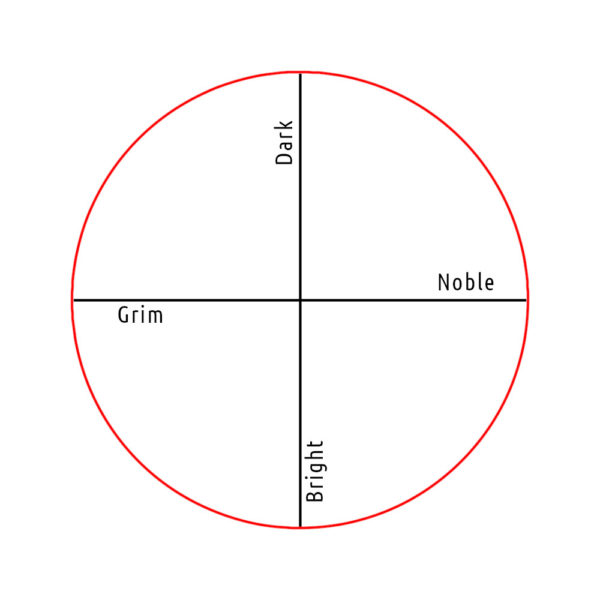
To start, we need to understand the difference between grimdark and noblebright. Both forms of fantasy exist on a field with two axes: noble vs. grim and bright vs. dark.
The bright vs. dark axis describes whether the fantasy takes place in a world where good usually triumphs over evil (bright), or a world where evil usually triumphs over good (dark).
The noble vs. grim axis describes whether the characters have the power to change the world (noble), or whether they do not (grim).
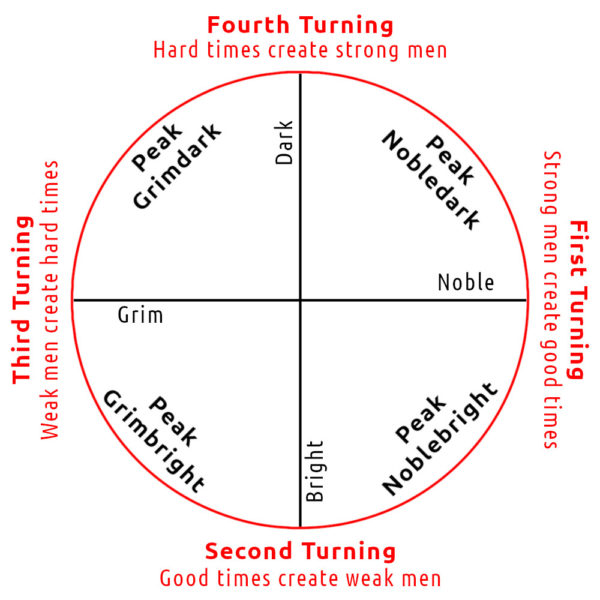
Thus, with these two axes, we get the following combinations:
Noblebright: A fantasy world where good usually triumphs over evil and the characters have the power to save it.
Grimbright: A fantasy world where good usually triumphs over evil, but the characters aren’t on a quest to save it and are usually preoccupied with smaller concerns.
Grimdark: A fantasy world full of moral shades of gray, where evil usually triumphs over good and the characters are either anti-heroes or otherwise fail to save the world.
Nobledark: A fantasy world where evil usually triumphs over good, but the characters are empowered to change it.
These categories are subjective to some degree, and fans will often disagree about which category to put each book/series. However, I think that most fans will agree on the following examples:
Noblebright: The Chronicles of Narnia by C.S. Lewis
Grimbright: The Princess Bride by William Goldman
Grimdark: A Song of Ice and Fire by George R.R. Martin
Nobledark: Lord of the Rings by J.R.R. Tolkien
Next, let’s review in the broadest possible terms William Strauss and Neil Howe’s generational theory. To really understand their work, I highly recommend that you read The Fourth Turning. I have some criticisms of the finer nuances of that book, but their ideas are really excellent, and their predictions hold up surprisingly well three decades later.
If I had to boil their theory down to one simple, easy-to-understand statement, it would be this:
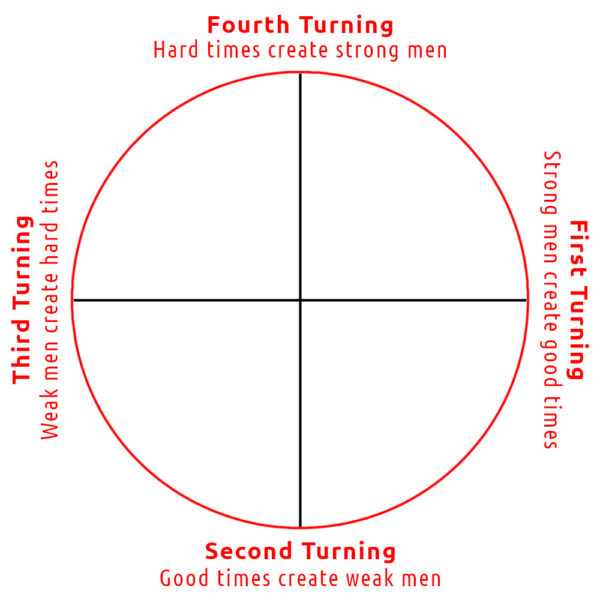
Strong men create good times.
Good times create weak men.
Weak men create hard times.
Hard times create strong men.
Thus, our society and culture passes through a secular cycle that takes about 80-100 years to complete (or in other words, the length of a long human life). The cycle has four seasons, or turnings, each one corresponding to a generational archetype (since it takes about 20-25 years for people born in the one turning to start having children of their own, thus moving us into the next generational turning).
The first turning happens when the society comes together after resolving a major crisis (eg the Revolutionary War, the Civil War, World War 2) and builds a new, stable order. The second turning happens when their kids rebel against that order, seeking freedom (eg the First and Second Great Awakenings, and the various counterculture movements of the 60s). The third turning happens when the order breaks down completely and everyone goes their own way (eg World War I, the Roaring Twenties, and the culture wars of the 90s). Finally, the fourth turning happens when the society faces a major existential crisis that totally reshapes it.
According to the theory, each axis of the grimdark/noblebright field corresponds to a different generational turning. Thus, stories that are noble have the most resonance in a first turning, stories that are bright have the most resonance in a second turning, grim stories resonate most in a third turning, and dark stories resonate most in a fourth turning.
In other words, the generation that comes of age during a major existential crisis will tend to gravitate more toward fantasy where evil typically triumphs over good, whereas the generation that comes of age during a period of rebuilding will tend to gravitate more toward fantasy where the characters have the power to change the world. And so on for bright and grim stories: the generation that comes of age during a spiritual awakening will gravitate more toward stories that take place in a world where good usually triumphs over evil, and the generation that comes of age in a declining and/or decadent society will gravitate more toward fantasy where the characters are relatively powerless.
Another way of thinking about it is to consider what each generation is not going to be drawn to, or which stories are not going to resonate well. An American who came of age in the 40s and 50s, when US power was on the rise and the Pax Americana was reshaping the world, isn’t going to resonate well with grim stories about powerless characters. Likewise, a boomer who came of age during the counterculture movements of the 60s and 70s isn’t going to resonate well with a dark fantasy world where evil usually triumphs, because (as much as they hate to admit it) they grew up in a very sheltered world that generally made sense—so much so, in fact, that they couldn’t help but rebel against it.
According to this theory, the next generational turning begins when one of the four forms of fantasy (noblebright, grimbright, grimdark, or nobledark) is at a peak. Over the course of the turning, that fantasy form declines until the next form in the cycle becomes ascendant, at which point the next generational turning begins.
Thus, at the start of a first turning, nobledark stories are typically ascendant, where the fantasy worlds are dark and morally gray, but the characters are empowered to save the world. As that generation successfully establishes a new order, the culture’s taste in fantasy shifts away from dark stories and toward noblebright stories, where the characters are still empowered but the world is more ordered and stable.
At the start of the spiritual awakening that characterizes a second turning, noblebright fantasy is ascendant: stories with an optimistic outlook on the world where the characters are larger than life. But as the awakening progresses, people in the society care more about freedom and individuality and less about the group, so stories about characters who sacrifice everything to save their world resonate less with them. Thus, by the end of the second turning, the ascendant form of fantasy is grimbright, which is really more of a slice-of-life fantasy about beloved characters having fun (but not world-altering) adventures.
At the start of a third turning, where the social order has started to break down and corruption begins to permeate all levels of the society, these grimbright stories start to take a darker tone. Readers find it too “unrealistic” to believe that good always triumphs over evil, and they certainly do not believe that good people have the power to change the world—at least, not the “smells like teen spirit” world that they inhabit. Their tastes shift away from the fun, adventurous slice-of-life of grimbright, and toward the dark and gritty anti-heroes of grimdark.
Finally, at the start of the fourth turning, grimdark is ascendant, but readers are starting to lose patience with it. As each new crisis in the real world compounds with all the others, they find it unbearable to read about characters that don’t have the power to change the fantasy worlds they inhabit. At the height of the fourth turning, society reaches an existential breaking point where, in the words of Strauss and Howe, “all of [our] lesser problems will combine into one giant problem, [and] the very survival of the society will feel at stake.” (The Fourth Turning, p277) At this point, readers are ravenous for books about characters who are empowered to fight back against the tides of evil and darkness. Grimdark fantasy declines and nobledark fantasy ascends.
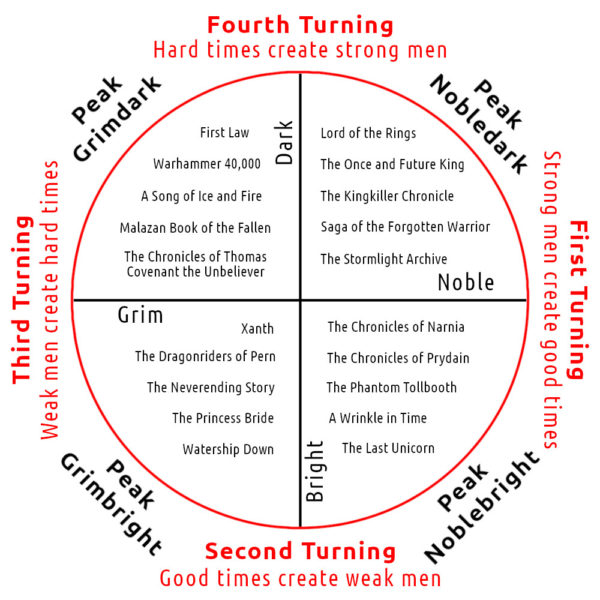
I haven’t read all of the series in the diagram above, but I do have a pretty good sense of most of them, and I put the diagram together with the help of my mastermind group. The key thing about it is that each fantasy series came out in roughly the generational turning that corresponds with each quadrant.
Now, it’s worth pointing out that these trends aren’t absolute. In each of the secular seasons, you can find examples of contemporary fantasy that runs counter to trend. For example, David Gemmell’s Drenai Saga came out in the 80s, at the start of the last third turning when grimbright should have been ascendant, and yet the Drenai Saga is solidly nobledark. Terry Pratchett’s Discworld books had their heyday in the 90s, 00s, and arguably 10s, but they probably fall into grimbright (though you could make the argument that, as absurdist fantasy, they are more similar to grimdark: stories where good and evil really doesn’t matter, and the characters are just doing their best to go along).
But the theory doesn’t state that each fantasy form’s antithesis dies completely when that form is ascendant: only that it reaches a nadir of decline in its resonance with the culture. But without sufficient contrast, the ascendant form cannot stand out. Thus, there still has to be some noblebright Paolini to provide sufficient contrast with the grimdark of Abercrombie and Martin, some low fantasy slice-of-life Legends and Lattes grimbright to make the epic nobledark high fantasy of Sanderson stand out stronger.
According to this theory, as we continue to muddle our way through this present fourth turning, the decline of grimdark fantasy will accelerate, and the bestselling fantasy books of the 2020s will mostly be nobledark. And indeed, we can already see that happening with the meteoric rise of Brandon Sanderson (especially his Stormlight Archive series), the popular enthusiasm surrounding Larry Correia (whose Saga of the Forgotten Warrior falls squarely into nobledark), and the enduring anticipation of Patrick Rothfuss’s fans for the conclusion to the Kingkiller Chronicle. Meanwhile, enthusiasm for George R.R. Martin has waned significantly with the train wreck of Game of Thrones, and Abercrombie, though still quite popular, seems to be testing the nobledark waters with his YA books.
It would really be interesting to do a deep dive on the generational archetypes and make a study of how that affects the fantasy forms that run counter to the cycle. But that’s beyond the scope of this blog post, and frankly I need to get back to writing my own books. But what do you think of this theory? Does it resonate with you, or is there something that we missed?