Few things are more awesome than a lightning storm, but a lightning storm in slow motion is certainly one of those things!
Tag: nature
Conquering the mountain
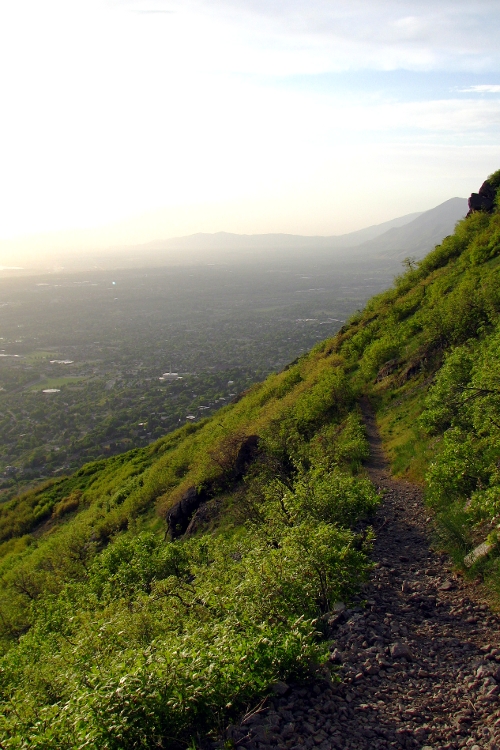 So this last weekend, I decided to solo climb Y Mountain. For those of you who don’t know, Y Mountain is one of the smaller mountains along the Wasatch range local to the Provo/Orem area. It’s called Y Mountain because of the enormous letter “Y” painted on its side (yeah, that’s what they do to mountains in this part of the country).
Of course, the only reason I did a solo hike was because I’ve been up this mountain multiple times before and I know the trail. Plus, it’s kind of a smaller mountain–it’s still over 8,000 feet, but the trail is only about 2 miles long. I’m a slow hiker, so it took me about three hours to get to the top.
To get to the top, you first have to hike the Y, which is the most boring part. The trail is literally wide enough for a truck to drive up–that’s how they repaint the Y every few years–and it’s all on the side facing the valley, so all you can really see is city.
After the Y, you go up a much smaller trail that cuts across the face of the mountain south, into Slide Canyon. At the entrance to the canyon is this really cool rocky outcropping that some people call Lover’s Point–I like to call it the Citadel. The trail winds up the canyon a ways, passes another really cool overlook, and turns a couple of bends before you reach the canyon head.
This is where things get interesting. At the head, there’s a small meadow surrounded on all sides by forest. On the right is a campsite, where the trail forks and heads up to Maple Mountain. If you stay left, though, the trail eventually takes you to the summit of Y Mountain.
The next half mile or so is pretty strenuous. The trail goes through an aspen grove, past another meadow, into this freaky dark forest, past another meadow, into another forest…and then you find yourself in this vast meadow, above the trees, surrounded on all sides by mountains.
I have to be honest: when I got to this point, I was absolutely terrified. The roar of the city was gone (and yes, the city roars–it’s a very distinct sound), the only other people around were a couple of hikers somewhere behind me, whom I hadn’t heard in maybe an hour, and all around was such incredible vastness…it’s hard to explain without actually being there. I just felt so small and isolated, surrounded by this immensity of nature that didn’t know who or what I was, or even that I was…
It was AWESOME.
By the time I got to the peak, the sun had set and the stars were already coming out. I only climbed to the false summit–the one with the view of the entire valley–and from there, I could see past Point of the Mountain all the way north to Sandy, with Spanish Fork and Elk Grove to the south, and Utah Lake a giant puddle in between. It was pretty cool.
But again, the alone-ness of the place really got to me. It made me wonder: is this how future space explorers will feel, when they’re traveling between stars? I can’t imagine how much greater is the vastness of space, compared to what I felt. If so, what kind of an effect with that have on the people who live out there on the fringes of settled space? How will it affect their culture, their religion, their sense of who they are and what their place is in this infinite universe?
I wish I could say I felt this huge sense of triumph after getting to the top, but honestly all I could think was: “oh crap, now I’ve got to walk all the way down.” I did it the same way anyone does anything–one step at a time–and thankfully, I made it down without incident.
Passed a young couple up on a date; they were pretty impressed that I hiked by myself, and gave me some water (which was fortunate–I ran out at the summit). Passed another pair of backpackers who were hoping to camp overnight on the summit, but other than that, I didn’t see anyone else until I got to the Y.
So that was my adventure this weekend, and how I celebrated my 27th birthday. It was totally worth it. In a couple of days, I’ll share the photos.
Plans for Edenfall
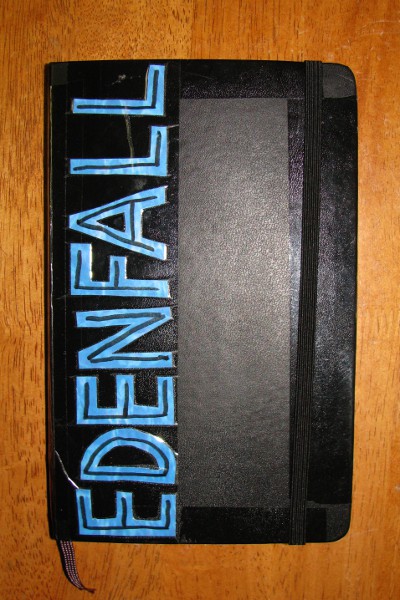 I’m trying something a little different with Edenfall: I’m writing the first draft entirely in longhand.
I first got the idea a couple of years ago, when I was camping in Moab. The beautiful landscape of southern Utah made me realize that I wanted to write Edenfall while experiencing that sort of connection with nature, and pen and paper seemed to be the best format in which to do that. This year, when I decided that I’d definitely write it, I ordered the notebook on the left and fitted it out for the project.
With every novel I write, I like to challenge myself in some new way. In Genesis Earth, I tried out a first person POV with an unreliable narrator. In Bringing Stella Home, I tried to write a believable female viewpoint character. I also like to experiment with my writing process, trying out different outlining techniques and writing schedules. Sometimes, these experiments fail spectacularly, but they also teach me a lot and keep me sharp.
The goal with this experiment is to see how divorcing myself from my computer (with all its myriad distractions) and getting out in nature changes my writing. I live a short bike ride from the Provo River Trail, and weather permitting, that’s where I’ll probably spend most of my writing time in the next few days. Besides, I want to see how much of a difference the format makes.
Books existed long before word processors, so I have no doubt that writing a novel longhand is entirely possible. How much of an adjustment it will be remains to be seen. My handwriting is messy, and I can’t write as fast as I can type, but that hardly matters since rough drafts are slow going for me anyways.
In any case, it’s going to be interesting to see how it turns out. It’s been a little slow so far, but that’s mostly because I haven’t settled into a routine yet. By the end of this week, I hope to be fully immersed in the world of this story.
In other news, I sent off the manuscript for Sholpan to my editor, and he just got finished with his first pass, so I’m hoping to get the edits back in a couple weeks and have it epublished by mid-September. More on that as things develop.
Also, an old friend from Brandon’s 318 class posted a favorable review of Bringing Stella Home up on Amazon. He was one of my first readers back when the story had a lot of problems, so I’m glad he enjoyed the final version. Thanks Stephen! And yes, I’ve got a lot more novels forthcoming in the Gaia Nova universe, including a direct sequel to Bringing Stella Home. Will the McCoy family save the universe from the Hameji? Well…you’ll see. 🙂
Finally, I plan on participating in the Out of This World blog tour being organized by the SFR Brigade, which means you’ll be seeing some guest posters in the near future. That’ll probably wrap up the Genesis Earth blog tour too, since it’s been winding down for the last month or so. If I agreed to write a guest post for your blog and haven’t done so yet, let me know and I’ll do my best to get that out to you. Sorry to be a bit of a flake these past few weeks; I’ll try to organize my next tour a little better.
And that just about does it for now. I’ll be sure to keep you posted on how things go with Edenfall. Until then, take care, and thanks for reading!
Story Notebook #5 (part 1)
Alright, time to revisit my old story notebooks and run through some of the ideas there. This one starts in fall of 2009, my last semester at BYU, and ends shortly after my hasty exodus from a miserable internship in Washington DC.
And now, without further ado, here goes:
A super-celibate society that holds that sex is evil and reproduces entirely by artificial insemination.
In other words, what if the Shakers had had our modern reproductive technology? Weird, but not beyond the realm of plausibility.
I suppose that in such a society, the nuclear family would not exist, and children would instead be raised by the community as a whole–kind of like Plato’s Republic. Question is, would this be a happy utopia, or a miserable dystopia? I know how I’d write it…
Shattered glass sparkling in the roadside desert
Okay, that’s less of an idea and more of an experiment with prose. I suppose I saw broken glass on some dusty asphalt and wanted to capture it with words.
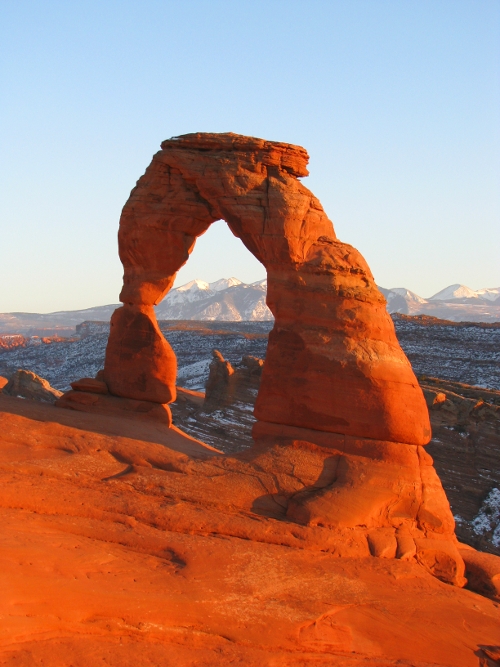 The next passage is from an assignment for the wilderness writing class at BYU. We went camping in Moab and hiked up to Delicate Arch, perhaps the most iconic natural landform in all of Utah. Shortly after taking this picture, here is more or less what I wrote:
They say that the arches in this national park are formed by wind erosion. The funny thing is, so is the slickrock. The same wind that carved the gravity defying structure of the arches also wore the rock all around them almost perfectly smooth, so smooth that you feel as if you’re about to slip and fall even as you sit on the edge of a relatively flat ledge.
It makes you wonder: what was here before the wind blew it away? What did the land look like before the wind took out the loose material, leaving behind only the strongest, most resilient bedrock? How many other arches lie underneath our feet, waiting only for time and the wind to unearth the landscape that hides them?
Awesome class; if you ever get a chance, take it. Professor Bennion is great.
A boy born without a name.
Not sure where that came from, but it kind of makes me think of this girl in an abusive household, who grew up to age 14 before learning how to speak. It seriously crippled her intellectual development, so much that she never became fully independent.
Think about it: how would not having a name stunt a person’s growth?
Below them lay the alluvial plains–miles of silt and dirt vomited from the mountains over the passing of countless centuries.
I think I intended this to be a line in the first chapter of Worlds Away from Home…and unless I’m mistaken, something very similar to this passage made it into the book.
The detritus of life from which we extract the fossil record of our memories
Another passage meant to evoke something in the reader. I think I wrote it when I was cleaning out my apartment shortly before leaving for DC. It certainly makes me think of a dirty, junk-filled room.
And that’s enough for now. This basically takes us up to January 2010, when I left for the BYU Washington Seminar program. All the other ideas in this notebook have a decidedly civic/political bent to them, so stay tuned!