The Grand Conspiracy, Part 1: Malice or Incompetence?

Remember the time before the pandemic, when “conspiracy theory” was still a dirty word? It still is in some quarters, but for many of us the term is now closer to “spoiler warning.”

After all, what are we supposed to believe: that Epstein hung himself with a bedsheet that couldn’t hold his weight, from a height that couldn’t kill him, at exactly the moment when the guards had abandoned their posts and all of the surveillance equipment had mysteriously and inexplicably gone dark? That is still the official story—just like Ghislane Maxwell, Epstein’s Madam, was thrown in prison for trafficking sex slaves to… well, nobody, at least officially.

Or are we supposed to believe that a novel coronavirus whose genetic profile shows clear evidence of artificial manipulation jumped species from a bat to a pangolin to a human, in a Chinese wet market (which the CCP destroyed before any investigation could be launched) more than 900 miles from the bat’s native habitat, which also just happens to be down the street from the Wuhan Institute of Virology where gain-of-function research was being conducted with bat coronaviruses? I’m not generally a fan of Jon Stewart, but I think he hit the nail on the head with this one:

Of course, this isn’t to say that all conspiracy theories have weight and value. By no means do I believe that the moon landings were fake—there are just too many people who would have to be in on the thing to keep it secret for long, and also, we can see the tracks of the moon landings from Earth. But conspiracies do happen, and often have tremendous impact on the course of history. For example, the United States constitution was born out of the Philadelphia Convention, which conspired to throw out the Articles of Convention and replace them with something entirely different, which was technically an act of treason at the time.

Conspiracies are real, though not all conspiracy theories are true. The challenge is separating conspiracy theory from conspiracy fact.

Which brings us to the old aphorism: “never attribute to malice that which can be attributed to incompetence.” For the last two years, when I look at the direction my country is going and all of the harm that the Biden Administration has done, I find myself constantly asking: “is this malice, or is this incompetence?” After all, if my goal was to destroy this country, I could hardly do better than what this administration has already done (Victor Davis Hanson has an excellent article about that, and he says it better than me). And yet, every time the press secretary opens her mouth, I am reminded of just how staggering is the incompetence of these people. Or is it?

And then I had a realization: if you go up high enough, all of these people are useful idiots to a force of pure malice that is striving to bring about our spiritual enslavement and destruction. I am speaking, of course, of Satan himself.

Now, perhaps you don’t believe that the devil is real. Laying aside the aphorism that “the greatest trick the devil ever pulled was convincing the world he doesn’t exist,” you don’t have to believe in a literal fallen angel and his hordes of demonic followers in order to follow this particular rabbit hole. The devil is an archetype for a reason, after all. Personally, my own experience has convinced me that demonic forces do indeed exist, but that’s all I care to say on the subject, and I’ll leave you to draw your own conclusions.

But my point is that it’s not like the forces of evil are monolithic: there is a hierarchy of conspirators and useful idiots, and some who may be conspirators on one level are useful idiots on another. At the bottom, it’s almost all useful idiots wreaking havoc by their own incompetence, but at the top, it’s all driven by malice.

Because here’s the thing: when we attribute a particular action to incompetence, we are making an implicit assumption about the motive behind that action. If we assume that Biden’s motive is to serve the interests of the American people, he’s doing a piss-poor job of it—but if we consider that he may have been compromised by China (as the Hunter Biden laptop implicates), or that he only cares about the Biden crime family’s interests, then his actions no longer reak of so much incompetence.

In the game of chess, there’s a thing called a gambit, where the player sacrifices a piece in order to gain an advantage of tempo or position. To the inexperienced player, a gambit often looks like a mistake. Some of the most brilliant chess moves involve a gambit that seems, at first, to be an act of utter incompetence, but that in fact make winning inevitable if the opponent falls for the gambit.

So even though “never attribute to malice” is a good rule of thumb, it’s clearly not sophisticated enough to explain all the insanity we’ve seen in the last two years. But neither is it sufficient to explain this insanity in terms of pure conspiracy—indeed, falling into that trap makes us susceptible to becoming infected by that insanity ourselves. Mattias Desmet points this out in chapter 8 of his seminal work, The Psychology of Totalitarianism. He also says:

In the whole process of exercising power—i.e., shaping the world to the ideological beliefs—there usually is little need to make secret plans and agreements. As Noam Chomsky put it, if you have to tell someone what to do, you’ve chosen the wrong person. In other words: the dominant ideology selects who ends up in key positions… Consequently, all people in positions of power automatically follow the same rules in their thinking and in their behavior and are under the influence of the same attractors.

One of the main points that Desmet makes in this chapter is that when people are driven by an evil ideology—or, in the words of Jordan Peterson, become ideologically possessed—their actions often appear, to someone on the outside, as if they are all part of a grand conspiracy. And yet, none (or at least, very few) of these people have actually entered into a clandestine agreement to support a deliberate plan: they are all just playing the part that they find themselves in, most of them unwittingly.

And yet, even though there is no “conspiracy” in the classical sense, the people who get caught up in the insanity all end up working to advance the purposes of something much bigger than themselves. Indeed, explaining this phenomenon is the entire purpose of Mattias Desmet’s book. He does a brilliant job of it, but mostly from a psychological perspective.

What I want to do is look at this phenomenon from a spiritual and an archetypal perspective, not as a scientist but as a storyteller. That’s why I’m calling it the “grand conspiracy,” even though I recognize that on most levels, it’s not a conspiracy so much as a confluence of interests (or more accurately, a confluence of lusts). I do think that there’s a lot that can be gleaned by looking at it this way, because there is a spiritual dimension to our lives—as Mattias Desmet emphatically points out—and stories and archetypes have been absolutely essential to our understanding of the world since prehistoric times. I happen to believe that Satan is more than just an archetype, but you don’t have to believe that in order for this grand conspiracy to be useful and make sense.

I’ve planned this series out in twelve parts, listed here. From now until the end of February, I’ll post about once a week. Since Christmas is coming and I don’t want to be thinking about all this diabolical stuff over the holiday itself, I’ll post part 2 next Tuesday, and part 3 the week after that, then go back to posting on Saturdays. The first three parts will outline the general theory that I’ve come up with, and the next eight parts will examine each piece of the theory in detail. In the end, I’ll share some concluding thoughts about how this grand conspiracy can—and indeed, ultimately will—be defeated.

I hope you find this series interesting, and I look forward to hearing what you think about it!

Part 2: Creator vs. Created

The Grand Conspiracy (Index)

The argument that converted me to pro-life

I’ve never been one of these pro-abort people who sees abortion as a virtue or a fundamental right. I do understand the “my body, my choice” argument and still think that it carries some weight—after all, bodily autonomy is an important component of personal liberty and sovereignty—and for a long time, that argument had won me over. I also bought into the lie (and it is a lie) that when abortion was illegal, thousands of women were dying in back-alley abortions, so therefore it’s better to legalize and regulate it than it is to just make it illegal across the board. I also believed (and to an extent, still believe) that there are circumstances where an abortion should be legal, such as ectopic pregnancies, other instances of severe health threats to the mother (including mental health), and cases of rape and incest.

But mostly, I just didn’t want to think about abortion. It’s a very icky subject. Also, because I’m a man and will therefore never be pregnant (contrary to extreme leftist dogma, which apparently holds that nothing in this world is real, or sacred, or true), I didn’t think that the issue really affected me, and was more or less bullied into believing that as a man, I wasn’t qualified to have an opinion. This was something to be left “between a woman and her doctor,” and to my shame, I was content to leave it that way.

Then I graduated from university and went out into the “real world,” declining to pursue a master’s degree (which I am totally convinced is the best life decision I have ever made). After a few years outside of the cloistered halls of academia, my political views began to change rather radically. I can’t point to a single thing as my “red-pill moment,” but the insanity of the 2016 US election brought the pot to a boil, and I found myself rethinking everything that I thought I knew.

One of the voices of reason and sanity that I discovered during this time was Jordan B. Peterson. I don’t know what Peterson’s views on abortion are, and frankly I wouldn’t be surprised to find that he adopts a position that makes most pro-lifers uncomfortable. He’s very good at being a contrarian. But while I was following Peterson, reading 12 Rules for Life and listening to a bunch of his lectures and interviews, I came across this point that he often makes:

You probably would have been a Nazi. They weren’t all that different from you—and besides, you’re probably not as virtuous or as heroic as you think.

We like to think of the Nazis as being extraordinarily evil, but the truth is that they were ordinary people who just happened to live in an extraordinary time and place.

Not unlike the times in which we currently live.

That argument really stuck with me. As the oldest child in my family, I was often told that I needed to set a good example for my younger siblings, and so I grew up thinking of myself as someone who would do the right thing, even if no one else was doing it. The thought that I am the kind of person who would have consented, or even participated, in something as evil as the holocaust was utterly hateful to me. That’s not who I thought I was.

But how could I prove to myself that I was not, in fact, that person? How could I know? I thought about that for a long time—not just about the Nazi thing, but about the Milgram experiment and the Stanford prison experiment as well. Was I the kind of person who would blindly follow the rules, no matter how horrific they were? If I wasn’t that person, how would I know?

As I pondered over this question, I began to reframe it. Instead of asking what I would have done if I’d lived in 1930s Germany—a historical counterfactual that is impossible to disprove—I began to wonder if there was anything happening today that future generations will look back on with the same horror and contempt that we look back on the holocaust.

In other words, is there anything happening today that we all blindly take for granted, or that we all just turn our heads away from, but that future generations who are removed from our historical context will look back on and ask “how could you all have gone along with that? How could you possibly be that evil?”

This prompted me to look at the abortion issue in a completely different way. And the more I studied it, the more convicted I became that this is our generation’s equivalent of the holocaust.

In fact, the more I examined our own genocide of the unborn and compared it with the holocaust, the more I came to realize that we may have actually exceeded the evil of the Nazis. Consider this:

The Nazis killed about six million Jews and several hundred thousand (at least) more people from groups such as the Roma, the Jehovah’s Witnesses, homosexuals, the mentally handicapped etc. But in the time since Roe v. Wade legalized abortion in the US, we have aborted 65 million children—an order of magnitude more than the victims of the holocaust.

The holocaust didn’t go on much longer than a decade: the Nazis came to power in 1933, and surrendered to the Allies in 1945. But our own genocide of the unborn has been happening for multiple generations now—nearly fifty years.

The holocaust happened in the context of a post-war Germany where the people were shattered and impoverished, and children were literally starving to death in the streets. Our genocide of the unborn has happened during a period of such incredible prosperity that it is unparalleled in human history.

While many of the victims of the Holocaust were innocent children, there were also many adults who perhaps were not so innocent or powerless. But no one is as innocent and powerless as the unborn.

Generally speaking, the Nazis weren’t killing their own family when they sent the Jews off to the death camps. But with abortion, we are slaughtering our own children—our very flesh and blood.

Many women who get abortions are deceived by the pro-abort arguments, and do not believe that they’re committing an evil act. But many of the German people were deceived by the Nazis as well. Is that really a valid excuse?

I won’t go into all of the pro-life arguments. There’s a lot that can be said about Margaret Sanger and Planned Parenthood’s connection with actual Nazis and other eugenicists (and how that connection still exists), as well as a lot of good arguments—both religious and scientific—about how life begins at conception, and the unborn are as deserving of human rights, including the right to life, as any other living person.

But you’ve probably already heard all those arguments. I doubt there’s much that I can rehash here that will change your mind. I will, however, link to an excellent podcast that does put forward all those arguments, so you can examine them if you’re curious:

With all of that in mind, I came to realize that there is a way to know whether I’m the kind of person who would have been a Nazi, and that involved answering the question:

“What are you doing about the genocide of the unborn?”

Now, I recognize that those who disagree with the pro-life side are not, for the most part, heartless monsters who do not deserve to live. There are a few extraordinarily evil serial killing abortionists out there, but most pro-choicers are genuinely decent folk who happen to see things differently. I get that. The same was probably true of most Germans in the 1930s: they weren’t extraordinarily evil, but ordinary folk like you and me who just happened to be caught up in the mass psychosis of their time.

I do believe that we are witnessing the formation, or perhaps the final expression, of a mass formation psychosis over the abortion issue. With all of the hysteria surrounding Dobbs v. Jackson and the Supreme Court’s decision to return the abortion issue to the states, the left is coalescing around this issue—but they aren’t content with “safe, legal, and rare” anymore. Instead, abortion is now proclaimed as something virtuous, and the women (and “men”) who get abortions as heroes. It’s perverse, deranged, pathological, and evil in the extreme.

So what should we do about that? Take up arms? Punch a Nazi? Go back in time and kill baby Hitler? No. The kind of people who fantasize about such things are also, in the abortion context, the kind of people who bombed abortion clinics in the 80s and 90s, or who send death threats to abortionists and pro-abort activists. All of those actions play right into the pro-aborts’ hands.

But the truth is that the sword cuts two ways. If most of us are the kind of people who would have gone along with the Nazis, then the people who actually did support the Nazis weren’t extraordinarily evil—and neither are most of the people who are going along with abortion. Their evil—our evil—is of the ordinary variety.

And how do we fight ordinary evil? By changing hearts and minds so that it comes to be regarded as extraordinary.

As a writer, I recognize that I’m in a unique position to do that. And it isn’t an accident that in the last few months, my writing (most of it currently unpublished) has taken a very pro-life bent. Not that I’m trying to evangelize a pro-life position—that would be propaganda, not art—but my recent work has a much more pro-life bent to it, and I don’t intend to hide or run away from that.

Not surprisingly, I haven’t been able to find a home for these stories in the traditional sci-fi magazines and anthologies. And at this point, I’m assuming that many of these editors have put me on some sort of author black list for my pro-life themes—in fact, I’d be surprised if none of them had.

But no matter. This is what rings true to me, and it would be an artistic betrayal to self-censor my pro-life sensibilities at this point. And that would be just as bad as producing mere propaganda.

In the next few months, I plan to self-publish several stories that have been influenced by my pro-life views, assuming that they don’t get picked up by a magazine or anthology first. The first one is “The Freedom of Second Chances,” scheduled for December, and another one, “The Body Tax,” is scheduled for January.

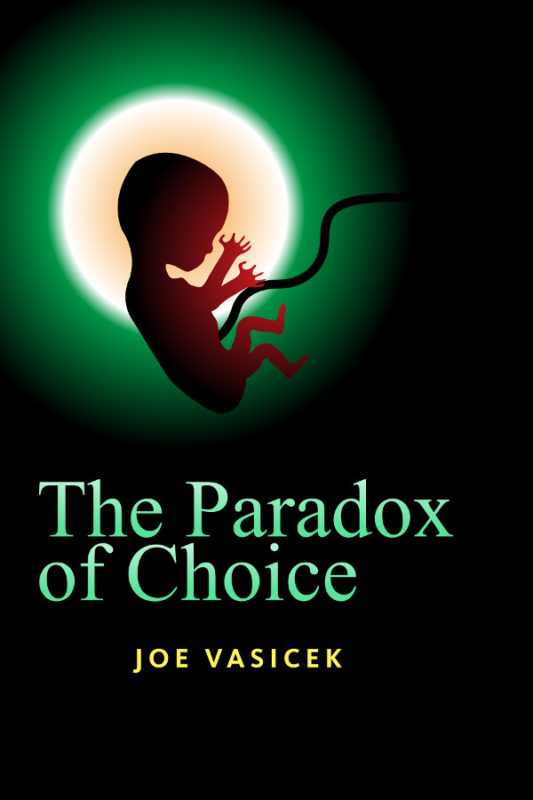
Beyond that, I don’t have anything specific planned, but I’m sure I’ll be writing more unapologetically pro-life stuff moving forward. And of course, there’s still “The Paradox of Choice,” which I’ve released into the public domain in case anyone wants to republish it or rewrite it or otherwise make it their own:

The Paradox of Choice: A Short Story

The Paradox of Choice: A Short Story

“In cases where there may be severe deformities… I can tell you exactly what would happen. The infant would be delivered. The infant would be kept comfortable. The infant would be resuscitated if that’s what the mother and the family desired, and then a discussion would ensue between the physicians and the mother.”

More info →