All of my books are available as ebooks, but only a few of them were available in print. Until now. If you’ve looked to buy one of my paperbacks, you may have noticed that none my books are available in print. Why?
TL;DR: KDP Paperback sucks monkey balls, and I’m not going to sell a book if I can’t assure my readers that the product will meet an acceptable level of quality.

I originally published my paperbacks through CreateSpace, before they were acquired by Amazon. The books they printed were great, and I never had a problem with any of them. On the contrary, whenever I had a question about the publishing process, their customer service team far exceeded my expectations and helped to shepherd many of my books to final publication.
I learned a lot of things the hard way, and made a lot of mistakes along the way. But that was all on me. When I finally figured out the right way to do what I wanted, I could alway count on CreateSpace to produce a quality product.
Fast forward to 2018. Amazon shuttered CreateSpace and began the migration of all of their books to KDP Paperback. I loved CreateSpace, but I also saw the writing on the wall, and migrated my books early. I also published several new paperbacks through KDP Paperback, using their cover creator program.
The publishing process went about as smoothly as it had through CreateSpace. The customer service wasn’t nearly as good, but I had a pretty good idea what I was doing, and with a little experimentation, I was able to produce a quality product.
Or so I thought.
I always order proofs when putting together a paperback, and scrutinize that proof carefully before approving it. For Heart of the Nebula and The Sword Keeper, I had to go through a couple of proofs before I was satisfied that I’d gotten it right. The most common problem was that the front cover would bleed onto the spine. After a couple of failed adjustments on the KDP Paperback cover creator, I decided to just upload the jpg and not futz with it, letting the program adjust it instead. And for a time, that seemed to work.
For the Star Wanderers books, I did the same thing, letting the KDP Paperback cover creator do its thing without futzing with the placement of the front cover image. A couple of the proof copies had the bleeding problem, but after following a couple of online discussions, it seemed that the consensus was that the proof copies were of lesser quality than the actual customer copies.
That should have been a red flag right there, but I went ahead and approved them anyway, since the bleed was only about a millimeter or so, and I couldn’t justify the expense of another eight proof copies.
Big mistake.
A couple of months later, I ordered about $100 worth of author copies to sell at conventions. This was the result:
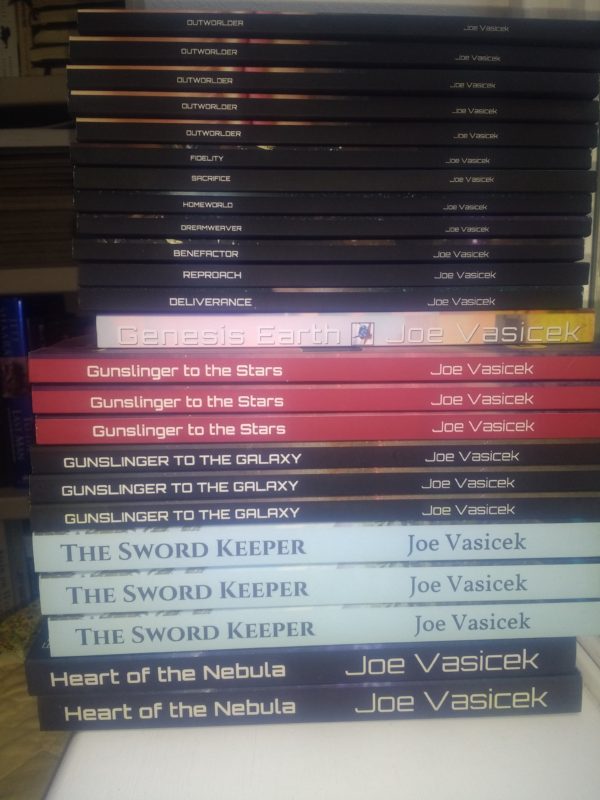
Every damn book had the cover bleed problem. Every. Damn. Book. And it wasn’t a small print error, either. The bleed was as much as 3 millimeters on some copies.
Keep in mind that except for Genesis Earth, all of these covers were designed through KDP Paperback cover creator. Also keep in mind that aside from a couple of the Star Wanderers books, this printing error was not present in any of the proofs that I approved.
Genesis Earth was particularly troubling, because that was a book that I migrated from CreateSpace. None of the author copies that I’d ordered from CreateSpace ever demonstrated this printing error. In fact, I’d gone through several proofs to ensure that the front cover image was completely outside of the red zone, to ensure that such a bleed problem would never be an issue.
KDP’s customer service promises that they respond to every issue within 24 hours. That is a lie. My first inquiry received no reply—not even the standard copy-paste boilerplate response that they usually send first.
I waited three days and sent a second inquiry, threatening to email Jeff Bezos and pull all of my books if I did not receive a response within 24 hours. As you can probably surmise, I did not get a response within 24 hours.
I did eventually get a response, and ultimately I did get a partial refund for my books. But by then, I’d had enough.
KDP Paperback produces an unacceptably inferior product. Furthermore, their customer service is terrible. Because I cannot asure my readers that they will receive an acceptable quality book, I have decided to pull all of my paperbacks from KDP Paperback and go through someone else.
It may take a few months to figure this out, in which time, my books unfortunately will not be available in print. However, I think that this will be the best solution in the long run. I’ve heard good things about Ingram Spark, so I’ll check them out, but it may take a while to do things properly.
And this time, I’m not going to take any half measures.