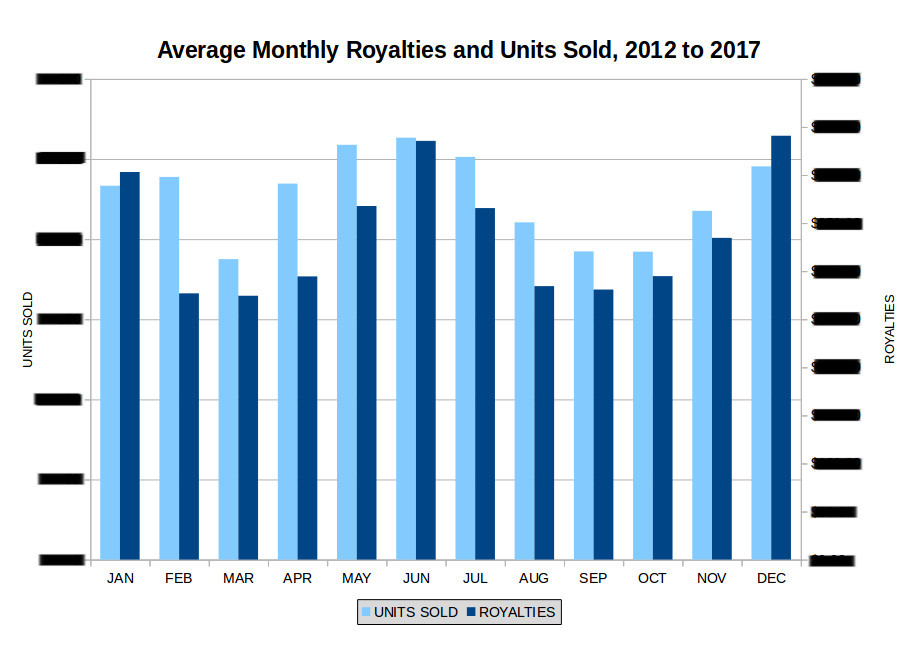
As I mentioned in a previous post, I’ve been crunching the data from my last seven years of indie publishing, and it’s yielded some very interesting information. Here’s another graph that I managed to pull out:
This graph shows all of the monthly averages for royalties earned and units sold, across all my books, from 2012 to 2017 (excluding February 2017, which was an outlier due to having a book in a story bundle). I haven’t adjusted for anything else, such as new releases or total books out, so take it with a grain of salt.
One of the big assumptions and/or questions in the book world regards the existence of a “summer slump,” where books (depending on genre) don’t generally sell as well and people generally aren’t reading. Judging from the data and my own experience, there does appear to be a slump from August to October. However, there also appears to be a “midwinter slump” from February to April.
The interesting thing is that units sold don’t appear to dip all that much, for whatever reason. It’s just the royalties that are affected. And in December and January, readers appear to be willing to buy more expensive books, as the royalties go up by more than units sold.
From this, it appears that the prime time of the year for bookselling are November to January and May to July. Of course, bear in mind that this is only my anecdotal experience, and the plural of anecdote is not data.
If I had to hazard a guess as to what is going on, it would be that readers are tighter with their money in the months following the holidays, and that the summer doldrums do indeed tend to stifle their enthusiasm for books. Interestingly, though, there seems to be a spike in reading with the spring, perhaps as they come out of hibernation.
Of course, it’s also possible that my own enthusiasm for marketing and publishing is greatest in the spring and early summer, and tends to fall off with the winter cold and the summer heat.
Either way, my own data tend to suggest that yes, there is a summer slump.
Last October, Dean Wesley Smith wrote an interesting blog post on the subject of pricing. As an indie writer (or really, as a small business owner in general), pricing is one of those things that’s constantly on my mind. Pricing too high can be fatal for any business, but pricing too low can be a terrible mistake as well.
Dean Wesley Smith’s pricing strategy basically went like this:
Novels
$3.99 to $6.99
Price according to genre, not length
Romance on the lower end
Mystery on the higher end
SF&F in the middle
Short Stories
$1.99 to $3.99
Price according to length, not genre
$1.99 for under 3k words
$2.99 for 3k to 10k words
$3.99 for 10k to 20k words
Over 20k words price as a novel
From November until now, I’ve basically followed this strategy, with a few tweaks for short stories. Under 1k words, I’ve priced at $.99, and between 3k and 20k words, I’ve priced at $2.99. It’s only at 30k words that I’ve priced my books as novels.
This isn’t my first time experimenting with prices. I’ve been publishing since 2011, and have all of the sales reports and other data in one form or another. So last week, I decided to crunch that data and compare it with the last four months.
Genesis Earth is my first novel, and the book on which I have the most data. It’s a 70k word YA science fiction novel.
Crunching the data, I found that on average, the book performed best when priced at $3.99, with a few outliers at $2.99. However, most of those outliers are from 2011, before Kindle Unlimited or KDP Select, and before the book had fallen off of the 90 day cliff. Excluding the first two quarters of 2011, those outliers fall away.
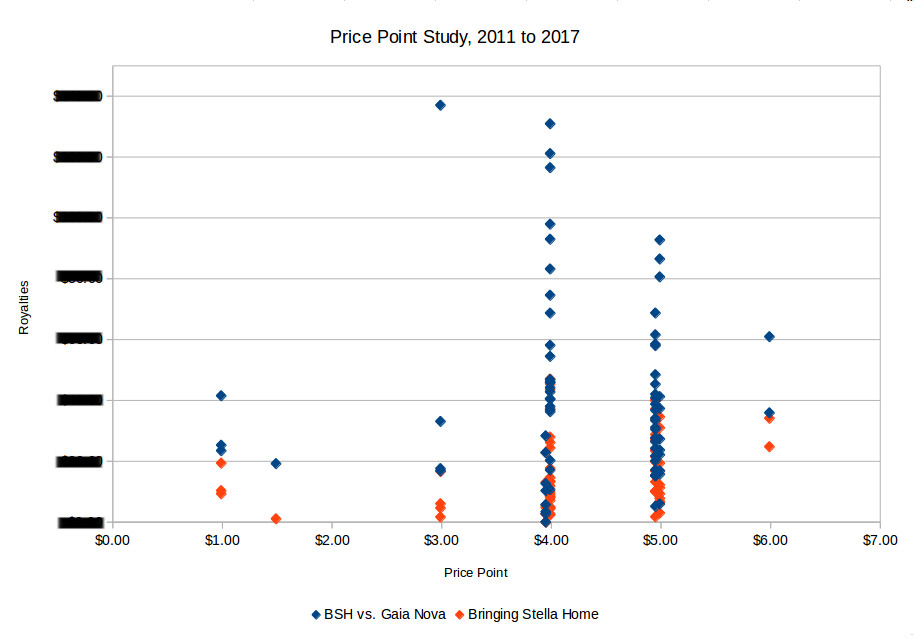
Bringing Stella Home is the first book in the Gaia Nova series, and the book for which I have the most data that is also part of a series. It is a 110k word space opera novel.
Interestingly, the book appears to perform differently as a standalone than it does as part of a series. As a standalone, it appears to perform best at $4.99, but the series as a whole performs best when it’s priced at $3.99.
By the way, I tend to price all the Gaia Nova books at the same price point, so except for $.99 and $1.49, it’s fair to assume that all the books share the same price as Bringing Stella Home for any given datapoint.
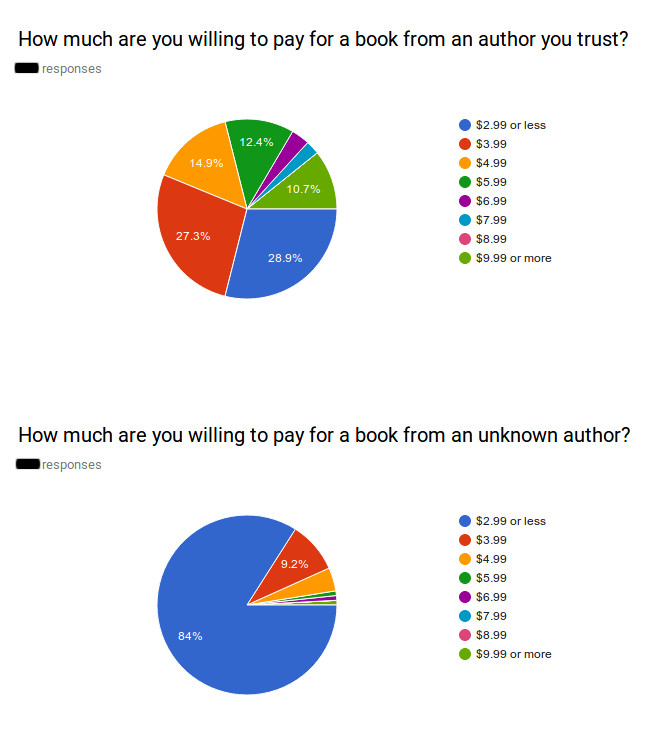
Interestingly, the data tend to confirm the results of an ebook pricing survey I sent out to my email list about a year ago. The results are pictured above. More than half of respondents said that they were only willing to pay $3.99 or less for an ebook from an author they trust, and more than 80% weren’t willing to pay more than $2.99 for an unknown author.
Unfortunately, I don’t have enough pricing data for my novellas and short novels (under 50k words) to draw conclusions for any other price points besides $.99 and $2.99. Obviously, the $2.99 price point performs vastly better than $.99. There’s a little more nuance than that when it comes to series pricing, but I’m keeping that data close to the chest.
I have yet to crunch the data for my short stories. When I do, that will probably be the subject of another blog post.
From these results, it appears that $3.99 is the sweet spot, both for series and for standalone novels. The data from the last three months are not included in the graphs, but from what I’ve managed to gather my books do not perform as well when I use Dean Wesley Smith’s pricing strategy. It was worth trying out as an experiment, but four months during the prime bookselling time of the year is enough to conclude that it doesn’t work, at least for my books and my readership.
Here’s the pricing strategy I’ll be using from now on:
January is a time for making forecasts and predictions, and Mark Coker of Smashwords certainly did not disappoint. I have a lot of respect for Mark Coker, not only for being one of the pioneers of indie publishing, but for continuing to share his data and insights with us over the years.
That said, I have many much opinions.
Mark gets a lot of flak from authors for his anti-Amazon stance, which is nowhere crystalized quite so perfectly as his 2018 publishing industry predictions. Seriously, half the post is a massive litany against Amazon’s publishing practices that systematically recounts just about everything he sees wrong. It’s quite impressive.
Perhaps the most inflammatory thing he says is this:
Authors who now derive 100% of their sales from Amazon are no longer indie authors. They’re dependent authors. I suppose we have indie authors and de-authors now.
Here’s the thing, though: he isn’t wrong.
Back in 2010, when self-publishing was still considered by many to be the “kiss of death,” I read a post on a writing blog (I think it was Writer Beware) that said, basically: “if you’re taking the indie publishing route instead of traditional publishing, that makes you self-published. So call yourself a self-published author, because you are one.”
At first, I was really pissed off at that blogger. Couldn’t she see that there was a huge gulf between indie publishing and self-publishing? A year or two later, though, I had to concede that she had a point. I was bringing my own baggage to the table by insisting that indie publishing was separate and distinct from the dreaded “self-published” label. Today, I don’t give a damn whether or not a book is self-published, and I don’t think most readers do either.
It’s the same thing with Mark Coker’s “indie authors” and “de-authors.”
The truth is, if you depend on only one publisher or publishing platform for all of your writing income, then by definition you are dependent. It doesn’t make a difference whether that’s a traditional publisher or Amazon. If you want to be independent, then you have to cultivate multiple income streams from multiple sources. It’s that simple.
You’re still a self-published author, whether you do savvy ebooks and print-on-demand editions. or whether you did a 5,000 book print run with a vanity press that sits in your basement from now to eternity. You’re still a dependent author, whether you’re making a killing on Kindle Unlimited or whether you sold your copyright to a Big 5 publisher for a mess of pottage.
However, while I agree with Mark on that much, I disagree quite strongly on his conclusion that the government needs to break Amazon up. Oh, no. Hell no. It’s not different this time, Mark. The Luddites are still wrong.
The biggest publishing story of 2017 was that Amazon’s biggest enemy is… Amazon. Because it turns out that when you stop paying authors for single-book sales and instead pay them shares out of a massive fixed pot, it incentivizes scammers to find all sorts of interesting ways to game your system. And if your business model depends on automating as much of your website backend and customer service as possible, you can’t fix the scamming problem without pissing off indie (and not-so-indie) writers everywhere.
It’s going to take a while for all this to shake out, but I do believe that indie writers will come out on top—so long as Amazon’s competitors in the publishing world step up and actually compete.
Stop whining about Amazon, Mark, and bring your damn website out of the late 90s.
With that out of the way, here are Mark’s predictions, with my thoughts.
1. 2018 will be another challenging year for the book industry
Has there ever been a year in which this hasn’t been the case? Long before KDP, Smashwords, or any other epublishing platform was invented, all of the best books have been up on the internet for free. Movies, TV, video games—we’ve always competed with these things for reader attention, and always will. I don’t see anything that makes 2018 different in that regard.
In fact, I’m going to go out on a limb and predict that the book industry will stabilize and grow—not as measured by traditional metrics like Nielsen Bookscan, but in non-traditional metrics like the Author Earnings Report. Why? Because books are counter-cyclical, and we’re already overdue for the next recession. The stock market is melting up, the yield curve is flattening, inflation is already hitting real estate, healthcare, and education, and the geopolitical situation is a nest of potential black swans.
I don’t think 2018 will be the year when shit hits the fan—I expect that will happen in Trump’s second term, sometime around 2021 or 2022. If nothing else, the tax cuts have applied palliative care to our economy. But the debt will continue to grow, the deficits will get worse, and inflation is going to hit the average consumer in a massive way this year.
All of this bodes well for books.
2. The glut of high-quality low-cost ebooks will get worse
Please, Mark. The Tsunami of crap was never a problem to begin with. Like I said above, long before epublishing was a thing, the best books ever written in the history of the world were already available, for free, through sites like Project Gutenberg.
There’s still plenty of opportunity for new authors. The Childlike Empress still needs a new name. The Nothing is not going to swallow Fantastica. If you know how to swim, you can still swim just as well, whether the water’s ten or ten thousand feet deep.
3. Barnes & Noble is sick and will get sicker
I can see this happening. I haven’t been following Barnes & Noble too closely, but they failed pretty hard with the Nook and their corporate troubles haven’t been good for the bottom line. At this point, though, Barnes & Noble is dead wood that needs to burn in order for something else to come up in its place.
4. Kobo’s sales will falter
I don’t think they will. Kobo is much bigger in the international markets than Amazon, and the economic problems are worse overseas than they are here in the States (which means that conditions are better for books). I think Kobo will do just fine, though I’m not sure that Smashwords books on Kobo will do as well.
Kobo is still innovating, with things like Kobo Plus and the promotions tab on KWL. Mark Lefebvre had a good run, but I think it’s a good thing that they’ve got some new blood coming in. I predict that Kobo will do just fine.
5. Devaluation pressures will persist
Again, I completely disagree with Mark Coker on this one. Ebook prices for indie books have actually stabilized over the past few years, and with increasing inflation, I predict they will tend to rise in 2018, though not in a dramatic way.
Once you get below a certain price point, competing on price really doesn’t make much of a difference, and I think a lot of successful indies understand this. Also, books are not fungible. When I make time to read, I don’t want just any book—I want that book. So long as it costs me less than a good meal, price be damned.
There is, of course, an argument to be made that all else being equal, power readers are drawn to lower-priced books. It’s probably an exaggeration to say that these power readers are king makers, but it’s not too far from the truth. That said, the way to get around this is to run periodic sales and promotions, just like any other industry.
Come on, Mark. Just because your book is $5.99 doesn’t mean you can’t mark it down to free or 99¢ every once and a while.
6. Single-copy ebook sales will decline
On Smashwords, perhaps. I’m not convinced that they will generally.
For the entertainment value, it’s a hell of a lot cheaper to buy a book (especially an indie book) than it is to buy a video game or a movie. Because of that, books tend to be counter-cyclical. The real economy is not doing as well as the official numbers say: households are still under massive pressure, with debt at unprecedented levels and wages shrinking as adjusted for price inflation. I predict that this trend will continue in 2018.
I haven’t seen the data on this, but if I had to speculate, I would say that power readers tend toward subscription models for books, whereas casual readers tend toward single-copy book sales. I would also speculate that power readers are less responsive to economic shocks than casual readers—they’re going to read whether or not their pocketbook is getting squeezed. Again, I haven’t seen the data for this, but if I had to plant a flag, that is where I’d plant it.
Are single-copy sales cannibalized by book subscriptions? To an extent, yes, but I think we’ve already hit something of a floor. If the economic pressures on the middle class worsen and we see an influx of casual readers into the market, I think single-copy sales will start to bounce back. As I see it, there’s a lot more room on the upside than the downside.
7. Romance authors will feel the most pain from KU
Can’t speak to that, as I’m not a romance author. But based on Amazon’s missteps in 2017, I think KU will actually see a decline as authors continue to flee and scammers continue to dominate. Again, I don’t see much more room on the downside for things to fall.
8. Large traditional publishers will reduce commitment to romance
And large traditional publishers will continue to shove their heads up their backsides, so no one in the indie publishing world will care. Kris Rusch wrote a much more lengthy analysis where she says as much.
9. Email list fatigue
Totally disagree. The guys over at the Science Fiction and Fantasy Marketing Podcast discussed this recently, and the conclusion they came to is that authors who claim that email lists don’t work as well as they used to are doing it wrong.
That said, I could see a bit of a shakeout as readers who have signed up for every author’s list go through and cull their inboxes. And I could also see a stabilization and/or decline in sites like InstaFreebie that offer free books in exchange for signing up for an author’s list. But I don’t think this will translate into declining effectiveness of email lists generally.
In contrast, I predict that email lists will continue to be the most effective marketing tool for the vast majority of authors, myself included. My list has never been larger, and never been more effective at selling books.
10. Pressure will build to drop author royalties
I could see this happening. That said, the pessimists in the industry have been predicting this for years, and I don’t see why it would happen now. In fact, if it did happen now, it would create a great opportunity for competing publishing platforms.
Amazon may be the big dog in the publishing industry, but they don’t have their house in order. The KU scamming scandals of 2017 demonstrated this quite clearly. If Amazon were to cut author royalties, it would hurt KU authors the most, and really bite Amazon in the ass long-term.
It’s not a bad idea to have contingency plans in place, in case something like this happens. That said, I don’t think Amazon’s position is strong enough to pull it off.
11. Audiobooks will be a big story in 2018
This, I can see happening. From what I can tell, audiobooks are experiencing explosive growth, which will continue as more competitors like Findaway Voices find a place in the market, and more indie books come out of their exclusivity agreements with Audible. I really need to figure out how to put out audiobook versions of all my books.
12. Audible will face increased competition
This is already happening, and I believe it will continue. Perhaps we will see more pressure to raise author royalties for audiobooks than we will see pressure to lower author royalties for ebooks.
13. Readers will still pay for books worth reading
Yes, indeed. In other news, the sun will continue to rise in the east, people will continue to grow old, and teenagers will continue to believe that they are the very first ones to discover human sexuality.
14. New subscription services will be introduced
I’m very interested in this one. Mark is in a much better position to see these things coming than I am, and if he’s right, that would be very big news indeed.
Will it be a game changer? I don’t think so, but I half expect to be wrong. Right now, my books are on Scribd and Kobo Plus, and I haven’t seen much of an effect, but subscription services tend to shake up every industry where they take root, and ebooks aren’t an exception.
That said, I don’t think that any new book subscription services will dramatically change my own indie publishing business in 2018. I hope to be proven wrong.
15. Calls will grow in the US for antitrust action against Amazon
Fat chance, Mark. If anything, Walmart and Home Depot are going to eat Amazon’s lunch. The “Amazon effect” has been greatly exaggerated: truth is, the retail sector is just full of dead wood after a decade of easy credit, stock buybacks, and government bailouts.
Trump is going to defy expectations and win a second term. The Republicans may lose the House in 2018, but I don’t think they will. As for the Senate, almost all of the seats up for election are currently held by Democrats. The Russiagate narrative is coming apart, the Clinton Foundation is once again under investigation, tax cuts are coming, and #MeToo is causing the Left to eat their own. I think the Republicans are going to have a good year.
If calls for anti-trust action against Amazon grow, they will fall on increasingly deaf ears. Thank goodness.
16. Indies will reassert control over platform
More to the point, Twitter and Facebook will generally decline, while sites like Steemit and Weme will pick up the slack.
If indies do take control of their own platforms, it will be through things like blogs and email lists, which runs contrary to Mark’s prediction in #9. However, I half expect a shakeup in social media to lead to a mass migration of authors to some new site, once the first movers experience huge success.
I’m not sure of this one. It could go either way. Barring the rise of the next Facebook, I think Mark may be right. But I consider it just as likely that we see Facebook go the way of MySpace as something else takes over.
17. Indie authors will take a closer look at podcasting to reach new readers
Not a bad idea. I doubt it will take off generally, but a few authors will certainly find new opportunities here—especially authors who are also invested in producing their own audiobooks. Could shake things up a bit.
Overall, while I tend to disagree with Mark’s 2018 predictions, he raises some interesting points to consider. Here are some predictions of my own:
I will continue to write new books.
I will continue to publish new books.
A lot of new readers will discover my books.
My email list will more than double.
I will fall behind on this blog more than I should.
Write a bunch of short stories. One or two a week if possible. Keep that up for a year or two, tapering off at the end to transition into novels. But keep writing short stories even after novels have become the main focus.
Make a serious effort while writing short stories to master both the craft and the art of storytelling. View it as an apprenticeship period. Experiment. Try out new things. Join a writing group, preferably of experienced professional writers, and have them rip your stories apart. Soak up as much constructive feedback as possible, and apply it to the next story.
At the same time, don’t spend so much time reworking old stories that you aren’t producing new ones. Learn how to keep a rigorous production schedule. If a story is totally broken, toss it out! Get to the point where you can hit 2k words consistently every day, and knock out a story at least every couple of weeks or so.
In a word, learn how to be prolific.
Experiment with standalones, but also build a couple of universes with recurring characters. Write a few series, both sequential and non-sequential. Focus especially on the non-sequential series, though—the ones where any story can be an entry point. Learn how to find the sweet spot between writing a satisfying ending and leaving a hook for the next one. That sweet spot is different for every genre.
Submit every story you write to the traditional short story markets. Start with the highest paying markets and work your way down. Pay close attention to average response times on sites like the Grinder and don’t submit to any market with an average response time of more than 30 days, no matter how high the pay rate. The goal is to get each story through all of the pro- and semi-pro markets in about a year. If a market can’t get back to you in a timely fashion, it’s not worth your time. Ideally, you want to be receiving multiple rejections every day.
Once you’ve got about twenty or so stories that have come off of submission, start self-publishing.
Use the first couple of stories to learn how the process works. Figure out how to format, do cover work, and write up all the metadata on your own, then do all you can to streamline that process until it becomes automatic. You can outsource some of the more difficult stuff, but learn to do as much as you can on your own. Don’t spend more than about $50 per story to publish it, preferably more like $30.
Once you’ve got a process down, set a rigorous release schedule of 2 stories per month. Keep to that schedule religiously. Don’t worry too much how the stories are selling: they probably won’t sell well until you’ve got a couple dozen or so out. Just focus on getting them out.
Keep an email list, with links to subscribe in the front and back of all your books. Build that list as much as you can. Most of your early marketing efforts should go to building that list, and cultivating a relationship with the people on it. Don’t rely on Facebook, because you don’t own that site and can’t control it. Same with any other social media. Do all you can to bring your readers to a place you control.
Start blogging. Build relationships with other bloggers. Strive to post something new every day. Make it the kind of site that your readers will want to come to. Be sure to have pages for all of your books, as well as a series page that lists every story in every series, in chronological and written order (side note: I really need to write up a series page).
Experiment with free pulsing and price pulsing. Experiment with price points. Experiment with bundles. Experiment with everything.
ORGANIZE YOUR DATA. Ohmygosh. You’re going to be drowning in data after just a few months. Keep all of your sales reports, and compile all that into spreadsheets showing how many sales you got of each title each month, how much you earned from each title each month, etc. Data, data, data! Learn how to thrive with data!
Write a formal business plan, and update it constantly as you go. Write down all the strategies that work, as well as the ones that don’t. Write down all the strategies you want to try out. In case it wasn’t obvious, write down your release schedule. Write down your to do list, organized by urgent / not urgent and important / not important quadrants. Write down everything.WRITE IT DOWN.
Eventually, you’ll get to the point where you’re releasing bundles alongside or even in place of your short stories. Don’t unpublish anything. Maybe update the covers, if you decide your early ones are really really bad. But don’t worry about it too much. Just focus on being as prolific as possible.
As long as you keep moving, you’re going to get somewhere. So always keep moving. Even when you have a disappointing sales month, or a spat of bad reviews, or whatever, just keep moving. Even if you’re moving in the wrong direction, that’s better than not moving at all.
At some point, you’re going to start to see some success. You may even have a breakthrough. At that point, you can start moving on to novels. Hopefully you’ve written a couple of them by now. Your first one is probably utter crap, so toss it out and focus on the good ones.
Hopefully, you’ve written it in the same universe as a bunch of your short stories. That will make the marketing easier, but its not strictly necessary so don’t worry about it too much if you haven’t. Also don’t worry too much if the novel isn’t in a series of its own. It’s better if it is, but standalones have their place too.
Try to write in trilogies, or to write standalones that can easily be turned into trilogies. The first book should stand on its own, the second should end on a low note and hook into the third book, and the third book should blow the reader’s mind away. Brandon Sanderson’s Mistborn series is a great example of this.
If your career hasn’t taken off by now, you aren’t experimenting enough. That, or you’re cutting too many corners. One way or another, you’re going to have to put in the work.
I recently read an interesting blog post on Dean Wesley Smith’s blog, about how, how not, and whether to make your books free. The conclusion he comes to is this:
Free is short time, limited supply, and never on the major bookstore shelves.
In other words, no permafree, no free pulsing, and no publishing free online content on sites like InstaFreebie unless it’s for a limited time.
Three or four years ago, I probably would have pushed back pretty hard against this advice. There are still points of it that I disagree with, such as the idea that giving anything away for free devalues all your other work. Perhaps that’s true for physical product, but for digital content I think there’s a solid argument to be made that the rules have changed.
That said, a lot has happened in the last three or four years. Permafree worked really great until about the middle of 2014, at which point I noticed that it was a lot harder to generate any kind of interest in my free books. I switched to a free pulsing strategy in 2015, which was a lot more effective at giving away free books, but that didn’t always translate into more sales.
In fact, there’s a passage from Dean’s blog that sums it up real well:
A customer walks through your door and you have a wall of twenty pies in glass cases, all the smaller short story pies in a case in the center, and some specials near the cash register.
And there on your wall are three pies that say, “Free.”
And a bunch of short stories that are “Free.”
The customer can take an entire pie for free or buy one. As a customer, what would you do? Duh. You take the free pie and leave.
…
And pretty soon your customers start to change. The only people who come through the door are people who only want the free stuff. They would never buy something under any circumstances, but you are giving your pies away for free, so they take one.
Pretty soon there would be lines out the door to get your free pies and you would make nothing. The free takers would crowd out and devalue the pies you are trying to sell.
Now, I don’t entirely agree with Dean here. My 90-day sales chart on Amazon shows a predictable uptick in sales every time I set a book free and send out an email to my list. Most of my subscribers signed up through InstaFreebie, which means they’re probably not quite fans yet (and probably signed up for a bunch of authors’ lists).
But my long-term data tends to agree with Dean. Back in 2012 and 2013, there was a very clear correlation between free downloads and royalties / paid sales. Then, in 2014, that correlation started to become fuzzy. Over the next several months, it got progressively fuzzier (even though I was giving away more books), until today there’s really no correlation at all.
Obviously, YMMV and I can only speak for my own books. But there have been a lot of major shifts in the ebook market over the last five years. Kindle Unlimited has had a huge impact on the effectiveness of permafree, or any kind of free book strategy for that matter.
Point is, it may be personally useful to rethink my free strategy. I’m not going to stop doing the free book thing altogether, since I do think there’s still value to it (if for no other reason than that little sales bump, plus the handful of “thank you!” responses I get from my email subscribers each month). But instead of free pulsing two books each month, usually including a first-in-series novel, it may be better to do a 99¢ novel and a free short story.
The two biggest mistakes I’ve made so far in my writing career have been 1. underpricing my books, and 2. unpublishing books that were still selling. (I still can’t believe how stupid I was) Holding onto a free books strategy that isn’t working could easily become a close third. I’m not going to throw the bus into reverse while it’s barrelling down the highway at 70 mph, but some experimentation and a course correction may be in order.
I read an interesting post on the Bookbub Partners Blog a couple of weeks ago, where they shared some of their findings on backmatter optimization. “Backmatter” is all the stuff that goes in the back of the book, like teasers, first chapters, buy links, author bios, and the like.
Way back when I first started publishing, I decided to write a unique author’s note at the back of each of my books. I’ve gotten a lot of positive feedback on that from my readers, so I intend to keep doing it (though they may get a little shorter as time goes on).
I’ve also avoided putting sample chapters for other books, mostly because of some advice I read on KBoards early on about how that changes the “percentage read” bar at the bottom of the ereader. A lot of people on KBoards complained about how annoying it was when a book ended at only the 90% mark, or 85% mark.
That was anecdotal, though. Bookbub crunches a lot of data, and their report says that sample chapters are more effective. So be it.
I’ve also been putting links to the book pages on my blog, where I’ve condensed all of the ebookstore links for each book. If you put a buy link to Amazon and try to upload that book to iBooks, they will block it. Likewise for many other stores. The laziest solution for this was to just have a page on my blog that links to all the stores, so that I can upload the same file everywhere.
Again, however, the Bookbub data show that you sell a lot more books when your backmatter links directly to that store. So even though it means making a separate file for each publishing platform, that’s what I plan to do.
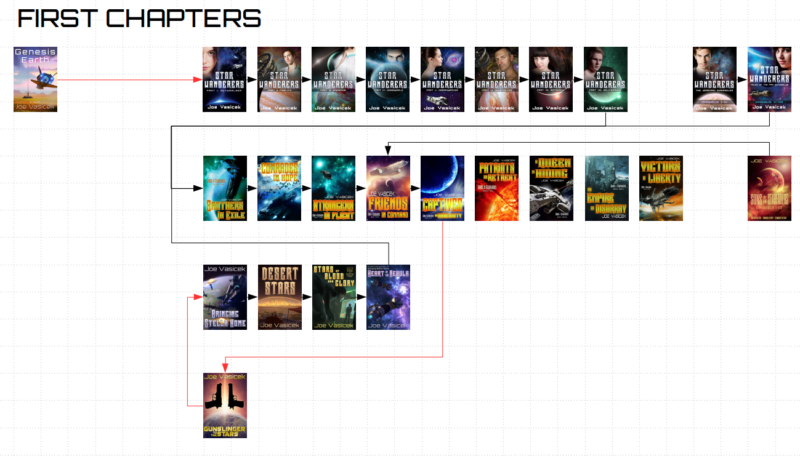
And it’s actually not as hard as I thought it would be. I upload to Kindle Direct Publishing, Kobo Writing Life, Draft2Digital, and Smashwords, so I only need four different files for each book. Because of the modular way epubs are structured, each sample chapter is an .xhtml file with a link at the end, and all I need to change really is the link. Drop the sample chapter at the back of the master file, export as epub, swap out for the other sample chapter with the different store link, export again. A little tedious, but not overly difficult once all the .xhtml files are made.
Point is, I’m making a big change to my publishing process, and it’s going to take a while for all these changes to trickle down through my catalog. But the only thing that’s changing is that I’m taking out the book teasers and adding a sample chapter. All of the author’s notes are staying, and nothing in the actual book content is changing.
Most of the prep work is already done. I’ve mapped out where all the sample chapters need to go, and made all the .xhtml files that I need to add to the master epubs. Now I just need to make the new epubs and upload them, which I plan to do one series at a time.
All told, this is probably going to take another 8-12 man hours to accomplish. But that’s on top of all the other stuff I need to do, like writing. If I can put in half an hour to an hour each day, this project should get done by the end of the month.
So that’s what I’ve been up to on the publishing end. This is one of those things where it’s best to make a decision early on in your career, because it’s a lot more work to change course midway. Of course, you should always be willing to change that decision based on data, which is what I’m doing here.
I recently read Rich Dad, Poor Dad by Robert Kiyosaki. It’s a fantastic book, not only because it gives you a basic education on financial literacy, but because it gives you a solid foundation for making money in general. It’s one of those books that really deserves its bestseller status.
About midway through reading it, I realized that I’ve been thinking all wrong about my writing. Everyone always says that if you want to write professionally, you should treat your writing as a business. But that’s not entirely correct.
Writing is not a business, it is an investment. Publishing is a business.
The basic argument of Rich Dad, Poor Dad goes like this: if you want to be wealthy, don’t work for money—make your money work for you. How? By owning more assets than liabilities. An asset is something that puts money in your pocket. A liability is something that takes it away.
When you write a book, you are creating an asset. A book is an intellectual property that generates money. Dean Wesley Smith compares it to a piece of pie in a magical bakery, where you can cut infinite pieces for your customers. With online publishing through ebooks and print-on-demand, that’s not a bad analogy.
If I were to cease all of my publishing activities right now, including all marketing and promotion whatsoever, my books would still generate income. It probably wouldn’t be a lot, but it would still be something. Even starting from zero, with a single book on Amazon under a totally unknown name, over time it will generate a small trickle of income.
A book is an asset. Writing is how you create that asset. Publishing is how you service that asset to make it more profitable.
As an indie writer, I am my own publisher. The business that I own is a publishing business, not a writing business. It’s a subtle but important distinction. I could still create books if I weren’t my own publisher, but at that point I’d be a contractor, not a small business owner.
Writers are not paid by the hour. As an indie, I’m still earning money on work I did ten years ago, and I fully expect to continue earning income on that work for the rest of my life. That’s because writing is an investment. Not a job. Not even a business. An investment.
Which is not to say that the publishing aspect—or in other words, the business aspect—is less important. Quite the contrary. A rental property is an asset, but it won’t make any money unless you find renters and take care of the upkeep. Similarly, a prime plot of farmland is an asset, but it won’t make any money unless you work it.
So how do you “work” your books? By publishing them, of course. Publishing is your business. This includes marketing, promotion, branding, and the like. Publishing is the business that makes your assets—your investments—profitable.
The implications of this are really interesting. For example, suppose you have a book that doesn’t sell very well, or that gets a bunch of negative reviews. Does that make you a failed writer? Does it spell doom for your career? It’s easy to think so if you think of writing as your business.
But when you think of writing as an investment, everyone changes. Got a book that tanked? That’s okay, it’s just that book. Every investor gets it wrong every once in a while. Learn from the mistake and pick a better investment next time.
If all your books are tanking, is that a sign that you’re just not cut out for this writing thing? Possibly… or it could just be that you need to work on your publishing. Even the richest farmland needs to be tilled, and fertilized, and watered properly. Perhaps you just need to learn how to market better, or brand your books better, or do a better job of finding and connecting with your readers.
On the flipside, suppose you have a book that used to do well, but now it isn’t selling as well as you would like. You’ve clearly done a good job of marketing it in the past, but what can you do now? Market it even harder? Or recognize that this is just a normal part of the investment cycle and go out to develop a new asset?
If writing is your business, then the success or failure of your books is a direct reflection of yourself as a writer. With that kind of mindset, it’s easy to fall into some traps. On the one extreme are those who believe that publishing well is secondary to writing a good book, and that therefore they should devote the bulk of their time and energy to writing. On the other extreme are those who seek validation so hard that they put all of their effort into the publishing aspect and neglect the writing. The truth is NOT somewhere in the middle, because both extremes grow out of a faulty premise: that writing is your business.
This is the Fugio cent. It was commissioned by the Continental Congress before the ratification of the Constitution, and designed by Benjamin Franklin. Fugio means “I fly,” referring to the sundial, which represents time. Taken with the inscription below, it is a reminder that we can all leave the world a better place by doing our best in whatever line of work we choose to pursue.
For many of us, writing is more than just a hobby, or a job, or even a career. It is a vocation. It is our calling. And yet, we live in a commercial world, where the price of a thing is often conflated with its value. How, then, can we best fulfill our calling as writers? By ignoring the demands of the market? By fancying that our books are simply unappreciated by those of inferior tastes? Or by losing sight of our calling for that lucre that will perish with us?
Benjamin Franklin’s message is that we can best fulfill our calling by pursuing excellence in every aspect of it. That includes the commercial aspect as well as the artistic, the practical as well as the spiritual. When we truly learn how to excel, we will see that there is no contradiction between the two sides.
Writing is our calling. Publishing is our business. Our books are investments, many of which may very well outlive us. By understanding this, I firmly believe that we can mind our business as well as Franklin admonished us, and truly fulfill our calling.
So you’ve written a short story, and you’re wondering what to do with it. You think it’s pretty good and you want to see it published, but you’re wondering what’s the best way to do that.
I can’t guarantee that this is the best way, but it is the way that I do it. Let’s start with the basics.
Indie vs. Traditional
Traditionally, short stories were published in magazines, anthologies, or collections. These were known as the “markets.” The editor was the one who chose which stories would go in and shepherded them to publication. Because of the periodical nature of the markets, there were a lot more short story slots than openings at the big publishing houses for novels, and many editors considered it a way for new writers to cut their teeth and prove their chops. It was also a great way for writers to get feedback, on the rare occasion that an editor wrote a personalized rejection.
In the 90s and 00s, the short story markets entered a period of decline, mostly due to the technological disruption of this newfangled thing called teh internets. Subscription rates for all the major sci-fi magazines went down, just like they did for newspapers. However, several new markets emerged to take advantage of the new ways to reach readers. The same innovations that spurred the indie publishing revolution also gave birth to new short story markets.
Today, when you write a short story, the first question you’ve got to answer is “do I want to self-publish this, or should I submit it to the markets first?” If you’re a happily self-published indie writer like me, the urge will be to self-publish first and ask questions later.
But Wait!
The awesome thing about short stories is that you can get the best of both worlds. How? Because unlike the major publishing houses, the traditional short story markets don’t impose prohibitive measures designed to gobble up your rights and lock down your publishing options. Publishing the same story in multiple markets is not only possible, it’s encouraged.
To maximize your returns, you have to be patient and impervious to rejection. You also have to learn some key terms. But first, as with any job, you have to select the right tools.
Get Thee to the Grinder!
To start out, you’re going to have to need some way to track all of your story submissions. By far, the Submission Grinder is the best free tool on the internet to do that. It’s a massive database for every English-speaking short story market, with stats compiled from user data. Not only does it tell you where you can submit, it gives you all sorts of useful statistics about each market. Create a free account, log your story, and use the Grinder’s search tools to find out where you can submit it.
Because I’m paranoid and believe in redundancy, I also keep a spreadsheet with all of my story submissions. At this point, though, it’s largely a backup. There’s no one right way to keep track of your submissions, but you absolutely need a system to keep track of them, and the best one out there is the Grinder.
Pro vs. Semi-Pro vs. Token
To decide whether a market is worth submitting to, you first have to determine how professional that market is. The best way to do that is by looking at the pay rates.
In the old days, when SFWA was more than just a snobbish in-crowd full of petty drama, you could tell that a market was professional if it was on the qualifying list for SFWA membership. Today, though, any market is considered professional if it pays at least 6¢ per word.
If a market pays between 1¢ and 6¢ per word, it is considered semi-pro.
If it pays less than 1¢ per word, it is considered a token-paying market.
Original vs. Reprint
Some markets want to be the first place where a story appears. If it’s already published elsewhere, they won’t touch it. Other markets don’t really care, though they may pay less for reprints.
The thing to look for here is “original fiction” or “first publication rights.” If a market’s submission guidelines specify either of those, then they won’t take your story if it’s self-published. Obviously, if you want your story to appear there, you can’t self-publish it first.
Most of the markets that accept reprints don’t mind if your story is already self-published. A couple of them do, which is super annoying, but whatever. As always, read the submission guidelines carefully before you submit.
In general, the more a market pays, the less it’s willing to accept reprints. Adjust your publishing strategy accordingly.
Multiple and Simultaneous Submissions
If the first thing you do after finishing a short story is submit it to every market that might possibly accept it, you’re liable to get yourself blacklisted and make a lot of editors angry. There is etiquette and protocol to the traditional publishing game, and if you want to succeed by going that route, you’re going to have to learn it.
A simultaneous submission is when you submit the same story to more than one market simultaneously.
A multiple submission is when you submit another story to the same market where you already have a story in consideration.
Most editors hate multiple and simultaneous submissions. If they like your story and want to buy it, the last thing they want is to find out that another editor beat them to the punch. Likewise, if they’re swamped with submissions (as they usually are), the last thing they want is more stories from someone who’s already submitted something to them.
For that reason, assume that a market does not accept multiple or simultaneous submissions, unless their guidelines say otherwise.
Of course, what’s bad for the editor isn’t necessarily bad for the writer. You can greatly speed up the submissions process by submitting to all the simultaneous-friendly markets at once, or by not having to wait for a response before submitting to a market again. The faster you can get through the submission process, the sooner it makes sense to self-publish.
With That Out of the Way…
Before you decide which publishing path to take, you first have to determine your publishing goals. Are you trying to make money, to build an audience, or both? Can you afford to be patient, or is time not on your side for whatever reason? Once you’ve determined what you personally want to accomplish, you’re able to make the important decisions that will take you there.
As a professional writer, it’s important for me to maximize profits. Also, I’ve found that I can do more to build an audience by self-publishing than by going through the traditional markets. That said, the prestige of publication in a pro market is still important in my field, so I find it worthwhile to submit original fiction to the pro markets before self-publishing.
Here are my criteria for submitting original fiction:
Will I make at least $100 from this story sale? ($20 for flash)
Is the average wait time for this market more than 60 days?
In a world where I can self-publish my stories and sell them directly, or give them away as freebies to build a readership for my other books, the traditional submission process costs both time and money. Also, if a market has eggregiously long wait times, that’s usually a red flag. Publish with them at your own risk.
However, for reprints I will submit my stories just about anywhere. They cost neither time nor money, because they don’t care if you self-publish first; all they want is non-exclusive publication rights. They don’t typically pay as well, but who cares? It’s free money, and the extra exposure isn’t going to cost you anything.
When making simultaneous submissions, I generally do it by tiers. If the story is at a pro market that accepts simultaneous submissions, I will only submit it to other pro markets. Likewise, if a story is at a semi-pro market, I will only simul-submit to other semi-pros. This is the best way to maximize your potential returns for original fiction.
In practice, though, since most simultaneus markets don’t pay more than $100, I usually end up submitting to them after I’ve already self-published. At that point, it doesn’t really matter where I submit, since a sale to a token market isn’t going to keep a semi-pro market from buying it too.
So in short, here’s my process:
Submit to all the markets that will pay at least $100 and respond in a reasonable manner (usually takes 1-2 years).
Self-publish.
Submit everywhere that accepts reprints and pays at least token rates.
A Word About Royalty-Share
In today’s rapidly changing publishing environment, a few markets are experimenting with non-traditional forms of payment. Royalty share is one of those. Instead of paying up front by the word, these markets pay you a share of the profits after the work is published.
In general, this is what I think of that:
Unless the royalty share arrangements are made against some sort of an advance, the publisher is basically asking you to take the risk for their venture. For original fiction, I’m generally not open to that, especially for markets with long exclusivity periods after publication. Tried that once, got burned, learned my lesson.
However, once I’ve self-published, the reprint rights are basically free money anyway, so I’m happy to give it a shot. Worst case scenario, I neither lose nor gain anything. And there are some places like Digital Fiction that are doing some really interesting things with non-traditional payment methods. I just signed a contract with them this week.
So yeah, that’s my process. The money in short fiction isn’t all that great, but if you’re systematic, organized, and prolific, you can make a decent profit at it. It’s one of the few areas of publishing where it still makes sense to go traditional, but you’ve got to know when to pull out and go indie. If you can afford to wait, it makes sense to run down all the pro and semi-pro markets with your original fiction. Otherwise, you have to figure out the cutoff point where it no longer makes sense to hold out.
A couple of weeks ago, Kobo came out with some new terms and conditions for their Kobo Writing Life program. Under the new terms, the list price for a book (not the sales price) cannot be higher than it is elsewhere.
This throws a kink in the works, since the only way I’ve ever gotten traction on Kobo is by taking advantage of their promotions, like the half off box set sales or the 30% off monthly sales. The problem, of course, is that Amazon has the same clause in their TOS, and if you undercut the Amazon price they will 1) match the lower price, and 2) send you a nastygram threatening to close your account if you don’t change your prices to comply.
(This is also the reason why my books are not on Google Play Books. Google will arbitrarily drop the prices of your books, sometimes setting the price to free without any prior warning, leading to a loss of income on Amazon when they price match your books.)
Until now, the way I’ve gotten around that is by pricing my books a little higher on Kobo so that I can drop the price for the promotional sales. But it does feel a little weird to have the same product at a different price on different sites. If I were a Kobo reader, that would turn me off (hence the change in their TOS).
At the same time, it’s come to my attention that unless your book has an ISBN, Kobo will not distribute your books to the many local ebookstores that they partner with. You can still publish on Kobo, but your books won’t go any further.
In the United States, ISBNs are insanely expensive. If you buy them one at a time, it costs $125 for each one. You can get them as low as $1.50 each, but you have to buy 1,000 at a time.
Until now, I haven’t really bothered with ISBNs. Most ebook publishing platforms don’t require them, and for those that do, you can publish through a distributor like Draft2Digital who will assign you an ISBN for free. The catch is that the publisher on record for the free ISBN will be D2D, but that doesn’t impact your publishing rights at all.
(Print also requires ISBN, but CreateSpace also gives you an option for a free CreateSpace-assigned ISBN, which is what I’ve been doing for print.)
In short, by publishing my books directly to Kobo without providing my own ISBNs, my reach is greatly limited. I can publish to Kobo via D2D and get the extra reach, but then I’ll lose access to the promotions tab, which is pretty much the only way to get my books in front of Kobo readers. But that doesn’t matter anyway, since I can’t price my books on Kobo higher than they are on Amazon, and if I drop the price on Kobo for a sale, Amazon will start sending nastygrams.
So here’s my new strategy:
I’m going to pull all of my books out of Kobo Writing Life and go through Draft2Digital instead. There really is no advantage to staying all-in with KWL anymore, and the added benefit of the D2D ISBNs is enough to convince me to go through them.
At the same time, I’m going to create some Kobo-exclusive bundles to take advantage of the KWL promotions tab. If the bundle doesn’t appear on Amazon, then it doesn’t matter how I price it on Kobo because there’s nothing for Amazon to match. At the same time, the contents of the bundle are still available as individual books, so my Amazon readers lose nothing.
For my single-title books, the price on Kobo will be the same as the price on Amazon. For the Kobo-exclusive bundles, the list price will be higher, but they’ll also be on sale more often which should bring more attention to my single-title books.
The biggest downside I can see is that my Kobo royalties will be split between D2D and KWL. To offset this, I’ll have to publish a variety of Kobo-exclusive bundles. Here are some of the ones I have in mind:
Bringing Stella Home and Heart of the Nebula, in one double-novel.
Desert Stars and Stars of Blood and Glory, in one double-novel.
The complete Star Wanderers series, with Brothers in Exile.
A first-in-series bundle, with Outworlder, Brothers in Exile, and Bringing Stella Home.
The first Sons of the Starfarers omnibus (I-III). This means I will take it down from Amazon.
So that’s the plan. I probably won’t announce these new bundles to my email list, since most of my subscribers are Kindle readers and I don’t want to be too spammy. But I will announce them here.
The OP had asserted that Amazon is “still the only real game in town,” which I attempted to refute. It ended with the fine folks at Mad Genius Club putting words in my mouth, threatening to ban me for my “tone,” and calling me a “pompous blowhard” and a “prancing, self-aggrandizing, self-congratulating spunkmuffin.” Which would have been amusing except that… okay, it was pretty amusing. But it was also a bit infuriating to watch so many people deliberately take offense simply because I disagreed with them.
(The irony was especially thick as they viciously attacked me, then turned around and emphatically denied that KU pits authors against authors, all while demanding me to prove to them that it does—often in the same breath.
And for the record, I do not think that there’s anything “dickish” about asking the other side to back up their argument with sources. This is especially true for things that “everybody just knows,” and doubly so when forming a negative argument, such as “no one bothers with outside Amazon.”)
In all fairness, however, there were a few arguments I made that I could have done a better job supporting. And since this is my blog, where no one holds the ban-hammer but me, it seems appropriate to make them here.
First, though, I want to make it clear to any KU readers that I’m not trying make you feel guilty for subscribing to KU. If you are a KU subscriber and you enjoy the program, great! I have nothing at all against that. Whether or not the system is broken, we’ll still find ways to get paid. Have fun, and as always, thanks for reading.
Also, I want to point out that even though I believe KU is broken, I would still love to enroll my books. The problem, as I’ve pointed out before, is that Amazon demands exclusivity for the privilege. Not only am I wary of putting all of my eggs in a basket (especially a broken one), I also think that that’s a bad deal for my readers on iBooks, Kobo, Nook, etc, or who live outside of the territories where Amazon operates. Their numbers are not insignificant.
So why is Kindle Unlimited a broken system? In a word, incentives.
In a healthy system, writers write the books that readers want to read, readers support the writers by voting with their dollar, and the middlemen (publishers, distributors, booksellers, etc) provide value to both readers and writers commensurate with the cut that they take.
A healthy system is not closed. If readers collectively decide to read twice as many books, writers collectively earn twice as much. If another writer’s books do twice as well, it does not take away from the money I earn from my books.
Contrast that with the closed system that is KDP Select. We have only a ballpark estimate for the size of the KU subscriber base. Amazon keeps that (and most other KU-related data) close to the chest. We have no idea if the pay is commensurate with the subscriber base.
Instead, writers are paid out of a fixed pot, the KDP Select Global Fund. If readers collectively read twice as many KU books, it doesn’t increase the size of the pot. The pot only increases if Amazon decides to increase it, which again may or may not be commensurate with the increase in books read, or subscribers enrolled. We have no way of knowing.
Worse, because pay is based on a share of the pot, if someone else’s books receive twice as many borrows, everyone else’s earnings go down—even if their readership remains unchanged.
This is why so many writers are up in arms about the latest KU scandal, covered in depth by Phoenix Sullivan and Ann Christy. To summarize, the current iteration of Kindle Unlimited (KU 2.0) pays authors based on number of pages read, and scammers are gaming the system with text synthesizers and click farms. It’s not impossible to make $500,000 a month with this scam, all of which is taken out of the share of legitimate writers.
Is Amazon working to fix the problem? Until last week, it wasn’t clear that they were—and it’s still an open question if they can. It’s a perpetual game of whack-a-mole where the moles keep getting smarter, increasing the odds that legitimate writers will get whacked.
When you look at the way the incentives are structured, however, there’s nothing surprising about this unmitigated mess. Amazon has divorced the readers from the writers in such a way that pricing signals no longer work. Worse, the fixed pot pits authors against authors in a zero-sum race to the bottom. You do not earn more by simply getting more readers—you earn it by getting more reads than other authors. In the meantime, Amazon keeps lowering the KENPC payment rate, and authors keep bending over.
Is there still value in an ebook subscription service? Readers certainly seem to think so. If there’s value for readers, it shouldn’t be too difficult to also find value for writers.
But when you look back on the history of KU, you realize that it’s not really about providing value for readers or writers, but undercutting Amazon’s competition. KU launched right around the same time as two other subscription ebook services: Oyster and Scribd. These subscription services did provide value to writers, as they paid full price for every completed read.
Amazon responded by launching KU 1.0, which paid writers significantly less. However, since Amazon had most of the ebook market share (at least in the US), and since non-KU books receive much less visibility on the Kindle Store than KU-enrolled books, authors were aggressively pressured to sign up. Amazon’s exclusivity requirements kept its competitors from receiving content, and as a result, they have since either folded (Oyster) or failed to gain much traction (Scribd).
It ultimately comes down to the contrast between makers and takers. KDP Select is a closed system, where the size of the pie is fixed and the best you can expect is to get a larger slice than the person next to you. This turns everyone into a taker: someone who feels threatened by other people’s success and jealously guards their own.
Is it any wonder then that KU authors, when presented with someone critical of the KDP Select program, resort to rhetorical tactics like gaslighting, lampost-moving, name-calling, and conflating disagreement for personal attacks? Sadly, no. These are all classic hallmarks of a taker, which the system has forced them to become. In this way, Kinde Unlimited pits authors against authors.
It’s a broken system, but of course, different people experience the brokenness in different ways. When I was living in Georgia, I met several older people who believed that things were better under Communism. Without a doubt, the Soviet system was broken, but these people did better under it than they did after it fell. In the same way, there are a lot of authors doing very well under KU 2.0 who would love to keep things exactly the way it is.
Several of them employ text synthesizers and click-farms.
And when KU 3.0 comes out, as it inevitably will, it will sort out a new batch of winners and losers just like KU 2.0 did before. Because of Amazon’s exclusivity requirements, many writers will lose just about everything, having developed no other income streams.
But not the scammers. They’ll just find a new way to game the system, based on the way KU 3.0 misplaces the incentives. Amazon will continue to aggressively insert itself between readers and writers, breaking the incentives structure in new and interesting ways.
 This graph shows all of the monthly averages for royalties earned and units sold, across all my books, from 2012 to 2017 (excluding February 2017, which was an outlier due to having a book in a story bundle). I haven’t adjusted for anything else, such as new releases or total books out, so take it with a grain of salt.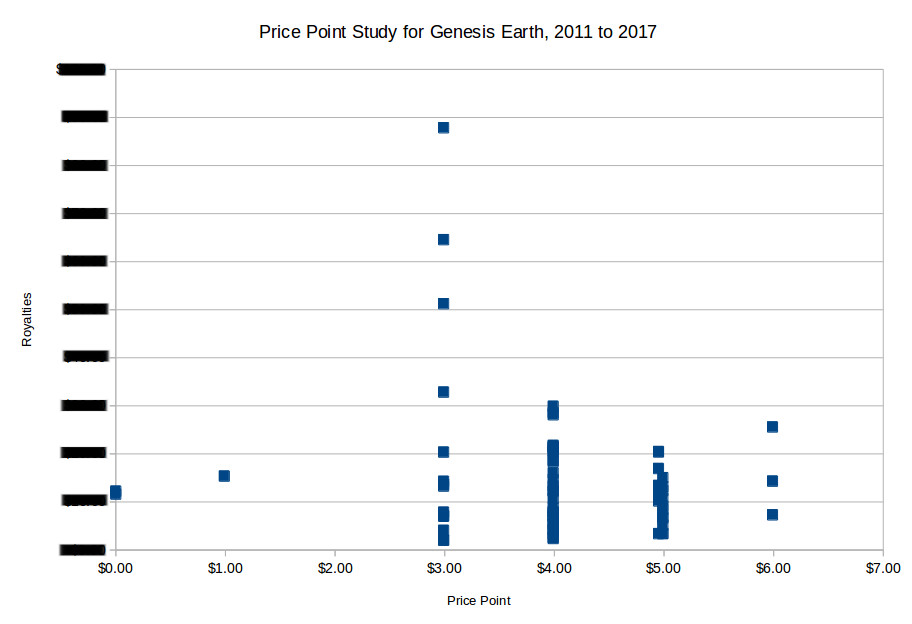
 In a word, short stories.
 Most of the prep work is already done. I’ve mapped out where all the sample chapters need to go, and made all the .xhtml files that I need to add to the master epubs. Now I just need to make the new epubs and upload them, which I plan to do one series at a time.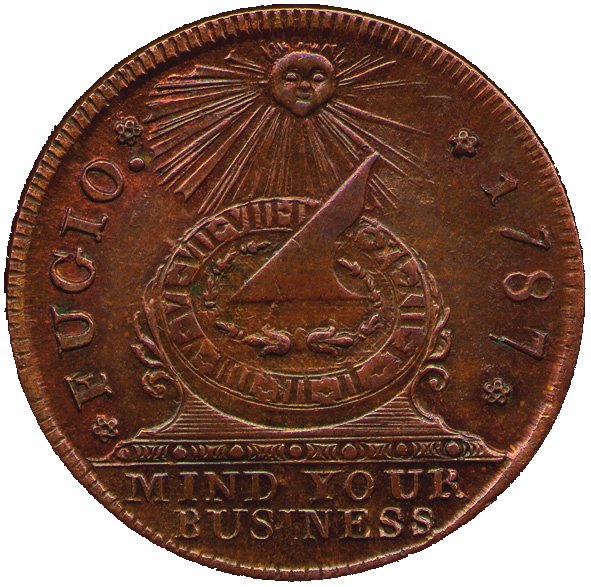

 I recently became embroiled in