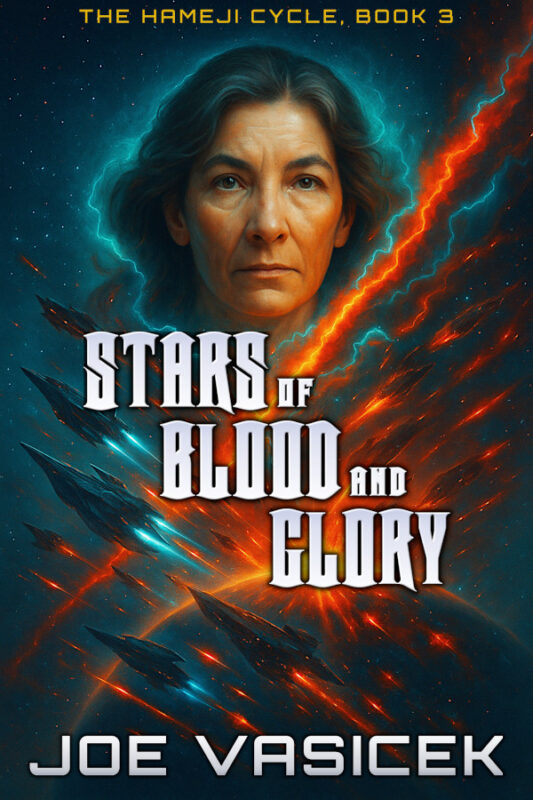
War stories often promise a payoff: win the battle, save the people, earn the glory. But Stars of Blood and Glory is a military science fiction novel that keeps circling a harder question—what does victory actually cost, and who gets stuck paying the bill? In this character-drive space opera, “winning” is never free. It’s a debt—paid in lives, in conscience, and in the things you can’t unsee afterward.
Although this is the third book in The Hameji Cycle, Stars of Blood and Glory is written as a standalone military science fiction novel, with a complete character arc and a decisive turning point in the war. Readers can start here and experience a full story, then explore the wider series if they want more context and depth.
Where the Idea Came From
The seed of this novel came from history. After writing Bringing Stella Home with the Mongol conquest of Baghdad (1258) as a loose influence, I knew I wanted to follow it with the Battle of Ain Jalut—the moment when an apparently unstoppable force suffers its first decisive defeat. That became the backbone of this book’s premise: a war that turns, a juggernaut that finally bleeds, and the uneasy question of what it takes to make that happen. As I developed the cast and conflicts—especially the mercenaries and the Rigelan/Japanese culture thread—the theme of cost kept asserting itself, not as an “idea,” but as the emotional truth underneath every major decision. That historical moment helped crystallize the book’s central question: what does it cost to stop a conquering power, and what kind of victory is worth surviving?
How The Cost of Victory Shapes the Story
In Stars of Blood and Glory, victory is never framed as a clean scoreboard result. It’s framed as a choice with consequences that keep expanding outward—through fleets, through civilians, through relationships, through the survivors who have to live with what was done in their name. The war demands miracles, but miracles here look less like triumph and more like someone volunteering to be the price. You see this at the strategic level, where commanders and leaders make wartime command decisions, gambling with everything they have left because “not losing” is no longer an option. When the moment comes, the story doesn’t celebrate the win—it forces you to sit in the silence afterward and feel what it took.
That theme also plays out at the personal level, where sacrifice isn’t abstract. Sometimes the cost is paid in one decisive, irreversible act—someone choosing to stay behind so others can escape, buying a few minutes that matter more than a lifetime. Sometimes the cost is paid in guilt and moral injury, as characters realize too late that their mistakes don’t just endanger themselves, they drag everyone else into the blast radius. Even when the battle goes “right,” the human math never does. The book keeps asking: If your survival requires someone else’s destruction—what does that make you?
What The Cost of Victory Says About Us
I think this theme resonates because it’s true far beyond war fiction. In real life, we’re always tempted to treat outcomes as if they’re separate from the means: If it worked, it must have been worth it. But human beings don’t actually live that way. We carry the cost in our bodies and memories. We mourn what we had to trade away. We wonder whether the thing we saved was worth what we became in the saving. Stars of Blood and Glory leans into that uncomfortable moral realism: sometimes the “right” outcome still leaves blood on your hands, and the only way forward is to acknowledge it instead of pretending victory makes everything clean. For readers who want science fiction that treats war as a human and moral problem—not just a tactical one—this question sits at the heart of the story.
Why This Theme Matters to Me
I’ve always believed that character death—and sacrifice more broadly—should mean something. Not as shock, not as spectacle, but as a kind of honoring: the idea that people matter enough that their loss changes the shape of the story and the people left behind. That’s why I keep returning to this question of cost. It’s easy to write war as adrenaline and hero-posters. It’s harder—and more honest—to write it as a series of choices that leave scars, even when you win. And if this book has a heartbeat, it’s that: the stubborn belief that what we do matters, what it costs matters, and the people who pay that cost deserve to be remembered.
Where to Get the Book








