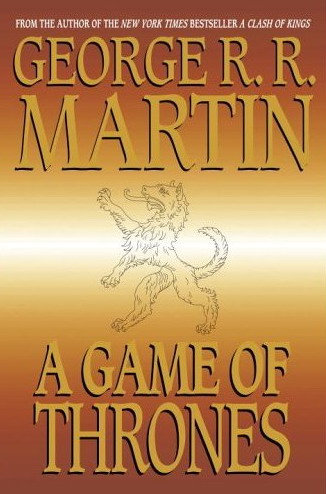
A Game of Thrones by George R. R. Martin

Almost twenty years have passed since the fall of the Targaryen dynasty–twenty years since the last of the dragons was seen in the Land of the Seven Kingdoms.  Now, the libertine Robert Baratheon sits on the Iron Throne, blind to the conspiracies and secret combinations that surround him.

In this dangerous time, Ser Jon Arryn, the King’s Hand, dies of mysterious causes.  Most of the realm accepts the official story that the death was natural, but when Arryn’s wife Lysa sends a letter to her sister, Catelyn and her husband Ser Eddard Stark immediately suspect that the death was orchestrated by the Lannisters.  Only one thing remains: to travel to King’s Landing and uncover the proof.  Soon, King Robert calls on Ser Eddard to become his new Hand, giving them the perfect opportunity to do this.

Little does Ser Eddard know, the intrigue goes much deeper than any of them realize.  For the Lannisters are gathering an army, and Queen Cersei and her brother, Ser Jaime, harbor a secret that would tear the realm apart.  Meanwhile, the last of the Targaryens bears a child prophesied to rule the world, while far to the North, an ancient evil bides its time, waiting to sweep the seven kingdoms with horror the likes of which has not been seen in a thousand years.

Winter is coming–and the people of the Seven Kingdoms are ill prepared to face it.

Everyone seems to be talking about George R. R. Martin’s Song of Ice and Fire series these days–next to The Wheel of Time, it’s probably the biggest epic fantasy line of the last ten or fifteen years.  Martin is well known for killing off his characters and writing in shades of gray, so I thought it would be good to give this series a try.

As soon as I picked up the book, I was hooked.  Martin knows how to craft a beautiful, engrossing fantasy world.  In order to leave no doubt on that point, observe:

Yeah, that pretty much sums up what Martin did with his Land of the Seven Kingdoms. It’s an awesome fantasy world, and I found myself lost in it from the first page.

I must admit, however, after hearing so much about the Song of Ice and Fire series, I was surprised at how few characters died in this book. That’s not to say everyone survived–in fact, Martin killed my favorite character, which made me feel HORRIBLE–but I was expecting there to be more. However, this is the first book in the series, so I assume that the really crazy stuff happens later.

While overall I loved A Game of Thrones, I admit I did have a few misgivings about the book. Martin really does write in shades of gray, and while that makes the story unpredictable and surprising, it also makes things very dark and austere. Martin seems to have no interest in redeeming his characters, and when any of them try to be noble, he cuts them down at every turn.

Personally, I don’t care for that. Flawed characters may be more relateable, but seriously flawed characters (or characters with no interest in overcoming their flaws) turn me off. In this way, Martin is practically the antithesis of David Gemmell; whereas Gemmell makes you love his characters despite their flaws, Martin keeps you reading in spite of the fact that you hate all his characters.

How does he do it? By creating a beautiful, wondrous world. By crafting a masterful story full of intricate twists and turns. By making you hate some of the characters so #%$^! much that you have to stick around and see how they die. It’s all entertaining and extremely engrossing, but at the end of it all, I didn’t come away with any real love for Martin’s characters–except perhaps for a couple of Eddard’s kids, who are still young enough to be somewhat innocent.

I suppose it’s all a part of this new non-conciliatory movement in fantasy. Don’t get me wrong; A Game of Thrones is an EXCELLENT book, but it’s very…non-conciliatory. If that’s your thing, more power to you, but I personally prefer stories about redemption, where romance still lives and even the most unlikely character can be a True Hero, if only for a few fleeting, glorious moments.
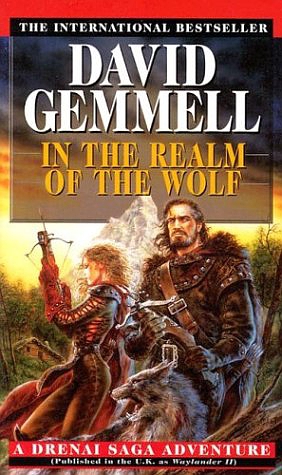
In the Realm of the Wolf by David Gemmell

Never leave home without a weapon, Dakyras taught his adopted daughter Miriel.  Though they live a quiet life alone in the mountains, death is never far from the man known as Waylander.

When the Assassin’s Guild puts out a high price on Waylander’s head, both Waylander and Miriel find themselves on the run.  With them come two ill-fated gladiators from Drenai: the loyal and steady Angel, and the arrogant and reckless Senta.  Both men vie for Miriel’s hand–and both are honor bound to kill each other.

But in the face of the evil hunting Waylander, Angel and Senta must lay aside their vendetta and take up arms against the Gothir army hunting the Wolf clan, tribe of the prophesied chieftain that will one day unite the Nadir.  For deep in the realm of the Wolf lies a castle more ancient than the three empires–a castle whose dark secrets threaten to upset the global order forever.

This book was awesome.  I loved every moment of it.  With each page, the story just got better and better, right up to the climactic finish.  If you’re looking for a rousing adventure, you can’t go wrong with David Gemmell.

One of the things I loved the most about this story was the love triangle between Miriel, Angel, and Senta.  At first, I thought I knew who was good, who was bad, and which one she’d end up with, but then things changed and I wasn’t too sure.  Even though I hated Senta at first, I spent most of the book vacillating with my feelings on him.  And the way things ended–I wasn’t disappointed.  Not one bit.

Even though the overall story conflict was much, much larger than life, Gemmell’s characters always felt very real.  Perhaps it has to do with the way their true nature always seems to come out in battle–and Gemmell gives them plenty of opportunity to show their true nature.

It also has to do with the things they’re fighting for, though–the stakes are always clear for each character, and when they’re confused what they’re fighting for, that’s made clear too.  Though the conflict itself is larger than life, the stakes for each individual character never are.

The ending really took the cake for me, though.  When I finished the book, I couldn’t help but smile.  Gemmell is a master at writing endings that make you want to stand up and cheer.

As awesome as this book was, though, the last book in the trilogy, Hero in the Shadows, is so much better.  The last scene of that book stands out so much more to me, now that I know everything about Waylander’s past.  So.  Freaking.  Epic.

But do yourself a favor: don’t read the last book first, like I did.  Start with Waylander, which is a good book–not great, but good–and read through the trilogy.  If you love stories about true heroes and epic adventures, you won’t be disappointed.

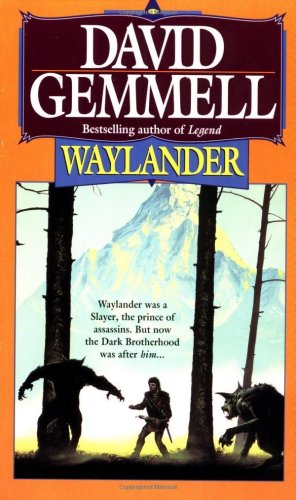
Waylander by David Gemmell

The Drenai lands have been overrun, and the Vagrian conquerors, led by Kaem and the Dark Brotherhood, are laying waste to all that lies before them.  Only the stronghold at Purdol withstands them, but unless the Drenai can rally a counterattack, all will be lost.

In these trying times, a strange old man visits the assassin Waylander and urges him to go to the sacred Nadir mountain of Raboas and retrieve the legendary Armor of Bronze.  With this armor, the Drenai commander Egel can rally the army that will save the kingdom.

But Waylander is a hunted man–a man of dark secrets and many enemies.  Kaem wants him dead for killing his son.  The Nadir want him dead for violating their lands.  And the Drenai want him dead for assassinating their king.

I love David Gemmell.  When you pick up one of his novels, you know exactly what you’re going to get: gritty, complex characters, bloody battles, ruthless villains, and difficult moral decisions that transform even the most depraved individuals into true heroes, if only for a few moments before they die.  Waylander is no exception.

Perhaps the most interesting part of the book is the story behind the founding of the Thirty.  When the young Source priest named Dardalion forsakes the pacifism in order to save the lives of his fellow countrymen, twenty nine fellow priests join him to form the band of legendary warrior monks.  This religious order goes on to play a pivotal role in some of Gemmell’s best works.

Waylander himself is also an interesting, memorable character.  During the events of Waylander, he’s basically hit rock bottom, but as he learns again what it means to love and fight for what he loves, he climbs out of that dark place.

I really enjoyed this book.  My only complaint is that the ending felt a little rushed.  All the plots and subplots get tied up, but some of them so abruptly that there’s little room to savor the emotional impact.  Still, the novel was quite satisfying overall.  I look forward to reading the next book in the Waylander saga.

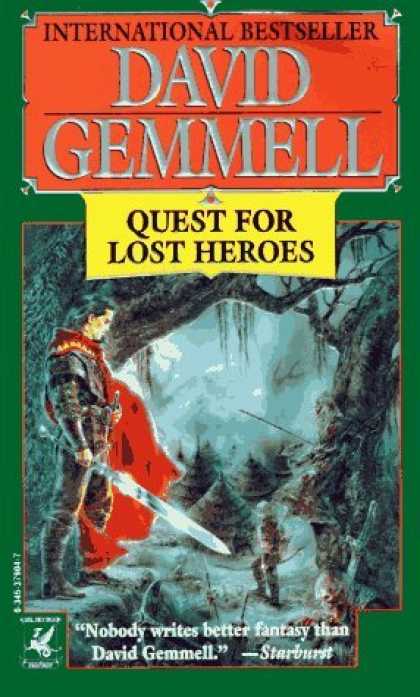
Quest for Lost Heroes by David Gemmell

It has been forever since I read this book.  Still, I really should review it.  Here goes.

At Bel-Azar, four friends held out against hopeless odds, only to be spared by the Nadir Khan.  Known by the Nadir as the “ghosts yet to be,” they enjoyed the fame of heroes for a time, but now live in obscurity in their own kingdom.

When a band of slavers raze a village and carry off the women, however, a young, reckless boy named Kiall calls upon the forgotten heroes to help him free his unrequited love.  And so the “ghosts yet to be” join together for one last quest, only to find that the stakes are much higher than any of them could have forseen…

David Gemmell writes awesome fantasy!  Some of the best I have ever read.  This one, while not quite as deep and meaningful as others like Legend, had its moments.  Let me just say, Gemmell knows how to kill off his characters.

The story started off very well, with some interesting introductions.  It felt a bit like a cowboy movie, where the heroes are all outcasts, unable to find their place in mainstream society.  I immediately took a liking to the main character, Chareos–Gemmell knows how to write heroic characters, even dark heroic characters.

The action began immediately, with blood and battle in every chapter.  As usual, Gemmell did an excellent job getting to the meaning (or lack thereof) of it all, but at times, it felt a little bit superficial.  Not very much, but sometimes, it seemed that he threw the action in just to keep the story interesting.  It didn’t pack quite the same punch as Legend, which was a much superior book.

It took me a few chapters to feel that the story was progressing–Gemmell isn’t always strong on plot–but once I did, it really took off.  I finished the last hundred or so pages at a sprint, and the ending, like all of Gemmell’s endings, did not disappoint.

Overall, I’d say this book is more fan action-adventure story than anything else–light reading, compared to Gemmell’s other work.  Still, it was definitely entertaining, and much deeper and well-written than your typical thriller.  If you like heroic adventure stories with lots of action, you’ll love this book.

“Why people read”

Dave Farland puts out this great e-newsletter called “Dave’s Daily Kick-in-the-Pants.” For the kick today, he suggested the following exercise:

You probably have a good idea about what you want to write—horror, mainstream, fantasy, historical, romance, westerns, religious fiction, and whatnot. Sit down for ten minutes and on the left-hand side of your paper, list five things that you feel you most like in the fiction you read. On the right-hand side of your paper, list the biggest potential danger that you see in trying to create that effect.

Doing this exercise will help you understand who your potential audience is, and some of the challenges that you may face in reaching that audience.

This was my response:

Why I read:

1) To meet interesting characters and get lost with them in an exciting fantastic world.

2) To think deeper about fundamental truths I see in my own life.

3) To feel like I understand another person and connect with them.

4) To be reassured that true heroism is real, alive, and within the realm of possibility.

5) To experience beauty in the language and metaphor, the imagery and tension.

Potential dangers:

1) Trying to write about a world without a story–all info dumps, exposition, lacking interesting characters with whom the reader can journey and experience the world.  Story IS experience, and experience does not exist independent of the person doing the experiencing.

2) Waxing allegorical or didactic in the writing–trying to force the message instead of leaving it open for the reader to discover multiple layers of meaning.

3) Focusing so hard on the character that the plot lacks the structure and tension to keep the reader interesting.  Characters do not exist separate from plot or setting; they change and grow in reaction to both.

4) Creating a hero whose struggle is so far removed from the real world or our real life experience that the reader feels that this type of person could only exist within the pages of a book.  Or, trying so hard to follow the monomyth structure that the story falls flat (ie Star Wars I, II, III).

5) Thinking that poetic license frees you from basic rules of style and grammar.  Creating metaphors that are so unusual that they are merely non sequiturs.  Writing prose so thick and “literary” that it kicks the reader out of the book.

LTUE 2009

Wow. Life, the Universe, and Everything 2009 is over, and it’s hard to believe that only three days have passed. It feels as if this symposium has been going on for a week, and that’s a good thing. Friday and Saturday, I spent practically every waking moment in the Wilk, the student center where the symposium was held. By the end, I think some of the professionals there were starting to recognize me and strike up conversations with me instead of the other way around. Kind of interesting. Way fun. Loads and loads of helpful advice and information to process. I’ll be lucky if I can soak it all in before the end of the year.

I’m glad to say I was able to open up and talk with a lot of people these past few days–in fact, I got a chance to talk with just about everyone who was on a panel that I’d attended. It was fun to shake their hands, compliment them on what they said, and strike up a conversation around that. It was surprisingly non-threatening, to be honest. I definitely feel more prepared for World Fantasy 2009 now–definitely.

By far, my favorite part of the convention was Tracy Hickman’s main address. It was titled Creative Reading 201, and it was all about how the reader and the writer are both collaborators in the creative experience, something that’s fascinated me for a long time. The implications of this simple fact are tremendous. First of all, it means that a story does not come to life until it is read. Anyone can get published, especially with the technology today, but all of those words are empty symbols until someone takes the time to read it. Second, it means that the spirit speaks to us in the white spaces between the lines. Just as people with different needs take the unique message they need from the scriptures through the power of the holy spirit, so each work of fiction speaks differently to us. Finally, all of this means that stories change as we change, even as they inevitably change us. As we grow, the stories that touched us the most simultaneously grow with us even as they help us to become better people.

Tracy Hickman then shared an incredible story about a book signing he and collaborator Margaret Weis had recently at a veteran’s home. A man in a wheelchair came up to them with an extremely tattered copy of one of their earlier works, about a knight who sacrifices his life in battle to save the order, even though all of his fellow knights in the order look down on him as less than a true knight. This wounded soldier then told them that this tattered book had traveled with him in his pocket throughout his military career, through parajumps, underwater operations, and into war theaters like Afghanistan. While fighting in Afghanistan, this soldier was shot in the lower back. As he went down, his first thought was “what would the knight in Tracy’s book do?” He saw the Taliban forces setting up a mortar on the opposite ridge, and in spite of his wounds and the risk to his life, he took down the enemy and saved twelve of his fellow soldiers fighting in that battle. The soldier then presented his purple heart and bronze star to Margaret Weis and Tracy Hickman, for writing the story that inspired him to be a hero.

Sometimes, as I’m sludging away with my writing and wondering what I’m going to do in 2010 when I finally graduate, I wonder if I’m somehow being lazy. I worry that I’m somehow being irresponsible by not going into some other profession, some kind of respectable 9 to 5 job in an office, the kind of thing that everyone else goes into. I wonder if I’ll ultimately become some kind of a parasite on society, trying to make it big as a writer. In the worst moments, I worry that even if I make it big, I’ll still be some kind of parasite, not really producing anything respectable or useful. After all, fiction is entertainment, especially in genre fiction–don’t we have enough of that already?

Then I remember the impact that one good book can have on people–the way it changes us, the way it opens our eyes and helps us to become better people than we were before we picked up the book. Then I realize: what could possibly be more respectable than telling good, honest, life-changing stories? And then, as I think about it a little more, I realize that that 9 to 5 office job isn’t what I think it is. I realize that I’m not slacking off by trying to be something more than a cog in the corporate machine, producing widgets.

If I strive to tell the truth as a storyteller, and to write the kinds of stories that truly inspire people to do marvelous things and become better people, what greater career is there than that? Teaching, I suppose, comes close to having a similar impact, as well as some kinds of therapy work. Certainly there are other careers that have tremendous opportunities to sacrifice and have a meaningful impact on one’s fellow men. However, my talent is in writing and telling in stories–and it’s a talent that I cannot suppress, from which I cannot escape. So long as I live, I will always tell stories–it’s just hardwired into who I am. Certainly I can use this talent to serve my fellow men in a way that is both respectable and meaningful. And really, for me personally, what else could be better?

It doesn’t mean that it isn’t scary. However, thanks to LTUE this year, I feel that I’ve learned a lot that can help me break in and make it. Whether it was something said in one of the panels or just the experience of attending, it was a truly awesome experience for an aspiring writer like myself.

As far as the files, I’ll post links to the audio files from the conference after I get them uploaded. I should be able to do that sometime within the next 24 to 48 hours, so look out for that.