Thoughts after finishing In the Realm of the Wolf

Wow.  I just finished In the Realm of the Wolf by David Gemmell a couple hours ago, and it was AMAZING.  So amazing, in fact, that I want to write a post examining my reaction to it before I write the review.

You know that ecstatic, otherworldly feeling you get when you finish an amazingly good book?  Where you feel like you just came home from a long, epic journey and you can’t stop thinking about it?  Where your mind is racing with all sorts of new and beautiful ideas, as if you’ve opened your eyes for the first time?

That’s how I felt after finishing this book.

As a writer, I want more than anything for my readers to have the same experience when reading my books.  I don’t expect everyone will, but I want to be able to connect with a good chunk of my readers this way.  David Gemmell does this for me, and my main question is therefore: how does he do it?

Looking back, I’ve got to say that the book started good and steadily got better, right up until the awesome finish.  The first two chapters were good, but around the third chapter, my expectations started to be exceeded.  It wasn’t until the last half of the book that I realized just how much I was connecting with the characters, and when the climaxes hit, I found myself rooting for them more than I usually do.

So I guess escalation had something to do with it.  Gemmell starts with a pretty simple plot: Waylander has to evade a bunch of guild assassins out to kill him, but he doesn’t want to because his wife just died and he’s depressed.  Then more and more characters get involved, and the stakes steadily grew until the fate of global empires hung in the balance.

Yet throughout it all, the focus was always on the personal conflicts and the impact of the events on the individual characters.  The vast armies sweeping the land were more of a background setting element than anything else; the real story lay in the choices the characters made and why they made them. And when the characters started confronting their demons, I rooted for them as if they were my close, personal friends–or more than friends.

Yet Waylander himself is very much a larger-than-life character.  He’s a better hunter and tracker than the Sathuli tribesmen, a better swordsman than most of his opponents, by far the best crossbowman in the Drenai saga, and a cold, efficient killer with a body-count of hundreds.  Not only is he rich enough to support the bankrupt king of Drenai singlehandedly with his vast financial assets, but in each of the three books in his trilogy, he plays the most pivotal role of any character in the rise and fall of nations and empires.

And yet…I can still connect with him.  Why is that?

Maybe it’s because he’s far from perfect.  He vanquishes hundreds of soldiers, assassins, monsters, and demons, but he doesn’t escape uninjured.  In Realm of the Wolf, his less-than-perfect swordsmanship is a key element of the plot.

It’s the internal conflict, however, that really makes me connect with him.  Don’t get me wrong–I’m not a cold, unfeeling killer, nor have I lost my whole family to roving bandits–but I can understand his struggle to find happiness in the face of so much evil, both within him and without.

Or maybe it’s not so much that I understand him as that I’m fascinated by him, and I don’t know why.  It certainly helps that he has a soft side–that he’s not a complete monster.  In all the books, his quest is always to save lives, not just to take them, and every once and a while he does something to keep my sympathy.  The way he spared the Sathuli scout in Realm of the Wolf, for example.

Overall, though, I think it’s the characters and their conflicts that made this book come alive.  Waylander is basically an adventure tale with some interesting characters; In the Realm of the Wolf is also an adventure tale, but the personal stakes are much higher, and the focus is more on the characters than on the rise and fall of empires.

Anyways.  I still feel like there’s something elusive that I’m not quite getting, but those are my thoughts after finishing this book.  If you didn’t find it helpful, I hope you at least found it interesting.  And if you have the chance, read the trilogy!  It’s goood!
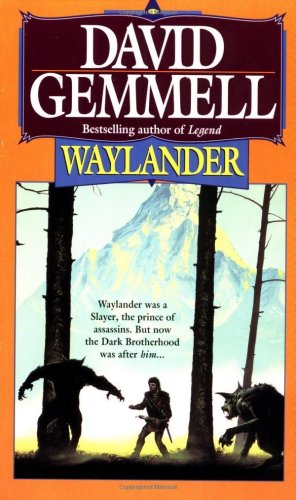
Waylander by David Gemmell

The Drenai lands have been overrun, and the Vagrian conquerors, led by Kaem and the Dark Brotherhood, are laying waste to all that lies before them.  Only the stronghold at Purdol withstands them, but unless the Drenai can rally a counterattack, all will be lost.

In these trying times, a strange old man visits the assassin Waylander and urges him to go to the sacred Nadir mountain of Raboas and retrieve the legendary Armor of Bronze.  With this armor, the Drenai commander Egel can rally the army that will save the kingdom.

But Waylander is a hunted man–a man of dark secrets and many enemies.  Kaem wants him dead for killing his son.  The Nadir want him dead for violating their lands.  And the Drenai want him dead for assassinating their king.

I love David Gemmell.  When you pick up one of his novels, you know exactly what you’re going to get: gritty, complex characters, bloody battles, ruthless villains, and difficult moral decisions that transform even the most depraved individuals into true heroes, if only for a few moments before they die.  Waylander is no exception.

Perhaps the most interesting part of the book is the story behind the founding of the Thirty.  When the young Source priest named Dardalion forsakes the pacifism in order to save the lives of his fellow countrymen, twenty nine fellow priests join him to form the band of legendary warrior monks.  This religious order goes on to play a pivotal role in some of Gemmell’s best works.

Waylander himself is also an interesting, memorable character.  During the events of Waylander, he’s basically hit rock bottom, but as he learns again what it means to love and fight for what he loves, he climbs out of that dark place.

I really enjoyed this book.  My only complaint is that the ending felt a little rushed.  All the plots and subplots get tied up, but some of them so abruptly that there’s little room to savor the emotional impact.  Still, the novel was quite satisfying overall.  I look forward to reading the next book in the Waylander saga.

Worlds Away from Home 1.2 is finished!

That’s right!  Here are the stats:

Worlds Away from Home 1.2

mss pages: 536
words: 116,219
file size: 259 KB
chapters: 24
start date: 9 June 2010
end date: 16 August 2010

And here’s the wordsplash:

Wordle: Worlds Away from Home 1.2

Also, I don’t know if this is of any significance to anyone, but this is the song that I had playing while I wrote the last scene. Thanks to Rafael for tipping me off to it.

And what are my thoughts, now that it’s finished?

1) Thank goodness it’s over.
2) Wait, it’s over?
3) Wow, the ending didn’t suck as bad as I thought it would.
4) …is it really over? Really? Like, I’m not going to wake up tomorrow and procrastinate writing all day, like I have for the past two months?
5) Huh.

Of course, it still needs a TON of work–plot holes to fill, character inconsistencies to mend, worldbuilding crap to throw in (or throw out), climaxes to resolve. I won’t send it out to any first readers until after I’ve done at least one major revision.

Still, there’s something satisfying about finishing a 120k word novel. Most of my misgivings about the story disappeared as I wrote the final chapters, and now I’m much more confident that I can make this thing publishable.

Eventually, that is. For now, it’s time to move on to the next big project.

Slogging through to the bitter happy ending

Oh man.  I was hoping to hit 5k words today, and even though I must have spent five or six hours writing, I only managed half of that.  It’s progress, I know, but it’s not as much progress as I’d like; the words just aren’t coming, no matter what I do.  Blarg.

The worst part is that I know that most of these words are just crap.  I’ll get to the end of a chapter and think “oh yeah, shouldn’t these characters be doing/thinking this?” And I’ll make a couple of notes in the revision guide, or touch up what I’ve written just a little bit, but one thing compounds on another until everything’s got problems.

But you know what?  I’m almost three quarters of the way through, so it’s probably better just to write on through these problems and finish the @#$! thing.  At this point, I’ve got a good enough story that I can carry things through to the end, as horrible as it may be, and just fix everything in the next draft.

It’s frustrating, though, because I know that most of the changes I’m going to make will seem obvious.  Why can’t I just get it right the first time?

Is it because I failed to outline things enough?  I know from experience, however, that outlining too much can be fatal for me.  Is it because I didn’t take the time to immerse myself in my story?  But then again, I’ve been spending so much time on my writing, everything else seems to be suffering, including my social life…

BLARG.

I’m probably just missing the forest for the trees.  Once I get out of these woods, though, I’m sure things will fall into place.  One way or another, in two weeks this abomination will be FINISHED! …at least until the next draft.

How Avatar should have ended

Before I came out to Washington DC, I saw Avatar in the theaters.  AWESOME movie.  Loved the concept, loved the characters, LOVED the science fiction elements and how well they were woven into the story.
However, like much of the stuff that comes out of Hollywood, I was disappointed with the ending.  It felt too cheap–kind of like Matrix: Revolutions.

ONCE AND FUTURE SPOILER WARNING!  MAJOR SPOILERS AHEAD!

The ending of the story didn’t really solve the initial problem–it only put off the inevitable defeat of the good guys.  Do you REALLY think that the corporations of Earth are going to let a band of primitive aliens keep them from exploiting the natural resources of Pandora?  No way–they’ll be back, and with much bigger guns than before.  The ending solves nothing.

What they should have done was created an interstellar authority that the corporation needed to answer to–a weak, toothless one, at least initially, but one that becomes more important as the movie progresses.  This is because the real bad guy was the CEO, not the colonel–the colonel always answered back to the guy running the company.  HE was the one who made all the real decisions for the bad guys.

Things started to get cheesy once the rogue pilot sprung Jake, Norm, and Dr. Grace from the holding cell.  She should have hidden the trailer for the outpost, then sprung them out, since the only place they would go after leaving the base was the remote outpost. Where else could they go to access the avatars?

Moreover, Jake and his allies wouldn’t want to hide the trailer near the alien holy place.  That’s one of the last places they’d want to go–the aliens would just kill them, after the destruction of the mother tree.

Capturing the red and yellow dragon bird was a good way to get the legitimacy Jake needed to lead the aliens, but would the young prince really cave in so easily? I think not–especially after Jake stole his betrothed.

And summoning all the other alien tribes from across the planet? This was when I thought things had gone too far–no way was a coalition of bow and arrow wielding blue people take down the human armada.

This is where the interstellar authority comes in.  Without any oversight, the corporation can do whatever it wants.  Even if the aliens drive them off the planet, they or someone else will just come back.  Instead, the authority should have played the key role in defeating the evil corporate bad guys.

The scientists working for the corporation should have been in connection with scientists back at Earth from the very beginning.  Once the corporation pulled the plug on the science operation, it would have created discontent back home–only among the scientific elite at first, but as knowledge of Pandoran biology and its secrets begins to spread, public sympathy for the alien’s cause would grow–and with it, political capital that the scientists could leverage to stop the corporation.

Knowing this, the CEO would do everything in his power to keep the alien sympathizers from sharing their full discoveries with the scientists back on Earth.  To counter this, the good guys would have to either use their spy or covertly break into the facility to transmit the information to the people who can leverage it.

This sets up a “time bomb,” so that the goal of the good guys is no longer to defeat the bad guys in one last spectacular battle (which, let’s face it, they never could have realistically won), but instead to hold out until the cavalry arrives to save them.

There’d be a show down with the colonel, and a big epic battle to save the holy place, but the REAL victory would come when the interstellar authority comes in, arrests the CEO and his staff, freezes their operations, and slaps a whole host of regulations on the corporation, effectively saving Pandora–FOR GOOD.

That’s the way I think it should have ended.  I look forward to seeing how the guys at How It Should Have Ended.com handle it.

In the meantime, check out their take on Twilight:

I agree 110%!

Fine tuning and David Gemmell ROCKS!!!

With Danke’s help, I’ve tweaked the site yet some more: updated the header image, put in the site description under the title, moved the comments link at the bottom of each post (where it really belongs–having it at the top is confusing), etc.  Now, the site is even better than ever!

All this playing around with CSS and the site code is making me wish I had majored in computer science or graphic design–this stuff is kind of fun!  I’ve also noticed that there seems to be a ton of job opportunities for graphic design (though I haven’t really been looking)–maybe this is something I could teach myself and figure it out while on the job?  It sounds like fun, but where to start?

Speaking of which, I need to do something useful with my photoblog.  I’ll bet I could make money off of it, I’m just not sure what the best way to approach it is.  I’m thinking a “tip the artist” button somewhere unobtrusive, a “buy this image” kind of thing, perhaps some kind of a print-on-demand coffee-table book…well, probably the BEST place to start is to drive more traffic to the site.  30 unique visitors per day isn’t all that impressive. =P

In miscellaneous updates, I picked up a book by David Gemmell at the library.  Gemmell writes some amazing heroic fantasy, and I’ve realized that that’s kind of what I’m shooting for with Bringing Stella Home.  I’m reading some other novels, too, but none of them have really grabbed me (in fact, I put a couple of them down just out of disgust and content issues).  

This Gemmell book I picked up, however, is awesome!  Hooked me on the first page, with some fast action, engaging characters, and interesting philosophical reflections.   Unlike the other stuff I’ve been reading, most of which I’ve been reading over the past few weeks, I’ll probably finish this Gemmell book in a few days.  Good stuff!

And…it’s past 2am.  Bah.

EDIT: Oh, I forgot to mention that I decided to pick up Hero in Exile and revise it.

 I’ve completely revised my outline (translation: I threw it out wholesale and decided to play it by ear, with a vague idea of the ending instead of a firm plan) and decided to give one of the side characters a viewpoint, since I don’t think the main protagonist has enough of a story to drive the entire novel by himself.  Renamed him from “Tristan” to “Cavin,” and I’ll probably change the title as well.  

The first chapter is still shaky, but meh, it’s good enough for a first draft.  I’ll probably throw it out once I’ve written the ending and start somewhere else.

There are two reasons I decided to pick up this project–three, actually: 1) I enjoy writing in the universe of Bringing Stella Home, and Hero in Exile is where I got most of my setting ideas for that novel; 2) I need practice writing endings, so I didn’t want to leave this as an unfinished project, and; 3) I feel I need a second project to work on when I get exhausted with the first one.  

Hopefully, instead of getting tripped up,  can recharge my creative batteries for the one while working on the other.  At least, that’s the theory; we’ll see how it translates into practice.

The second wind of inspiration

The more I write, the more I’ve come to realize that in order to finish a novel, you have to rediscover something powerful about the story that motivates you to tell it.  The thing that motivates you to start the story is rarely the thing that drives you to finish it.

Around the second half of the novel, I usually find yourself losing steam and groping for inspiration. As I write, the story takes its own shape and morphs into something different than it was when I started. My initial motivating idea becomes obsolete, and I have to find another source of inspiration to drive me to finish.

For Genesis Earth, that thing was a scene in the fourth chapter. Late at night sometime in March 2008, I sat down in the FLSR laundry room to clunk out the 2,000 words required for my English 318 class that week. I don’t know what it was, but everything aligned just right and the words flowed out beautifully onto the page. When I was finished, I looked over what I had written and realized that it wasn’t that bad.  On the contrary, it was unusually good.

A few months later, when I was about halfway through, everything seemed to be going wrong. The characters weren’t working, the conflict was petering out, my writing sucked, and it was all terrible. I was honestly tempted to throw out the whole novel and forget about it.

But then I remembered that scene–the one that was so much better than all of the other stuff that I’d written. I realized that if I threw out the novel, that scene would die with it. I had to finish my story, if for no other reason than to give that scene a place to live. As a result, I pulled through and finished the novel–and I’m glad I did, because that work represents a major landmark in my writing life.

The scary part is that you can never really know what it is that will give you your second wind. If you’re too critical, too judgmental of your own work, or sometimes just too focused, you’ll miss it. To find it, you have to be flexible with your outline, sensitive to new thoughts, emotions, and impressions, and (perhaps most important of all), you just have to have faith in the story you’re trying to tell.

I recently found the inspiration for my second wind with Bringing Stella Home. It’s a scene that I wrote just last week, where a major character dies.  I’d planned it out as a gut-wrenchingly tragic moment, the ultimate low point in the protagonist’s quest.  When I wrote it, however, I realized that it was much more than that: it was a merciful release for the character who died, and (though he doesn’t realize it) a victory of sorts for the protagonist.

That scene affected me in ways that I was not expecting. While the prose itself needs tightening and the scene needs revision, I realized that it has some great potential.  Because of that, I now have a driving desire to see the story finished.