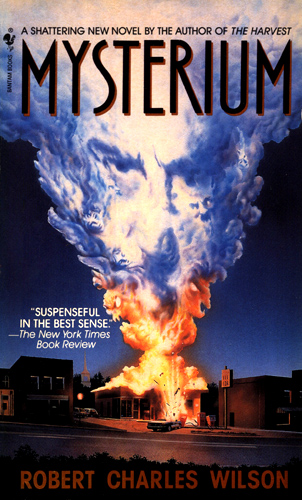
Mysterium by Robert Charles Wilson

Nobody knows why the government chose the small town of Two Rivers, Michigan, as the site for a top secret military project.  Even most of the people involved in the project don’t know what it’s really about.  That’s alright, because most of the denizens of this backwoods community are used to minding their own business.  But after a mysterious explosion bathes the entire city in light, that becomes impossible.

On the outskirts of town, all the roads and power lines dead end in ancient virgin forest.  It’s as if a perfect circle has been drawn around the town on the map, and everything within the circle has been transported to a parallel world.

A very unfriendly parallel world.

Robert Charles Wilson’s writing is awesome.  I could eat up his prose all day.  It not only flows beautifully, it’s clear and transparent, to the point where I forget that I’m reading and feel as if I’m there.  He always uses the right expression, the right metaphor, and yet his prose never attracts so much attention to itself that it distracts from the story.

I noticed several similarities between Mysterium and Wilson’s other novels that I’ve read.  All of them start in our modern world and move into a mysterious, unfamiliar milieu.  All of them involve strange religions and religious conflicts.  All of them involve male and female characters struggling to face personal relationship problems and eventually coming together.  In these ways, this story felt very much like Spin.

At the same time, I can definitely tell that this is one of Wilson’s earlier works.  The story flows like a thriller, but lags in certain points.  After the town is transported into the parallel dimension, the story seems to meander without any clear direction.  For several chapters, I lost the sense of progress that usually accompanies a good plot.  The resolution receives very little foreshadowing–the “surprising yet inevitable” element was only “inevitable” three or four chapters from the end.  If it weren’t for Wilson’s beautiful writing, I would have put this book down in the middle.

<spoiler alert>

Unlike Spin, I found the milieu of this story somewhat depressing–not necessarily because of the setting itself (though it’s not the kind of alternate present that I’d want to live in), but because the people of Two Rivers never go back.

According to Card, there are two basic types of milieu stories: stories where the protagonist returns profoundly changed, or stories where the protagonist “goes native” and becomes assimilated.  But…if the new world isn’t the kind of place you’d want to live in–in other words, if it’s dystopian (and Wilson’s alternate world in Mysterium is fairly dystopian)–then there’s this tension of “will the protagonist make it back?  Will they return?” And if they don’t return, the story is emotionally disappointing.  That was the case for me with Mysterium.

</spoiler alert>

From this review, it probably sounds like I hated this book.  That wasn’t the case–not at all!  This was a good story, and I enjoyed it.  I finished the last hundred pages at a sprint at 1:30 in the morning–it was definitely that kind of a book.  I couldn’t put it down.  And at the same time, it was thoughtful and profound (as you can tell from my previous post, “Why I love Robert Charles Wilson“).

I’ve probably said enough.  If you like thrilling, parallel world adventure stories with a contemplative, thoughtful “what if?” element, read this book.  Even with all the misgivings I’ve mentioned here, it’s good SF.  Very good.
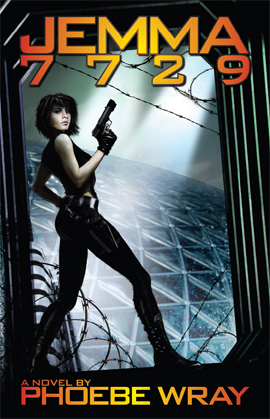
Jemma 7729 by Phoebe Wray

The following is a book review I wrote for The Leading Edge. It will be coming out in the November issue, along with my short story Decision LZ150207.  The editors gave me permission to post the review here.  Be sure to pick up a copy of the magazine when it comes out!

Jemma is a rebel, fighting against a system that teaches women to be obedient and submissive and “alters” those who refuse to assimilate.  After escaping the giant dome cities of a post-apocalyptic California, Jemma joins with a band of rebels known as the Movers in the free, uncultivated country.  But as her reputation grows and the people in the domes begin to take up arms, the government stops at nothing to hunt Jemma down and silence her for good.

With images reminiscent of Brave New World, 1984, and A Handmaid’s Tale, Jemma7729 is a dystopian, post-apocalyptic novel with a YA feel.  The first half of the book details Jemma’s childhood and her transformation from daughter of two mid-level government workers to a rebel fighting to overthrow the system.  I enjoyed the first part of this novel, with its intimate human drama and its resourceful, sympathetic viewpoint character.  The story was paced well and kept my interest.

The second half of the book, however, was somewhat disappointing.  Once Jemma escapes the domes and begins her campaign as a rebel terrorist, the story loses a lot of tension.  Even though she is barely a twelve year old girl, she still, without any outside assistance, manages to blow up almost a dozen government facilities without getting caught or killed.  The villains’ reasons for creating such an oppressive, anti-feminist regime are never adequately explained, and when Jemma starts to fight back, the government is too weak to put up a believable resistance.  The middle of the novel lags considerably, with very little real action or suspense.

When the pace finally does pick up again, about forty pages from the end, the action is so confusing and happens so quickly that I felt completely lost.  The main character’s voice gets lost in a blow-by-blow account of impossibly rapid events, as if the author was trying to compress two hundred pages of story into less than a quarter of that space.  I fount it disappointing and inconsistent with the tone of the rest of the book.  However, the twist at the end caught me by surprise and gave me some degree of satisfaction as I finished the book, though I would have been more satisfied if the last half of the book had been as good as the first half.

Review of JEMMA7729
Joe Vasicek
Jemma is a rebel, fighting against a system that teaches women to be obedient and submissive and “alters” those who refuse to assimilate.  After escaping the giant dome cities of a post-apocalyptic California, Jemma joins with a band of rebels known as the Movers in the free, uncultivated country.  But as her reputation grows and the people in the domes begin to take up arms, the government stops at nothing to hunt Jemma down and silence her for good.
With images reminiscent of Brave New World, 1984, and A Handmaid’s Tale, Jemma7729 is a dystopian, post-apocalyptic novel with a YA feel.  The first half of the book details Jemma’s childhood and her transformation from daughter of two mid-level government workers to a rebel fighting to overthrow the system.  I enjoyed the first part of this novel, with its intimate human drama and its resourceful, sympathetic viewpoint character.  The story was paced well and kept my interest.
The second half of the book, however, was somewhat disappointing.  Once Jemma escapes the domes and begins her campaign as a rebel terrorist, the story loses a lot of tension.  Even though she is barely a twelve year old girl, she still, without any outside assistance, manages to blow up almost a dozen government facilities without getting caught or killed.  The villains’ reasons for creating such an oppressive, anti-feminist regime are never adequately explained, and when Jemma starts to fight back, the government is too weak to put up a believable resistance.  The middle of the novel lags considerably, with very little real action or suspense.
When the pace finally does pick up again, about forty pages from the end, the action is so confusing and happens so quickly that I felt completely lost.  The main character’s voice gets lost in a blow-by-blow account of impossibly rapid events, as if the author was trying to compress two hundred pages of story into less than a quarter of that space.  I fount it disappointing and inconsistent with the tone of the rest of the book.  However, the twist at the end caught me by surprise and gave me some degree of satisfaction as I finished the book, though I would have been more satisfied if the last half of the book had been as good as the first half.

Some thoughts

This is going to be real quick, since it’s 1:30 am and General Conference is tomorrow.   The revision is going along really well for Genesis Earth–I am really excited about this project.  My only regret is that I don’t have more time to dedicate to it.  As it is, I’m probably putting too much time into it already.  But it’s worth it–it makes me happy, and I feel I’m telling a story worth hearing.

Yesterday was also the awards banquet for the English department.  It was a very positive experience.  I saw a few familiar faces–Chris from my English 318 reading group last year, and slipperyjim from Quark.

The main address and proceedings in general were very interesting.  There was a lot of talk about the value of literature, its importance in our society, but more than that, the importance to write good literature.  By that, I don’t mean the kind of stuff that has the stamp of approval of some elite clique of stuck up literary types somewhere–by that, I mean literature that has purpose and meaning, that shows us something worth living for, not merely pointing out the absurdities of our modern world.  There are plenty of absurdities and paradoxes and stupid little meaningless things, but where does it really get us to be pointing those out all the time?

I came away from the conference with something really valuable: a heightened awareness of all the things that made me want to write Bringing Estella Home, the novel I’ve been working on this semester. 

Bringing Estella Home is very tragic, a little dystopian, and has a lot of unrealized hopes–a lot of shattered lives.  It’s essentially a tragedy, and I’ve found that I don’t particularly enjoy writing tragedies.  When you’ve worked on one for a few months, it tends to grate on you–all of these suffering characters, and you with the knowledge that it’s only going to get worse.  Not very feel-good.

But that’s not the thing that made me want to write this book.  There were two things that I wanted to get across, two major ideas: sacrifice and loyalty.  If that makes any sense.  I guess it won’t, unless you read the finished book, but I wanted to show how people struggling to do the right thing in a world turned upside down could find meaning and depth in their suffering, in their trials.  Suffering comes and goes, but it shapes you in ways that last forever, and I wanted to show good people becoming better through their suffering.  I guess that’s the best way to put it.

I think I’d lost sight of that recently.  This novel needs a lot of major changes to it, especially in the middle section, which I was just wrapping up when I put it on hold.  But with a clearer idea of the overarching goal of the story–what deeper meaningfulness I’m trying to get across–I think I’ll be able to pick it up again and give it a strong finish.  That’s good.

I don’t know if I’ll ever write another tragedy again.  This one has been quite a ride.  However, I shouldn’t just throw it out and run away from it–I really need to listen to this story and tell it like it needs to be told.  I guess that’s the ultimate motivation, or should be.  I don’t just sit down and write because it’s what I do, I do it because it is something meaningful, something that can help others see the world in a new, better way, and obtain those truths that will really bless their lives.