Steve Deace made an interesting point on his show today. They were talking about the tendency for some people to vote purely along cultural lines, even when they disagree with almost everything that “their” candidate stands for—or in other words, people who vote Democrat “because we are Democrats” or Republican “because we are Republicans.” In that context, he posed the question: in the Fetterman-Oz race, where Fetterman clearly is not mentally fit for the job, would he and his co-hosts have voted for the Fetterman candidate if the R and the D were reversed?
They all admitted that yes, they would have plugged their nose and pulled the lever for the incompetent candidate over the one from the party that is, in their words, advancing a demonic agenda. In other words, when you’re in the midst of a “cold civil war” (I don’t really like that term, but it is gaining traction for a reason), the most important thing is to close ranks and defeat the other side, no matter how bad your own guys may be.
With the way our politics are trending, I think there are a lot of people on Team Red and Team Blue who see it that way. I also think there are a lot of people on Team Don’t-Talk-To-Me-About-Politics who despise that, and are deliberately voting against the partisan firebrands because they are such firebrands. And that’s laying aside the question of voter fraud, which is really starting to piss me off. Seriously, if Arizona were a developing country, our State Department and half the NGOs in Washington would be crying foul right now and declaring that Arizona is no longer a democratic nation capable of holding free and fair elections. But I digress.
The discussion made me think about something my wife said about the abortion debate, how the deeper problem is that we only ever frame it in terms of what is legal, not in terms of what is good. By focusing on the law and on what is or should be permissible we overlook things like the rape victim who decides not to get an abortion, but put the child up for adoption instead, or the struggling young mother who doesn’t want to get an abortion, but doesn’t feel like she has any other option.
This tendency that have to make everything about politics, or everything about the law, is very convenient for those agendas that are seeking to subvert our individual liberty and sovereignty, and turn us from citizens into mere subjects and wards of the state. Under these circumstances, the more we look for a political solution, or turn to a political savior, the more we play into the factions with the anti-freedom agenda.
In other words, we don’t just have a political problem in this country: politics is the problem. If our families were strong, our culture were wholesome and uplifting, our churches (or mosques, or temples) were full, and our money were based on honest value, our politics would not be so toxic and divisive, because we wouldn’t feel like we needed our politicians to save us.
Of course, if this is true, it means that the partisan divide is merely symptomatic of a much deeper political problem. Even if one side got their savior, be it Trump, or Desantis, or Bernie Sanders—or dare I say, Barack Obama—the underlying issue would remain. And what is that issue? I suspect it has to do with our transformation from a nation of citizens into a nation of subjects, or of debt-serfs subjugated to a fundamentally dishonest fiat money system.
At the end of the day, we get the politicians that we deserve and are willing to put up with. Even the most totalitarian dictator only rules because of the will of the people. When enough people are willing to risk everything to stand up to him, that is the day that he falls. Likewise, it’s not our “sacred democracy” that makes us free. God made us free. The state cannot grant us the freedom that God has already given us; it can only take our freedom away.
As I write this, it’s the morning after the US 2022 midterm elections. The results aren’t totally in yet, but it appears that the Republicans are going to have a slight majority in the House, while the Senate is poised on the edge of a knife and could go either way.
Republicans had convinced themselves that a massive “red wave” was coming, and the fact that it didn’t materialize has left many of them believing that the judgments of God hang over this country. Meanwhile, the Democrats had worked themselves into a frenzy over the abortion issue, and the fact that the Republicans gained ground is probably making many of them fear that a Handmaid’s Tale future is not far off for us.
Those who believe that the 2020 elections were rigged by the Democrats have ample reason to believe that the 2022 were rigged as well, with some very suspicious anomalies happening in key Democrat strongholds. Meanwhile, those who fear that “election deniers” are a threat to “our democracy” have ample ammunition to support their views too, as the final results weren’t that far off from the polls.
The divided government is likely to give us two long years of gridlock, which wouldn’t be a bad thing under normal circumstances, but with inflation being what it is, the (manufactured) energy crisis crushing us, and the war in Ukraine getting messier by the day, we’re likely to see all of those things get worse, not better. The stock market might see a slight reprive, but the real economy is going to be a slaughterhouse for the next two years—and each side will try to pin the blame on the other.
Meanwhile, I doubt there’s going to be any real accountability for the criminals who gave us the pandemic lockdowns and the jab mandates, at least in the next two years. And the Biden administration is likely to get even more aggressive with their weaponization of the DOJ and other government agencies, since they won’t be able to get their agenda through congress.
In short, this election provided zero clarity, no firm direction, and is bound to reinforce everyone’s pre-existing biases, making the partisan divide even wider and the crazies on both sides even crazier. If we were on the path to a civil war before these elections, we are even more locked into that path right now.
Here’s a fun and cheery blog post for you. Just for fun, let’s run down all of the ways in which the world might come to an end in the next 12 months, and assign probabilities to each one. I’m not sure what qualifies as “the end of the world,” but for our purposes let’s say it involves (1) a massive loss of human life, and (2) a permanent and irreversible change to global living standards and our way of life. Ready? Let’s go!
Global Nuclear War: 1%
This is the one that everyone is talking about right now, what with the Russia-Ukraine war and the recklessness of Western powers in their support for it. Putin has formally annexed four occupied territories that are still under partial Ukrainian control, and now says that he will defend sovereign Russian territory with his country’s nuclear arsenal. With every possible offramp to the war now closed, it seems like it’s only a matter of time before someone uses a tactical nuke on the battlefield, and after that kind of an escalation, who knows what will happen next?
However, I actually think the probability of a nuclear armageddon in the next 12 months is actually quite low—not totally nonexistent, but still quite low. Putin is not the kind of politician to make tactical blunders, and that’s exactly what a nuclear strike would entail, especially given the current situation on the ground.
In a war of attrition between Russia and Ukraine, Russia wins. That’s true even with all of the weapons and material that we’re supplying to Ukraine. Furthermore, I suspect that Russia has a much stronger will to win this war than we do. With the energy crisis in Europe and all of the political discontent here in the US, I don’t see us continuing to write the Ukrainians a blank check for much longer. Also, Russia just destroyed a good chunk of Ukraine’s energy infrastructure in response to the Crimean bridge attack, which means that the average Ukrainian citizen is going to be in a world of hurt come winter.
It’s been very interesting to watch the progression of this war. In the runup to the war, the West mostly prepared Ukraine with cheap anti-air missiles, assuming that Russia would launch a shock-and-awe campaign, not a ground invasion. But Putin defied those expectations with the Special Military Operation, which consisted of a lightning strike on Kiev with his armored forces. However, once the Ukrainian resistance got going, it proved massively effective, thanks to the way the Javelin missile and other anti-tank weapons have altered the balance of war to favor defense over offense.
So Putin pulled back from Kiev, hunkered down in the occupied territories, and opted for a WWI-style artillery slugfest—in other words, a war of attrition. It’s unclear to me whether this has favored Russia or Ukraine. Most of the news that we hear comes from pro-Ukrainian sources, and claims that Russia is losing badly. But even though they’ve been able to retake some territory, they haven’t retaken any major occupied cities yet, and the figures on Ukrainian casualties are wildly different, depending on which source you check. I don’t think we’re getting the full story.
Now Putin has annexed the occupied territories, changing this from a Special Military Operation to something else entirely. At every step of the way, he’s been very gradual and methodical in his escalation, making sure that he has the legal justification first (even if it’s no more than a fig leaf) before taking the next step. Whether you support him or think he’s the anti-Christ, there is definitely a method to his madness.
In response to the destruction of the Nord Stream pipelines and the attack on the Crimean bridge, he’s been using cheap Iranian drones to destroy Ukraine’s critical energy infrastructure—and once again, we see how the nature of war has changed. Those drones are relatively cheap, but the anti-air defenses are hideously expensive, and they haven’t been able to stop every drone. Just like the Javelin missile favored the defenders, these drones appear to favor the invaders.
Putin’s best move at this point is to wait out his enemies, since they’re already showing signs of cracking. Europe is in a major energy crisis now, and the Prime Minister of the UK just resigned after less than two months. Biden isn’t doing much better, with the midterms shaping up to be a major red wave, and inflation is running dangerously hot across the entire West. For all of Biden’s talk about a “dark winter” last year, it appears that this year we’re actually going to get it—and a lot of that can be traced directly back to the Russia-Ukraine war.
So no, I don’t think there’s a very high chance that this war is going to escalate to a global nuclear conflict in the next twelve months.
Major Cyberattack on Critical Infrastructure: 3%
But a major global cyberwar is a much different story. Putin is on record saying that the next global war will be fought with 1s and 0s, and it would be foolish not to believe he hasn’t prepared for that. Same with us here in the West.
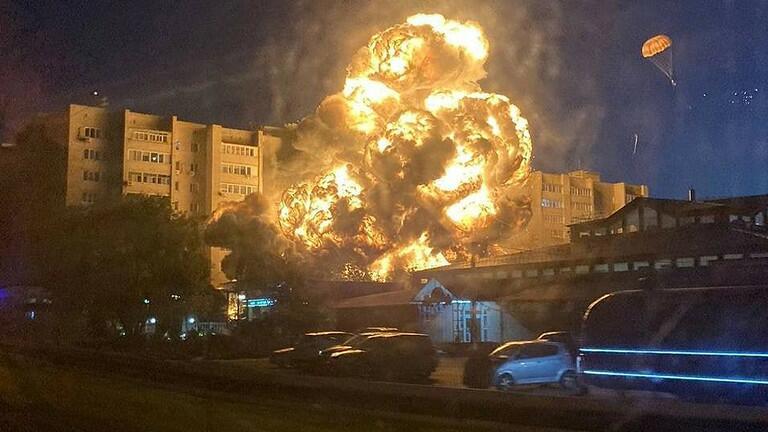
In fact, we may already be witnessing the beginnings of such a cyberwar. A week ago, a Russian jet slammed into a large residential building shortly after takeoff, and just this morning an F35 crashed out here in Utah. Could just be coincidence, as well as human error and/or mechanical failure—but it could also be true that these systems got hacked by hostile nation-state actors. If it is, I suppose we’ll never know for sure.
It makes a lot of sense to me that this conflict would escalate to a global cyberwar before it escalates to a global kinetic conflict. And if/when it does, energy infrastructure will be a major target. If so, it could get really, really ugly. The sources I follow estimate that we could see a 90% death rate after just two months of no power.
But again, I think Putin’s best move is to wait out his enemies and not show all his cards yet. We will amost certainly see limited cyberattacks, but a major global free-for-all? In my estimation, that’s unlikely, at least in the next twelve months. And even if it did happen, our power grid is so convoluted and Byzantine that I doubt that any nation state could knock it out 100% for a long period of time. It’s not a great defense against this sort of thing, but it does tend to work in our favor.
Global Famine: 5%
This is a big one. We’re already seeing a lot of warning signs pointing to major food shortages, with major droughts in North America, Europe, and Asia, energy and fertilizer costs at unthinkable levels, green public policies in places like The Netherlands that are just insane, and supply chains that are still incredibly bungled from the last pandemic. Global food prices are already going parabolic, and countries like Sri Lanka and Haiti are collapsing as a result.
I think this is a much greater immediate threat than some sort of global war. Every civilization is only three meals away from collapse. With that said, I’m not so sure it will be world-ending, at least in the immediate term. World-shattering? Yes. But the collapse is always distributed unevenly, and there’s still a lot of ruin left in the developed portions of the world, so I’m still pretty sanguine that we’ll find some way to muddle through this crisis, at least for the next twelve months.
Revolutionary Uprisings: 5%
As I mentioned above, the emerging global famine is already leading to popular uprisings in places like Sri Lanka and Haiti. I definitely think that trend is going to continue. But a lot of the unrest in the developed world is due to political instability that was already evident before the pandemic. Just look at the Yellow Vest movement in France, or the BLM and MAGA movements in the United States. Since the pandemic, those movements have only become more brazen, more entrenched, and more resolved.
Could we see an actual revolution in a major developed country, like the Bolshevik revolution in 20th century Russia, or the French revolution in 18th century France? I don’t think that’s beyond the realm of possibility. However, will we see such a revolution in the next 12 months? That’s a different story. Personally, I think the likelihood of such a thing is low, but that may just be my ignorance and normalacy bias speaking.
Here in the US, I think that the ruling Democratic party is going to get a truly historic spanking in November, which will go a long way to appeasing the popular discontent—at least in the short term. But I don’t think the Republicans are going to do any of the things that the people expect them to do, and long-term that will make the unrest that much worse. I doubt that it’s going to boil over in the next twelve months, but it could.
Hyperinflationary Collapse: 10%
There are a lot of reasons to think that we’re on the verge of experiencing a hyperinflationary event here in the US. The Fed exploded the money supply during the pandemic, which is we we’re currently experiencing such high inflation, and when you consider that velocity is at or near record lows, there is a lot of room for inflation to get much worse. Moreover, our glorious leaders seem determined to spend their way out of this problem, in much the same way that an alcoholic drinks himself out of a hangover.
But by far, the biggest and most dangerous factor is the collapse of the US dollar as the world’s reserve currency. If/when that happens, I frankly would be shocked if we didn’t experience a hyperinflationary collapse. Right now, the dollar is still the fastest fat man in the zombie apocalypse, but the Russia-Ukraine war is bringing a lot of countries together that would love to negotiate their trade deals in something other than US dollars. Not just minor countries either, but countries like China and Russia. Youch.
This isn’t something that came on us suddenly. In the past couple of decades, there have been a lot of red flags pointing to the end of the US dollar as the world’s reserve currency. The pandemic and subsequent events have accelerated those trends, and probably shortened the timeline of the collapse considerably.
But will we see a hyperinflationary collapse in the next twelve months? I’m skeptical of that. Right now, the dollar is strengthening against most other currencies, and I don’t see any other currency challenging ours for reserve currency status in the immediate future. Like I said above, we’re still the fastest fat man in the zombie apocalypse.
Global Unrest and Uncontrolled Mass Migration: 15%
If the coming global famine is going to be Earth-shattering, the secondary effects of that famine are going to be even worse. Like I mentioned above, Haiti and Sri Lanka are already in a state of collapse due to civil unrest, and global food prices have already exceeded the levels that gave us the Arab Spring. We’re probably not all going to starve, but enough of us very well might that the ensuring chaos will make the European refugee crisis of the 2010s and the current situation on the US southern border look like a dress rehearsal.
Again, the main reason I place this one at 15% is because I think it’s going to take some time for this one to really get going, and I’m skeptical that a twelve-month timeline is long enough for it to bring about the end of the world. But once this crisis does get going, it’s going to be ugly.
A Second (and Much Deadlier) Pandemic: 35%
Until last week, I placed the likelihood of this event happening at about the same level as a global nuclear war. But then I learned about the research at Boston University that was totally not gain of function, and managed to create a new strain of covid that was more transmissable than the Omicron variant and has a 80% fatality rate in experimental mice.
What the hell, you lab coat freaks? Do you WANT to kill us all? (No… please don’t answer that question.)
From what I understand, it wasn’t difficult to creat this new strain either. All they did was take the original alpha variant of covid-19 and splice it with the spike protein from the omicron variant. The alpha variant is now all but extinct in the wild, but if BU had managed to keep a sample, I’m sure that many others have too.
And exactly what is keeping some black hat actor from replicating this research and launching a second pandemic?
Even if the death rate in humans is only a fraction of what it was in the mice, that’s still a virus with an R0 at or near the omicron variant AND A MORTALITY RATE COMPARABLE TO THE BLACK DEATH. And now anyone with a halfway decent microbiology lab and a couple of covid samples can now create this insanely dangerous plague.
Given that this is a thing now, I would be extremely surprised if there isn’t another covid (or other artificially engineered) pandemic within my lifetime. Except that the next pandemic is going to be real, in a way that 2020 wasn’t. Seriously, when historians look back on this era, they probably won’t even look at 2020 as an historically significant year.
The only reason I’m putting this at 35% is because of timing. Will the black hat actor who concocts this plague decide to release it in the next year, or wait until conditions are more favorable for whatever agenda they want to push? Difficult to say. The likelihood is far greater than I would like, but I hope it’s no greater than 35%.
Global Debt Crisis and Financial Collapse: 80%
But of all the possible calamaties that could bring about the end of the world, the one that I most expect to see within the next 12 months is the collapse of the global debt market and a major financial crisis, even bigger than 2008. Much bigger, in fact, because we never actually solved any of the problems that gave us the GFC: we just papered over them and kicked the can down the road.
Well, it looks like we’ve just reached the end of the road. I can’t pretend to understand the financial markets in any sort of depth, but all of my sources—including folks who correctly called several false alarms in the past few years—are now saying that the big one is imminent. And when you look at what the US10Y is doing, or at how insanely inverted the yield curve is inverted, and realize that the debt bubble is orders of magnitude worse than 2008… yeah, that’s a big deal.
But would it truly bring about the end of the world as we know it? Well, consider this: what would you do if all of the banks closed, all of their websites went down, and you couldn’t use your debit or credit cards, or transfer cash into or out of your account, or even log into your account, or any financial account for that matter? What would happen if everyone on welfare suddenly found that their EBT cards didn’t work? If every employer suddenly found that they couldn’t make payroll? If the only thing left was cash, but none of the banks were open to disburse it?
That’s the sort of thing that would happen under this scenario. It might sound far-fetched, until you realize that it’s happened before. This exact thing played out in Cyprus a few years ago, and when the banks opened again, people were only allowed to withdraw something like a hundred Euros a day. It paralyzed everything.
Whenever there’s a major financial collapse, all of the big players get together in a smoke-filled room, lock the doors so no one can get out, and fight amongst themselves until they come up with a solution. “You bail out these institutions, I’ll bail out these ones, we’ll all take a 20% haircut, and the markets reopen at the end of the week.” Something like that. The last time this happened was 2008, and we were only hours away from a global banking holiday like the one I just described.
What happens if they can’t find a solution in time?
And even if they do, it’s not like there isn’t going to be any pain. Remember how bad the 2008 collapse was? That’s what happens when they find a solution—except this time, the underlying crisis has grown orders of magnitude larger, because we never actually solved it. We just papered over the problem instead.
I’m not an expert on this sort of thing, so the reason I’m pegging this one at 80% is because I’m a firm believer in the Pareto principle, and I don’t see any way that the status quo endures for another 12 months without a major catastrophe. Maybe the next financial collapse won’t be the end of the world, but given how unstable everything is right now, I don’t see it.
Climate Change: 0%
There is, however, one potential catastrophe that I can confidently peg at a 0% chance of ending the world in the next twelve months: climate change. It’s not a coincidence that this is also the one that’s probably eliciting the most panic right now. When the herd is all running mindlessly in one direction, it’s probably a good idea to stop and make sure there isn’t an abattoir up ahead.
Is the climate changing? Yes, as it always has. Is climate change man-made? Unclear. Is it changing catastrophically? Also unclear. Will we experience a catastrophic collapse of the global climate in the next twelve months? Let’s put it this way: climate activists have been warning us about an imminent catastrophe for 50+ years now, and the only people with a worse prediction track record are the ones who say “Jesus is coming on [insert date here].”
I would be a lot more inclined to listen to the activists if they didn’t all categorically reject the market-based solutions that have the best historical track record to reducing emissions and cleaning the environment. I would also be more inclined to listen to them if they weren’t so dead set against nuclear power, or if they were honest about the fact that drastic cuts to global energy production will lead directly to the deaths of many millions of people, especially in poor and developing countries.
When you combine that with how the all of the people who are most outspoken about climate change also fly to their conferences on private jets, have massive carbon footprints, and are buying beachfront property across the world, their hypocrisy speaks louder than their words. And as if that’s not enough, you have Project Veritas catching a major CNN executive on hidden camera confessing to how they plan to push climate change as the Next Big Thing after the pandemic is done.
So no, I don’t ascribe any credibility to the climate change hysteria that seems to have gripped the science fiction field. Twelve months from now, I guarantee that we will still have a human-habitable climate on this planet—unless the meteor finally kills us all.
Of course, I’m just a guy on the internet who follows this stuff for fun and uses it to write science fiction. I also have a political science degree, but don’t hold that against me, as I’ve been doing my best to unlearn all of that crap. But yeah: if the world does end in the next twelve months, I think the most likely scenario is a total collapse of the entire global financial system, followed by a second pandemic. It’s not as bright or as flashy as a nuclear war, but that’s where I’d put my money if I were a betting man.
Remember when the wrongfun brigade screamed and shouted and gnashed their teeth that the Sad Puppies were cheating the Hugo Awards through “slate voting,” or whatever the hell they called it? That we were somehow gaming the system to put our racist, sexist, misogynistic, fascist authors (many of whom were non-white, female, and/or flaming libertarians) on the ballot? Well… if you’ve been paying attention to the Dragon Awards, you know by now that those accusations were always flat-out lies, because the wrongfun brigade has been doing exactly the same thing they accused us of doing: cramming the wokest garbage on the Dragon Awards ballot, year after year after year.
It’s a toss-up which book is the worst offender, but so far I think that The Future of Another Timeline by Annalee Newitz takes the “worst book ever nominated for a Dragon by the wrongfun brigade” award. Seriously, if I were to write a parody of a book written by a washed-up second-wave feminist desperately trying to stay culturally relevant by proving her woke bona fides, there would not be any substantial difference between that and the actual novel. The villians—I kid you not—are an evil time-traveling brotherhood of men’s rights activists who are trying to rewrite history so that women are enslaved as breeders for the Patriarchy. Thankfully, the righteous sisterhood (er, trans-sister, non-binary… damn, that’s awkward) of uber-feminists thwarts the evil MRAs and defeats them in an epic time travel war. Abortions for all!
Seriously, it is clear from the very first page of this woefully inadequate toilet paper substitute that Newitz has never even attempted to thoughtfully and meaningfully engage with a men’s right’s activist, let alone an actual feminist who engaged meaningfully with them. And that’s what I find so fascinating. There was a time when the left was actually pretty good about engaging their ideological opponents on their own terms, and steel-manning, rather than straw-manning, the opposition’s arguments. Today, the left is totally incapable of that. That’s why all of the books that the wrongfun brigade afflicts upon us read like parodies, and why all of the awards that the wrongfun brigade has taken over are best taken as a list of books to avoid.
But all of this got me to thinking: am I capable of steel-manning the left’s argument on a position with which I vehemently disagree? Can I make their argument for them in a way that would make even the most rabid, foaming-at-the-mouth feminist nod reluctantly and admit: “yes, that is exactly what I believe”?
Let’s find out, shall we?
Since the dawn of time, women have been bound and fettered to their wombs. The ability to give birth, which the right sees as a privilege and a blessing, is actually the source of all the inequality between the sexes, and the reason why women have never been as free or as liberated as men.
Throughout history, men could have sex as often as they wished without any fear of becoming pregnant from the encounter. They might fear getting their female partner pregnant, but they always had the option to walk away. In contrast, women had to be constantly aware of the fact that any sexual encounter—whether wanted or not—could lead to nine months of exquisite physical torture, followed by a bloody birthing experience that often resulted in her death. And even in those cases where the mother survived, she now had a child who would be physically dependent on her for years, and mentally or emotionally dependent on her for decades. All of this could result from even the most innocuous sexual exploration—or a single unwanted rape.
Without reliable birth control—and many traditional religious societies still discourage birth control, same as they have for centuries—even a comfortably married woman could expect to spend the majority of her life bearing and caring for children, whether or not she wanted to. And because this experience was universal to all women, society developed strict gender roles that discouraged women from pursuing an education or a career. How could a woman pursue such things, when so many small children depended on her? In this way, the womb defined a woman’s station in life, and she had very little control or say in the matter. After all, what sort of a wife could deny her husband sex? And what sort of a woman could make a living in a world of men without a husband?
The invention of the birth control pill did a lot to liberate women, but it didn’t do enough. At best, the pill granted women a reprive that allowed them to see what the world might be like if they were no longer bound to their wombs. After all, even the most reliable birth control fails from time to time, especially if you forget to take it (or find it too difficult to obtain).
This is where the issue of abortion comes in. Conservatives like to smear us as being “unscientific” or confused about when life begins, but in truth that is just a side issue—a distraction from the real issue, which is liberating women from their wombs. Because the power to create life isn’t empowering at all if it only goes one way. If you have the power to give, but not to take, that power can be used against you. Same if you have the power to create, but not to destroy.
This is why abortion needs to be both legal and readily available through all stages of pregnancy: because unless women can choose to abort the life within them, then they will never be truly liberated. Nature has given them the power to give life, but without the power to take it, women will always be second-class citizens, confined to the restrictive gender roles imposed on them by their wombs. This is why birth control alone is insufficient: it only blocks the ability to create life, and that imperfectly. But power has to flow both ways.
Conservatives make a lot of noise about the value of life, but they are suspiciously silent on the issue of quality of life. Indeed, they seem to be unable or unwilling to consider that some lives simply are not worth living. Thus, they are willing to make exceptions to their pro-life stance for things like ectopic pregnancies—conditions where the choice is between letting both the mother and the baby die, or killing the baby to save the mother—but they fail to see how the same principle might apply in situations where the woman has to choose between aborting the child to obtain a successful career, or have the child and condemn them both to a life of abject poverty.
Not all life is equal. Some lives are more worth living than others, and some people’s lives are so terrible that they wish they’d never been born. How is it virtuous or noble to give anyone that kind of a life? It isn’t. Abortion is a hard thing, but sometimes it is necessary, and the alternative—the pro-life position—is downright cruel.
But that isn’t the main reason why abortion is so important. The main reason is that it liberates women from the fetters of the womb. It grants them the antithesis to the power that nature grants them, the power to create life, and thus allows them to pursue whatever sort of path they wish. Many women who have abortions go on to have children later in life, when the time is right for them. And because of those abortions, they are better able to care for those children, when they do come.
At this point, we should talk about how men control women’s bodies. Now, it’s obvious that there isn’t some super-secret Patriarchy society that meets on Tuesdays to discuss how they can advance their goal to turn all women into slaves for breeding purposes. That’s not what we mean when we say “controlling women’s bodies.” However, it is natural for people to fear the things that they don’t understand, and to try to exert control over the thing that they fear. Men clearly don’t understand women—that fact has been memed so often, it’s practically self-evident. So is it really all that hard to believe that men often try to exhert control over women, out of their fear and misunderstanding?
This control takes on many forms, but perhaps the most common form is that of gender roles. Men want women to take on a defined role because, among other things, that makes women understandable. But these roles are often more constrictive than the corresponding roles imposed upon men. A “mother” is often subject to a higher standard than a “father,” and is judged much more harshly when she fails to live up to that role. Also, the role of “mother” grants a lot less bodily autonomy than that of “father.” Is it really hard to see how this becomes a mechanism of control—specifically, over women’s bodies?
The issue at the heart of all of this is liberation. Freeing women from the harsh realities imposed upon them by their wombs is just the beginning. The ultimate liberation is the freedom to redefine reality itself—to decide whether or not one actually is a woman, and transcend the restrictions of sex and gender altogether. And why shouldn’t we exercise this power? Since the dawn of time, humans have been creatures of innovation, refusing to accept the constraints that nature has imposed upon us. When we looked up at the birds and saw that they could fly, we didn’t say “that’s nice, but nature didn’t give us that ability, so we should just stay in our place here on Earth.” Rather, we took inspiration from the birds and kept innovating and inventing until we, too, had the ability to fly. Why should sex or gender be any different?
This is why feminism and transgenderism aren’t actually at odds. It’s also why the new “what is a woman?” meme on the right, however cute, is totally irrelevant. Yes, it is true that ever since the dawn of time, a woman has been defined as an adult human female. That isn’t interesting. What is interesting is what women may become, after they’ve been liberated. Or men, for that matter. Because the liberation of women also ultimately liberates all of humanity: male, female, and everything in-between.
Liberation is the goal. Liberation is the key. Accept no boundaries, and refuse to live by the rules that are imposed upon you. Partake of the forbidden fruit, and you too may ascend to godhood. Refuse to accept the stories of Icarus and Prometheus as cautionary tales. Rage, rage against the dying of the light.
I’m calling it now: Trump season 6 has officially jumped the shark.
The show has been nothing if not a little over the top, but it’s been building steadily enough that even when it strains credulity, there ends up being a good reason for it. Until now, that is.
I’ll admit, when the global pandemic dropped at the beginning of season 4 right in the middle of the first impeachment, it made me wonder if the show had jumped the shark at that time. But the pandemic turned out to be a major turning point that redefined the whole show. It was also necessary to get him out of the White House in the beginning of season 5.
Now that was a bold move, to make him “lose” the election. But it was also quite brilliant, as it was necessary to show that even after he was nominally removed from power, Trump is still the center of gravity for the whole political system. Without him, the Democrats have absolutely nothing, as most of the country hates their policies as well as their hypocritical racism. Only by uniting the base against a common enemy do they have any hope of making it.
Also, it’s been really fascinating the way the writers have turned Biden into a mirror of Trump. Everything that Trump’s enemies have accused him of doing, Biden has actually done. Remember “Grab them by the pussy” from the first season? Yeah, Biden has actually done that. Also, stumbling on the stairs to Air Force One? I’d actually forgotten about that one, since it seemed like just a throwaway moment in season 2. The writers must have had tremendous foresight to set all that up way back then. It’s one of the reasons why this show ranks right up there with Breaking Bad and The Man in the High Castle.
Now, the show almost jumped the shark with the Ukraine-Russia war at the beginning of season 6. But that was actually foreshadowed back in seasons 3 and 4, with the first impeachment proceedings. Also, the very first episode of season 1 alluded to the simmering situation that Obama had left in Crimea and the Donbas after the Maidan protests. It was subtle, but it was there. Besides, with all of the talk about how Trump would start WWIII if he were elected, it was necessary for the writers to get Biden into a hot proxy war with Russia, which may yet prove to be the start of the next world war. Besides, they toned it down a bit by turning it into a WWI-style meatgrinder, rather than immediately jumping to a trans-Atlantic nuclear exchange.
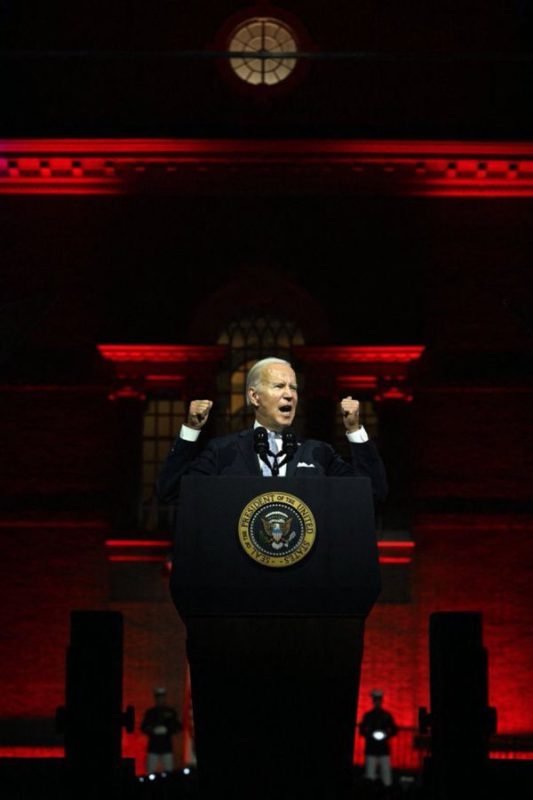
But Biden’s latest speech was just way too over the top. I mean, I know the show’s been setting things up for a civil war sometime in the next few seasons, but the optics of that speech were just way too on point. I could almost hear one of the soldiers off-screen asking “Hans, are we the baddies?” Dark Biden, my ass.
Still, I guess I’ll still keep watching the show, if for no other reason than to find out how the Ukraine war ends. At least that subplot is still interesting, though at the rate things are going, the Chinese invasion of Taiwan will be as ridiculous as the last season of Game of Thrones. So will the civil war, apparently. At this point, they’ve just been drawing it out for way too long.
What about you? Are you still enjoying the show, or do you agree with me that season 6 has really jumped the shark?
So a couple of days ago, I finished revising “The Freedom of Second Chances” and started looking for places to submit it. That was how I found this anthology call, for a pro-abortion anthology titled Aseptic and Faintly Sadistic: An Anthology of Hysteria Fiction. The guidelines were so unbelievable that I just have to fisk them on this blog. Here we go!
Hysteria
Interesting title for an anthology. I’m sure this will feature only the most thoughtful and enlightening stories that the speculative fiction field currently has to offer.
Irrational.
Okay.
Frenzied.
Uh, okay.
Unreasonable.
Oookay.
Unable to speak their own experiences.
One of those things is not like the others. One of those things just doesn’t belong.
Seriously, if you are free to be as irrational, frenzied, and unreasonable as you wish, then what exactly is preventing you from being able to “speak [your] own experience”? If you are still free to do this:
…then you are not being silenced by the pro-life crowd.
(As a side note, you would not believe how difficult it was to find that video. YouTube search would not bring it up, no matter how many combinations I tried. Even Brave search mostly brought up music videos and disgusting sex tapes. I had to go to The Comments Section by Brett Cooper, look up the video where she briefly reacted to it, freeze the frame, and scroll through a couple pages of search—not on YouTube, or on Google, or on Duck Duck Go (all of which are “curated” now), but on the Brave browser’s native search engine.
But tell me again how your side is the one that is “unable to speak their own experiences.” I’m sure that’s why this hilarious and eminently meme-able video about a story in the current news cycle has only received 10k views in the four days of its existence, and no mention on Know Your Meme at all. After all, it’s not like conservatives are the ones being censored and shadowbanned.)
In the case of abortion specifically, we have been told for decades in the United States that Roe v. Wade was safe
No, I’m pretty sure that was just something that you people told yourselves.
and that we were overreacting, illogical, needlessly aggressive—hysterical.
Actually, “safe, legal, and rare” was pretty much the majority viewpoint until Trump became president and all of the masks came off. So tell me, was “safe, legal, and rare” a lie from the very beginning?
Now look. We were none of those things.
Then why is the title of your page literally “Hysteria Submission Call”? Because it seems to me that all of those words—”overreacting,” “illogical,” “needlessly aggressive,” and “hysterical”—describe you people perfectly. As further evidence:
Aseptic and Faintly Sadistic:
It is so wonderfully fitting that the title of your anthology invokes the Marquis de Sade, the man who asked why everyone else’s pain should be more important than his pleasure. After all, why should 60 million dead babies—a death count that would make Hitler blush—be more important than your freedom to have promiscuous, irresponsible sex?
An Anthology of Hysteria Fiction,
I have literally never considered the combination of those two words until I saw them in your anthology call.
which is presented by CHM and will benefit the Chicago Abortion Fund, is seeking dark speculative fiction from anyone directly at risk as a result of the Supreme Court’s ruling on Roe v. Wade, defined inclusively.
But exclusively of, you know, actual women. After all, I noticed that you never mentioned the word “woman” in that sentence. Pretty weird, considering that Roe v. Wade was supposed to be about “a woman’s right to choose.” Or was that always a lie, too?
Guidelines
Genre: Dark speculative, widely defined. Don’t self-reject!
Oh no, honey. It’s not me that I’m rejecting when I say that you people will never see any of my work. Though I was tempted to troll you by submitting “The Freedom of Second Chances,” since it’s the most pro-life story I’ve written so far in my career. But I decided to fisk your anthology call instead.
Theme:
Hysteria.
Interpret the theme broadly. You don’t have to beat me over the head with the connection.
But how can it be “hysteria” if we aren’t beating you over the head? After all, that’s what the Trump years were all about: beating the narrative over all our heads until morale improved.
I am willing to look at everything from retellings of “The Yellow Wallpaper” to sci-fi space opera rockstars. Feel free to take on one of the many faces of the monstrous patriarchy directly.
Isn’t it curious how “the Patriarchy” totally isn’t a crazy conspiracy theory, but the Wuhan lab leak theory, or the efficacy of ivermectin in treating covid, or the reports of alarming menstrual irregularities and increased rates of myocarditis in people who took the covid vaccine all were. But since the pandemic, the difference between conspiracy theory and conspiracy fact has been between 4-6 months—except for the truly crazy conspiracy theories, like the idea that the moon landing was a hoax. Or the Patriarchy.
Because if you can’t now, when the heck can you?
Well, your anthology call is certainly taking this “hysteria” theme seriously. So points for consistency, I guess.
Open To: Anyone directly at risk as a result of the Supreme Court’s ruling on Roe v. Wade, defined inclusively
But once again, defined exclusively of actual, you know, women. And by “women,” I mean adult female humans, because those are, you know, the only people who can actually get pregnant (emojis notwithstanding) and therefore, you know, the only people who can actually get abortions.
Seriously, though, it is amazing what sort of knots these people will tie themselves into in order to avoid having to answer the question “what is a woman?”
(Also, this is a knitpick, but it’s worth pointing out that there’s a typo in that sentence, since it ends without a period. Pertinent because the anthology call was supposed to be written by a professional editor.)
Word Count: Maximum 5,000 words, no minimum.
Reprints: No.
Multiple Submissions: No.
Simultaneous Submissions: Yes! But please alert us immediately if the piece is accepted elsewhere and needs to be withdrawn.
In all fairness, I have to give these people credit for allowing simultaneous submissions. In this era of digital publishing, it is insane for publishers to expect writers to give them exclusivity when deciding whether or not to purchase publishing rights. It’s also inconsiderate, but that was true before digital publishing.
Simultaneous submissions are one of my industry hobby horses. Maybe I’ll write a blog post about that, though it may get me blacklisted from a few of these magazines. Then again, I’ve probably already been blacklisted for writing stories that are pro-life. Remind me how Dobbs v. Jackson makes you “unable to speak [your] own experiences” again? Oh, right.
Pay:
6 cents/word (USD)
As this is a charity anthology, authors who would like to contribute more and who are safe to do so may waive pay. This is completely optional, and we will never ask you to do this; you can only request it upon acceptance.
Except you kind of just did ask, in a passive-aggressive sort of way.
Date Open: July 18
Date Closed: August 1
Format:
Shunn-ish. I don’t need your home address or phone number, we haven’t even met.
No need to stress about the cover letter, but if you are a member of a marginalized community underrepresented in discussions of reproductive justice, feel free to note that if you are comfortable.
Notice again that they never actually mention the word “woman.” Which is incredible, because in the very act of discussing “marginalized” and “underrepresented” groups, they are literally erasing and marginalizing half of the people on this planet. Never forget: accusation = projection = confession 100% of the time with these people.
Submissions: AsepticAndFaintlySadistic@gmail.com
Please use this format for the subject line of your submission email.
Last Name; Story Title; Word Count
Other Stuff
The Editor Likes:
Forward-thinking,
Translation: pro-trans propaganda that refuses to acknowledge the existence of women.
expertly crafted
Translation: the sort of thing an English major would write.
speculative fiction. Work that uses innovative forms,
Translation: the sort of thing that wouldn’t appeal to people who like fun, entertaining stories. Because that would be wrongfun.
original voices,
Translation: “We’re looking specifically for a previously unpublished writer who checks all the right intersectional boxes, so that when xe becomes an award-winning darling of the field, we can say that we were the first ones to publish xer.”
broken timelines,
I actually had to look this one up. Apparently, they want to publish the next “Unknown Number,” because if an artist can duct tape a banana to a wall in a gallery and call it fine art, then a writer who checks all the right intersectional boxes should be able to win the Hugo with a Twitter thread. Or something.
metafiction,
Translation: post-modern garbage.
etc, but is still legible.
But will you accept my submission if it’s written in crayon?
Think Carmen Maria Machado, Nadia Bulkin, Mona Awad, Rivers Solomon, Angela Carter, Emily M. Danforth, Caitlin R. Kiernan.
The only one of those writers I’ve actually heard of is Rivers Solomon, and from what I can tell her faer main claim to fame is that she fae checks all the right intersectional boxes.
Absolutely Not:
TERF-y, gender-essentialist fiction.
Lest you think I exaggerate when I say that these people want to erase and marginalize women, we have it right here, straight from the horse’s mouth. No trans-exclusionary radical feminist stories, aka anything that defines “woman” as an adult human female, no matter how feminist it might otherwise be.
Trans activists talk big about how everyone who opposes them treats them like they “don’t exist,” but that is exactly what they are doing to women: erasing them. Once again, accusation is ALWAYS projection is ALWAYS confession with these people.
Gratuitous sexual assault, gratuitous violence, and unchallenged -isms and -phobias (body horror welcome).
I’m not surprised. Abortion is the ultimate body horror.
The Title Comes From: Margaret St. Clair’s fantastic short “Brenda” (Weird Tales 1954).
Thanks for the tip. I will certainly avoid that one.
Why the Chicago Abortion Fund: It looks like, for the foreseeable future, Illinois is going to be the only state with abortion protections in place serving a very large section of the country.
And by “protections,” of course they mean that there will be no protections in Illinois for the unborn.
Abortion funds are especially critical at this time, as they provide financial assistance to directly cover the costs of abortion.
Because those abortionists really need their lamborghinis!
The Chicago Abortion Fund provides grants from between $100 to $300 dollars to those seeking abortion services, and they attempt to provide this grant for 100% of the people who contact them. They also provide assistance in locating additional funding, as well as with travel and associated expenses.
From their website: The mission of the Chicago Abortion Fund is to advance reproductive autonomy and justice for everyone by providing financial, logistical, and emotional support to people seeking abortion services and by building collective power and fostering partnerships for political and cultural change. We envision a world where everyone has the freedom and autonomy to create lives, families, and communities that are healthy, safe, and thriving and where the full range of reproductive choices, including abortion, are accessible and affirmed.
If these people are truly “pro-choice,” why are they so obsessed with shutting down crisis pregnancy centers? Just look into the crazy eyes of Elizabeth Warren as she talks about it, and then ponder on the fact that dozens of crisis pregnancy centers have been firebombed and vandalized by the left-wing terrorist group Jane’s Revenge in just the past month. Why?
Because the “pro-choice” crowd only really believes in one choice: abortion. But having only one choice means that you have no choices at all, meaning that “pro-choice” is actually a lie. Just like “safe, legal, and rare.” Just like “a woman’s right to…”
Which brings me back around to the most incredible thing about this anthology call: the fact that the words “woman” and “women” do not appear anywhere, even though this is supposedly a pro-abortion anthology. In fact, the anthology call goes out of its way to discourage submissions that are “gender essentialist,” meaning that they affirm the scientific, biological nature of sex. In a pro-abortion anthology call!
It is impossible to satirize these people. They are so possessed by their radical ideology that they satirize themselves without realizing it. In a sane and healthy world, the anthology would be a failure, the publisher would go bankrupt, and the stories themselves would quickly fade into cultural irrelevancy—
—which may happen yet. The cultural tides are turning, and these people are so devoid of self-awareness that they are totally blind to it. That is precisely why the overturning of Roe v. Wade caught them so flat-footed. And instead of responding to this setback with introspection and reflection, they immediately jump to hysteria, not realizing that doing so wins no converts and turns away many who would otherwise be sympathetic.
They are losing.
They are losing HARD.
Moreover, they have no idea how hard they are losing.
In their arrogance, they will fall.
And after they do, future generations of readers will look back in wonder and bewilderment at anthologies like this one that were products of their insane (and interesting) times.
I don’t usually do these fisking articles, but in my efforts to find more traditional markets to send my short stories, I’ve come across some truly insane submission guidelines. Since none of these markets is likely to publish anything by a conservative straight white cisgender Latter-day Saint Christian male such as myself, I don’t see much harm in fisking a couple more of them. What do you guys think?
This was a fun one to write, even if it did go a little dark at first. The idea for it came from this article about a couple in San Francisco who received an outrageously huge warning fine ($1,500) for parking their car in their own driveway. In the comments to the article, I wrote:
This is why property taxes are evil. If the government can seize your house for non-payment of taxes, was it ever really yours to begin with?
But here’s the thing: every possible answer to that question is terrifying.
If you answer “no, I guess it wasn’t ever really my house,” you’re acknowledging that Mao was right and all power (and with it, ownership) flows from the barrel of a gun.
If you answer “yes, it’s still my own house,” then you have to answer the question: does the state have the right to issue property taxes?
Answer “yes, the state is within its rights,” then congratulations, you’ve just given the Maoist approach to property ownership a veneer of legitimacy and revealed yourself for a boot-licker and a coward.
Answer “no, the state is not within its rights,” then you’ve just acknowledged that you live under a tyrannical regime. It might be a relatively benign regime, but a petty tyrant is still a tyrant, as we saw during the covid lockdowns.
But you’ve still got one more question: do you pay the property taxes, or don’t you?
Answer no, and the state seizes your property and/or throws you in prison.
Answer yes, and you’ve just put yourself in the same position as the landlord who pays protection money to the mob. The only difference is that this mob wears uniforms and has a geographic monopoly on the use of deadly force.
This is why the Roman farmers welcomed the barbarians. Perhaps we should as well.
Later, as I thought on it, I wondered if perhaps I couldn’t write a short story that gets across everything I hate about the property tax. I came up with an idea where the thing that’s being taxed isn’t your property, but your time and your body—literally.
Once a quarter, you are required to voluntarily submit your body to the state, who uses a chip in your brain to turn you into a mindless zombie and exploit you for manual labor. If you have no record and a clean social credit score, it’s typically only for a couple of days. Otherwise, you’ll be a mindless zombie slave of the state for a couple of weeks, or maybe even a couple of months. If you’re a criminal, you may spend more of your life as a zombie slave than as a free man.
To make it even more outrageous and controversial, the story is about a young woman who wakes up from the body tax and finds that she’s pregnant. She was used as a sex worker, and the birth control failed. But the twist is that she’s pro-life, and wants to keep the child. Yay for controversy!
Like I said, it was a really fun story to write. And even though it goes to some pretty dark places, it actually has a happy ending, oddly enough. But the way I’ve currently written it, I think it’s a bit too sappy, so hopefully my writing group can help to smooth that out and make it end on the right note.
This will probably be my last short story for a while. I’ve decided to turn “Christopher Columbus, Wildcatter” into two stories: “Christopher Columbus, Wildcatter” (which I’ve already written) and “Christopher Columbus, Treasure Hunter.” That will probably turn into a wild and zany series of short stories. Also, based on the feedback from my writing group, I will probably turn “The Freedom of Second Chances” into two short stories (one of which will also be very pro-life, oddly enough).
But I may have to come back and write more short stories soon. “Blight of Empire” and “Christopher Columbus, Wildcatter” are both out on submission to the traditional markets, and both of them have received some surprisingly favorable responses from the editors. No contracts yet, but they are on hold for consideration. If they do get picked up, then I’ll have to write a couple more short stories (probably in the Christopher Columbus series) to fill out my publication schedule. Got to keep a solid buffer of short stories to publish.
In the meantime, I’ve resumed work on Children of the Starry Sea and hope to have it done by Thanksgiving. That should be enough time to finish the rough draft and cycle through all the necessary revisions, barring some unforeseen hangups like another major writing block or a difficult life event. But that’s the plan.
That’s all for now. I’ll leave off this post with an excerpt from “The Body Tax,” where Ellie (the protagonist) confronts the terrorist leader who has kidnapped her:
“If the state can throw you into prison—or worse, turn you into a robota—for failure to pay the body tax, was your body ever really yours to begin with? Be careful, because every possible answer to that question is terrifying.”
I sighed heavily. “All right. Suppose I say that you’re right, and it means that I don’t own my own body?”
Mav leaned forward, grinning manically from ear to ear. “Then you’ve just admitted that Mao Tsedong was right, and all power—as well as ownership—flow from the barrel of a gun. But consider the implications if your answer is no—that in spite of the body tax, you do still own your body. Then you have to ask yourself: does the state have the legitimate authority to levy such a tax, or does it not?”
“I don’t know,” I said, growing tired of these rhetorical games.
“If you answer that the state is acting within its authority to issue such a tax, then congratulations, you have just legitimized the Maoist philosophy of property and ownership. Might makes right, the strong always take what is theirs, and possession is the whole of the law. But if you answer contrarywise, that the state does not have legitimate authority to issue the body tax, then why do you pay it? Is it not simply because you fear what the state will do to you if you do not pay? In that case, your position is no different than the man who pays protection money to the mob—only this mob wears uniforms and calls itself the law. In which case, the state is simply the dominant criminal enterprise—or dare I say it, terrorist organization—in the area in which you live. Terrifying, yes?”
“Yes,” I agreed, more to get him to drop the subject than anything else. “It’s terrifying.”
A couple of months ago, I was discussing genre trends with my indie publishing mastermind group where we drew some fascinating connections between grimdark fantasy, noblebright fantasy, and Strauss-Howe generational theory. In that discussion, we came up with a theory that predicts when each type of fantasy (grimdark, nobledark, noblebright, and grimbright) will be ascendant, and explains exactly why. According to this theory, grimdark is currently in the beginning phase of a multi-generational decline, and will be replaced by noblebright as the ascendant form of fantasy by about the mid-2030s.
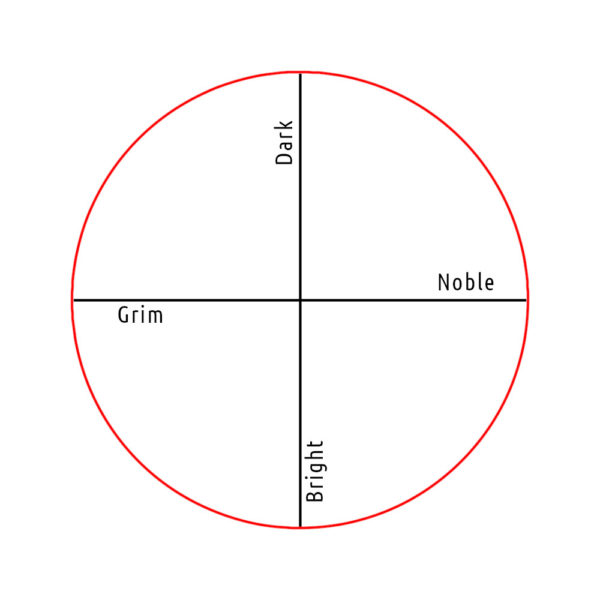
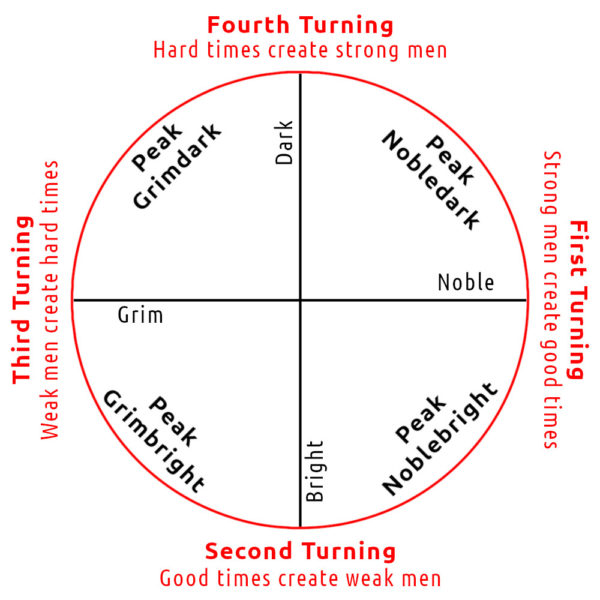
To start, we need to understand the difference between grimdark and noblebright. Both forms of fantasy exist on a field with two axes: noble vs. grim and bright vs. dark.
The bright vs. dark axis describes whether the fantasy takes place in a world where good usually triumphs over evil (bright), or a world where evil usually triumphs over good (dark).
The noble vs. grim axis describes whether the characters have the power to change the world (noble), or whether they do not (grim).
Thus, with these two axes, we get the following combinations:
Noblebright: A fantasy world where good usually triumphs over evil and the characters have the power to save it.
Grimbright: A fantasy world where good usually triumphs over evil, but the characters aren’t on a quest to save it and are usually preoccupied with smaller concerns.
Grimdark: A fantasy world full of moral shades of gray, where evil usually triumphs over good and the characters are either anti-heroes or otherwise fail to save the world.
Nobledark: A fantasy world where evil usually triumphs over good, but the characters are empowered to change it.
These categories are subjective to some degree, and fans will often disagree about which category to put each book/series. However, I think that most fans will agree on the following examples:
Noblebright: The Chronicles of Narnia by C.S. Lewis
Grimbright: The Princess Bride by William Goldman
Grimdark: A Song of Ice and Fire by George R.R. Martin
Nobledark: Lord of the Rings by J.R.R. Tolkien
Next, let’s review in the broadest possible terms William Strauss and Neil Howe’s generational theory. To really understand their work, I highly recommend that you read The Fourth Turning. I have some criticisms of the finer nuances of that book, but their ideas are really excellent, and their predictions hold up surprisingly well three decades later.
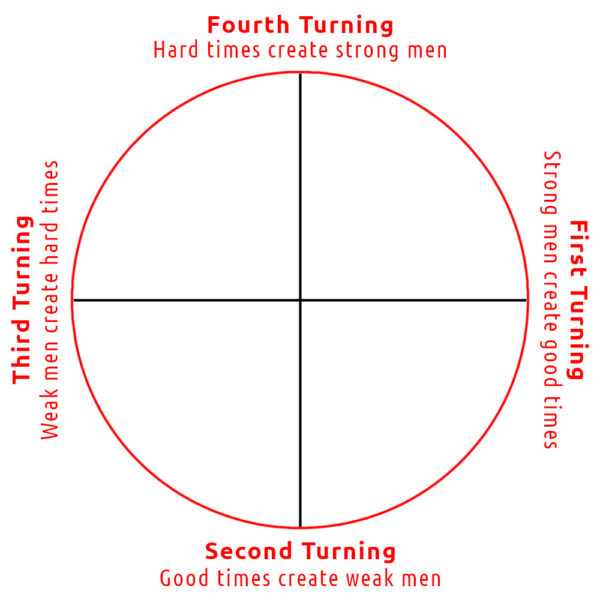
If I had to boil their theory down to one simple, easy-to-understand statement, it would be this:
Strong men create good times.
Good times create weak men.
Weak men create hard times.
Hard times create strong men.
Thus, our society and culture passes through a secular cycle that takes about 80-100 years to complete (or in other words, the length of a long human life). The cycle has four seasons, or turnings, each one corresponding to a generational archetype (since it takes about 20-25 years for people born in the one turning to start having children of their own, thus moving us into the next generational turning).
The first turning happens when the society comes together after resolving a major crisis (eg the Revolutionary War, the Civil War, World War 2) and builds a new, stable order. The second turning happens when their kids rebel against that order, seeking freedom (eg the First and Second Great Awakenings, and the various counterculture movements of the 60s). The third turning happens when the order breaks down completely and everyone goes their own way (eg World War I, the Roaring Twenties, and the culture wars of the 90s). Finally, the fourth turning happens when the society faces a major existential crisis that totally reshapes it.
According to the theory, each axis of the grimdark/noblebright field corresponds to a different generational turning. Thus, stories that are noble have the most resonance in a first turning, stories that are bright have the most resonance in a second turning, grim stories resonate most in a third turning, and dark stories resonate most in a fourth turning.
In other words, the generation that comes of age during a major existential crisis will tend to gravitate more toward fantasy where evil typically triumphs over good, whereas the generation that comes of age during a period of rebuilding will tend to gravitate more toward fantasy where the characters have the power to change the world. And so on for bright and grim stories: the generation that comes of age during a spiritual awakening will gravitate more toward stories that take place in a world where good usually triumphs over evil, and the generation that comes of age in a declining and/or decadent society will gravitate more toward fantasy where the characters are relatively powerless.
Another way of thinking about it is to consider what each generation is not going to be drawn to, or which stories are not going to resonate well. An American who came of age in the 40s and 50s, when US power was on the rise and the Pax Americana was reshaping the world, isn’t going to resonate well with grim stories about powerless characters. Likewise, a boomer who came of age during the counterculture movements of the 60s and 70s isn’t going to resonate well with a dark fantasy world where evil usually triumphs, because (as much as they hate to admit it) they grew up in a very sheltered world that generally made sense—so much so, in fact, that they couldn’t help but rebel against it.
According to this theory, the next generational turning begins when one of the four forms of fantasy (noblebright, grimbright, grimdark, or nobledark) is at a peak. Over the course of the turning, that fantasy form declines until the next form in the cycle becomes ascendant, at which point the next generational turning begins.
Thus, at the start of a first turning, nobledark stories are typically ascendant, where the fantasy worlds are dark and morally gray, but the characters are empowered to save the world. As that generation successfully establishes a new order, the culture’s taste in fantasy shifts away from dark stories and toward noblebright stories, where the characters are still empowered but the world is more ordered and stable.
At the start of the spiritual awakening that characterizes a second turning, noblebright fantasy is ascendant: stories with an optimistic outlook on the world where the characters are larger than life. But as the awakening progresses, people in the society care more about freedom and individuality and less about the group, so stories about characters who sacrifice everything to save their world resonate less with them. Thus, by the end of the second turning, the ascendant form of fantasy is grimbright, which is really more of a slice-of-life fantasy about beloved characters having fun (but not world-altering) adventures.
At the start of a third turning, where the social order has started to break down and corruption begins to permeate all levels of the society, these grimbright stories start to take a darker tone. Readers find it too “unrealistic” to believe that good always triumphs over evil, and they certainly do not believe that good people have the power to change the world—at least, not the “smells like teen spirit” world that they inhabit. Their tastes shift away from the fun, adventurous slice-of-life of grimbright, and toward the dark and gritty anti-heroes of grimdark.
Finally, at the start of the fourth turning, grimdark is ascendant, but readers are starting to lose patience with it. As each new crisis in the real world compounds with all the others, they find it unbearable to read about characters that don’t have the power to change the fantasy worlds they inhabit. At the height of the fourth turning, society reaches an existential breaking point where, in the words of Strauss and Howe, “all of [our] lesser problems will combine into one giant problem, [and] the very survival of the society will feel at stake.” (The Fourth Turning, p277) At this point, readers are ravenous for books about characters who are empowered to fight back against the tides of evil and darkness. Grimdark fantasy declines and nobledark fantasy ascends.
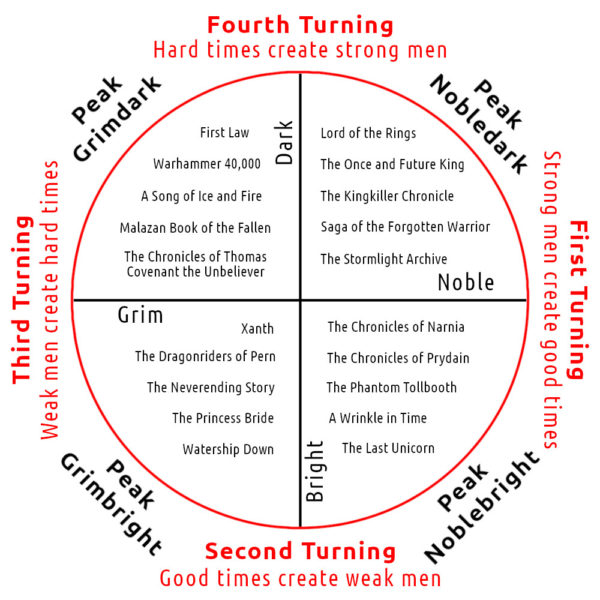
I haven’t read all of the series in the diagram above, but I do have a pretty good sense of most of them, and I put the diagram together with the help of my mastermind group. The key thing about it is that each fantasy series came out in roughly the generational turning that corresponds with each quadrant.
Now, it’s worth pointing out that these trends aren’t absolute. In each of the secular seasons, you can find examples of contemporary fantasy that runs counter to trend. For example, David Gemmell’s Drenai Saga came out in the 80s, at the start of the last third turning when grimbright should have been ascendant, and yet the Drenai Saga is solidly nobledark. Terry Pratchett’s Discworld books had their heyday in the 90s, 00s, and arguably 10s, but they probably fall into grimbright (though you could make the argument that, as absurdist fantasy, they are more similar to grimdark: stories where good and evil really doesn’t matter, and the characters are just doing their best to go along).
But the theory doesn’t state that each fantasy form’s antithesis dies completely when that form is ascendant: only that it reaches a nadir of decline in its resonance with the culture. But without sufficient contrast, the ascendant form cannot stand out. Thus, there still has to be some noblebright Paolini to provide sufficient contrast with the grimdark of Abercrombie and Martin, some low fantasy slice-of-life Legends and Lattes grimbright to make the epic nobledark high fantasy of Sanderson stand out stronger.
According to this theory, as we continue to muddle our way through this present fourth turning, the decline of grimdark fantasy will accelerate, and the bestselling fantasy books of the 2020s will mostly be nobledark. And indeed, we can already see that happening with the meteoric rise of Brandon Sanderson (especially his Stormlight Archive series), the popular enthusiasm surrounding Larry Correia (whose Saga of the Forgotten Warrior falls squarely into nobledark), and the enduring anticipation of Patrick Rothfuss’s fans for the conclusion to the Kingkiller Chronicle. Meanwhile, enthusiasm for George R.R. Martin has waned significantly with the train wreck of Game of Thrones, and Abercrombie, though still quite popular, seems to be testing the nobledark waters with his YA books.
It would really be interesting to do a deep dive on the generational archetypes and make a study of how that affects the fantasy forms that run counter to the cycle. But that’s beyond the scope of this blog post, and frankly I need to get back to writing my own books. But what do you think of this theory? Does it resonate with you, or is there something that we missed?
In the next few days, I’m going to unpublish my short story “Payday.” It will still be available in the collection In Times Such As These, but I think it’s about time that its run as a free short story single should come to a close.
(For those of you who may not be familiar with how I do things around here, I typically publish my short stories first as free singles, then bring them down when I have enough to bundle into a collection. I’m actually going to take down a bunch of my short story singles over the next couple of weeks as I get ready to publish the second batch of stories that will appear in my fourth collection, Beyond World’s End, sometime this spring.)
I originally wrote “Payday” back in 2017, in response to an anthology call sponsored by the Economic Security Project, an NGO whose stated goal is to bring about a universal basic income. My story (which obviously did not win the contest) showcases all of the dangers of a UBI, such as inflation, supply chain shortages, and the breakdown of local businesses and communities.
I self-published the story in March of 2020, just as the pandemic was getting started. At the time, I had no idea that my warnings and predictions would soon become so prescient. The stimulus checks and unemployment benefits weren’t exactly a UBI, but they were regarded by many as a stepping stone to enacting that policy, and what did they lead to? Inflation, supply chain shortages, and the breakdown of local businesses and communities.
In January 2021, I unpublished “Payday” so as to include it in the collection In Times Such As These the following month, but then the other shoe of the pandemic began to drop. The threat of rampant inflation, which the authorities claimed would be “transitory,” convinced me that this story was too timely to take down, so I put it back up as a free short story single, where it remains until today.
At this point, however, the story is less of a prescient look at a troubling possible future than an obvious, and perhaps too “on the nose” (I tend to get that criticism a lot) extrapolation of our present situation. For that reason, I don’t think it’s worthwhile to keep it up any longer. It had a very good run, garnering more than 5,000 downloads, which isn’t enough to have a significant impact on the national discussion, but is still greater than the circulation of most science fiction magazines and podcasts (including, most likely, the original anthology call).
“Payday” will still be available in my collection In Times Such As These, and I do still plan to keep it on submission to the traditional magazines as a reprint, but the free short story single will come down in the next couple of days. If you haven’t already picked up a copy, now is the time to do it.
For the last several months, I’ve struggled to put my thoughts together into something that I felt was appropriate for this blog. Even though I allow myself to be political here, I’m also keenly aware that I have many readers who might enjoy my books and yet disagree with my politics. I don’t want my politics to become a stumbling block or a litmus test for them, and yet, with all that’s happened since November 3rd (and indeed, is still happening), it’s been very difficult to figure out how to put those thoughts into words.
First there was the election. I expected voting irregularities, but not on such an incredible scale. Then, the Great National Gaslighting, which has been ongoing ever since. To be fair, there was also a great deal of conspiratorial nonsense spewed out by the Qanon folks on the Right, which only served to obfuscate and confuse the issue (for that reason, I tend to believe that Qanon was a psyop from the beginning).
And then, the mostly peaceful protest* at the Capitol changed everything.
I was disappointed by the storming of the Capitol, but not surprised. Disappointed, because tactically, it was the stupidest possible thing that the folks on Team Red could have done. It accomplished nothing of lasting political value, completely sabotaged the lawful and legitimate efforts to question the legitimacy of the election, and gave Team Blue all the ammunition they needed to close the Overton window on the election irregularities, weaponize the surveillance state against their political enemies, and bring the War on Terror to American shores.
I wasn’t surprised, though. From November 3rd to January 6th, the news cycle was filled with the sort of stuff that color revolutions are made of. The mostly peaceful protest* at the Capitol fit the script perfectly—almost too perfectly. Anyone who keeps an ear to conservative media could have told you that the MAGA folks weren’t going to simply bend the knee—not with all of the voting irregularities and other shenanigans.
(*And I use the phrase “mostly peaceful protest” deliberately—not to excuse the storming of the Capitol in any way, but to point out the hypocrisy and Orwellian doublethink of those who unironically used that phrase to describe the George Floyd riots over the summer, and who now call the riot at the Capitol “sedition” and “insurrection” perpetrated by “domestic terrorists.” 1984 was supposed to be a warning, not an instruction manual!)
And then, Big Tech cynically took advantage of the moment to crush Parler, silencing and deplatforming the conservatives who had migrated their from Twitter. “If you don’t like what we’re doing, build your own platform,” they said. So we did, and then… this.
You know, I’m actually not all that concerned about Joe Biden taking the White House and the Democrats controlling the House and Senate for at least the next two years. Am I happy with that arrangement? No, of course not—but on a certain level, the hyperbolic rhetoric on both the Right and on the Left is all just part of the same grift. Politics is what got us into this mess—it’s not what’s going to get us out of it.
But the crap that Big Tech is currently pulling? That stuff genuinely scares me, not the least because my livelihood depends on it. Without Amazon, there would be no indie publishing right now. So for AWS to take down Parler on woke ideological grounds, while flagrantly violating contract law and antitrust—and now, for the chief of that department to replace Jeff Bezos himself—yeah, that doesn’t bode well for authors like me.
I do have some hope for remedy in the courts, but not much. If we do get recourse through the law, it will take years or even decades to get it, and an ugly, uphill battle against corrupt, partisan judges in every level of the judicial system. Ultimately, I think the only thing that will take down Big Tech will be a majority of Americans simply refusing to use their services, deleting their social media accounts and getting smart about their personal data. But I don’t have much hope for that, either.
So what can we expect in the short to medium term? Where do we go from here?
First, if the storming of the Capitol genuinely surprised you, buckle up. When people feel that they have no recourse through peaceful, democratic means—that no one on the other side is listening to them, even as their way of life is being systematically destroyed—they turn to violence. But where the Left sees political violence as a dial that they can gradually turn up, the Right sees political violence as a switch that gets turned on. A lot of people on the Right are now thinking about flipping that switch.
It will start with a series of high-profile political assassinations. I do not condone or encourage this in any way, but I expect that many prominent Democrats will not survive the year. If the violence continues to escalate, we will see more unrest and chaos, ultimately culminating in either a mutiny of the nation’s armed forces, or the return of Donald Trump to the White House. Possibly both.
The “sanctuary state” phenomenon will expand dramatically as red state governors challenge the unconstitutional dictates of the Biden administration. To put it bluntly, red state America is going to become ungovernable. There will also be calls for secession, at first just to extract certain political concessions, but depending on how things go it could become a serious movement.
The migration from blue cities and states to red parts of the country will accelerate dramatically, and may turn violent. States like New York and California are trapped in a death spiral, where rising taxes are causing the rich to flee, which causes the politicians to raise taxes even more. The pandemic has made this much worse. I don’t think New York City is going to survive the coronapocalypse, and will go the way of New Orleans or possibly even Detroit. This will have interesting implications for the traditional side of the publishing industry, which is New York centric to a fault.
At some point in the next two years, I think the other shoe of the economic collapse is finally going to drop, and all of the cans we’ve been kicking since 2008 are going to hit the end of the road. In response, I expect the Biden (or at that point, probably the Harris) administration to make a hamfisted attempt at turning our Economic Impact Payments into some sort of permanent UBI, but it will either be too little, or it will lead to the sort of runaway hyperinflation that I wrote about in my short story “Payday.”
Ultimately, I see only three ways that all of this insanity ends:
1) A peaceful (if messy) divorce. Red states go their way, blue states go theirs, and the Great American Experiment comes to an end with a minimum of bloodshed. I consider this the least likely outcome, and not a very desireable one.
2) A civil war or revolution of some kind. We may already be in the opening phases of this, where the starting factions vie for position before the shooting begins in earnest. We may be reaching the end of the opening phase right now.
3) Everyday Americans from across the political divide join together to reconcile their differences and oppose the social and cultural forces driving us apart. I want to believe that this is the most likely outcome, but it requires that people leave their echo chambers and genuinely listen to those they see as the enemy, and I don’t think that’s going to happen unless something changes dramatically with Big Tech. It wasn’t just politics that got us into this mess: social media played a role in it, too.
What does all of this mean for our family and my writing? I’m trying to work that out right now. Even in a worst case scenario, I think that where we live here in Utah is a good place to weather the coming storm. And in a best case scenario, I would like to be a part of the reconciliation that brings this country back together. But in the meantime, I expect that I’m going to have to find alternative platforms to publish and sell my books, because the ban lists are coming, and it wouldn’t surprise me to learn that I’m already on one of those lists.
In the long term, though, I’m grimly optimistic that things will work out. I’m not quite sure how they will work out, but I know that the forces driving this chaos will ultimately be undone by their own pathologies. The important thing is to find the strength to get through this moment without falling into any of those pathologies yourself. Even with all of this talk of violence and civil war, I have hope that the Great American Experiment is more resilient than anyone gives it credit, and great faith in the goodness of the American people, regardless of political affiliation.