I learned four things by living through covid. They are:
Whatever the mainstream narrative tells you to believe (or not to believe), you should probably believe the opposite.
Whatever the government tells you to do (or not to do), you should probably do the opposite.
Accusation is projection is confession.
At any given time, the most important story is the one that no one is talking about.
As the situation in Minneapolis continues to escalate, it’s not just the action on the ground that has me worried, but the rhetoric itself. Specifically, the one that has me worried is the accusation that ICE is somehow Trump’s Gestapo.
Obviously, this is ludicrous on its face—a wildly false accusation meant to rile up the useful idiots, many of whom received a public school education and thus know almost nothing about the actual Nazi Gestapo. But because accusation is projection is confession, it’s actually much more than that.
If there’s one thing that’s consistent about the left, it’s that they always accuse their enemies of doing the things that they are actually doing, or that they want to do. So when they say that Trump has some sort of Gestapo, that’s a very strong signal about their future plans, if they ever get power again.
The key question is this: by accusing Trump of setting up his own secret police force, are they confessing to something they hope to do, or to something that they are actually setting up right now? In other words, are they projecting something that’s purely aspirational, or do they already have the databases and surveillance infrastructure set up so that they can have a secret police force up and running the moment they come back to power in Washington again?
I just finished reading The Last Election by Andrew Yang and Stephen Marche. It’s a fascinating book, but not in the way that the authors probably intended.
The book basically presents a detailed account of the 2024 election, starting in November 2023 and ending with the results of a contingent election, after the (fictional) third party campaign disrupts things so thoroughly that no presidential candidate can get to 270 electoral votes. There’s violence in the streets, a supreme court justice who gets assassinated, a presidential debate that gets disrupted by a riot before it can really begin, a stealth military coup, and all sorts of insanity. And it ends (of course) with a Trump victory in the contingent election, where every state gets one vote and the representatives from each state vote behind closed doors. Cue the end of “our democracy.”
Partisan politics aside (and I am still genuinely undecided as to how, or even if, I will vote in 2024), there is sooo much to unpack in this book. The authors are totally ignorant about half of the country, and utterly clueless about the other half… and I can’t tell which half is which. That’s what I find so fascinating. Do the authors really believe that the average Trump voter hates and fears black people simply because they are black? Do they genuinely believe that sexual harrassment makes a better kick-the-dog moment than a coerced secret abortion ending in suicide? That such an abortion doesn’t even count as a kick-the-dog moment at all?
However, my purpose in this blog post is not to unpack all the myriad layers of willful and oblivious ignorance in The Last Election, but to point out what should be obvious by now: that most of the authors’ predictions are already failing to pan out.
By now, on the timeline, we should have had 1) an assassination of a justice of the supreme court, 2) RFK projected to win several states, and 3) street violence on the level of the George Floyd riots, with about as many casualties. Of course, none of those things have actually happened. And that, more than anything, makes me think that a hot civil war is unlikely to break out in this country.
Instead, people just seem to be exhausted. There are a few keyboard warriors, of course, but from what I can tell, most people on both sides are doing their best to tune them out. The memes aren’t anywhere near as good as they were in 2016. Of course, there’s still enough outrage for the political grifters to work with, but that outrage isn’t translating into lone wolves and false flags.
The 2024 election is shaping up to be the least important election in my lifetime. If our democracy were healthy, we would be debating the government’s disastrous response to the pandemic and whom we should hold responsible for it (of course, in a healthy democracy, the citizens would not have complied with those policies in the first place). Instead, the thing that’s sucking all the oxygen out of the room is the neverending lawfare against Trump—which is still important, don’t get me wrong, but is it really the most important thing happening right now? Inflation is crushing the economy, Europe is in the midst of its worst armed conflict since the Nazis, we are closer to a nuclear armed conflict with Russia than we were in the Cuban Missile Crisis, and Anthony Fauci is still both alive and free.
When I step away from the perpetual outrage cycle that passes these days for the news and look at the current state of the world, what I see is not a superpower that is careening toward a hot civil war, but a former superpower that is steadily disintegrating. Some parts of the country are in a greater state of collapse than other parts, but we are all in the midst of a collapse, and probably have been for years, perhaps even decades. Our dysfunctional politics is not the cause of any of this. It’s just a symptom.
As Americans, we like to think of ourselves as exceptional. We also like to obsess over the imminent fall of our cuntry. That’s probably why there’s been so much talk in the last few years about the possibility of a civil war. God forbid that America goes out with a whimper instead of a bang.
But the more I see, the more I think that that’s exactly how this country will fall apart: with a steady and unrelenting disintegration, until our politics are totally irrelevant, our military is unable to project power overseas, our national government is little better than that of a failed state, and our economy is so weak that no one bats an eye at rolling blackouts and empty grocery shelves.
Then we will pass through a period when things that cannot continue will not continue, and things that must happen will happen. Several states will become de facto autonomous, simply to survive. Many won’t. The dollar will collapse and the efforts of the global elite to replace it with a global digital currency will fail, but their depopulation efforts will succeed beyond their wildest dreams, and ultimately prove their downfall. The perpetual growth paradigm that the left calls “capitalism” and the right calls “progressivism” will unravel to devastating effect, and by 2100, there will be fewer than one billion humans on this planet (which will probably be significantly colder than it is now).
But there will not be a second American civil war, because that would require a level of dynamism that we simply do not possess. There is still a lot of ruin in this country, though, so we will probably endure longer than most other countries… kind of like how Japan is going on its fourth “lost decade” by now. But Japan had us to lean on. We’re not going to have anybody except ourselves.
…when you realize that the internet is a factory for creating cults, and that social media and smart devices are force multipliers for this effect.
Before the internet, your “community” was a geographically bound group of people, who were diverse enough (that’s “diverse” with a lower-case d) to give you an interesting variety of perspectives and worldviews. Also, you typically interacted with each other while physically in person. If you said or did something extremely embarrassing, it typically didn’t get beyond your immediate circle of associates, or the people you decided to tell about it.
The internet changed everything by turning “community” into something that was bound by interests, hobbies, perspectives, or worldviews. Now, every person with a weird and perverse fetish, who before kept it hidden because they were the only person in their community who held it, now could find all the other people in the world who held the same weird and perverse fetish, and create a “community” around that thing. Same with crazy political views. Same with radical ideology.
At the same time, if you said or did something embarrassing, and it went viral, your embarrassing moment would be broadcast far beyond your immediate circle of associates, to people you had never before met—as well as to people whom you would never want to hear about it. This effect was multiplied by the development of social media, and it led people to self-censor and conform to whatever “community” they were a part of, in the fear of standing out and going viral.
At the same time, all these “communities” turned into echo chambers that warped the various members’ view of reality. And because anger and outrage are the things that are most likely to get spread on the internet (see the video above), these echo chambers starting to become paranoid and break off from the rest of the world, taking the dimmest and least charitable view of everyone who wasn’t a member of their “community.”
As these online communities came to take a more prominent place in the average person’s life than their own families and communities, then the average person’s sense of identity increasingly became caught up in whatever hobby, fetish, or ideology united the “community.” And because of how paranoid these communities became, they increasingly came to demand absolute and preeminent allegiance. Is this starting to sound like a cult yet?
But it goes deeper than that, because the devices through which we connect with these “communities” actually make us more physically isolated from each other, while giving us the illusion of a genuine connection. When you’re holding up your smart device to capture a fireworks show, you’re not actually enjoying the fireworks. And when you’re lying in your bed, posting updates on your social media or chatting with your friends, you are still, in reality, lying alone in your bed. Combine with the internet’s penchant to drive outrage, and you have the two key ingredients for a mass formation psychosis: a large group of atomized and isolated individuals suffering from free-floating anxiety.
Before the pandemic, (that’s the Covid-19 pandemic of 2020, for future readers who may be wondering “which one?”) I think that we lived in a world where the majority of our countrymen—the members of our “community” in the traditional sense—were not caught up in one of these cults. Either the majority of people weren’t caught up in one of these echo chambers, or the majority of echo chambers hadn’t yet reached cult-status, but people were still generally reasonable, on the whole. But with the pandemic, I think we passed through some sort of a threshold, to the point where now the best way to make sense of our world is to assume that the majority of people around you are trapped in some sort of a cult—which may literally be the case, considering the theory of mass formation psychosis.
So what does this mean for where the world is headed? Nothing good. I suppose that in an optimistic scenario, a critical mass of people manages to break themselves and their friends out of this mess, and go on to build a new society with proper safeguards in place to prevent this sort of mess from happening again. But I think it’s much more likely that this thing runs its course, and large swaths of our civilization drink the proverbial Kool-Aid.
Fortunately, there is a script that we can run, as individuals and (more importantly) as families, to get through this mess. It’s the same script that we use to get ourselves or our loved ones out of a dangerous cult. I’m not yet an expert on that script, but I know that it’s out there, because cults have been a thing for a very long time. But I’m pretty sure it involves putting your family first, getting off of social media, limiting the amount of time that you spend on your smart devices, and becoming more involved in your real “community”—the real-life one where you actually live.
Of or pertaining to the mass formation psychosis currently gripping the United States and most of the developed world. This mass formation psychosis is led by radical leftist ideologues and driven by social media addiction. Due to the collusion between major technology companies and the US government, there is also an element of state-sponsored propaganda and control.
The mass began to form in the late 2000s with the popularization of social media. As these technologies began to replace face-to-face human reactions, it created the pre-conditions of social isolation and free floating anxiety, in large part due to the addictive nature of the algorithms which promoted content most likely to induce outrage and anger in the end-user (see CGP Grey, “This Video Will Make You Angry”). Once these pre-conditions were in place, all that was necessary to create the psychosis was a target or series of events to focus the attention of the mass.
The 2010s were characterized by several of these focusing events, starting in 2012 with the shooting of Michael Brown and the subsequent riots in Ferguson, Missouri, and continuing with numerous mass shootings such as Orlando and Sandy Hook, several landmark Supreme Court decisions on gay rights such as United States V. Windsor and Obergerfel v. Hodges, and the rise of such controversial movements as Gamergate and the Sad/Rabid Puppies. The culminating event in the creation of this mass formation psychosis was the election in 2016 of Donald J. Trump as President of the United States.
Following Trump’s election, rogue elements of the bureaucracy, the administrative agencies, and the intelligence community (colloquially referred to as the “deep state”) successfully exploited this mass formation psychosis in an effort to hamstring the Trump administration and ultimately remove him from power. These deep state actors acted in collusion with the Silicon Valley technology companies that ran the social media platforms.
Because of the inherently left-leaning political bias of these Silicon Valley companies, this mass formation psychosis always had a leftist bent, and tended to promote radical leftist ideologues as its leaders. However, in any mass formation, the leaders are often just as caught up in the psychosis as the followers. This soon became manifest in the moral and rational incoherence of its leaders (see “What Is a Woman?”), and in the various internal contradictions of their own respective causes and beliefs. While “wokeism” is inherently political, it is not primarily characterized by a unified political ideology or movement.
The high water mark of the mass formation psychosis occured in 2020 during the covid-19 pandemic, during which it took on all of the defining characteristics of a cult (see “What is the Covid cult?”). The George Floyd riots were the major culminating event, but Trump’s ostensible defeat in the disputed 2020 elections and his subsequent removal from power in the January 6th color revolution removed the central focusing element necessary for the mass formation psychosis. Since then, the deep state and political establishment has attempted several times to find a new focusing element for the psychosis, with such issues as climate change or the Russo-Ukraine war, but thus far these efforts have proven unsuccessful (see: “I SUPPORT THE CURRENT THING!”)
At this time (March 2023), it is unclear how this mass formation psychosis will end. If Trump is re-elected in 2020, it may catch a second wind, or it may be replaced by the right-leaning mass formation psychosis characterized by Trumpism and the MAGA movement. It may fizzle out slowly, or it may be defeated by the growing demand for a religious revival in the United States. Alternately, it may prove to be the precursor of a much more dangerous mass formation psychosis, this time driven by AI and the outbreak of World War III. Regardless, the events of the next 12 to 18 months will determine which course our society will take.
This is an extremely polarizing and contentious issue right now, so I’m going to try to make this post as fact-based and non-sensational as possible.
Full disclosure: I never got the covid shot. My wife and I both had covid before the “vaccines” became available, and decided that our natural immunity provided enough protection for us. We were also trying to become pregnant, and even in January 2021, we had heard rumors that the shots were affecting both men’s and women’s fertility, as well as women’s menstrual cycles, and didn’t feel that the risk was worth it, in spite of the tremendous social pressure to get “vaccinated.”
At the end of the day, we simply did not trust that the “vaccines” were safe (and I put “vaccine” in quotes, because we now know that these shots do not provide lasting immunity, nor do they prevent transmission. The health establishment literally had to change the definition of “vaccine” for that word to apply to these treatments). We were wary of the fact that the emergency use provisions absolved the manufacturers of any liability, and that the long-term effects of these shots was unknown. In our family’s calculation, the potential risks outweighed the potential benefits, especially since we already had natural immunity and were unlikely to contract covid again.
In the past year, some very disturbing things about the “vaccines” have come to light. A recent poll by Rasmussen shows that more than 1 in 4 Americans believe they know someone who has died of the covid “vaccines”—not from covid itself, but from the vaccines. Interestingly, more Democrats (about 1 in 3) than Republicans (about 1 in 4) claim that they know someone, which is interesting, because the political left was much more taken with the “vaccine” mania than the political right. Remember that super cringey vaccine song on Colbert’s show?
The last two years have been crazy, for sure. But how has it affected the science fiction and fantasy world? The January issue of Locus Magazine made me curious about this, since Greg Bear recently passed away “after complications from heart surgery,” and the obituary section mentioned two other people under the age of 60, one of whom “died unexpectedly.”
So I went through all of the back issues of Locus from January 2021 to the present, and made a comprehensive list of every person mentioned in the obituaries, with their age and cause of death. If they died of a stroke or an accute heart-related issue, I bolded their name, since the mechanism for death appears to be related to blood clots caused by the spike protein that the mRNA “vaccine” is designed to generate. Also, I bolded the name of anyone 70 or younger who died without the cause of death listed. The global average life expectancy is just north of 70, which is lower than the US, but I decided to take the lower of those numbers. I also bolded any names where the cause was listed as covid, since many people who died in the first couple of weeks after getting the shot were automatically listed as covid, especially in the initial rollout.
Here is the list:
JAN 2021
Ben Bova (88): “contracting COVID-19, developing Pneumonia, and suffering a stroke.”
Phyllis Eisensetein (74): “suffered a stroke in January 2020 and entered hospice care not long after.”
Richard Corben (80): “died December 2, 2020 after heart surgery.”
Dean Ing (89): cause not listed (died July 21, 2020).
FEB 2021
James Gunn (97): cause not listed.
Storm Constantine (64): “following a long illness.”
Anton Strout (50): “died unexpectedly.”
Jael (83): cause not listed.
Alison Lurie (94): “in hospice.”
Richard West (76): “of COVID-19.”
Joseph Altairac (63): cause not listed.
MAR 2021
Kathleen Ann Goonan (68): cause not listed.
Rowena Morrill (76): “following years of poor health.”
Jean-Claude Carrière (89): “of natural causes.”
APR 2021
Norton Juster (91): “complications following a stroke.”
Dean Morrissey (69): cause not listed.
Michael G. Adkisson (65): cause not listed.
MAY 2021
John C. Pelan (63): “of an apparent heart attack.”
Wanda June Alexander (69): “diagnosed with lung cancer last year, and though she underwent successful treatment, her lungs were severely damaged, and she entered hospice care in January 2021.”
JUN 2021
Marvin Kaye (83): “in hospice care.”
Don Sakers (62): “of a heart attack.”
Jan Stirling (71): cause not listed.
Jim Rittenhouse (64): “in hospice care.”
Anish Deb (69): “of COVID-19.”
JUL 2021
Bob Brown (78): “after a valiant battle with esophageal cancer.”
AUG 2021
William F. Nolan (93): “of complications from an infection.”
Stephen Hickman (72): “of natural causes.”
Joe McKinney (52): “in his sleep.”
Paul Alexander (83): cause not listed.
John Longendorfer (90): cause not listed.
SEP 2021
Elizabeth Anne Hull (84): cause not listed.
Patricia Kennealy-Morrison (75): cause not listed.
C. Dean Andersson (75): “in his sleep… after a long illness.”
J.W. Rinzler (58): “of pancreatic cancer.”
Ron Weighell (70): “a few weeks after suffering a stroke.”
Lorna Toolis (68): cause not listed.
Judi B. Castro (58): “following a brief illness.”
OCT 2021
Erle Korshak (97): cause not listed.
L. Neil Smith (75): “after a lengthy battle with heart and kidney disease.”
Carol Carr (82): “of lung cancer.”
Genevieve DiModica (73): “of natural causes.”
NOV 2021
Mary Kay Kare (69): “of a blood infection.”
Gary Paulsen (82): “of cardiac arrest.”
Lou Antonelli (64): cause not listed.
Douglas Barbour (81): “of lung cancer.”
Otacilio Costa D’Assuncao Barros (67): “was found dead in his apartment… after two days without contact by neighbors. The cause of death has not been disclosed.”
DEC 2021
Petra Mayer (46): “died suddenly of a pulmonary embolism.”
Robert Thurston (84): cause not listed.
Jim Fiscus (76): “died suddenly.”
Catherine M. Morrison (52): “after a brief illness.”
JAN 2022
Anne Rice (80): “of complications from a stroke.”
Diana G. Gallagher (75): “of chronic obstructive pulmonary disease.”
William G. Contento (74): “after a long struggle with prostate cancer.”
Jeremy G. Byrn (57): “after a long illness.”
Chris Achilleos (74): cause not listed.
Jose Luis Benicio da Fonseca (84): cause not listed.
FEB 2022
Willie Siros (69): cause not listed.
Dave Wolverton (64): “after suffering a severe head injury falling down the stairs the previous day.”
Ron Goulart (89): cause not listed.
John Jos. Miller (67): cause not listed.
J. Brian Clark (93): cause not listed.
Sally Gwylan (67): “in a traffic accident.”
Jane E. Hawkins (70): “was a cancer survivor, but she received a terminal diagnosis and went into hospice.”
Elizabeth Miller (82): cause not listed.
Bill Wright (84): “fallen at home and ‘thought he had broken his back.’”
Chuck Verrill (unknown): “after a long illness.”
Athos Eichler Cardoso (87): cause not listed.
MAR 2022
Angelica Gorodischer (93): cause not listed.
Tom Dupree (72): “of cardio-respiratory arrest.”
Harold R. Johnson (68): “of lung cancer.”
APR 2022
Andy Remic (50): “of cancer.”
Faren Miller (71): “after being hospitalized with serious respiratory problems.”
Shirley Hughes (94): cause not listed.
Melissa Mead (62): cause not listed.
Priscilla Tolkien (92): “after a brief illness.”
Aiki Flinthart (unknown): “after receiving a terminal cancer diagnosis.”
MAY 2022
Robert C. Cornett (69): cause not listed.
Bill Johnson (65): cause not listed.
Valerio Evangelisti (69): cause not listed.
Joel Houssin (68): “after a long battle with MS.”
Carlos Emilio C. Lima (65): “from an infection following surgery.”
Lygia Fagundes Telles (98-103): cause not listed.
JUN 2022
Patricia A. McKillip (74): cause not listed.
Sergey Dyachenko (77): cause not listed.
JUL 2022
Ken Kelly (76): cause not listed.
AUG 2022
Eric Flint (75): cause not listed.
Geoffrey H. Goodwin (50): “of heart failure.”
Dorothy J. Heydt (80): cause not listed.
Barbara Haldeman (Barbara Delaplace) (69): cause not listed.
Jonathan Lyons (52): “succumbed to injuries after being mugged.”
SEP 2022
Nichelle Nichols (89): “of heart failure.”
Alexei Panshin (82): cause not listed.
Robert “Bob” Self (55): “as the result of an accident.”
Wayn McCalla (53): “following a long illness.”
Roland J. Green (76): cause not listed.
OCT 2022
Peter Straub (79): “after a long illness.”
Bruce Taylor (75): “after a brief hospital stay. He had a heart condition and was in poor health recently.”
Maureen Kincaid Speller (63): “she had cancer.”
J.G. “Huck” Huckenpohler (81): cause not listed.
NOV 2022
Robert A. Madle (102): “died peacefully in his sleep.”
Albert E. Cowdrey (88): cause not listed.
Hilary Mantel (70): cause not listed.
Matthew Mather (52): “died suddenly.”
Lani Forbes (35): “of neuroendocrine cancer.”
DEC 2022
Tom Maddox (77): “of a stroke.”
Martin Morse Wooster (64): “the victim of a hit-and-run.”
Jill Pinkwater (81): cause not listed.
Sue Strong Hassler (84): “of complications from back surgery and COVID.”
Anne Fakhouri (48): “following a long illness.”
Justin E.A. Busch (63): cause not listed.
Ned Dameron (79): “of ALS.”
JAN 2023
Greg Bear (71): “after complications from heart surgery.”
Anne Harris (58): “after suffering a stroke.”
Marcus Sedgwick (54): “died unexpectedly.”
To be clear, there may be benign explanations for many or even most of the people whose names are bolded. Strokes and heart attacks have been killing people long before the covid “vaccines” existed, and continue to kill people without any help from the “vaccines.” Also, many people who died under 70 may simply have been in poor health—after all, it’s not like the SF field is known for robust physical fitness. However, there may also be people on this list who did die of vaccine-related issues, whose names I did not bold because they were over 70 and the cause wasn’t listed. So it cuts both ways.
My purpose is not to compile a comprehensive list of vaccine-related deaths in the SF field, but to point out some deaths that appear to be suspect. And of the 114 people listed, more of them “died unexpectedly” or “died suddenly” than died of covid, which is worth noting.
If you haven’t seen the documentary Died Suddenly, it’s worth watching, even though it does have some flaws. Most notably, toward the end it recycles some disturbing footage of people who either did not die, or who died before the pandemic, implying that they all died of the vaccines. You can find a much more in-depth and non-sensational treatment of vaccine-related deaths and injuries on Chris Martenson’s channel, especially in this video where he interviews several morticians about the clotting issue:
Vaccine safety is a very serious issue, and every day, it seems that we are learning new things about the covid “vaccines” that call into question all of our assumptions and beliefs. The science fiction field has always leaned to the political left, especially on the traditional publishing side. For the past two years, many of our conventions and other events have pushed mask mandates, or required proof of vaccination, including our own LTUE here in Utah.
Has this lockstep, unquestioning, and at times almost militant advocacy of the establishment narrative led to the tragic loss of several writers and artists before their time? Has it decimated—indeed, is it continuing to decimate—the talented creators in our field? How many wonderful stories will never be written because of this? How many voices will no longer be heard?
I hope that we can come to a place where we can honestly start asking these questions. Because if we can’t, then the science fiction and fantasy field has lost much more than those who have died, and the gifts they would have shared with us.
Remember the time before the pandemic, when “conspiracy theory” was still a dirty word? It still is in some quarters, but for many of us the term is now closer to “spoiler warning.”
After all, what are we supposed to believe: that Epstein hung himself with a bedsheet that couldn’t hold his weight, from a height that couldn’t kill him, at exactly the moment when the guards had abandoned their posts and all of the surveillance equipment had mysteriously and inexplicably gone dark? That is still the official story—just like Ghislane Maxwell, Epstein’s Madam, was thrown in prison for trafficking sex slaves to… well, nobody, at least officially.
Or are we supposed to believe that a novel coronavirus whose genetic profile shows clear evidence of artificial manipulation jumped species from a bat to a pangolin to a human, in a Chinese wet market (which the CCP destroyed before any investigation could be launched) more than 900 miles from the bat’s native habitat, which also just happens to be down the street from the Wuhan Institute of Virology where gain-of-function research was being conducted with bat coronaviruses? I’m not generally a fan of Jon Stewart, but I think he hit the nail on the head with this one:
Of course, this isn’t to say that all conspiracy theories have weight and value. By no means do I believe that the moon landings were fake—there are just too many people who would have to be in on the thing to keep it secret for long, and also, we can see the tracks of the moon landingsfrom Earth. But conspiracies do happen, and often have tremendous impact on the course of history. For example, the United States constitution was born out of the Philadelphia Convention, which conspired to throw out the Articles of Convention and replace them with something entirely different, which was technically an act of treason at the time.
Conspiracies are real, though not all conspiracy theories are true. The challenge is separating conspiracy theory from conspiracy fact.
Which brings us to the old aphorism: “never attribute to malice that which can be attributed to incompetence.” For the last two years, when I look at the direction my country is going and all of the harm that the Biden Administration has done, I find myself constantly asking: “is this malice, or is this incompetence?” After all, if my goal was to destroy this country, I could hardly do better than what this administration has already done (Victor Davis Hanson has an excellent article about that, and he says it better than me). And yet, every time the press secretary opens her mouth, I am reminded of just how staggering is the incompetence of these people. Or is it?
And then I had a realization: if you go up high enough, all of these people are useful idiots to a force of pure malice that is striving to bring about our spiritual enslavement and destruction. I am speaking, of course, of Satan himself.
Now, perhaps you don’t believe that the devil is real. Laying aside the aphorism that “the greatest trick the devil ever pulled was convincing the world he doesn’t exist,” you don’t have to believe in a literal fallen angel and his hordes of demonic followers in order to follow this particular rabbit hole. The devil is an archetype for a reason, after all. Personally, my own experience has convinced me that demonic forces do indeed exist, but that’s all I care to say on the subject, and I’ll leave you to draw your own conclusions.
But my point is that it’s not like the forces of evil are monolithic: there is a hierarchy of conspirators and useful idiots, and some who may be conspirators on one level are useful idiots on another. At the bottom, it’s almost all useful idiots wreaking havoc by their own incompetence, but at the top, it’s all driven by malice.
Because here’s the thing: when we attribute a particular action to incompetence, we are making an implicit assumption about the motive behind that action. If we assume that Biden’s motive is to serve the interests of the American people, he’s doing a piss-poor job of it—but if we consider that he may have been compromised by China (as the Hunter Biden laptop implicates), or that he only cares about the Biden crime family’s interests, then his actions no longer reak of so much incompetence.
In the game of chess, there’s a thing called a gambit, where the player sacrifices a piece in order to gain an advantage of tempo or position. To the inexperienced player, a gambit often looks like a mistake. Some of the most brilliant chess moves involve a gambit that seems, at first, to be an act of utter incompetence, but that in fact make winning inevitable if the opponent falls for the gambit.
So even though “never attribute to malice” is a good rule of thumb, it’s clearly not sophisticated enough to explain all the insanity we’ve seen in the last two years. But neither is it sufficient to explain this insanity in terms of pure conspiracy—indeed, falling into that trap makes us susceptible to becoming infected by that insanity ourselves. Mattias Desmet points this out in chapter 8 of his seminal work, The Psychology of Totalitarianism. He also says:
In the whole process of exercising power—i.e., shaping the world to the ideological beliefs—there usually is little need to make secret plans and agreements. As Noam Chomsky put it, if you have to tell someone what to do, you’ve chosen the wrong person. In other words: the dominant ideology selects who ends up in key positions… Consequently, all people in positions of power automatically follow the same rules in their thinking and in their behavior and are under the influence of the same attractors.
One of the main points that Desmet makes in this chapter is that when people are driven by an evil ideology—or, in the words of Jordan Peterson, become ideologically possessed—their actions often appear, to someone on the outside, as if they are all part of a grand conspiracy. And yet, none (or at least, very few) of these people have actually entered into a clandestine agreement to support a deliberate plan: they are all just playing the part that they find themselves in, most of them unwittingly.
And yet, even though there is no “conspiracy” in the classical sense, the people who get caught up in the insanity all end up working to advance the purposes of something much bigger than themselves. Indeed, explaining this phenomenon is the entire purpose of Mattias Desmet’s book. He does a brilliant job of it, but mostly from a psychological perspective.
What I want to do is look at this phenomenon from a spiritual and an archetypal perspective, not as a scientist but as a storyteller. That’s why I’m calling it the “grand conspiracy,” even though I recognize that on most levels, it’s not a conspiracy so much as a confluence of interests (or more accurately, a confluence of lusts). I do think that there’s a lot that can be gleaned by looking at it this way, because there is a spiritual dimension to our lives—as Mattias Desmet emphatically points out—and stories and archetypes have been absolutely essential to our understanding of the world since prehistoric times. I happen to believe that Satan is more than just an archetype, but you don’t have to believe that in order for this grand conspiracy to be useful and make sense.
I’ve planned this series out in twelve parts, listed here. From now until the end of February, I’ll post about once a week. Since Christmas is coming and I don’t want to be thinking about all this diabolical stuff over the holiday itself, I’ll post part 2 next Tuesday, and part 3 the week after that, then go back to posting on Saturdays. The first three parts will outline the general theory that I’ve come up with, and the next eight parts will examine each piece of the theory in detail. In the end, I’ll share some concluding thoughts about how this grand conspiracy can—and indeed, ultimately will—be defeated.
I hope you find this series interesting, and I look forward to hearing what you think about it!
Here’s a fun and cheery blog post for you. Just for fun, let’s run down all of the ways in which the world might come to an end in the next 12 months, and assign probabilities to each one. I’m not sure what qualifies as “the end of the world,” but for our purposes let’s say it involves (1) a massive loss of human life, and (2) a permanent and irreversible change to global living standards and our way of life. Ready? Let’s go!
Global Nuclear War: 1%
This is the one that everyone is talking about right now, what with the Russia-Ukraine war and the recklessness of Western powers in their support for it. Putin has formally annexed four occupied territories that are still under partial Ukrainian control, and now says that he will defend sovereign Russian territory with his country’s nuclear arsenal. With every possible offramp to the war now closed, it seems like it’s only a matter of time before someone uses a tactical nuke on the battlefield, and after that kind of an escalation, who knows what will happen next?
However, I actually think the probability of a nuclear armageddon in the next 12 months is actually quite low—not totally nonexistent, but still quite low. Putin is not the kind of politician to make tactical blunders, and that’s exactly what a nuclear strike would entail, especially given the current situation on the ground.
In a war of attrition between Russia and Ukraine, Russia wins. That’s true even with all of the weapons and material that we’re supplying to Ukraine. Furthermore, I suspect that Russia has a much stronger will to win this war than we do. With the energy crisis in Europe and all of the political discontent here in the US, I don’t see us continuing to write the Ukrainians a blank check for much longer. Also, Russia just destroyed a good chunk of Ukraine’s energy infrastructure in response to the Crimean bridge attack, which means that the average Ukrainian citizen is going to be in a world of hurt come winter.
It’s been very interesting to watch the progression of this war. In the runup to the war, the West mostly prepared Ukraine with cheap anti-air missiles, assuming that Russia would launch a shock-and-awe campaign, not a ground invasion. But Putin defied those expectations with the Special Military Operation, which consisted of a lightning strike on Kiev with his armored forces. However, once the Ukrainian resistance got going, it proved massively effective, thanks to the way the Javelin missile and other anti-tank weapons have altered the balance of war to favor defense over offense.
So Putin pulled back from Kiev, hunkered down in the occupied territories, and opted for a WWI-style artillery slugfest—in other words, a war of attrition. It’s unclear to me whether this has favored Russia or Ukraine. Most of the news that we hear comes from pro-Ukrainian sources, and claims that Russia is losing badly. But even though they’ve been able to retake some territory, they haven’t retaken any major occupied cities yet, and the figures on Ukrainian casualties are wildly different, depending on which source you check. I don’t think we’re getting the full story.
Now Putin has annexed the occupied territories, changing this from a Special Military Operation to something else entirely. At every step of the way, he’s been very gradual and methodical in his escalation, making sure that he has the legal justification first (even if it’s no more than a fig leaf) before taking the next step. Whether you support him or think he’s the anti-Christ, there is definitely a method to his madness.
In response to the destruction of the Nord Stream pipelines and the attack on the Crimean bridge, he’s been using cheap Iranian drones to destroy Ukraine’s critical energy infrastructure—and once again, we see how the nature of war has changed. Those drones are relatively cheap, but the anti-air defenses are hideously expensive, and they haven’t been able to stop every drone. Just like the Javelin missile favored the defenders, these drones appear to favor the invaders.
Putin’s best move at this point is to wait out his enemies, since they’re already showing signs of cracking. Europe is in a major energy crisis now, and the Prime Minister of the UK just resigned after less than two months. Biden isn’t doing much better, with the midterms shaping up to be a major red wave, and inflation is running dangerously hot across the entire West. For all of Biden’s talk about a “dark winter” last year, it appears that this year we’re actually going to get it—and a lot of that can be traced directly back to the Russia-Ukraine war.
So no, I don’t think there’s a very high chance that this war is going to escalate to a global nuclear conflict in the next twelve months.
Major Cyberattack on Critical Infrastructure: 3%
But a major global cyberwar is a much different story. Putin is on record saying that the next global war will be fought with 1s and 0s, and it would be foolish not to believe he hasn’t prepared for that. Same with us here in the West.
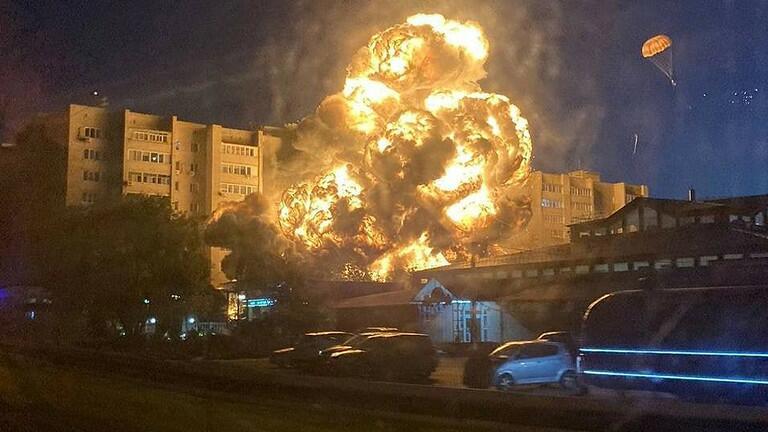
In fact, we may already be witnessing the beginnings of such a cyberwar. A week ago, a Russian jet slammed into a large residential building shortly after takeoff, and just this morning an F35 crashed out here in Utah. Could just be coincidence, as well as human error and/or mechanical failure—but it could also be true that these systems got hacked by hostile nation-state actors. If it is, I suppose we’ll never know for sure.
It makes a lot of sense to me that this conflict would escalate to a global cyberwar before it escalates to a global kinetic conflict. And if/when it does, energy infrastructure will be a major target. If so, it could get really, really ugly. The sources I follow estimate that we could see a 90% death rate after just two months of no power.
But again, I think Putin’s best move is to wait out his enemies and not show all his cards yet. We will amost certainly see limited cyberattacks, but a major global free-for-all? In my estimation, that’s unlikely, at least in the next twelve months. And even if it did happen, our power grid is so convoluted and Byzantine that I doubt that any nation state could knock it out 100% for a long period of time. It’s not a great defense against this sort of thing, but it does tend to work in our favor.
Global Famine: 5%
This is a big one. We’re already seeing a lot of warning signs pointing to major food shortages, with major droughts in North America, Europe, and Asia, energy and fertilizer costs at unthinkable levels, green public policies in places like The Netherlands that are just insane, and supply chains that are still incredibly bungled from the last pandemic. Global food prices are already going parabolic, and countries like Sri Lanka and Haiti are collapsing as a result.
I think this is a much greater immediate threat than some sort of global war. Every civilization is only three meals away from collapse. With that said, I’m not so sure it will be world-ending, at least in the immediate term. World-shattering? Yes. But the collapse is always distributed unevenly, and there’s still a lot of ruin left in the developed portions of the world, so I’m still pretty sanguine that we’ll find some way to muddle through this crisis, at least for the next twelve months.
Revolutionary Uprisings: 5%
As I mentioned above, the emerging global famine is already leading to popular uprisings in places like Sri Lanka and Haiti. I definitely think that trend is going to continue. But a lot of the unrest in the developed world is due to political instability that was already evident before the pandemic. Just look at the Yellow Vest movement in France, or the BLM and MAGA movements in the United States. Since the pandemic, those movements have only become more brazen, more entrenched, and more resolved.
Could we see an actual revolution in a major developed country, like the Bolshevik revolution in 20th century Russia, or the French revolution in 18th century France? I don’t think that’s beyond the realm of possibility. However, will we see such a revolution in the next 12 months? That’s a different story. Personally, I think the likelihood of such a thing is low, but that may just be my ignorance and normalacy bias speaking.
Here in the US, I think that the ruling Democratic party is going to get a truly historic spanking in November, which will go a long way to appeasing the popular discontent—at least in the short term. But I don’t think the Republicans are going to do any of the things that the people expect them to do, and long-term that will make the unrest that much worse. I doubt that it’s going to boil over in the next twelve months, but it could.
Hyperinflationary Collapse: 10%
There are a lot of reasons to think that we’re on the verge of experiencing a hyperinflationary event here in the US. The Fed exploded the money supply during the pandemic, which is we we’re currently experiencing such high inflation, and when you consider that velocity is at or near record lows, there is a lot of room for inflation to get much worse. Moreover, our glorious leaders seem determined to spend their way out of this problem, in much the same way that an alcoholic drinks himself out of a hangover.
But by far, the biggest and most dangerous factor is the collapse of the US dollar as the world’s reserve currency. If/when that happens, I frankly would be shocked if we didn’t experience a hyperinflationary collapse. Right now, the dollar is still the fastest fat man in the zombie apocalypse, but the Russia-Ukraine war is bringing a lot of countries together that would love to negotiate their trade deals in something other than US dollars. Not just minor countries either, but countries like China and Russia. Youch.
This isn’t something that came on us suddenly. In the past couple of decades, there have been a lot of red flags pointing to the end of the US dollar as the world’s reserve currency. The pandemic and subsequent events have accelerated those trends, and probably shortened the timeline of the collapse considerably.
But will we see a hyperinflationary collapse in the next twelve months? I’m skeptical of that. Right now, the dollar is strengthening against most other currencies, and I don’t see any other currency challenging ours for reserve currency status in the immediate future. Like I said above, we’re still the fastest fat man in the zombie apocalypse.
Global Unrest and Uncontrolled Mass Migration: 15%
If the coming global famine is going to be Earth-shattering, the secondary effects of that famine are going to be even worse. Like I mentioned above, Haiti and Sri Lanka are already in a state of collapse due to civil unrest, and global food prices have already exceeded the levels that gave us the Arab Spring. We’re probably not all going to starve, but enough of us very well might that the ensuring chaos will make the European refugee crisis of the 2010s and the current situation on the US southern border look like a dress rehearsal.
Again, the main reason I place this one at 15% is because I think it’s going to take some time for this one to really get going, and I’m skeptical that a twelve-month timeline is long enough for it to bring about the end of the world. But once this crisis does get going, it’s going to be ugly.
A Second (and Much Deadlier) Pandemic: 35%
Until last week, I placed the likelihood of this event happening at about the same level as a global nuclear war. But then I learned about the research at Boston University that was totally not gain of function, and managed to create a new strain of covid that was more transmissable than the Omicron variant and has a 80% fatality rate in experimental mice.
What the hell, you lab coat freaks? Do you WANT to kill us all? (No… please don’t answer that question.)
From what I understand, it wasn’t difficult to creat this new strain either. All they did was take the original alpha variant of covid-19 and splice it with the spike protein from the omicron variant. The alpha variant is now all but extinct in the wild, but if BU had managed to keep a sample, I’m sure that many others have too.
And exactly what is keeping some black hat actor from replicating this research and launching a second pandemic?
Even if the death rate in humans is only a fraction of what it was in the mice, that’s still a virus with an R0 at or near the omicron variant AND A MORTALITY RATE COMPARABLE TO THE BLACK DEATH. And now anyone with a halfway decent microbiology lab and a couple of covid samples can now create this insanely dangerous plague.
Given that this is a thing now, I would be extremely surprised if there isn’t another covid (or other artificially engineered) pandemic within my lifetime. Except that the next pandemic is going to be real, in a way that 2020 wasn’t. Seriously, when historians look back on this era, they probably won’t even look at 2020 as an historically significant year.
The only reason I’m putting this at 35% is because of timing. Will the black hat actor who concocts this plague decide to release it in the next year, or wait until conditions are more favorable for whatever agenda they want to push? Difficult to say. The likelihood is far greater than I would like, but I hope it’s no greater than 35%.
Global Debt Crisis and Financial Collapse: 80%
But of all the possible calamaties that could bring about the end of the world, the one that I most expect to see within the next 12 months is the collapse of the global debt market and a major financial crisis, even bigger than 2008. Much bigger, in fact, because we never actually solved any of the problems that gave us the GFC: we just papered over them and kicked the can down the road.
Well, it looks like we’ve just reached the end of the road. I can’t pretend to understand the financial markets in any sort of depth, but all of my sources—including folks who correctly called several false alarms in the past few years—are now saying that the big one is imminent. And when you look at what the US10Y is doing, or at how insanely inverted the yield curve is inverted, and realize that the debt bubble is orders of magnitude worse than 2008… yeah, that’s a big deal.
But would it truly bring about the end of the world as we know it? Well, consider this: what would you do if all of the banks closed, all of their websites went down, and you couldn’t use your debit or credit cards, or transfer cash into or out of your account, or even log into your account, or any financial account for that matter? What would happen if everyone on welfare suddenly found that their EBT cards didn’t work? If every employer suddenly found that they couldn’t make payroll? If the only thing left was cash, but none of the banks were open to disburse it?
That’s the sort of thing that would happen under this scenario. It might sound far-fetched, until you realize that it’s happened before. This exact thing played out in Cyprus a few years ago, and when the banks opened again, people were only allowed to withdraw something like a hundred Euros a day. It paralyzed everything.
Whenever there’s a major financial collapse, all of the big players get together in a smoke-filled room, lock the doors so no one can get out, and fight amongst themselves until they come up with a solution. “You bail out these institutions, I’ll bail out these ones, we’ll all take a 20% haircut, and the markets reopen at the end of the week.” Something like that. The last time this happened was 2008, and we were only hours away from a global banking holiday like the one I just described.
What happens if they can’t find a solution in time?
And even if they do, it’s not like there isn’t going to be any pain. Remember how bad the 2008 collapse was? That’s what happens when they find a solution—except this time, the underlying crisis has grown orders of magnitude larger, because we never actually solved it. We just papered over the problem instead.
I’m not an expert on this sort of thing, so the reason I’m pegging this one at 80% is because I’m a firm believer in the Pareto principle, and I don’t see any way that the status quo endures for another 12 months without a major catastrophe. Maybe the next financial collapse won’t be the end of the world, but given how unstable everything is right now, I don’t see it.
Climate Change: 0%
There is, however, one potential catastrophe that I can confidently peg at a 0% chance of ending the world in the next twelve months: climate change. It’s not a coincidence that this is also the one that’s probably eliciting the most panic right now. When the herd is all running mindlessly in one direction, it’s probably a good idea to stop and make sure there isn’t an abattoir up ahead.
Is the climate changing? Yes, as it always has. Is climate change man-made? Unclear. Is it changing catastrophically? Also unclear. Will we experience a catastrophic collapse of the global climate in the next twelve months? Let’s put it this way: climate activists have been warning us about an imminent catastrophe for 50+ years now, and the only people with a worse prediction track record are the ones who say “Jesus is coming on [insert date here].”
I would be a lot more inclined to listen to the activists if they didn’t all categorically reject the market-based solutions that have the best historical track record to reducing emissions and cleaning the environment. I would also be more inclined to listen to them if they weren’t so dead set against nuclear power, or if they were honest about the fact that drastic cuts to global energy production will lead directly to the deaths of many millions of people, especially in poor and developing countries.
When you combine that with how the all of the people who are most outspoken about climate change also fly to their conferences on private jets, have massive carbon footprints, and are buying beachfront property across the world, their hypocrisy speaks louder than their words. And as if that’s not enough, you have Project Veritas catching a major CNN executive on hidden camera confessing to how they plan to push climate change as the Next Big Thing after the pandemic is done.
So no, I don’t ascribe any credibility to the climate change hysteria that seems to have gripped the science fiction field. Twelve months from now, I guarantee that we will still have a human-habitable climate on this planet—unless the meteor finally kills us all.
Of course, I’m just a guy on the internet who follows this stuff for fun and uses it to write science fiction. I also have a political science degree, but don’t hold that against me, as I’ve been doing my best to unlearn all of that crap. But yeah: if the world does end in the next twelve months, I think the most likely scenario is a total collapse of the entire global financial system, followed by a second pandemic. It’s not as bright or as flashy as a nuclear war, but that’s where I’d put my money if I were a betting man.