Y is for Yog’s Law

Anyone who was trying to break into publishing before the ebook revolution should be familiar with Yog’s law, which states:

Money should always flow toward the writer.

The purpose of the law was to keep new writers from falling into one of the many writing scams. Places that charged writers to publish were almost all vanity presses, and those that weren’t didn’t give writers access to the distribution channels necessary to make their work widely available. If you wanted to have a career, you had to go with a publisher, and the best way to tell if a publisher was legitimate was to look at how the money flowed.

Nowadays, with self-publishing, the line between writer and publisher has been blurred. An indie writer can expect to contract out work, sometimes to the tune of several hundred or even thousand dollars, in order to produce a professional product. In these cases, money clearly is not flowing to the writer. So what does this mean for Yog’s Law?

Some people have attempted to reformulate Yog’s law by drawing a distinction between the writing side of the business and the publishing side. While I think that that’s instructive, I’m not convinced it’s entirely useful. The distinction is not always clear, and even where it is, in practical terms it’s basically meaningless. You can just as easily fall for a publishing scam with your publisher hat on as with your writer hat.

So is Yog’s Law obsolete? Is it a curious relic of a publishing era that is passing into the twilight of history? In its old formulation, perhaps, but I would like to propose a new formulation that is perhaps even more relevant to today’s publishing industry than the old one ever was. That formulation is as follows:

Control should always flow toward the writer.

In the old days of publishing, writers had virtually no control over their careers. Publishers decided which books would make it to readers, which writers would get the attention of the publishing establishment, and how many books those writers could publish in a year. Authors had almost no say in their cover art, marketing, or any other aspect of the production and distribution of their work. In such an environment, the only assurance they had that their publisher would do a reasonably competent job was by seeing whether they put their money where their mouth was–hence Yog’s Law.

But today, writers do have control. We have a variety of publishing options today, and money isn’t the only factor in determining whether a path is legitimate. In fact, it may be one of the worst factors. Not only have advances gotten worse in the last few years, but the rights grabs have gotten so bad that signing a traditional book deal today basically amounts to selling your birthright for a mess of pottage. Yes, money is flowing to the writer, but the writer is still getting screwed.

Control means being able to have the final say on the cover art, the editing, or on an other aspect of a book’s production. It means that important stuff like the metadata or book description is not left to an entry-level employee that the author has never met.

Control means that no contract should be one-sided. It means an end to non-compete clauses of any kind. It means that rights reversions should actually have meaning, and that no book should be tied up for the life of copyright.

Control means that the bulk of the revenue should go to the person who does the bulk of the work. Bringing a book to market is not a challenge in the digital age, but writing a book certainly is. Publishers exist to serve writers, not the other way around.

Control means that a writer should know exactly what services they are paying for. If they commission work from a freelance editor or cover designer, they should be the one who directs that work, not a third-party who doesn’t also assume some of the risk if the project doesn’t work out.

By the standard of control flowing to the writer, most of the contracts coming out of New York fail miserably. That is not acceptable in an age where the New York publishers aren’t the only game in town. If a writer can make a living by going it on their own, then anyone who pays less than a living wage is basically running a scam.

Control should always flow toward the writer. Money used to serve as a proxy for control, but now that we have the real thing it’s no longer the best measure. Control, not money, is what you need to build a career.
H is for Hybrid Author

Is it worth seeking traditional publication if you’re an indie writer? Are there advantages to going with a legacy publisher after you’ve published yourself?

A lot of writer throw around the word “hybrid” as if that’s their ultimate goal–the thing that’s going to make their career. A hybrid author is an author with their feet in both sides of the publishing world: the legacy world, with corporate publishers or small but reputable houses, and the indie world with their self-published books.

This might be a bit controversial, but I’m going to throw down the gauntlet and argue that most of the praise of the hybrid path is either hype or wishful thinking. From what I’ve seen, most hybrid authors fall into one of three camps:

  • Veteran authors who are disillusioned with the legacy industry and are doing everything they can to self-publish everything. They still have contracts that they can’t get out of, though, so technically they are considered ‘hybrid,’ even though many would rather not be.
  • Indie authors who haven’t been disillusioned about traditional publishing yet and believe that a legacy publisher would carry some of the burden for things like marketing and promotion. In other words, indies who believe that the grass is greener on the other side of the fence.
  • Unpublished writers who have been submitting to traditional publishers for years, and have deer-in-the-headlights syndrome with all the new publishing options available to writers. They’ll dabble with self-publishing, but their heart is still set in the old world.

So would I ever consider signing with a traditional publisher? I’ve thought about it quite a bit over the last few years, and I’ve come up with four conditions that have to be met before I’d do so. Please keep in mind, though, that I am not a contract lawyer, and that the following is my opinion and not legal advice.

Three of them are deal breakers on my side. They are:

1. Non-compete clauses

This is absolutely non-negotiable. In fact, if I see any sort of non-compete clause in a contract sent to me, I’ll pull out of negotiations altogether since it shows to me that the publisher is negotiating in bad faith.

A non-compete clause is a contract clause that says something like “the author shall not publish or cause to be published anything that may compete with the work.” Basically, it’s a publisher’s way of clamping down on you and saying you can’t publish anything without their approval. There is no f****** way I would ever tie myself up like that–not only would it kill the self-publishing side of my career, but it would also be unfair to my readers who have come to expect regular releases from me.

Let’s flip this on its head and say that I put in a non-compete clause for my publisher. For example, suppose I signed a contract with Tor Books that said “the publisher (Tor Books) shall not publish or cause to be published anything that may compete with the author’s work.” Can you see how ridiculous that is? How insanely one-sided it makes the contract out to be?

A publisher would never sign one, and neither will I.

2. Rights reversion clauses

If I’m going to sign a contract with a traditional publisher, I want to know when that contract is going to end. Life of copyright is life of the author plus 70 years, and that is far too long for me. But a lot of traditional publishing contracts contain loopholes that keep the rights from ever reverting back.

There are reasons why a publisher would want to hold onto your rights without actually publishing your book. Copyright is an intellectual property, and shows up on a corporate publisher’s ledger as an asset. Just by sitting on your rights, they’re able to show an accounting gain. So if they can hold onto your rights, they probably will.

I won’t sign a contract unless it includes an explicit date when the rights will revert to me. The length of the term and the options for renewal are open to negotiation, but having an explicit date is not.

3. Any payment terms based on net

Right now, the industry standard for ebooks is 25% of net. What does that mean? It means “we’ll pay you 25% of the revenue from your ebooks, after costs.” What costs, you may ask? There’s the rub–they aren’t specified.

“Net” is how Hollywood screws people over. It’s how a rockstar can go on a multi-million dollar tour and end up owing the record label money. It’s a dirty trick of creative accounting that the large corporate publishers are now starting to employ. In the old days, they used to base royalty payments off of the list price of the book. Now, though, New York is becoming more like Hollywood and less and less author friendly.

The fourth condition is a deal breaker for most publishers, on which I don’t see myself giving any ground. It is:

4. Ebook rights

Ebooks are where the money is. Legacy publishers understand this, and they’re doubling down on them. Hugh Howie, who signed a print-only deal with Simon & Schuster, has since said that the publishers are not open to considering that sort of deal now–not even for a massive bestseller like him.

The thing is, what value does a legacy publisher bring to epublishing? In less than an hour, I can craft an ebook that’s formatted better than most of the ebooks coming out of New York. As an indie, I have access to all the same online bookstores and distribution channels as the big publishers. And by self-publishing, I have control over the critically important metadata–a ball that legacy publishers often drop by relegating it to the lowest employees on the corporate ladder.

When it comes to ebooks, I do not see a single item of value that legacy publishers can bring to the table. Rather, I see a host of liabilities, and for what? With self-publishing, I can earn up to 70%-80% for every ebook I sell. With a publisher, I’d be lucky to get 15%–and that’s if they’re being generous.

For novels and other book-length works, it simply does not make sense to me to sign with a traditional publisher. Not in today’s industry, at least. And with the way legacy publishers are clamping down and making rights grabs, I don’t see it ever making sense in the foreseeable future either.

HOWEVER …

For short stories, the situation for authors is much more favorable. The magazines have no inclination to tie you up with non-compete clauses, the rights to the story revert back to you soon after publication, the payment is usually based on word count and specified in the contract, and the ebook rights stay with you (the magazine might purchase non-exclusive digital rights, but that won’t prevent you from republishing it as an ebook on your own).

I can see myself going hybrid by publishing short stories through the traditional markets. In fact, that’s exactly what I’m trying to do. Besides the chance to refine my craft by working on my short game, I figure that getting picked up by the major magazines will help to draw new readers to my other books. I have no idea how much it will help, but I figure it’s worth trying out. Besides, science fiction is a genre where reputation can make a big difference to your career, and you can build a reputation a lot more effectively through traditional short story markets than through self-publishing.

At the same time, though, that’s more of a side project than anything. My bread and butter is self-publishing, and that’s where my feet are firmly planted. I don’t see that changing anytime soon.

Why I’m not submitting to the 2012 Amazon Breakthrough Novel Award contest

Last year, I submitted Genesis Earth to the Amazon Breakthrough Novel Award contest and made it to the quarter-finals.  I’m pretty sure I could do at least that well this year, but after reading the contest rules, I’ve decided not to participate.

Why? Because of this:

5. GRANT OF RIGHTS. By submitting an Entry and if you are selected as a Quarter-Finalist or Semi-Finalist, you grant Penguin the exclusive first publication rights to your Entry. If you are selected as a Quarter Finalist, Penguin’s exclusive first publication rights to your Entry terminate when you are eliminated from the Contest (unless you are selected as a Semi-Finalist); and if you are selected as a Semi-Finalist, Penguin’s exclusive first publishing Rights to your Entry terminate after June 30, 2012.

But mostly because of this:

A. Grand Prize. If you are selected as the Winner in a category, you will receive one of two Grand Prizes each consisting of a full publishing contract with Penguin to market and distribute your Manuscript as a published book…you may not negotiate the publishing contract with Penguin, and you must sign it “as is” upon receipt of the executable contract.

The language is a little unclear as to whether the grand prize winner can elect to turn down the publishing contract, but considering how merely submitting to the contest constitutes a grant of publication rights, I’m guessing no.

So why is this a big deal?  Because it gives the writer no room to negotiate.  Suppose the boilerplate contract is unfavorable when it comes to rights reversion, non-compete clauses, or derivative works.  Penguin could conceivably retain the rights to my book indefinitely, even if I’m earning less than $10 a year on it.  With a non-compete clause, they could forbid me from writing or publishing any other books.  Even worse, they could conceivably buy up rights to the world or the characters, making it impossible for me to write any other books in my own series without their approval.

But even if none of those unfavorable terms are in the contract, the standard royalty for erights is 25% of net, not gross.  For those of you who know the difference between net and gross, that’s a red flag in itself, but even supposing Penguin does pay me the full 25% of the 70% it receives from Amazon, that comes to only 17.5% of the cover price.  Right now I’m getting 70%.  Is it really worth it?

I checked the sales rankings for the last three years of ABNA winners, and they aren’t all that great.  The ebook versions for the 2010 winners have a slightly better ranking than mine, but they can’t be selling more than a couple of books a day.  At the prohibitively high price of $9.99, that’s $.30 less per unit than what I’m earning for Genesis Earth at $2.99.  And the 2009 winners?  Their sales rankings are abysmal.  Whatever Penguin did to market those books, it either didn’t work or they’ve given up and moved on to other things.

Now, I don’t expect to win the grand prize even if I submit to this contest.  Most of the previous winning novels are either literary, mystery, or mainstream YA–no science fiction.  Even so, by submitting to this contest, I would not be able to negotiate a publication contract with any other publisher until my book is eliminated.  That’s a headache I could do without.  And as for the consolation prizes, if this year’s Publisher’s Weekly reviewer is anything like last year’s, I already know what she’ll say: “science fiction is garbage.”

So yeah, I won’t be submitting to this year’s ABNA contest.  If I win, I’m forced to sign a contract that I haven’t seen and have no power to change, and if I lose, I get an unnecessary hassle for all my time and effort.  Thanks but no thanks.

Deceptively unproductive day

Man, where did the day go?  I don’t feel like I was lazy, yet I only wrote about 1.2k words for the whole day.  And things were going so well the day before…

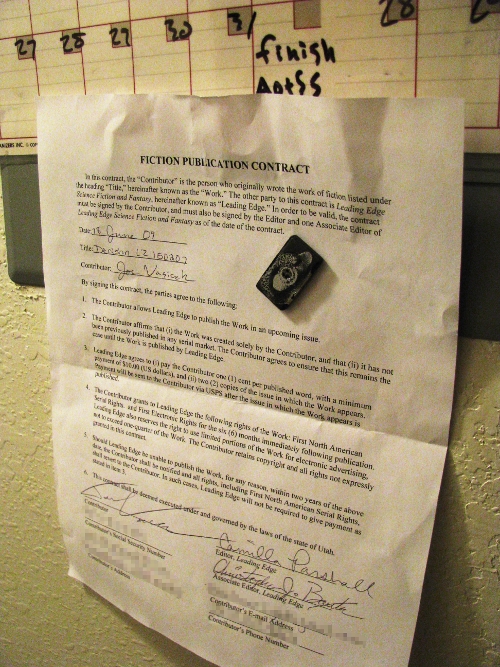
Well, I guess I was busy, just with a whole lot of other things.  Donated plasma (which took all morning), got some groceries, started GMing another round of werewolf on the quark forums, did some more research into ebooks, started the online TEFL course, went to Leading Edge and signed a contract for a poem they’re going to publish–

Oh yeah, check it out!  I signed my second publishing contract today–again, with Leading Edge.  They’re going t0 publish a short poem I wrote about Gliese 581g, otherwise known as Zarmina’s World.

(which reminds me, I’ve been meaning to blog about NASA’s Kepler mission since forever.  It’s an incredible mission which, I believe, will lead to some revolutionary astronomical discoveries–and may even rejuvenate interest in science fiction.  But more on that later…)

So yeah.  My goal is to finish WAFH before the end of February, which is going to require a lot of work.  Two and a half weeks, with LTUE 2011 sucking up one of the weekends…it’s going to be tough.

Numbers-wise, though, it’s still quite doable.  I want to keep this draft pretty close to 90k (no more than 100k), and I’m already at 53k words.  With sixteen days left in the month, I need to write between 2.3k and 2.9k words per day to make it.

In the meantime, it’s 2 am, and I’d better get some sleep. Waking up late is definitely bad for productivity, and I hate it. If I could train myself to wake up every morning at 5 am like Aneeka, that would be awesome. Actually, I’d probably just complain about how much it sucked to get up early every day, but hey–the grass is always greener…