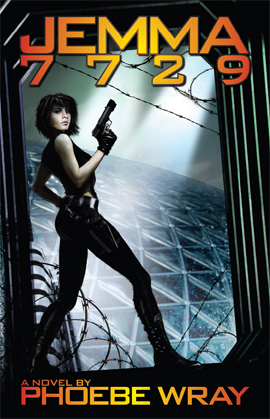
Jemma 7729 by Phoebe Wray

The following is a book review I wrote for The Leading Edge. It will be coming out in the November issue, along with my short story Decision LZ150207.  The editors gave me permission to post the review here.  Be sure to pick up a copy of the magazine when it comes out!

Jemma is a rebel, fighting against a system that teaches women to be obedient and submissive and “alters” those who refuse to assimilate.  After escaping the giant dome cities of a post-apocalyptic California, Jemma joins with a band of rebels known as the Movers in the free, uncultivated country.  But as her reputation grows and the people in the domes begin to take up arms, the government stops at nothing to hunt Jemma down and silence her for good.

With images reminiscent of Brave New World, 1984, and A Handmaid’s Tale, Jemma7729 is a dystopian, post-apocalyptic novel with a YA feel.  The first half of the book details Jemma’s childhood and her transformation from daughter of two mid-level government workers to a rebel fighting to overthrow the system.  I enjoyed the first part of this novel, with its intimate human drama and its resourceful, sympathetic viewpoint character.  The story was paced well and kept my interest.

The second half of the book, however, was somewhat disappointing.  Once Jemma escapes the domes and begins her campaign as a rebel terrorist, the story loses a lot of tension.  Even though she is barely a twelve year old girl, she still, without any outside assistance, manages to blow up almost a dozen government facilities without getting caught or killed.  The villains’ reasons for creating such an oppressive, anti-feminist regime are never adequately explained, and when Jemma starts to fight back, the government is too weak to put up a believable resistance.  The middle of the novel lags considerably, with very little real action or suspense.

When the pace finally does pick up again, about forty pages from the end, the action is so confusing and happens so quickly that I felt completely lost.  The main character’s voice gets lost in a blow-by-blow account of impossibly rapid events, as if the author was trying to compress two hundred pages of story into less than a quarter of that space.  I fount it disappointing and inconsistent with the tone of the rest of the book.  However, the twist at the end caught me by surprise and gave me some degree of satisfaction as I finished the book, though I would have been more satisfied if the last half of the book had been as good as the first half.

Review of JEMMA7729
Joe Vasicek
Jemma is a rebel, fighting against a system that teaches women to be obedient and submissive and “alters” those who refuse to assimilate.  After escaping the giant dome cities of a post-apocalyptic California, Jemma joins with a band of rebels known as the Movers in the free, uncultivated country.  But as her reputation grows and the people in the domes begin to take up arms, the government stops at nothing to hunt Jemma down and silence her for good.
With images reminiscent of Brave New World, 1984, and A Handmaid’s Tale, Jemma7729 is a dystopian, post-apocalyptic novel with a YA feel.  The first half of the book details Jemma’s childhood and her transformation from daughter of two mid-level government workers to a rebel fighting to overthrow the system.  I enjoyed the first part of this novel, with its intimate human drama and its resourceful, sympathetic viewpoint character.  The story was paced well and kept my interest.
The second half of the book, however, was somewhat disappointing.  Once Jemma escapes the domes and begins her campaign as a rebel terrorist, the story loses a lot of tension.  Even though she is barely a twelve year old girl, she still, without any outside assistance, manages to blow up almost a dozen government facilities without getting caught or killed.  The villains’ reasons for creating such an oppressive, anti-feminist regime are never adequately explained, and when Jemma starts to fight back, the government is too weak to put up a believable resistance.  The middle of the novel lags considerably, with very little real action or suspense.
When the pace finally does pick up again, about forty pages from the end, the action is so confusing and happens so quickly that I felt completely lost.  The main character’s voice gets lost in a blow-by-blow account of impossibly rapid events, as if the author was trying to compress two hundred pages of story into less than a quarter of that space.  I fount it disappointing and inconsistent with the tone of the rest of the book.  However, the twist at the end caught me by surprise and gave me some degree of satisfaction as I finished the book, though I would have been more satisfied if the last half of the book had been as good as the first half.

Battle scenes are HARD

I’m in the middle of revising a major battle scene right now.  This is supposed to be one of the more important climaxes of the book, adding a lot more tension and emotion as the novel approaches the main climax.

Let me just say, writing a good battle scene is tough.  The first version of this one…yeah, it sucked.  Hardcore sucked.  I’m cutting whole sections at a time–five hundred words, eight hundred words–and completely rewriting them from the ground up.  I’m not sad to see these sections go, either–they were BAD.

I think the most difficult thing is to keep the pacing up without confusing the reader.  For that reason, I reconceptualized most of the action here and made it simpler.  I also repeated several times the main point of tension–basically, will we get out of here before reinforcements come and kick our trash?  I hate it when a fight scene is so confusing that the tension just leaks out.  I don’t want that to happen here.

At the same time, I’m trying to filter everything through the viewpoint character.  Too often, I’ll read an action scene that’s just a blow-by-blow of the physical action.  That gets boring REALLY fast.  Without character, you have no stakes.  I want the stakes to be high from the very onset.

Still, it’s hard.  I don’t know if I’m succeeding yet.  I probably won’t until I distance myself from what I’ve written tonight and take a good, hard look at it.

Since I can’t do that until the third revision, I’m not going to worry about it.  Better to write it out now and move on than to try so hard to get everything perfect that I can’t see the story for the words.

On the plus side, I’ve been listening to a LOT of Star Wars battle music while writing this.  That’s always fun!

Outlining for a discovery writer

I’m almost finished with the rough draft of Bringing Stella Home, but I can’t shake the feeling that this draft really sucks and is full of holes.  

Part of that is probably that I wrote the whole thing  out of the top of my head.  The only part that I really took the time to outline was the back histories of the mercenaries–and that gave me material to make the story a LOT stronger.  This probably means that I need to do more outlining in the future.

I think I know now what to do and not to do.  Here’s my list of do’s and don’ts for someone like me who is more of a “discovery writer”:

Do’s:

  1. Keep a list of brief explanations for setting elements (history, cultures, traditions, technologies, magics, etc).  These do not need to be full length articles, but they should have enough information to trigger your knowledge and/or record the things that you are likely to forget.
  2. Keep profiles of all the major/viewpoint characters.  These should:
    –Briefly explain their backstory, including parents/family/origin, childhood, education/training, major formative events, etc.  This part should be fairly extensive, and will help you discover even more things about your character as you write your story;
    –Explain, in some detail, their motivations–not just their desires, but the basis behind their desires.  These usually grow out of the backstory;
    –List some basic stats: age, height, distinctive physical characteristics–basically, the stuff someone is going to get on a first impression;
    –List their important strengths.  This part can be sparse, but you should at least be aware of the things in which they are competent;
    –List their important flaws/handicaps.  This part can also be sparse, but it should be extensive enough to at least make you aware of and/or get you to think about the potential conflicts that will arise;
    –Explain why this character is sympathetic–why the reader is going to like this character.  You MUST make a conscious effort to think this out.  As the writer, you will love your characters simply because you created them, but the reader will not share in this euphoria.  Write this section like a pitch, as if you’re addressing the reader (I haven’t tried that yet, but it sounds like a good idea and I’m going to try it on my next project).
  3. Keep an ongoing list of all the major plot conflicts, with a checklist for each one of things that must/should happen in order to make the conflict as juicy and story-rich as possible.  These lists should be sparse: one sentence to explain the conflict (character vs. character), and each point of the checklist should also be one line.  You will flesh out each of these points as you go along, and you may even add new conflicts and get rid of old ones as your story takes shape.

Tip: None of these sections needs to be extensive.  Sometimes, it will work better if you simply cut and past excerpts from your novel in the appropriate places in your outline.  This may be especially helpful for setting elements and minor characters.

Tip: Not all of your outlining has to be done before you start writing.  The outline should be an organic document that expands and changes with your draft, and your best ideas will come as you write the story, not as you write the outline. The outline exists to serve the story, not the other way around. 

Don’ts:

  1. Don’t feel that you have to write encyclopedia-style articles on all of your setting/worldbuilding elements.  You are the only one who will see these, so you don’t have to extensively edit or proofread these sections.
  2. Don’t try to explain every detail of your characters’ personalities.  When you have a clear backstory, these will come out naturally.  To write believable characters, figure out the basics and then GET OUT OF THE WAY and let them take over.
  3. Don’t outline the plot; outline the major plot conficts with their necessary events, but expect these to change as you write.  This should be the most flexible part of your outline.
  4. NEVER feel that you have to fit your story to the outline.  The outline exists to serve the draft, not the other way around.  Use it as a reference and a set of guidelines, not a set of rules.  You will discover your story as you write and daydream about it, not as you write your outline.
  5. Don’t worry if your outline is spotty and full of holes.  You’re not writing this to an uninformed audience; you’re writing this to your future self, who can fill in the holes quite well.  In fact, your outline only exists to fill in the holes in your future self’s head and point him in a clear direction.
  6. Don’t worry if your story gets ahead of your outline on the rough draft.  For discover writers, outlines are more of an after-the-fact thing anyway, and your outline will continue to grow and expand in the rewrite.  In fact, you may find it more productive to write the rough draft in a burst of frenzied creative energy, leaving 90% of your outlining for the rewrite.

These are a few of the things that work for me, as a discovery writer.  I haven’t tried out everything on the do’s list, but looking back, I can see that they would have helped tremendously if I’d done them while writing Bringing Stella Home.  

Just because you’re a discovery writer, that doesn’t mean that you shouldn’t keep an outline.  It just means that you need to keep a different kind of outline, one that will enhance your discovery writing process rather than constrain it.

Revision, revision, revision

I finished revising chapter 6 of Genesis Earth today. It took a lot more time and effort than I’d expected. Even though I’d revised half the chapter yesterday, I started from the beginning and changed a lot of the other revisions I’d made. I think this version is stronger, but I’m not sure how it’ll fit in with the other chapters.

The thing about revising is that if you change something fundamental about the character / setting / plot early on, it changes everything that happens later, meaning that you have even more revisions to make. It’s like ripples on a pond, or switching tracks at a railroad junction hundreds of miles before your destination. Right now, a lot of the changes I decided to make earlier are making much larger changes necessary later on. That’s one reason why this chapter took so long to revise.

Another reason is because I felt I’d told it wrong the first time. A lot of my alpha readers said that my novel was weakest on conflict; they didn’t feel that it had enough conflict to carry them through the longer parts in the middle. I realized, when I reread it, that the conflict was mostly there, it just wasn’t emphasized properly.

A lot of these revisions had to do with connecting the events better, starting late and exiting early, creating more of a build up to the climax. They also involved changing the order in which I explained certain things–it created more tension to bring up certain things earlier, before the action. Tension and release.

I think I failed to do all that in the rough draft because I’m more of what Sanderson calls a “discovery writer.” The middle sections are always the hardest for me, because I have to figure things out as I go along. I’ve tried planning everything out from the beginning, but when I did that, the story that came out was completely different than what I’d planned.

Trouble is, if I’m discovering my story as I’m going along, the middle sections are going to be much more choppy and rough. I can write a pretty good beginning, and I think I can pull off a decent ending, but the stuff in the middle is just all over the place, every time I write.

Fortunately, I think the revision process is going well. It takes a lot of time and effort, but it’s producing results. I think chapter 6 works much better now, though it could probably use a little more tweaking just to fit it into the context of the story as a whole. Better finish the 2.0 revision before I do that, though.

For a while, I thought that with school out and all this free time on my hands before I really go anywhere, I could finish the 2.0 revision before the end of the week. Now, I’m thinking it will probably take more time. I could probably be about 75% done by the end of the week, though. Even with all these deep revisions, I’m plugging along at a healthy pace. And honestly, this is the kind of work I enjoy. It’s a challenge, but not an unpleasant one at all.