There Is No “AI Bubble”

In my various and sundry travels over this desolate wilderness we call the internet, I’ve recently heard a lot of people talk about this thing they’re calling the “AI bubble.” The basic theory is that all of this AI development is being artificially propped up, that it isn’t nearly as profitable or as transformative as the AI proponents claim. When the music stops and the curtain gets pulled back, all of these AI companies will collapse, and all of this AI that nobody asked for will get scaled back to something normal. Or something like that.

But here’s the thing… the fact that so many people are talking about the “AI bubble,” to the point that it’s now a talking point, is pretty strong evidence that it’s not actually a bubble. When a true economic bubble happens, nobody calls it a “bubble” because everyone is so euphoric about it. Indeed, it’s that very euphoria that fuels the bubble. Housing prices only go up, donchaknow. AOL and Pets.com is totally the way of the future. So shut up and mortgage your house so you can buy the latest tulip.

With AI, though, it seems that all of the most vocal people are anti-AI and want it all to go away. Indeed, the main driver of all this “AI bubble” talk seems to be fear that AI will drive large numbers of people out of work. So what’s actually happening?

I do think there is a bubble in our economy, but I don’t think it’s being driven by AI. Rather, I think what we have is a debt bubble, which is very close to unwinding in a catastrophic way. The only way to stop that from happening is to grow the economy faster than the debt bubble is inflating, but at this point, the only way to do that is through some hugely transformative new technology, such as generative AI.

So all of the forces that want to keep propping up this debt bubble have turned to AI as the salvation of our economy, pumping billions and billions of dollars into it in the hopes that it will yield the sort of economic growth that will allow them to keep growing the debt. But for ordinary people, it’s a lose-lose scenario, since if AI succeeds, lots of us will be out of work… but if AI fails, the economy collapses and lots of us will also be out of work. Hence why so many ordinary people see AI itself as the problem.

Here’s what I think is ultimately going to happen: AI will prove to be super transformative in the long run, just like the internet, but it won’t save us from the debt bubble the way that our business and political elites so desperately hope that it will. The debt bubble is going to pop, and we are going to have to face up to the consequences of decades of very bad fiscal and monetary policy, with or without AI. But after the dust settles, AI will play a major role in the rebuilding of the economy, for good or for ill.

A fascinating update on the ongoing fertility crisis

Stephen J. Shaw is doing amazing work on the fertility crisis and the ongoing depopulation collapse. He’s the one who made the original Birthgap documentary, and I think he just came out with a new one, which is why he’s doing the podcast circuit.

In any case, I found this interview quite fascinating. From what I’ve seen of him, Stephen J. Shaw strikes me as a thoughtful, gentle, and caring man—not at all the sort of monster that the left-wing opponents of the pro-natalist movement like to paint us all as. It’s not at all about forcing women to have children, or about trying to breed more of the right kind of genes and less of the wrong kind. Rather, he sees our collapsing fertility as an existential human crisis, and wants to do everything he can to avert (or at least mitigate) the coming collapse.

Why there will be no second American civil war

I just finished reading The Last Election by Andrew Yang and Stephen Marche. It’s a fascinating book, but not in the way that the authors probably intended.

The book basically presents a detailed account of the 2024 election, starting in November 2023 and ending with the results of a contingent election, after the (fictional) third party campaign disrupts things so thoroughly that no presidential candidate can get to 270 electoral votes. There’s violence in the streets, a supreme court justice who gets assassinated, a presidential debate that gets disrupted by a riot before it can really begin, a stealth military coup, and all sorts of insanity. And it ends (of course) with a Trump victory in the contingent election, where every state gets one vote and the representatives from each state vote behind closed doors. Cue the end of “our democracy.”

Partisan politics aside (and I am still genuinely undecided as to how, or even if, I will vote in 2024), there is sooo much to unpack in this book. The authors are totally ignorant about half of the country, and utterly clueless about the other half… and I can’t tell which half is which. That’s what I find so fascinating. Do the authors really believe that the average Trump voter hates and fears black people simply because they are black? Do they genuinely believe that sexual harrassment makes a better kick-the-dog moment than a coerced secret abortion ending in suicide? That such an abortion doesn’t even count as a kick-the-dog moment at all?

However, my purpose in this blog post is not to unpack all the myriad layers of willful and oblivious ignorance in The Last Election, but to point out what should be obvious by now: that most of the authors’ predictions are already failing to pan out.

By now, on the timeline, we should have had 1) an assassination of a justice of the supreme court, 2) RFK projected to win several states, and 3) street violence on the level of the George Floyd riots, with about as many casualties. Of course, none of those things have actually happened. And that, more than anything, makes me think that a hot civil war is unlikely to break out in this country.

Instead, people just seem to be exhausted. There are a few keyboard warriors, of course, but from what I can tell, most people on both sides are doing their best to tune them out. The memes aren’t anywhere near as good as they were in 2016. Of course, there’s still enough outrage for the political grifters to work with, but that outrage isn’t translating into lone wolves and false flags.

The 2024 election is shaping up to be the least important election in my lifetime. If our democracy were healthy, we would be debating the government’s disastrous response to the pandemic and whom we should hold responsible for it (of course, in a healthy democracy, the citizens would not have complied with those policies in the first place). Instead, the thing that’s sucking all the oxygen out of the room is the neverending lawfare against Trump—which is still important, don’t get me wrong, but is it really the most important thing happening right now? Inflation is crushing the economy, Europe is in the midst of its worst armed conflict since the Nazis, we are closer to a nuclear armed conflict with Russia than we were in the Cuban Missile Crisis, and Anthony Fauci is still both alive and free.

When I step away from the perpetual outrage cycle that passes these days for the news and look at the current state of the world, what I see is not a superpower that is careening toward a hot civil war, but a former superpower that is steadily disintegrating. Some parts of the country are in a greater state of collapse than other parts, but we are all in the midst of a collapse, and probably have been for years, perhaps even decades. Our dysfunctional politics is not the cause of any of this. It’s just a symptom.

As Americans, we like to think of ourselves as exceptional. We also like to obsess over the imminent fall of our cuntry. That’s probably why there’s been so much talk in the last few years about the possibility of a civil war. God forbid that America goes out with a whimper instead of a bang.

But the more I see, the more I think that that’s exactly how this country will fall apart: with a steady and unrelenting disintegration, until our politics are totally irrelevant, our military is unable to project power overseas, our national government is little better than that of a failed state, and our economy is so weak that no one bats an eye at rolling blackouts and empty grocery shelves.

Then we will pass through a period when things that cannot continue will not continue, and things that must happen will happen. Several states will become de facto autonomous, simply to survive. Many won’t. The dollar will collapse and the efforts of the global elite to replace it with a global digital currency will fail, but their depopulation efforts will succeed beyond their wildest dreams, and ultimately prove their downfall. The perpetual growth paradigm that the left calls “capitalism” and the right calls “progressivism” will unravel to devastating effect, and by 2100, there will be fewer than one billion humans on this planet (which will probably be significantly colder than it is now).

But there will not be a second American civil war, because that would require a level of dynamism that we simply do not possess. There is still a lot of ruin in this country, though, so we will probably endure longer than most other countries… kind of like how Japan is going on its fourth “lost decade” by now. But Japan had us to lean on. We’re not going to have anybody except ourselves.

Fortunately, in some places, that will be enough.

2019-12-19 Newsletter Author’s Note

This author’s note originally appeared in the December 19th edition of my author newsletter. To subscribe to my newsletter, click here.

I’ve been thinking a lot about self-reliance recently. I just finished reading One Second After by William R. Forstchen, and while it’s a good book—perhaps even an important book—I have to say that is not the sort of thing that is fun to read when you’re newly married and expecting your first child. It really makes you think about the things you take for granted, and just how fragile our world really is.

If you know the basic premise of the book, you’re probably nodding along sagely right now. If not, then you probably haven’t read much prepper fiction yet. One Second After is actually a pretty good book to start with, if you’re interested in the genre. In the next couple of weeks, I’ll write a proper review.

I don’t consider myself a “prepper” in the common sense of the word. I don’t have a stockpile of guns or ammo, I don’t really go for all the “tacti-cool” stuff that’s popular in prepper circles, and I don’t obsess over SHTF scenarios. That said, I’m not ignorant of the many ways our society could (or is) falling apart, and I do have contingency plans if/when that happens.

Probably the best prepper blog/resource that I’ve found is Listening To Katrina, which was written by a guy who lived through Hurricane Katrina and the aftermath. Lots of really fascinating stuff there, and he does a fantastic job of boiling his experience down into lessons for the rest of us. I discovered this blog just as I was starting to get more interested in self-reliance and emergency preparedness, and it did a lot to develop my thoughts on the subject.

Another big influence on me were the Forgotten Skills books by Caleb Warnock. A lot of really fascinating stuff there. He hits on things from the self-reliance angle more than the prepper angle, which is how I like to come at it too. It’s not about having two years of freeze-dried food in your basement that you never eat or use, it’s about living in such a way that you can provide for your own needs whether or not a disaster strikes, and produce more than you consume.

About a year ago, I took what I’d learned from these and other resources and mapped out something that I call my Path to Self-Sufficiency:

  1. Learn how to store and use oats, beans, and wheat.
  2. Learn how to make bread and maintain a sourdough culture.
  3. Start an herb garden and learn how to garden.
  4. Develop a storage system for canned and dry goods.
  5. Learn how to make kraut and fermented vegetables.
  6. Learn how to make yogurt and cheese.
  7. Keep a garden for greens, tomatoes, peas, and peppers.
  8. Learn how to can and pickle.
  9. Finalize the garden plan (including compost).
  10. Build a rainwater reclamation system.
  11. Develop a source of off-grid power.
  12. Build a wood-fired oven and learn how to make bread with it.
  13. Learn how to hunt and process game meat.
  14. Develop a plan for livestock.
  15. Secure a source for eggs and milk.
  16. Learn how to make clothing and work with textiles.
  17. Build a shop and learn how to work with wood and metals.
  18. Build a foundry and learn how to cast metals.
  19. Build a greywater reclamation system.
  20. Secure a source for homespun textiles.
  21. Acquire productive land and improve it.
  22. Build an off-grid cabin.

The items are listed in rough order, though I’ve jumped around a little bit since making the list. For example, Mrs. Vasicek and I have solar panels on our house (11), and we’re looking seriously into keeping bees (14). But it’s a pretty good reference point for answering the question “okay, what’s next?” Currently, I’m working on step 6, and when spring comes around I’ll dive into steps 7, 8, and 9.

A lot of this hearkens back to a blog series that I started several years ago, called “the self-sufficient writer.” At the time, I was exploring ways that I could incorporate what I was learning into my writing career and lifestyle. The goal, I suppose, was to show how it’s possible not only to make a living as a writer, but to achieve a healthy degree of self-reliance at the same time.

Would you be interested in reading that blog series if I brought it back? I’ve learned a few things since then, and would have to start it over from the beginning, but it’s an interesting subject that I enjoy exploring. And now that I’ve finally got some land to work with, there’s so much more to do.

The Path to Self-Sufficiency is very much a work in progress, and I doubt I’ll get to everything on it. A lot depends on Mrs. Vasicek and what she wants to do. With a child on the way, other projects will no doubt take priority, but with everything going on in the world, this is not a ball I think we can afford to drop. If you have any suggestions or stories of your own, I’d love to hear from you.

A Much Deserved Fisking

In the November issue of Locus magazine, Cory Doctorow wrote an op-ed piece defending Jeannette Ng and the decision to strip Campbell’s name from the Campbell Award. At least, that’s how it started out, but it quickly devolved into a hatchet piece against everyone in science fiction whose politics lie somewhere to the right of Stalin.

Ever since Sad Puppies III, I’ve more or less gotten used to the gaslighting, hypocrisy, and projection that has become de rigeur in the traditional publishing side of the field. But somehow, Doctorow’s hit piece manages to hit a new high water mark for leftist insanity.

Since my own politics lie somewhere between Boadicea and Genghis Khan, I thought it would be fun to give the piece a good old-fashioned fisking. I can’t pretend to be as good at it as Larry Correia (and I sincerely hope he fisks it himself), but damn, if anything ever was written to be fisked, it was this ridiculous piece.

Doctorow writes:

At the Hugo Awards ceremony at this summer’s Dublin Worldcon, Jeannette Ng was presented with the John W. Campbell Award for Best New Writer. Ng gave an outstanding and brave acceptance speech

Translation: Ng reinforced the dominant far-left narrative in the science fiction field, telling the gatekeepers exactly what they wanted to hear and earning widespread praise for it.

True bravery is Jordan Peterson deleting his $35,000/month Patreon in protest of their hate speech policies, or Kanye West coming out as a devout Christian, producing a worship album, and announcing that he will no longer perform any of his old songs.

in which she called Campbell – the award’s namesake and one of the field’s most influential editors – a “fascist” and expressed solidarity with the Hong Kong pro-democracy protesters.

You know who else shows solidarity with the Hong Kong protests? That’s right—everyone’s favorite deplorable frog!

Now that’s a dank meme.

I’m curious: does this make Ng a white supremacist for showing solidarity with people who use such a rascist hate symbol? Does it make Cory Doctorow a dog whistler to the far right for appealing to these obviously racist deplorables?

Of course not, but that’s the level of insanity we’ve fallen to.

I am a past recipient of the John W. Campbell Award for Best New Writer (2000) as well as a recipient of the John W. Campbell Memorial Award (2009). I believe I’m the only person to have won both of the Campbells,

All red flags to deplorable readers like me,

which, I think, gives me unique license to comment on Ng’s remarks, which have been met with a mixed reception from the field.

I think she was right – and seemly – to make her re­marks. There’s plenty of evidence that Campbell’s views were odious and deplorable.

There’s that word: “deplorable.” Whenever someone uses it unironically, it’s a sure sign that they hate you. It’s also a sign that they don’t actually have a good argument.

It wasn’t just the story he had Heinlein expand into his terrible, racist, authoritarian, eugenics-inflected yellow peril novel Sixth Column.

I haven’t heard of that one. Thanks for the recommendation, Cory! I’ve already ordered it.

Nor was it Campbell’s decision to lean hard on Tom Godwin to kill the girl in “Cold Equations” in order to turn his story into a parable about the foolishness of women and the role of men in guiding them to accept the cold, hard facts of life.

Okay, I call bullshit. “Cold Equations” wasn’t about the “foolishness of women,” it was about how when our inner humanity comes into conflict with the hard realities of the universe, the hard realities always win.

Switch the genders—a female pilot and a teenage boy stowaway—and the story still works. Switch the endings—have the pilot decide to keep the stowaway, dooming himself and the sick colonists—and it does not.

In fact, it makes the girl even more of a hapless, weak feminine stereotype. Stepping into the airlock voluntarily is an act of bravery. In some ways, she’s stronger than the pilot—and that’s kind of the point.

The thing that makes “Cold Equations” such a great story is that it functions as something of a mirror. It’s the same thing with Heinlein: those who see him as a fascist are more likely to be authoritarians, while those who see him as a libertarian are more likely to be libertarians themselves. After all, fascism is “citizenship guarantees service,” not “service guarantees citizenship.”

It’s also that Campbell used his op-ed space in Astound­ing to cheer the murders of the Kent State 4. He attributed the Watts uprising to Black people’s latent desire to return to slavery.

Was John Campbell a saint? No, and I don’t think anyone’s claiming that. In the words of Ben Shapiro, two things can be true at once: John Campbell had some racist, sexist views, and stripping his name from the award is wrong. (Also, that Doctorow is full of shit.)

The Campbell award isn’t/wasn’t named after him because he was a perfect, flawless human being. It was named after him because of his contributions to the field. If we’re going to purge his name from the award, are we also going to purge all of the classic golden-age books and stories that he edited, too? Are we going to have the digital equivalent of a book burning? Because that strikes me as a rather fascist thing to do.

These were not artefacts of a less-englightened [sic] era. By the standards of his day, Campbell was a font of terrible ideas, from his early support of fringe religion and psychic phenomena to his views on women and racialized people.

What are the standards of our own day? In what ways are we less-enlightened? Are future generations likely to accuse Doctorow of being a “font of terrible ideas,” just like he accuses Campbell here?

Do unborn black lives matter? If Trump is truly a fascist, why does the left want him to take all our guns? Is it okay to be white? Is Islam right about women? Is transgender therapy for prepubescent children just another form of conversion therapy? Are traps gay?

When you free your mind to explore new ideas, a lot of them are bound to be terrible. It’s simply Sturgeon’s law. So is Doctorow criticizing Campbell for having an open mind, or for not conforming to Doctorow’s values and beliefs?

Who’s supposed to be the fascist again?

So when Ng held Campbell “responsible for setting a tone of science fiction that still haunts the genre to this day.

I’m pretty sure that taking hormone blockers and getting your balls cut off makes you a hell of a lot more sterile than anything else. Lesbians, gays, transgenders, queers—all of these tend to be sterile as a general rule. Most babies are still made the old-fashioned way.

Male.

Isn’t her word choice kind of sexist here? I mean, she could have used the word “patriarchal,” but she didn’t. She. Deliberately. Used. The. Word. “Male.”

White.

Is she saying that it isn’t okay to be white?

Exalting in the ambitions of imperialists and colonisers,

Come on, Ng. Let’s not be racist. There were plenty of imperialists and colonizers who weren’t white Europeans. After all, how can we forget Imperial Japan and the Rape of Nanking? Now that was an ambitious massacre. The Turks also ran a pretty brutal empire, as did the Zulus and the Aztecs. You can’t tell me that cutting out the beating hearts of more than 80,000 prisoners to rededicate your temple isn’t ambitious.

settlers and industrialists,”

Find me one place that was not built by “settlers.” Find me one human being on this planet who has not benefitted from “industrialists.” Who do you think makes the vaccines and antibiotics? Who do you think makes machines that harvest your food?

Just for a single day, I would like to see all of these anti-capitalist types live without any of the benefits that capitalism and modern industry provide.

she was factually correct.

And yet, so completely full of shit.

In the words of Andrew Klavan, you can’t be this stupid without a college education.

Not just factually correct: she was also correct to be saying this now.

Because it’s [current year]!

Science fiction (like many other institutions) is having a reckoning with its past and its present. We’re trying to figure out what to do about the long reach that the terrible ideas of flawed people (mostly men) had on our fields.

The best way to fight a terrible idea is to allow it out in the open while fostering freedom of speech. In the words of Andrew Breitbart, sunlight is the best disinfectant.

The reckoning that Doctorow is calling for is something that’s already built into the field. Science fiction is constantly evolving and revisiting its past. Good science fiction not only builds on the stuff that came before, it critiques it while taking the ideas in a new direction.

We don’t need to tear down the legacy of the giants in the field who came before us; we simply need to build up our own legacies for the generations that come after us. But that’s not what Ng and the social justice warriors want to do.

It isn’t a coincidence that the traditionally published side of the field is rapidly losing market share as the SF establishment seeks to purge everything that could possibly offend their progressive sensibilities. The people doing the purging can’t compete on the open market because their toxic ideologies don’t resonate with the buying public, so they’re forced to resort to the digital equivalent of burning books and tearing down statues. Meanwhile, indie publishing is eating their lunch.

Get woke, go broke.

We’re trying to reconcile the legacies of flawed people whose good deeds and good art live alongside their cruel, damaging treatment of women. These men were not aberrations: they were following an example set from the very top and running through the industry and through fandom,

Future generations will struggle to reconcile our good deeds and our good art with our cruel and inhuman treatment of the unborn.

None of this is new. All of us are flawed; every generation is tainted with blood and sins that are reprehensible to those that follow. Realizing all this, you would think a little introspection is in order. But the people today who are so eager to throw stones are completely lacking in self-introspection that they can’t—or rather, won’t—see their own blood and sins.

to the great detriment of many of the people who came to science fiction for safety and sanctuary and community.

Is science fiction a “safe space,” or is it the genre of ideas? It can’t be both at the same time. Ideas are inherently dangerous.

It’s not a coincidence that one of the first organized manifestations of white nationalism as a cultural phenomenon within fandom was in the form of a hijacking of the Hugo nominations process.

Bullshit. If you think that the Sad Puppies were white nationalists, you’re either stupid or willfully ignorant (a distinction without a difference).

Larry Corriea’s flagship fantasy series, the Saga of the Forgotten Warrior, is set in an Indian-inspired fantasy world populated entirely by brown people. Brad Torgerson has been happily married to a woman of color for decades. Sarah Hoyt is both latina and an immigrant.

If this article was written three years ago, you would have just called them all racists, but you can’t do that now because “racist” has lost its edge. You’ve cried wolf far too many times, and no one pays attention to those accusations anymore. That’s why you use words like “fascist,” “white nationalist,” and “white supremacist” to describe your enemies—not because you actually believe it, but because those accusations haven’t yet lost their edge.

While fandom came together to firmly repudiate its white nationalist wing, those people weren’t (all) entry­ists who showed up to stir up trouble in someone else’s community. The call (to hijack the Hugo Award) was coming from inside the house: these guys had been around forever, and we’d let them get away with it, in the name of “tolerance” even as these guys were chasing women, queer people, and racialized people out of the field.

Translation: we’re done with paying lip service to “tolerance” and “open-mindedness.” From now on, if you don’t look like us, act like us, or think like us, we’re going to do everything we can to destroy you.

I’m telling you, these people hate us. That’s why they call us “deplorables.” That’s why they paint us as racists and fascists, even when we’re nothing of the sort. They don’t want to listen to us. They don’t want to give us a fair hearing. They want to destroy us.

Stripping Campbell’s name from the Campbell Award is just another example of this toxic cancel culture. It isn’t about reckoning or reconciliation. It’s a naked power grab.

Those same Nazis went on to join Gamergate, then became prominent voices on Reddit’s /r/The_Donald, which was the vanguard of white national­ist, authoritarian support for the Trump campaign.

See, this is why I can’t trust you, Cory. Gamergate had legitimate grievances with Anita Sarkeesian, Zoe Quinn, and Gawker. Trump supporters had legitimate reasons to want to stop Hillary Clinton from becoming president. Yet you casually dismiss all these people as deplorables, racists, and fascists without even listening to them.

That’s intelluctually dishonest, Cory. It’s also a form of gaslighting.

The connections between the tales we tell about ourselves and our past and futures have a real, direct outcome on the future we arrive at. White supremacist folklore, including the ecofascist doctrine that says we can only avert climate change by murdering all the brown people, comes straight out of SF folklore, where it’s completely standard for every disaster to be swiftly followed by an underclass mob descending on their social betters to eat and/or rape them (never mind the actual way that disasters go down).

I don’t think Cory Doctorow has any idea what actually happens when society collapses. When the thin veneer of civilization gets stripped away, people will eat each other. We’ve seen this just recently in Venezuela, Syria, and Mexico. Here in the US, we can see the seeds of our own collapse in Chicago, Portland, San Francisco, Baltimore, and Detroit (all very blue and progressive cities, by the way).

Also, I don’t think Cory Doctorow has any idea what he’s talking about when he says “white supremacist folklore.” What is that even supposed to mean? Just a couple of paragraphs ago, he called all the Sad Puppies “white nationalists,” and that obviously isn’t true. By “white supremacist folklore,” does he mean all the science fiction that doesn’t fit his radical progressive political ideology? Once again, he’s painting with an overly broad brush.

Also, notice how he uses “white supremacist” instead of “racist.” He can’t use “racist” because that word has been overused. Give it a couple of years, and “white supremacist” will lose its edge as well.

When Ng picked up the mic and told the truth about Campbell’s legacy, she wasn’t downplaying his importance: she was acknowledging it. Campbell’s odious ideas matter because he was important, a giant in the field who left an enduring mark on it. No one questions that. What we want to talk about today is what Campbell’s contribution was, and what it means.

Whenever the people on the progressive left claim that they want to have a “conversation” about something, what they really mean is “shut up and let me tell you how I’m right and you’re wrong.” There is no way to have an honest dialogue with these people, because they will not listen to us “deplorables.” Cory Doctorow has already demonstrated this with his blanket accusations against all the supporters of Gamergate, the Sad Puppies, and President Trump.

These people don’t want to talk about “what Campbell’s contribution was, and what it means.” They want to purge him from the field. Metaphorically, they want to burn his books and tear down his statues.

Look, I’m not trying to defend all of Campbell’s views here. I’m all for having an honest discussion about his bad ideas and how they’ve influenced the field. But I don’t believe I can have that discussion with people who clearly hate me, and will do whatever it takes to cancel and destroy me.

After Ng’s speech, John Scalzi published a post where he pointed out that many of the people who were angry at Ng “knew Campbell personally,” or “idolize and respect the writers Campbell took under his wing… Many if not most of these folks know about his flaws, but even so it’s hard to see someone with no allegiance to him, either personally or professionally, point them out both forcefully and unapologetically. They see Campbell and his legacy ab­stractly, and also as an obstacle to be overcome. That’s deeply uncomfortable.”

Scalzi’s right, too: the people who counted Campbell as a friend are au­thentically sad to confront the full meaning of his legacy. I feel for them.

Do you really, though?

It’s hard to reconcile the mensch who was there for you and treated his dog with kindness and doted on his kids with the guy who alienated and hurt people with his cruel dogma.

Did you catch the sneaky rhetorical trick that Doctorow uses here? He assumes that we’ve already accepted his argument that Campbell’s views were odious enough to have his name stripped from the award. Now he’s using an appeal to emotion to smooth it over.

Gaslighting of the highest order.

Here’s the thing: neither one of those facets of Campbell cancels the other one out. Just as it’s not true that any amount of good deeds done for some people can repair the harms he visited on others, it’s also true that none of those harms can­cel out the kindnesses he did for the people he was kind to.

Or cancel all of his contributions to the field?

If Doctorow actually believes all this, why does he support Ng, who argues that everything Campbell did should be cancelled out by his most odious views? If anything, this is an argument against stripping Campbell’s name from the award.

Life is not a ledger. Your sins can’t be paid off through good deeds. Your good deeds are not cancelled by your sins. Your sins and your good deeds live alongside one another. They coexist in superposition.

Yes, and you should never underestimate the capacity of the human mind to believe two mutually exclusive ideas at the same time, especially when his name is Cory Doctorow.

You (and I) can (and should) atone for our misdeeds.

Not in today’s cancel culture, where everything you’ve accomplished can be erased by the one bad thing you tweeted or posted to Facebook ten years ago. There’s also no forgiveness or repentance, when you will be forever remembered for the worst thing you said or did.

We can (and should) apologize for them to the people we’ve wronged.

No. Giving a public apology is the absolute worst thing you can do in today’s cancel culture, because your enemies will smell blood in the water and come in for the kill.

Never apologize to a mob.

We should do those things, not because they will erase our misdeeds, but because the only thing worse than being really wrong is not learning to be better.

Oh, this is rich.

You first, Cory. Have you taken a good, hard look in the mirror? Have you really, truly asked yourself “what if I’m wrong?”

I don’t see eye to eye with Vox Day about everything, but he was right about this: you social justice types always lie, you always double down, and you always project your own worst faults onto your enemies. That’s why you’re so blind to your own hypocrisy, even when it’s staring you in the face.

I completely and totally agree that we should all strive to admit when we’re wrong and learn to be better for it, but you’re not in a position to tell me that, Cory. Not after painting all us “deplorables” with such a broad brush.

People are flawed vessels. The circumstances around us – our social norms and institutions – can be structured to bring out our worst natures or our best. We can invite Isaac Asimov to our cons to deliver a lecture on “The Power of Posterior Pinching” in which he would literally advise men on how to grope the women in attendance, or we can create and enforce a Code of Conduct that would bounce anyone, up to and including the con chair and the guest of honor, who tried a stunt like that.

Honest question: was the sexual revolution a mistake?

Asimov, Heinlein, Farmer, and all the other science fiction writers who explored questions of sexuality back the 60s and 70s were speaking to a culture that had abandoned traditional morality for a new, “free love” ethic. In other words, having thrown out all the rules, they now felt free to explore their newly “liberated” sexuality.

Was Asimov wrong in his attempt to rewrite our sexual norms? Personally, I believe it was, but I come from a religious tradition that still practices total abstinence before marriage and total fidelity within. Even then, it still depends on context. Groping a random stranger at a science fiction convention is obviously wrong, but playfully pinching my wife when the two of us are alone? Not so much.

I find it really fascinating that the woke-scolds of the left have become far more puritanical and prudish than the religious right ever was. Within the bonds of marriage, most of us religious types are actually very sex positive—after all, where do you think all those babies come from?

And Ng calls us “sterile.” Heh.

We, collectively, through our norms and institutions, create the circum­stances that favor sociopathy or generosity. Sweeping bad conduct under the rug isn’t just cruel to the people who were victimized by that conduct: it’s also a disservice to the flawed vessels who are struggling with their own contradictions and base urges.

Fair enough, but there’s nothing generous about today’s cancel culture, which is frankly pathological in the way it defines everyone by their worst flaws and basest urges.

Creating an environment where it’s normal to do things that – in 10 or 20 years – will result in your expulsion from your community is not a kindness to anyone.

But how can we know what will and will not be acceptable in 10 to 20 years?

Twenty years ago, it wasn’t considered hate speech to say that there are only two genders. Ten years ago, “micro-aggressions,” “safe spaces,” and “white privilege” were not a thing. In fact, we’d just elected our first black president, bringing an end to our racially divisive past. /sarc

In the next 10 to 20 years, will we adopt all the theories and ideologies of the radical left? Or will the pendulum swing back in favor of more conservative morals and standards? We don’t know yet, because the future has not been written, and frankly, it’s not our place to write it. Every generation reinvents the world.

There are terrible men out there today whose path to being terrible got started when they watched Isaac Asimov grope women without their consent and figured that the chuckling approval of all their peers meant that whatever doubts they might have had were probably misplaced. Those men don’t get a pass because they learned from a bad example set by their community and its leaders – but they might have been diverted from their path to terribleness if they’d had better examples.

Certainly. I’m just not convinced that these virtue signalling, social justice warrior types are the examples that we should hold up.

They might not have scarred and hurt countless women on their way from the larval stage of shittiness to full-blown shitlord, and they themselves might have been spared their eventual fate, of being disliked and excluded from a community they joined in search of comradeship and mutual aid. The friends of those shitty dudes might not have to wrestle with their role in enabling the harm those shitty dudes wrought.

I’m confused. Does Doctorow believe that women are strong and independant, or does he believe that they’re tender, fragile creatures that need to be protected from socially inept, “larval” shitlords? I mean, I can see how they need to be protected from predators, since all of us—women and men—are vulnerable to various degrees… but you’d think that a strong, independent woman would be able to hold her own against a socially incompetent geek who is simply a “flawed vessel.”

Since her acceptance speech, Ng has been subjected to a triple-ration of abuse and vitriol,

Join the club.

much of it with sexist and racist overtones.

You keep using those words. I do not think they mean what you think they mean.

But Ng’s bravery hasn’t just sparked a conversation, it’s also made a change. In the weeks after Ng’s speech, both Dell Magazines (sponsors of the Campbell Award) and the James Gunn Center at the University of Kansas at Lawrence (who award the other Campbell Award at an event called “The Campbell Conference”) have dropped John W. Campbell from the names of their awards and events. They did so for the very best of reasons.

No, they did it because they were bullied into it by the woke-scolds.

As a winner of both Campbell Awards, I’m delighted by these changes. Campbell’s impact on our field will never be truly extinguished (alas),

Yes, because what you really want is to tear down all the statues and burn all the books. Who’s the fascist again?

but we don’t need to celebrate it.

Back when the misogynist/white supremacist wing of SF started to publicly organize to purge the field of the wrong kind of fan and the wrong kind of writer, they were talking about people like Ng.

Bullshit.

The entire point of the Sad Puppies (which Doctorow intentionally and dishonestly mischaracterizes as “the misogynist/white supremacist wing of SF”) was to bring more attention to a diversity of conservative and libertarian writers, many of whom are also women and people of color. We were the ones who were excluded, not the ones doing the excluding. In fact, we invented the words “wrongfan” and “wrongfun” to describe the unfair way that we were treated by the mainstream establishment.

Please stop trying to gaslight us, Mr. Doctorow. Please stop projecting your own faults onto us, and recognize your own hypocrisy which is laced throughout this article. I don’t expect a public apology, since I wouldn’t offer one myself, but do wish for once that you would just listen to the people on the other side of these issues. Just. Listen.

I think that this is ample evidence that she is in exactly the right place, at the right time, saying the right thing.

Meanwhile, traditional publishing and the SF establishment will continue to implode, and indies will continue to eat your lunch.

If all you want is to be king of the ashes, you can have it. The rest of us are off to build the new world.

Will A Song of Ice and Fire stand the test of time?

A while ago, I wrote a blog post titled Why I don’t like George R.R. Martin, in which I laid out some of the issues I had with the Song of Ice and Fire series, and why I decided not to read past the first book. That post has been getting a lot of traffic lately, probably because the last season of Game of Thrones is coming out and there’s a lot of hype right now about it.

At FanX a couple of weeks ago, I attended an interesting panel with Steve Grad from Pawn Stars on the do’s and don’ts of collecting. On that panel, he expressed some skepticism that Game of Thrones signatures and collectibles would hold their value over time. This made me wonder: will the books this TV series is based on stand the test of time?

Full disclosure: I have only read the first book, A Game of Thrones, and have not watched any episodes of the miniseries. I’ve watched a few of the more important scenes on YouTube and occasionally follow discussions about it on online forums. After reading the first book, I decided that this series was not the sort of thing I wanted to watch or read. See the blog post linked above.

People have been calling George R.R. Martin the American Tolkien for years now, but I’ve always been skeptical of that claim. Tolkien’s books are timeless because they are so archetypal, with the classic struggle of good vs. evil permeating every page. In contrast, Martin rejects the archtypes of good and evil for a nihilistic black-and-gray morality, where there are no heroes, only victimizers and victims.

Why, then, is A Song of Ice and Fire so popular? First of all, because the writing and storytelling really are top notch. For all my criticism of George R.R. Martin, I fully recognize that he is a master. But there are a lot of excellent, masterful books that never capture the public imagination quite like Game of Thrones and A Song of Ice and Fire. What, then, makes Martin’s work so different?

I believe it’s because George R.R. Martin has struck a nerve with the current zeitgeist, and scratches a uniquely contemporary itch in a way that none of the great works by the old masters can. What is that zeitgeist? It is spirit of a culture in the late stages of decadence, where wealth disparity, big government, endless wars, easy credit, runaway debt, moral decline, and corruption are the defining aspects of the age.

In a world where, in so many ways, we are shielded from the consequences of our own actions, morality becomes irrelevant and entertainment shifts to serve our basest, most carnal lusts. In such a world, we turn to nihilistic stories like Game of Thrones, which are saturated with sex and violence. They reinforce the view that good and evil don’t exist, that honor and integrity are for fools, and that wealth, power, and sexual indulgence are all ends in themselves. “Eat, drink, and be merry, for tomorrow we die, and it shall be well with us.”

At the same time, these stories satisfy a deep sense of self-loathing that arises out of the very nihilism that they celebrate. In those few moments when we are honest with ourselves, the decadence of our age profoundly disgusts us. As Haruki Murakami put it, “secretly everyone is waiting for the end of the world.” That is exactly what stories like Game of Thrones give us: gleeful destruction and total collapse, with blood, fire, ice, and steel. No one is safe. Anyone can die, even our most beloved characters. Winter is coming.

Every empire collapses, however, and every age of dedadence comes to an end. The very nihilistic elements that make stories like A Game of Thrones so appealing ultimately cause them to fall away and vanish, along with the culture itself. To stand the test of time, stories must be built upon archetypes that transcend the spirit of the age, rather than indulge it. Does George R.R. Martin do this? I don’t believe that he does.

A Song of Ice and Fire has an added disadvantage in that the TV series has overtaken the books. How many people will simply give up on the books after watching the season 8 finale? A Dance with Dragons averaged a 2.9-star rating on Amazon the year it came out, with thousands of reviews. It takes George R.R. Martin so long to write these books that it’s already become a meme, and his health isn’t all that great.

Personally, I think we’ve already reached peak George R.R. Martin. The season 8 finale will be an enormous affair, but after that the show’s popularity will steadily decline, and the books will not renew the public interest. I still think the books will do well compared to other books in the fantasy genre, but compared to previous installments, I think the Song of Ice and Fire series will go out with a loud and plaintive whimper.

A generation from now, when the current age of decadence is over and our children and grandchildren are rebuilding the world, I believe they will look at these books and scratch their heads—if they even bother to read them at all.

The end of politics in America, part 2

How did Trump become the leader of the most powerful nation on Earth?

A lot of people are asking that question, while a lot of other people already know (hint: it wasn’t the Russians). But I want to get beyond the circus that is Washington DC, and answer that question by asking another:

Can politics solve our nation’s greatest problems?

I think there is a dawning realization among Americans that it doesn’t really matter who lives on 1600 Pennsylvania Avenue. Republican or Democrat, the outcome is pretty much the same.

Never at any point in living memory have we been so politically divided, but the party distinctions have become increasingly meaningless. Trump campaigned on providing universal healthcare. Clinton campaigned on escalating our military involvement in Syria. Which one was the Republican, and which one was the Democrat?

In the previous post, I said:

I am convinced that the grand key to understanding United States history in the 20th century—and by extension, current events in the 21st—is a deep knowledge of monetary policy and the financial system.

What is that system?

It is a system of debt. Pure and simple. We have turned our debt into money, and made every other form of money illegal. And the rest of the world has followed us gleefully off the cliff.

Washington is bankrupt. Literally bankrupt. Every year, the Treasury runs an internal audit, and every year, that audit fails. The government’s single biggest asset on their balance sheets is… $1 trillion in student loan debt. Social Security is insolvent and, according to the government’s own reports, will completely run out of money in less than twenty years.

So if Washington is bankrupt, why haven’t they declared bankruptcy? Because they can just keep printing money through the Federal Reserve.

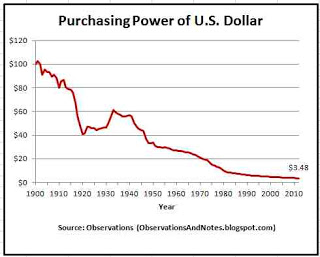
Because of this, the US dollar has lost about 97% of its value since the Federal Reserve system was established in 1913. A time traveler from the new Wonder Woman movie couldn’t buy $5 worth of stuff with $100 of our dollars today. And to keep up this Ponzi scheme we call “money,” Washington has gone nearly $20 trillion in debt.

How much longer can we keep that up?

If we could grow our economy fast enough, and never stop growing, we could keep up the Ponzi scheme for a very long time. But growth is no longer a solution, because the debt is bigger than the economy. The debt is the reason we can’t grow.

If we could innovate fast enough, we could lower the cost of living so much that the poor don’t realize that they’re poor. To some extent, we’ve already done that. But the effects are too uneven: startphones and computers are super cheap, but houses and health care are practically unaffordable.

Which brings us to serfdom.

Let’s go back in time a couple thousand years. Before the days of the empire, the Roman dream was that every family would have their own plot of land, making them independently wealthy, and the head of every family would take up arms in defense of his country whenever called upon by the state. This was not all that different from the Jeffersonian ideal of the yeoman farmer.

Then the Punic wars happened, which, for the Mediterranean world, was basically the ancient WWI and WWII. As Rome became a major world power, the military-industrial complex made a few select elites fabulously wealthy, who kept the masses pacified with welfare handouts.

But the endless cycle of foreign wars came at a heavy cost. Decades of budget deficits and an unsustainable national debt forced the Romans to debase their currency, which completely collapsed. Trade halted, the middle class lost everything, and the 1% became fantastically wealthy, buying up all the real estate and forcing everyone else out. The Roman dream was dead, replaced by a form of bondage called serfdom.

Serfdom came in a number of different flavors:

  • Slaves, who had always existed in the Roman world and continued for some time in the Medieval. Landlords got tax benefits for holding slaves.
  • Villeins, who were bound to the land and worked for the landlords. In exchange, they enjoyed protection and tax relief. Theoretically.
  • Coloni, or sharecroppers, who leased land in exchange for labor and a portion of their harvest. They were eventually taxed out of existence.
  • Freemen, who technically weren’t serfs, but were only a raid or a bad harvest away from becoming one. They were basically renters.

The corvée was a tax, paid in labor, that non-landowners owed by law. Basically, for every XX days out of the year, you worked for the state. It continued even after the abolition of serfdom, until the revolutions of 1848. My Czech ancestors paid the corvée, which is probably one of the reasons they and their children emmigrated to the United States.

But wait—we pay the corvée too! It’s called the federal income tax: for XX days out of the year, you work for the state. The taxes are even higher if you’re self-employed or a small business owner.

Except… not everyone pays the income tax. In fact, nearly half of Americans pay no income tax. Why? Because the politicans know that they can use the welfare system to buy votes. If you’re on welfare, who are you going to vote for: the guy who plans to cut your handouts, or the guy who says that the wealthy should pay their “fair share”?

And sitting at the top of it all are the central bankers.

The medieval serfs were bound to the land and worked for the landlords. In contrast, modern debt-serfs are bound to their debt—national debt, student loan debt, mortgages, consumer debt—and work for the banks.

So I ask again: can politics solve this problem? Can we find a political solution to our national debt?

Unfortunately, there is only one political solution: default on the debt. If we default on entitlements like social security, there would be chaos, riots, and anarchy… and we still wouldn’t pay down hardly any of the debt. If we defaulted on our treasury bonds, it would send a ripple of financial panics across the world, destabilizing the flashpoints in Europe and Asia before returning to our shores. Stocks, mutual funds, and pensions would all be wiped out. Almost the entire savings of the Baby Boomer generation, gone.

But there is another option, though it’s hardly a “solution”: kick the can a little further down the road. Print the money, devalue the debt, and inflate the currency to oblivion.

This is the path we’ve been on since 1913. This is the reason why our dollars buy a little less each year. And this is the reason why we, as a nation, are backsliding into serfdom.

We’ve seen this happen before. Rome fell because of it. Europe came under the yoke of serfdom as a result of it. Our ancestors fled to this country to escape it. And now, we are repeating it.

This isn’t a political problem: it’s a math problem. The numbers just do not add up. The next financial crisis could very well be the “extinction level event” that puts the final nail in the coffin of the US dollar, throws the world into a global war, and sends the United States into its greatest existential crisis since the Civil War. The Republicans don’t have the solution, and neither do the Democrats, because the problem is not political.

This is what the end of politics in America looks like. We’re watching it happen in real-time. Our politicians have become the clowns in the bread-and-circuses routine. Meanwhile, the central bankers are shackling us in chains with every dollar that passes through their hands.

What are you going to do about it?

A fascinating journey of discovery

I had a really fascinating experience last year that has turned into something of a journey of discovery. It’s still ongoing, and I’m sure it will affect my writing in years to come.

It started with family history. Long time readers of this blog will know that I’ve been interested in family history for some time. My sister is a professional genealogist who specializes in Czech records (she keeps a blog here), and I got started by helping her.

In the United States, the census records are only useful to about 1850. Before that, you have to get into land records, probates and wills, and local courthouse type stuff to really go anywhere. But in the Czech lands, the Catholic Church has kept meticulous parish records going back to the 15th and 16th centuries. They’re handwritten in old German and totally unindexed, but the books are all digitized and available online.

As I worked on this research with my sister, I started to wonder: how far back can we push these lines? What are the limits?

The Czech lands were part of the Holy Roman Empire, under the Austrian Habsbugs. In the 15th century, the Hussite Wars shook things up quite a bit, and that’s about as far back as the Catholic parish records go. But the noble genealogies were very well kept, and go back quite a bit further. If one of your lines connects to the nobility (which is very possible, given how many bastard children were running around), you can push back really far.

But past the 8th century, things start to get sketchy. Most of the nobility in Europe are descended from the barbarian tribes who invaded the Roman Empire: the Goths, the Franks, the Vandals, etc. Same thing with the Slavs and the Byzantine Empire, though the Byzantines held out much better than the Western Roman Empire (it was the Turks, not the barbarians, who eventually did them in).

The trouble is that when these barbarians took over, they tried to establish their legitimacy by fabricating genealogies. Plenty of royal European lines go back all the way to Adam and Eve, but how reliable is that really? As rulers of Christian lands, of course they would try to connect themselves to famous characters from the Bible.

The Dark Ages might not be as dark as we think they are, but in terms of records and record-keeping, they certainly are. The largest and most civilized empire in the world had just collapsed, with barbarians running amok in the countryside and the Persians threatening the last vestiges of the empire in the east. Very few historians have documented this era, and it was a huge dark spot in my own understanding of the world.

So I set out to study it. I scoured Wikipedia, subscribed to the Western Civ podcast, and listened to the entire History of Rome by Mike Duncan (excellent podcast, by the way). The Roman Empire had dominated Europe right up to the early middle ages, and I wanted to learn why it had fallen.

That led to a journey of discovery all in itself. Roman history is a fascinating subject in its own right, and the four or five centuries from the Punic Wars through the reign of Marcus Aurelius are very well documented. Rome faced a lot of challenges, and even a few existential threats, but for more than a thousand years they dominated the known world.

So why did they fall?

The more I studied about the Romans, the heavier this question weighed on me. I learned about Diocletian and the Tetrarchy, the crisis of the third century, and Constantine the Great—a period of Roman history that was much less familiar to me. And then things started to click.

My Czech ancestors were serfs. They emmigrated to Texas shortly after the last vestiges of serfdom were abolished in 1848. Under serfdom, they were little better than slaves. The land they lived and worked on was owned by the Hukvaldy Estate, and they were bound to it by feudal law.

When Diocletian became Augustus, the Roman Empire was reeling from half a dozen existential crises, including an economic collapse. The money was so worthless, most of the empire had resorted to a barter economy. Diocletian established a system of exchange where people could pay their taxes with trade goods rather than money. However, the only way for that system to work was 1) for everyone to take the profession of their parents, and 2) for no one to move without Imperial permission. Otherwise, you might have too many pig farmers in one province and not enough blacksmiths in another.

In other words, the system of feudal serfdom that my ancestors labored under had its roots in the reforms of Diocletian. But it went much deeper than just one man. Diocletian reforms were necessary because the Roman economy had collapsed, and the economy had collapsed because for more than a hundred years, the Empire had been in massive debt, and had serviced its debts by devaluing its currency.

Sound familiar?

The Roman Empire fell because of deficit spending, government debt, and currency devaluation over the course of several generations. In 1913, the United States established the Federal Reserve, beginning our own process of currency devaluation. Our national debt has doubled every eight years since 2000, when the stock market peaked as measured in gold. Right now, our debt-to-GDP is 104%. One hundred four percent.

And that’s just our sovereign debt. Our household debt is north of $12 trillion, or another 73% of our GDP. The largest portion of that is student loans, which cannot be resolved through bankruptcy.

Seven out of ten Americans have less than $1,000 in savings.

Half of Americans would have to beg, borrow, or steal if slapped with an unexpected $400 expense.

Twenty percent of American households do not have a single person that is working.

Fully one-third of America is in debt collections, meaning that they have an unpaid debt more than 180 days past due.

Is it any wonder that the middle class is shrinking? We’re following the same path that Rome followed, except where they merely walked, we’re running headlong. With our modern communications, the pace of life is so fast that I suspect we’re completing the cycle in a fraction of the time.

And then you realize that what passes for money these days isn’t “money” at all, but government paper backed by government debt. What happens when we default? What happens when the credit markets freeze up and contagion spreads across the global economy? What happens when you wake up one morning, only to find that all the ATMs are down, the banks are all closed, and everyone’s accounts are all frozen?

So what started as an interest in family history took me down a rabbit hole where I learned all about how Rome fell, and how we’re following in the footsteps of Rome. It led to a keen interest in monetary policy and our global monetary system. It also gave me a new hobby: coin hunting.

The Romans devalued their currency by melting down the old gold and silver coins, and minting new ones mixed with copper. Over time, the melt value of the coins went down, and that’s exactly what’s happening to our US currency now.

Before 1965, dimes and quarters were made from 90% silver. After, they were made from copper with a thin nickel coating. Nickels have always been made from a 75/25 copper-nickel alloy, however, and pennies were all 95% copper until 1982. Right now, the melt value of a US penny is actually 1.8¢. At the height of the “jobless recovery” it was closer to 4¢.

Now, it’s illegal to melt down pennies because they are currently legal tender. However, as the currency continues to inflate, the penny will become even more worthless, eventually reaching the point where it doesn’t make sense to make anymore. Right now, the material cost alone of each zinc penny is 70% of the face value. Canada has already discontinued minting pennies, and we aren’t far behind.

I started dabbling in copper hoarding. But as I went through lots of pennies, I started coming across some really old ones. Which got me to wondering if maybe the numismatic value of some of these coins eventually might be more than their melt value. After all, when everyone’s melted down their copper pennies, a complete collection of Lincoln cents is going to be something special.

So I started building a collection of Lincoln cents. Then I got into state quarters, first as a cool Christmas gift for one of my nephews, then for myself. Then I got into Jefferson nickels, and started finding silver.

Right now, I have a complete set of Lincoln Memorial cents. They’re all from circulation, and some of them are pretty beat up, but there are a few really nice ones in there too. My wheat cents collection is much less complete, but the coolest piece is a 1909 VDB in very fine condition, with all the wheat berries still showing. That’s a $10-$15 penny that I found in a normal coin roll.

It’s a fun hobby, and it comes around full circle to what got me started down this rabbit hole in the first place. Each one of these coins is a small piece of history. That 1909 VDB is more than a hundred years old. I’ve got coins that my parents and grandparents would have used, and a penny for every year of my father’s and mother’s lives. With a bit of luck and a lot of patience, I’ll be able to find a penny for every year of my grandparents’ lives as well.

So yeah, it’s been a fascinating journey of discovery, and it’s still ongoing too. I just got started with Roosevelt dimes, and I’m catching up on Mike Duncan’s Revolutions podcast, which is just as interesting as his History of Rome. Turns out that the French Revolution also happened because of deficit spending and a runaway government debt. Surprise, surprise.

Life is a giant rabbit hole when you’re curious about everything!