Bringing Stella Home 1.1 is finished

A few minutes ago, I finished the rough draft of Bringing Stella Home. This is my third completed novel. Huzzah!

It needs a ton of work, too…there’s no way I’m going to let this thing see the light of day, not until I finish the second draft.

In fact, I should probably set down tomorrow and start listing all the plot holes that need to be fixed in the revision, before I forget them all. It feels like there are dozens and dozens of holes. Not a good feeling.

Still, IT’S DONE!!! All that worrying and fretting and gtalk rants at Charlie along the lines of “GAH!! THIS NOVEL SUCKS!!!” have paid off, and I’ve got a draft I can work with! Inshallah, it should be downhill from here.

I remember when I wrote Genesis Earth, how all throughout the process of writing the rough draft, I felt that the work was terrible. And it’s true–the rough draft needed a lot of work. However, I think revising comes easier to me than drafting, and the process of writing the second draft was much, much smoother and more enjoyable than the first one.

So, what I have now is a hunk of rock roughly in the shape of a face. I can’t quite tell if it’s th face of a man, a woman, or a monkey, but it’s a face nonetheless. That’s better than an unworked block of stone, at least. Maybe someday it will be a decent work of art, if my hands don’t slip and I shave the nose off by accident.

I’ll let this draft sit for a few weeks, maybe a month, then pick it up again for the revision. In the meantime, on to other things.

And really, as rough as this draft may be, it feels awesome to finally have it finished. Reality sets in tomorrow, when once again I find myself staring at a blank page.

Bringing Stella Home 1.1

mss pages: 416
words: 118,596
file size: 791 KB
chapters: 21
start date: 6 May 2009
end date: 10 June 2009

Wordle: Bringing Stella Home 1.1

POSTSCRIPT: Hahaha! MS Word just popped up a dialogue box saying “there are too many spelling and grammar errors to underline them all” or something like that! HILARIOUS.

Genesis Earth pitch and other assorted thoughts on writing

Today I got together with Charlie after her work and discussed how to pitch my novel Genesis Earth.  We did it in the following way: I took a few minutes to explain what the book was about, while she wrote down the words that stood out and excited her.  Later, I took the words and worked out a thirty second pitch for it.

It was HARD!  I spent nearly two hours after meeting with her just to write out a stupid four or five sentence blurb!  Selling your work is totally different from producing it.  Anyway, here’s what I came up with:

Michael has never set foot on Earth, but it haunts him as much as the legacy of his parents.  So when his parents build the first artificial, traversable wormhole, he sets out with his mission partner, Terra, to explore the Earthlike planet on the other side.  They arrive only to discover an empty, abandoned world and an unresponsive ghost ship advancing towards them.  When Terra’s schizoid tendencies threaten her mental stability, they both must learn to trust each other in order to confront the mysteries of the new universe–and the personal insecurities that keep them from what they truly desire.

I have that down to 29.6 seconds.  I should probably cut it shorter, but as it is it only has about half of the words that Charlie wrote down.  If I cut it any more, I’m afraid it just won’t make sense.

It’s a start, though, and talking with Charlie helped me out tremendously.  I realized that when I’m selling this stuff, I need to focus on the characters.  Sure, all the worldbuilding stuff is interesting, but it’s not what hooks the reader.  If all you’ve got is thirty seconds, don’t cut to the chase–and don’t give a synopsis!  Synopsis =/= pitch!

Charlie was exhausted, so as we talked, she started ranting in a way that can be described as bluntly honest.  Interestingly enough, most of what she said was actually quite helpful, not only for Genesis Earth, but also for my other projects.

The most helpful thing she mentioned was that when you’re writing characters, you often have to pick out their distinctive character traits and consciously overemphasize them.  If you don’t, the reader might not pick up on it and find your characters stale and boring.  While I hate melodrama and try to keep my novels free of it, I also need to keep my characters interesting.  It’s a fine line to walk, but one that you can’t avoid.

She also said that it’s very easy for protagonists to be more boring than the main characters.  I think this is probably because we rely on formulas and cliches when we’re starting out, since that’s much less risky than breaking the rules we don’t yet fully understand.  The protagonist is the character closest to the trope, while the side characters can do what they want without threatening the integrity of the story.  

Charlie said that because it’s so easy to fall into the trap of a boring protagonist, you need to consciously choose the traits that are interesting about that character and work them into the story as much as possible.  I realized, as she said that, that my main protagonist for Hero in Exile is, indeed, a boring character.  I need to pick out the things that make him interesting and consciously work those into his character.

This got me to think about planning.  I’ve found that if I try to outline a novel when I set out to write the rough draft, I end up telling a completely different story.  However, if I try to write a second draft without an outline, I have a hard time keeping things straight and fixing all the stuff I missed while discovery writing the first draft.

(I’m really upset now, because I was going to mention something that I need to foreshadow in the next revision of Genesis Earth, but…I totally forgot what it was!  GAH!!!  That’s what I get for not outlining!)

Charlie then started to rant about some of our writing friends, and how she would never listen to criticism on her writing from someone she considered to be an inferior writer to herself.

That part was…interesting.  While I agree 110% that arguing with criticism is a sign of a poor writer, I don’t think it’s especially useful to rank writers in terms of “good” or “bad.” I would like to believe that I can learn something from everybody, and not just what not to do.  Perhaps that’s optimistic, but I think it’s also practical–I’ve found that a bloated ego can shoot you in the foot six ways to Sunday before you even know what’s going on.  I’ve found that not just through one unfortunate experience, but through several.

Brandon Sanderson said something very interesting in the last email he sent out to his English 318 class: he said that in New York, editors and agents don’t rank manuscripts by “good” and “bad,” they rank them by how much work they think it needs to be publishable.  There is a distinction between the two, just as there’s a distinction between recognizing something that works really well and something that follows the rules.  

That’s about all I have the time for now.  I’ve got to get to bed.  Late night internet == bad idea.

Breaking 90k and other mundane excitements

(I almost always have trouble figuring out titles for these blogs posts.  I mean, my writing life isn’t all that exciting–I just write.  Check out my study abroad blog from last year for true (if old) excitement).

I broke 90k words in Bringing Stella Home today.  According to my goal of 120k, that’s the 3/4 mark.  Yay!  I’m happy to say I’m going strong, and will probably “finish” this thing in a couple of weeks.

I say “finish” because it needs a LOT of work.  Oh yeah.  Not even ready for the alpha readers yet.

But I’m excited for the story.  Dave Wolverton at CONduit this past weekend suggested full and complete immersion as a way to write well.  I think that applies here: without school or a job, I basically write all day.

Speaking of which, I haven’t quite gotten up to doing 4k words steadily each day.  Right now, I’m hovering at around 3k, which is twice as much as my daily wordcount during the school year, but not yet up to where I want it to be.

However, getting up to that level is like training your muscles.  Through a number of small, intangible things, I feel that I’m working myself up to the 4k/day level.  

For example, I’ve been opening my word document and plugging out the first few hundred words BEFORE I open a web browser and waste an hour of time checking out my favorite blogs and websites.  That’s progress.

I’ve also started writing more in the time that I set aside to write.  These days, I usually write for a couple hours from 11pm to 2pm, take lunch and do something to recharge my creative batteries, do some more writing in the midafternoon (usually not too much), then take dinner, head out to the library (because the parking gate opens at 7pm) and write until about 11:30pm when the LRC closes.

In each of those three blocks of time, I used to be getting around 800 to 1,200 words done.  Today, from 11am to 1pm I wrote about 1,500.  Progress.

The bar says that I only did about 2,9k today, but that was because a good friend of mine is going active duty in the Air Force and his farewell party was tonight.  Also, Leading Edge took up the 7pm to 9pm slot.  So, without those things, it probably would have been 4k.

However, I’ve noticed something interesting: doing the math, 4k/day equates to just over 120k per month.  120k is a freaking novel!  Taking out Sundays, that’s still over 100k, which is also an acceptable novel length.  

So…if I were really doing 4k/day, would I be writing a rough draft of a novel each month?  Or are most published writers doing less than 4k words of new material each day?  I wouldn’t be surprised–this is not a business you get into because of your glowing math skills.

Regardless, 4k/day is still my goal.  Heck, if I get used to writing that much and find that the practice improve my craft, I might even go up to 6k/day.

Oh, and one more mundane excitement: Charlie got freaked out by a spider today and had me come over to hunt it down.  After sprawling out on her bathroom floor and looking under all the appliances, I didn’t find it–but I did find the hole that it probably escaped through.  I didn’t think it was much of a deal, until I read this post from Miss Snark’s archives.  So…I may start making it a practice to shake out my shoes from now on, especially since my room in my sister’s apartment is slightly buggy.

Fortunately, I usually wear my old pair of Birkenstocks these days.  Awesome footwear.  I quite literally love them to pieces.

“That’s what it looks like when the infection sets in.”

So said Howard Tayler at CONduit today when he saw the expression on my face at the Aspiring writers Q&A panel.  We chatted a bit afterward, and he said something very encouraging: that if I continue to pursue my writing career with the same hunger he saw on my face, he believes I will be successful.  Awesome!

This weekend, I attended CONduit 2009 in Salt Lake.  It was my first con experience, and I had a great time!  Besides being just plain fun, it was very educational and inspiring.

I felt a bit unnerved at first to be surrounded by so many people that I barely knew, in a comfort-zone shattering kind of way.  I went up with  Charlie and Laura, though, and it helped to have friends sharing the experience.  By Saturday, we were all getting around very well.  By the end, I figured that I did know a lot of people there–and, surprisingly, that a lot of people recognized me.

I came away with a TON of ideas and things learned!  Here are just a few of them:

  • One of the panelists on Friday suggested this revision method: use search-and-replace to color all filler words (such as “really,” “just,” “very,” “was”; basically, the words I always overuse on this blog).  That way, you can easily see which sentences you need to rewrite.
     
  • Howard and Sandra Tayler mentioned, almost in passing, how they made it a matter of prayer before deciding to go full time on the web comic thing.  I definitely need to include the Lord more as I try to figure out how this writing thing is going to fit into my life.
     
  • In their Saturday panel, Howard made a very interesting remark about cultivating your personal image.  I realized that if I want to be seen as a professional by editors and agents, I need to adjust my wardrobe and appearance accordingly.  I don’t necessarily have to go the suit-and-tie route–Howard’s  image involves jeans and a button-up shirt–but my dress and appearance should say “I am competent, sharp, and serious about what I do.”
     
  • Dan Willis had a very interesting suggestion for writers: get and use business cards.  Networking is one of the most important business activities that aspiring writers can, should, and must engage in, so using business cards at conventions is very important.  It sounds so obvious, but I’d never given it much thought.   I’ll have to get some printed up for myself before I go to World Fantasy and Worldcon later this year. 
     
  • Between panels, I got into a fascinating conversation with Eric James Stone about networking at these conventions.  From that conversation, I learned how important it is to be genuine and personal as you network, to listen more than you talk, and to never see people as mere stepping stones for your career.  He got an anthology contract with Kevin J. Anderson through a con, and he never approached him with that attitude–ever.  Other people he saw who did, Anderson treated politely but never contacted.  You should certainly have a pitch ready, but you should also give time for contacts to develop.  Over time, people will remember your face and recognize you at these events.

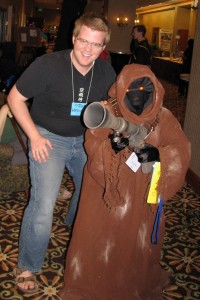
conduit2009-jawaConventions are definitely great for networking, but I absolutely hate walking up to a stranger and asking for favors.  It makes me very nervous.  As a result, I’ve adopted the philosophy of asking myself what I can offer the person I’m trying to connect with, rather than asking something of them.  I tried to follow this philosophy at CONduit, even if all I could offer was a compliment on something they’d said on a panel.

Using this strategy, I was able to get into a lot of interesting, genuine conversations with some of the big names at the con.  Charlie, Laura, and I got into a long, interesting conversation with L. E. Modessitt at one point.  He gave me some advice on women, which Charlie found hilarious (he must have seen us bickering/bantering earlier).  Had some good conversations with Dave Wolverton as well–he probably recognized me as the crazy fanboy who had him sign a poster of his first (now out of print) novel.  It was also good to see Brandon and talk with him–I thanked him for his helpful (if harsh) comments on my English 318 final.  Other people like James Dashner and Julie Wright recognized me from LTUE, which was really cool.

If people in the local scene are starting to recognize my face and my name, I must be doing something right.  That’s very encouraging.  Plus, the convetion was just plain fun. To top it off, the guy in the jawa costume was awesome.  All around, good times.  Very good times.

CONduit 2009 mp3s

I was fortunate enough to attend CONduit 2009 this weekend, up in Salt Lake.  It was a ton of fun, and very educational and inspiring as well;  I’ll sum up more of my thoughts and impressions from the con later.

I recorded most of the panels I attended, and I’ve linked to the full mp3s here.  I haven’t listened to any of them all the way through, so there might be some background noise (or hilarious snorting laughter from my friend Charlie).  I’ll put these out on a CC license so you can touch them up on your own time.

Friday, May 22nd

Clint Johnson’s writing workshop

Writing evil overlords

Culture building in SF&F

Main address: Howard Tayler

Structuring Creativity (Howard & Sandra Tayler)

Saturday, May 23rd

Dan Willis on writing

The stenchless chamberpot

Nuts and bolts of creativity (Howard & Sandra Tayler)

The Mike show

Main address: Dave Wolverton

Sunday, May 24th

Intellectual property

Aspiring writers Q&A

Creative Commons License
This work is licensed under a Creative Commons Attribution-Noncommercial-Share Alike 3.0 United States License.