Wow, has it really been almost three weeks since I finished another short story? I really need to get back into the game. Still, this was a fun one, and I’m really looking forward to turning it into something great.
As with the two previous stories, I used the Mythulu cards to come up with this one. Here’s what I drew:
STATISTIC: The face, pile, voice, or sacrifice that gives personal meaning to a problem previously encountered and ignored.
EXPLORER: Enchanted by novelty. Energized by challenge. Brave, joyful, and resilient. Worst thing that can happen is for life to become too predictable.
GHOST LIMB: When amputees receive nerve signals from non-existant limbs.
MINE: Gleaning useful or shiny resources from the earth. Runoff from mines causes ecologically devastating pollution.
DEBTOR: One who has received something they cannot yet repay. Leads to either accountability or slvaery. Not free to pursue their own heart until absolved.
WATER: Currency of life. Symbolizes connection. Breaks boundaries. Patient, responsive, nurturing.
VIBRATING: A gentle resonant sumble. Usually felt when some kind of energy is flowing freely, whether sound, electricity, or emotion.
RECOVERING: Half-healed from some kind of significant damage.
FUZZY: A soft, comforting layer associated with innocent living things.
ADORABLE: Too cute to be taken seriously. Cannot intimidate others, no matter how hard they try. Their boundaries are frequently ignored.
LOUD: Showy in a way that interrupts others. Uncomfortably irreverent, noisy, or insistent.
HUNGRY: Ravenous and/or so desperately poor that they cannot afford food.
TEMPLE: Home of the gods. Point of access where higher powers can be found and petitioned.
MONK: Offers total forgiveness. Able to see through deception, especially self-deception. Invites, but never forces.
THRESHOLD: A Doorway that leads to a new life. Once you cross a threshold, you cannot return the same.
WIND: Represents connection to the unknown. Responsible for storms, pollinations, erosion. Influences evolution, spread of disease, and pollution dispersal.
For most of these elements, I ignored the flavor text altogether. With “statistic,” for example, all I did was start the story off with a random statistic I heard somewhere. No idea if it’s actually true, but hey, it makes for a great story. And with “threshold,” I traded out the card I’d actually drawn with one that worked much better. Also, I’m not entirely sure how “wind” fits in with the rest of it, but it feels right.
I’m going to keep going through with these Mythulu-inspired stories until I’ve used all of the cards. That definitely won’t happen until after Memorial Day, which I’ve marked as the end of this Spring Shorts challenge, but I’ll keep track of which cards I’ve already used and continue to write short stories on the side. With luck, I’ll be able to write at least one more story here, and I may keep it up for a while in the summer just until I’ve filled up the buffer in my publishing schedule. But more about that in a later post.
The god Luck is deaf in one ear, they say, the ear we pray to; he can’t hear our prayers. What he hears, what he listens to, nobody knows. Denios the poet said he hears the wheels of the stars’ great chariots turning on the roads of heaven.
Half an hour after the show is over, a random viewer is staring into their refrigerator, vaguely bemused by the fact that their six-pack of beer has somehow become a two-pack of beer. Rather than work out how this might have happened, it occurs to them to wonder how in the hell Sydney Bristow went from Hungary to Melbourne, Australia, then to LA, all within 24 hours. Or maybe it occurs to them that they’ve never met anyone who actually named their dog Fido. It didn’t bother them during the show. It wasn’t until they discovered they were running short of beer that it became an issue.
When China Mike Glyer picked up my post a couple of days ago, I was skimming over the comments and saw one that said, in effect, “every book deserves to be read.” At the time, I thought “well, that’s obviously stupid” and moved on, but last evening I had a moment of fridge logic, almost exactly like TV Tropes describes (minus the beer, since I don’t drink).
Every book deserves to be read? Really? Prove it by reading the Bible cover to cover. And the Book of Mormon. And the Doctrine and Covenants / Pearl of Great Price. And the Complete Journal of Discourses. And every General Conference report going back for the last two centuries. Heck, even as a believing Latter-day Saint, I don’t think there’s anyone alive who’s read all of that.
Or how about Mein Kampf? Does that deserve to be read?
(I happen to believe that it does, but in a “he who knows himself and the enemy does not need to fear the outcome of a hundred battles” sort of way. And no, I haven’t read it yet.)
Seriously, though, how insane do you have to be to actually believe something like that? “All books deserve to be read.” That’s not the sort of thing that a person comes up with unless they’ve been programmed to think a certain way. Like, “all women deserve to be believed” (except for Tara Reade, of course).
Now, I don’t believe that there’s a nefarious conspiracy to deliberately program people like this commenter to read crappy books. But there is a lot of propaganda out there that follows the formula “all _____ deserve to be ______.” Case in point, believe all women. What probably happened was this commenter, who has already been programmed by this sort of propaganda, tried to reformulate it in a way that would make me look bad. As in, “Vasicek is such a heartless monster to DNF so many books. All books deserve to be read.”
Here’s the thing, though: books are inanimate objects. They don’t have feelings. They don’t care if you read them or not. But readers do care if a book wastes their time. Time is a scarce resource for all of us, and there are more books in the world than can be read in a thousand lifetimes. So if you want to have any chance of finding and reading the best books, you need to be discerning—and that means acknowledging that some books just aren’t worth your time.
This is why I’m such a firm believer in DNFing books early and often. There’s nothing I hate about reading more than slogging through a book that isn’t working for me, only to find that I should have DNFed it a hundred pages ago. That’s why I was so frustrated with Stranger in a Strange Land. I love many of Heinlein’s other books, especially his juveniles, but some of them really misfire for me. So now, I assume that the author needs to prove themselves with every book.
But Joe, doesn’t it bother you as an author that people are DNFing your books? Not at all! Reading is an act of collaboration between the reader and the writer, which means that everyone’s “best books” list is going to be subjective. Some of the elements that make a book good can be measured objectively, but those elements are going to hit differently for different people—and that’s okay. Besides, even Jesus gets one-star, “did not finish” reviews. Who am I to think that I’m better than Him?
I used to worry that I was DNFing books to easily. But over the course of this last year, I’ve come to trust my own tastes. One of the things that I do test this is to skip to the last chapter of every book that I DNF, and read that. In 9/10 cases, I find that yes, there really is something objectionable about the book, and I made the right choice. And in the 1/10 books where that isn’t the case, something about it usually sticks with me, so that I end up coming back and reading it later. One of those books for me now is Deadhouse Gates, which I am thoroughly enjoying.
But you can’t learn to trust your own tastes if you adopt this insane idea that “every book deserves to be read.” In fact, if I still believed that I needed to finish every book that I started, I probably wouldn’t be much of a reader right now, just like most Americans.
So no, not every book deserves to be read. And at the end of the day, it isn’t about the books at all: it’s about the readers.
I never know which posts of mine China Mike Glyer is going to pick up for his pixel scroll, or whatever he calls the daily bucket of chum that he feeds the folks over at File 770 (the ones who aren’t Chinese bots, anyway). I’ve written at much greater length about my 2022 reading resolution here, and my insights and impressions gained through the experience here and here, but for some reason the post he decided to pick up was the last one. Perhaps he thought that it would be better at ginning up outrage than the other posts? But if that were the case, surely he would have picked up the one before that instead. It was practically written for ginning up outrage among the File 770 crowd (or at least the ones who aren’t Chinese bots).
So when I got the pingback last night, I glanced over the post over at File 770 and saw this comment from Cora Buhlert:
I have to admit that whether or not writers have children is not a characteristic I pay the slightest bit of attention to. Never mind that it is difficult to tell, because even today, not every writer chooses to talk about their family or private life.
But I guess that Joe Vasicek is the sort of person for whom people without children, particularly women without children, are by definition evil.
Cora is an indie writer from Germany that I used to interact with a lot on the KBoards Writer’s Cafe, and some other indie author hangouts. She’s earned the ire of Larry Correia a couple of times, and she has a bad tendency to straw man any opinions or perspectives that challenge her worldview. On one thread, we went back and forth over whether Hitler was a creation of the political right or the political left. I tried to explain that “left” and “right” mean different things in the US than they do in Europe, but it was like trying to have a discussion with a brick wall.
So it doesn’t surprise me in the least that she’s completely mischaracterized me in the comment above. I do not believe that childless women are evil—if I did, I would not have served in the bishopric of a mid-singles ward (a mid-singles ward is a Latter-day Saints congregation of unmarried and divorced people in their 30s and 40s. I was the ward clerk—basically, the guy who handled all the finances and other paperwork for the congregation). My faith teaches me that people are not evil, but are all children of God, no matter who they are born to or what their life choices may be.
In fact, my interest in the parental status of the Hugo and Nebula winning authors has nothing to do with religion or morality, and everything to do with life experience. I didn’t get married until almost a decade after I had started to write professionally, and the experience of becoming a father was so completely lifechanging that it’s transformed my writing as well: what I choose (and don’t choose) to write about, who I choose (and don’t choose) to write for, as well as the themes and ideas that I explore in my books.
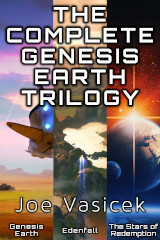
You can see this transformation if you read my Genesis Earth Trilogy. Genesis Earth was my first novel, but it wasn’t until almost nine years later—after I’d met my wife and was engaged to be married—that I felt I had the life experience necessary to write the sequel, Edenfall. And the final book, The Stars of Redemption, was not the sort of thing I was capable of writing until after I had become a father and knew what it was like to help bring a child into the world.
When my daughter was born, the very first thought that came into my mind was “this is her story now, not yours.” We all like to say that we’re the hero of our own story, and in a very basic way, that’s true. But when you become a parent (assuming that you’re a responsible parent, and not a scumbag), you’re no longer living just for yourself, but for your children. “He who findeth his life shall lose it: and he that loseth his life for my sake shall find it.”
Having a child changes your perspective on everything. Among other things, you have a much deeper and more personal investment in the future, since you know that your child will inherit that world. Your perspective on your own family history changes too, as you have become a link in the generations, not merely a byproduct of it. Life becomes a lot harder, but it also becomes more meaningful. Things that took up a great deal of your time and attention when you were single suddenly become trivial, and other things that didn’t make much sense to you about people before suddenly click into place.
So that was why, when I decided to read all of the Hugo and Nebula winning novels, I was curious about the parental status of the authors. I wanted to know if the experience of being a parent had affected the quality of their writing, since I know it’s affected mine. And honestly, it’s not that hard to look up: almost all of these authors have Wikipedia pages with a section about their personal lives. Obviously, the details about their children are sparse, but the only thing I cared about was whether or not they had any.
(As a side note, there were other stats that I decided to track, such as the age of the author when they won the award. That hasn’t seemed to have impacted my taste, except that I have not enjoyed a single award-winning novel by an author who was in their 20s at the time that they won. The only exception was Isaac Asimov with the retro-Hugo for The Mule (Foundation and Empire), but that wasn’t awarded until after he was dead. There are also three authors whose age I was unable to determine from a quick internet search: Michael Swanwick, Sarah Pinsker, and Charlie Jane Anders.)
(As another side note, I’ll be the first to admit that I may have made some errors in my research. For example, if a five-minute internet search on an author didn’t tell me anything about their kids, I assumed they didn’t have any. It’s entirely possible that they just prefer to keep that information private. Also, I didn’t bother to look up when they had their children, so it’s possible that they were still childless at the time they won the award.)
Why should I be interested in this sort of thing? Why look at things like an author’s age, gender, or parental status?
Two reasons. The first is that I wanted to do a deep dive on the Hugos and the Nebulas, the two awards which represent themselves as representing the very best of the science fiction genre. Since that is the genre that I write, I want to understand not just the kind of books that win these awards, but the kind of authors who win them. The goal is to have a deeper understanding of the genre, and to look for trends and movements within it.
Second, and more importantly, I want to have a better understanding of my own reading tastes. All of this is subjective, of course, since the act of reading is always a collaboration between the reader and the writer. I’m sure that some of the books I think are terrible are considered by others to be the best in the world, and vice versa. My goal is to look for patterns that will tell me whether I’m likely to enjoy a book (or an author), so that I can find the best books more efficiently. I don’t do this for all of the books that I read, but since the Hugo and Nebula winning books are supposed to be the very best, I figured it was worth it to do a deeper analysis—especially since my goal is to read all of them.
The thing that surprises me is that it isn’t parental status that matters, but gender + parental status. I can think of a couple of reasons why this would be the case. The most obvious is that it’s easier for me to empathize with a childless man, since that was me for such a long time. And I do think that’s a major part of it.
But I also think that there’s something specifically about being a mother—or deliberately choosing not to be one—that’s also a factor. And yes, I’m talking about biological essentialism. I mean, I’m not a biologist, but I know that I will never be able to be a mother—that’s a life experience that I will never be able to have. Conversely, I will never be able to deny my potential motherhood, an equally major life decision. Both of those experiences are bound to have a major impact on an author’s writing, either way.
I also think this factor is what lies at the heart of Roe v. Wade, the worst decided Supreme Court case since Dred Scott v. Sanford. Certainly the cultural impact of that decision has profoundly influenced how our society views children and motherhood. It’s also why I am sooo looking forward to Matt Walsh’s documentary What Is a Woman? coming out in two weeks:
With all of this in mind, I find it fascinating that every Hugo Award for best novel after 2015 (the year that the Sad Puppies had their high water mark) was won, as far as I can tell, by a childless woman. It would be interesting to see if that trend extends to nominees, or to the other categories like best short story, best novelette, and best novella. Maybe I’ll look that up sometime.
And now that I’ve referenced Roe v. Wade, I’m sure that Cora Buhlert (if she’s reading this) is saying to herself: “yup, he just thinks that all childless women are evil.” And to the extent that File 770 is read by humans and not bots, they’re no doubt picking and choosing those parts of this post that confirm their prejudices (if China Mike Glyer even has the balls to cross link to a post that includes that trailer—do it, China Mike! I dare you!)
But I don’t really care either way, because now I have a much better understanding of my own personal reading tastes, and how they contrast with the Hugo/Nebula crowd. For me, the best books are those that are written by authors who have had the life experience of being a mother, and the worst books are by those who have chosen to deny themselves that path. Apparently, the Hugo/Nebula crowd takes the opposite view. Good to know.
I just made a very interesting personal discovery, gleaned from the data on my reading of the Hugo and Nebula winning books. Of the 110 novels that have won either award, I have now read all but 16 of them, which is enough data to get some reprentative results.
One of the best predictors that I will DNF a book is whether the author is a childless woman. Of the 18 books written by childless women, I have DNFed all but three of them (Downbelow Station by C.J. Cherryh, which I read years ago and would probably DNF today, and Network Effect by Martha Wells, which is a genuinely entertaining read, and Jonathan Strange & Mr. Norell by Susanna Clarke, which I haven’t read yet). For childless men, it’s a little bit more of a crapshoot: of the 31 books written by childless men, I’ve DNFed 16 of them and read 11, but only 6 of those are books I thought were worth owning.
Conversely, one of the best predictors that I will enjoy a book is whether the author is a mother. Of the 20 books written by mothers, I have DNFed only 6 of them and read 8, all of which I think are worth owning. Of the six remaining books that I haven’t read yet, I will almost certainly finish four of them, and may finish all six. The only book by an author I haven’t already read and enjoyed is The Speed of Dark by Elizabeth Moon, which I am currently reading and will probably finish next week.
For fathers, it’s more of a mixed bag. Of the 40 books written by fathers, I have DNFed 19 of them and read 16 (12 of which I think are worth owning). Of the five that I haven’t read yet, I’ll probably DNF at least one or two, so it’s safe to assume that there’s only a 50/50 chance I’ll enjoy a book if it’s written by a father, a little better than if it’s written by a childless man but not by much.
So there’s something about female authors that makes me much more likely to enjoy their books if they’ve decided to have children, and much less likely to enjoy them if they haven’t.
But I have to couch this discovery by saying “one of the best,” because so far, the best predictor that I will DNF a book is whether it won a Nebula without also winning a Hugo. Of the 31 books that have only won the Nebula, I have DNFed a whopping 23 and finished only 3 of them, none of which I thought was worth owning. Of the remaining five, however, I will probably finish at least another three of them, and all are books that I will probably decide are worth owning (Falling Free by Lois McMaster Bujold, The Speed of Dark by Elizabeth Moon, and Powers by Ursula K. Le Guin—all of them written by mothers). If that is the case, then the child-rearing status of the author (provided that she’s a woman) will indeed be the best predictor as to whether I’ll enjoy the book.
As for the decade in which the book came out, I’m slightly more likely to enjoy it if it was written between the mid-40s (counting retro-Hugos) and the mid-60s. From the mid-60s through the 70s, I thought almost all of the award-winning books were terrible (the only exceptions were Dune by Frank Herbert, which is more a creation of the early 60s, and The Left Hand of Darkness and The Dispossessed by Ursula K. Le Guin).
I haven’t yet read all of the books that came out in the 80s and 90s, but it generally looks like a 50/50 split, slightly favoring books from the mid-80s and disfavoring books from the late 90s. For the 00s, there isn’t enough data right now to say one way or the other. It’s the one decade left where most of the Hugo and Nebula award-winning books are still on my TBR.
But starting in 2010, the books all seem to become terrible again. The only exceptions are Blackout and All Clear by Connie Willis (whose heyday for the awards was really more in the 80s and 90s), The Three-Body Problem by Cixin Liu (a Chinese author who isn’t caught up in all of the culture war baggage here in the West), and The Network Effect by Martha Wells, which once again seems to be the exception that proves the rule.
So I DNFed Timescape by Gregory Benford today. I didn’t like any of the characters, and the retro-future view of the 90s as a dystopian post-climate catastrophe wasteland was predictably bad. But this quote from the afterword got me to thinking:
Habitual readers of science fiction will feel right at home with some features of Timescape: the ecological crisis, the contact between past and future and resultant time paradox, the scientists working to solve a scientific puzzle and save the earth [sic], and even a certain amount of scientific theorizing.
For 70s science fiction, the idea of an imminent, inevitable, and nigh-apocalyptic environmental collapse was thought to be so ingrained in the genre that it was accepted as a foundational trope of the genre. As a consequence, 70s science fiction tends to age very poorly. Almost all of the “important” works of the era, like Timescape, are infused with this Malthusian nonsense, and accept as axiomatic that all of the big crises of the 70s would only get worse and worse.
In contrast, the science fiction of the 40s and 50s was all about how science could help us to overcome the crises of their time, not how those crises were fundamentally insurmountable. Small wonder, then, that authors like Heinlein and Clarke inspired us to put men on the moon and satellites into orbit. And what did the authors of the 70s inspire us to do? Certainly not to tear down the Iron Curtain, pull the world back from the brink of nuclear war, or reduce global poverty at the most extraordinary rate in history. And yet, all of those things actually happened.
It makes me think of this apocryphal Mark Twain quote:
It ain’t what you don’t know that gets you into trouble. It’s what you know for sure that just ain’t so.
So what are some of the current assumptions of the science fiction field that will make future generations of readers scratch their heads? What are the things that will make the “important” works of 2020s science fiction age rather poorly?
Racial essentialism is probably a big one. I sense a growing cultural backlash against the racism of the intersectional left, especially in the wake of the George Floyd riots of 2020. That’s why the term “white supremacy” is in vogue right now, because the word “racist” has lost all of its power through overuse. If Worldcon doesn’t survive the pandemic, then I suspect that at least a few future SF historians will draw a connection between the Hugo’s demise and N.K. Jemisin’s three consecutive Hugo wins in the 2010s.
Transgenderism is probably another. Laying childish things aside, a society that rejects the biological essentialism of gender is not even metastable, as we’re seeing right now with all of the rapes in transgender bathrooms and prison facilities, with the obvious social contagion driving LGBTQ trends in the rising generation, and with all of the ways that political correctness demands that we reject basic science, typified so perfectly by the pregnant man emoji. That doesn’t necessarily mean that gender norms will revert to what they were in the 50s—in fact, I tend to think that the norms of that era were only metastable at best—but I do think that there’s a major cultural backlash on the horizon.
There’s a lot of other low-hanging fruit: the cli-fi of our era will probably age just as poorly as the apocalyptic visions of climate catstrophe written in the 1970s, and books that are based on 20s feminism will probably age just as poorly as 20s feminism itself. But what about some of the more difficult things to predict?
One of the more subtle ways that our current science fiction may age poorly is the complete ignorance of worldviews that clash with the established narrative. I would say that there’s a refusal to engage with contrary narratives, but it actually goes much deeper, as many writers are so deep in their own echo chambers that they don’t even know that contrary viewpoints exist. This has less to do with partisan politics and more to do with all of the ways that social media has re-engineered our society. Future generations will probably see the effects of this re-engineering much more clearly, and will wonder that the science fiction writers of our age were so unaware of how it affected them—both on the political right and on the political left.
Another less obvious thing is our generation’s lackadaisical and often schizophrenic attitudes on the importance of the family. When the chaos of the 20s is finally in the rear-view mirror, I suspect that there’s going to be a major groundswell of public interest in forming, cultivating, and maintaining strong families—largely because I suspect that’s how we’re ultimately going to find our way out of all this chaos. There’s a reason why Augustus Caesar, founder of one of the greatest empires in world history, placed such an emphasis on the importance of the family. Much of today’s science fiction takes it for granted that “love makes a family,” which was never true in any age—not even our own. It also takes for granted that found family is an adequate substitute for the real thing. With mutual commitment and great personal sacrifice, it can be, but that isn’t usually expressed on the page.
Does this feel a bit too much like wishcasting? How am I wrong, or what are some of the other things that I’ve missed? It’s probably just as difficult for us to answer this question as it is for a goldfish to comprehend what water is, but it is an interesting exercise, and hopefully a useful (or at least entertaining) one.
My 2022 reading resolution: Read or DNF every novel that has won a Hugo or a Nebula award, and acquire all the good ones.
In 2007, when I was a sophomore in college, I went up to Salt Lake City with some friends and was browsing the awesome (and fairly run down, even at the time) used bookstore near the Gallivan Plaza TRAX stop, which has since changed names and moved to another location. It was a really awesome used bookstore, and I determined to buy a SF novel while I was there, since I was really getting back into SF after my mission. I saw a massive 600+ page trade paperback edition of Cyteen by C.J. Cherryh, and since I was reading Downbelow Station at the time, I decided to get that one.
For the next fifteen years, I lugged that book everywhere, through more than a dozen moves (though for the biggest move, where I made the pioneer trek in the wrong direction and repented 8 months later, I boxed it up with my other books and left it in a friend’s basement). In all that time, I never actually read it—or even opened it up, really—but it was always there, somewhere in the middle of my dismally long TBR list.
It wasn’t that I didn’t want to read it: I just didn’t have (or make) the time. Downbelow Station had been an okay read, if not spectacular, but I had really enjoyed some of C.J. Cherryh’s shorter books, like Merchanter’s Luck and Voyager in Night. Also, space opera books about sprawling galactic empires were right up my wheelhouse, so it didn’t seem odd for me to own such a book that I hadn’t yet read. In fact, most of the books that I owned throughout this time were books that I wanted to read but hadn’t gotten around to yet. If I have a superpower, it’s an uncanny ability to acquire books no matter where I am. Unfortunately, I’m not as good at reading them.
Fast forward to 2022. I’ve gotten married, had a daughter, launched my own writing career, and become a homeowner—and I’m still lugging this massive 600+ page trade paperback book that I’ve never read. But I’ve just set a resolution to read (or DNF) every Hugo and Nebula award-winning novel, and Cyteen is on the list. So around the middle of March, I finally open it up and start reading it.
After about a month, I decided to DNF it.
It’s not that it was terrible. Perhaps you enjoyed it, and that’s fine. I just found it to be too drawn out and confusing. I think C.J. Cherryh does better when she’s focusing on just a few characters, rather than trying to give the grand sweep of galactic civilization or whatever. I didn’t finish Foreigner for similar reasons. Maybe someday I’ll return to that one and Cyteen, but for now, I’m counting it as a DNF.
But the thing is, I was hauling around this massive book for most of my adult life. When I bought it in 2007, I figured that since it had won a Hugo, it had to be good. Perhaps, if I’d read it back then, I would have been more patient with it and slogged through to the end. Perhaps I would have decided it was just as good as Downbelow Station. Or perhaps, if I read Downbelow Station today, I would end up DNFing it as well.
The point is, I wish I’d been a lot more discerning about my reading when I was younger, and not just acquired books that I hoped to read “someday”… because books (at least the paper ones) are heavy and take up a lot of space. And a lot of them really aren’t worth reading. Of course, you’ve got to read a few stinkers to figure out what you really like, so it isn’t always a waste… but libraries exist for a reason.
So what this experience really tells me is that Mrs. Vasicek and I are doing the right thing by taking our family to our local library once a week. Also, it tells me that the second part of my resolution—to actually acquire all of the books that I think were worth reading—is just as important as actually reading them. Because, if the ultimate goal is to “seek… out of the best books words of wisdom,” then it’s not enough to just make a list: you actually have to read the damned things, and keep your own personal library in order to revisit those words and share them with others. Because ultimately, you have to discover which books are the “best books” on your own, and your best books list isn’t going to be the same as anyone else’s best books list. Which means that you can’t rely on anyone else’s list. You can use it as a starting point to make your own list, but that’s all you should use it for.
So now I want to go through all of the books I’ve acquired over the years and figure out which ones I ought to get rid of, because Cyteen certainly wasn’t the only one. In fact, most of the books in our family library are books that I haven’t (yet) read. By my count, there are just under 150 of them, totalling about 55k words. Even at a rate of 100 words or two hours of reading each day, that’s still going to take almost two years… and that’s not counting all the library books that we’re sure to check out in the meantime.
Oh well. I suppose this is more of a process than anything else. Journey before destination, and all that. And I’m sure I’ll have fun in the process, since despite the fact that I DNF far more books than I actually read, I do genuinely enjoy reading.
In any case, here are all of the Hugo and Nebula award-winning books that I read (or DNFed) in the month of April:
Books that I read and plan to or have already acquired:
Rainbows End by Vernor Vinge (2007 Hugo)
Blackout by Connie Willis (2011 Hugo and Nebula) (audio)
Books that I read and do not plan to acquire:
Blackout by Connie Willis (2011 Hugo and Nebula) (print)
Books that I did not finish:
A Time of Changes by Robert Silverberg (1972 Nebula)
The Gods Themselves by Isaac Asimov (1973 Hugo and Nebula)
The Fountains of Paradise by Arthur C. Clarke (1980 Hugo and Nebula)
The Claw of the Conciliator by Gene Wolfe (1982 Nebula)
Cyteen by C.J. Cherryh (1989 Hugo)
Tehanu by Ursula K. Le Guin (1991 Nebula)
The Diamond Age by Neal Stephenson (1996 Hugo)
The Moon and the Sun by Vonda N. McIntyre (1998 Nebula)
Parable of the Talents by Octavia E. Butler (2000 Nebula)
2312 by Kim Stanley Robinson (2013 Nebula)
Beyond This Horizon by Robert A. Heinlein (1943 Retro Hugo, awarded in 2018)
The Nemesis from Terra by Leigh Brackett (1945 Retro Hugo, awarded in 2020)
Total books remaining: 26 out of 110 (currently reading 12 and listening to 3).
It’s been a little crazy over here, which is probably why I’ve found it so difficult to write lately. It’s not a function of time so much as brainspace, and I really need to find ways to refill the creative well. But I did manage to finish another story this week, and I think it has real potential. Next step: writing group.
This is another Mythulu-inspired story, and I ended up using more cards for this one than any other story I’ve written. Here are the cards I used:
DREAM: A space where anything is possible but nothing lasts. Often inspires discovery and change elsewhere.
SCAVENGER: Symbolizes poverty of mind. Lives on the leftovers of greatness because they are unable to create something new.
DATA: The element you draw next is the primary means for carrying data. (Draw +1 Element)
MACHINE: The messy, awkward, expensive try-fail attempts of those who elevate a race to god-like status.
HIBERNATES: Enters a standby state with low power usage to survive extreme conditions. Most animals cannot heal during hibernation.
AWAKE: Pulled from sleep, animated, enlightened. A higher state of consciousness.
ARTIST: Passionately engaged in a profession that doesn’t pay. Artists are soul-healers and their work transcends political sides.
LOVER: The other self. True lovers always fill a hole. Stronger together than the sum of the parts.
METALLOID: A non-metal element that behaves like metal. Conductive, fusible, and/or ductile. Trouble being categorized or fitting in is usually connected to extraordinary abilities.
RUST: Deterioration caused by extended contact with water, air, or acid. Threatens functionality. Difficult to restore.
STOCKHOLM SYNDROME: A captive who has developed sympathy for their tormentor.
I was worried at first that this short story would expand into something longer, but I managed to keep the first draft under 5,600 words. If I can get it under 5,000, so much the better. I really do feel like it could benefit from another set of eyes looking at it, so I’m going to hold off on sending it anywhere.
Dean Wesley Smith likes to boast how in the early days of his writing career, he would submit his stories to the editors before he workshopped them in his writing group, and often the things that his writing group criticized were things that the editors loved. But he also says that writers should never revise their work, and that anyone who reads critically needs to “go get help. And I mean real help, professional help, because you have lost all ability to see a story and are trapped by the little black marks on the paper.” In fact, some of the worst writing and publishing advice I have ever heard has come from Dean Wesley Smith, so at this point I feel no compulsion to follow anything he says that doesn’t make sense on its face. But hey, he’s the guy who always tells us to turn off our critical minds, so that’s really just following his advice.
(The crazy thing is that some of the best writing and publishing advice I’ve ever heard has also come from Dean, which makes his bad advice—and it is truly bad—all the more puzzling. How can someone who knows so much also be so wrong? I’ve come to my own conclusions about that, but this is a public blog, so I’ll refrain from posting my thoughts on the subject here.)
In any case, I’ve been really happy with the feedback from my current writing group, so from now on I think I’m going to workshop all of my short stories through there before publishing or submitting them. And I look forward to getting their feedback on this one, because even though I think it turned out pretty good, it needs an extra something and I’m not sure what.
As for the next story, I will try to use just as many cards as I did with this one, since my goal for this writing challenge is to use all of the cards in the deck. But there are a lot of cards, so it’s entirely possible that I won’t end up doing that. Should be fun, though.
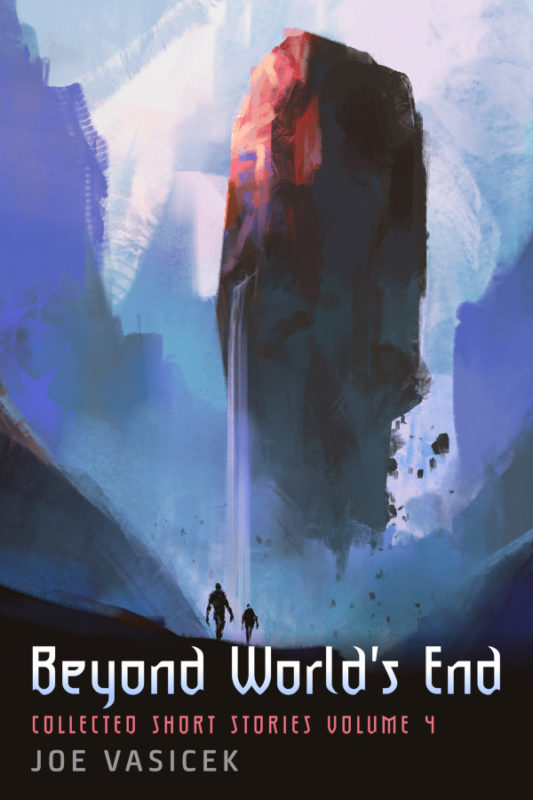
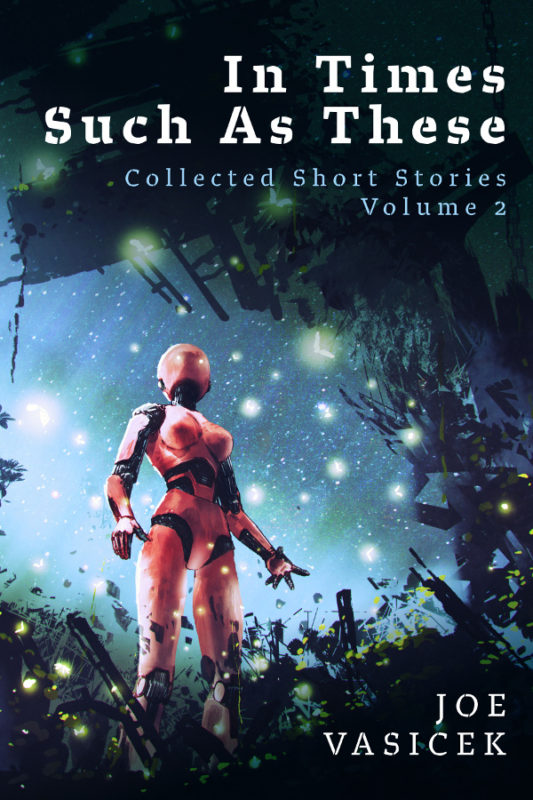
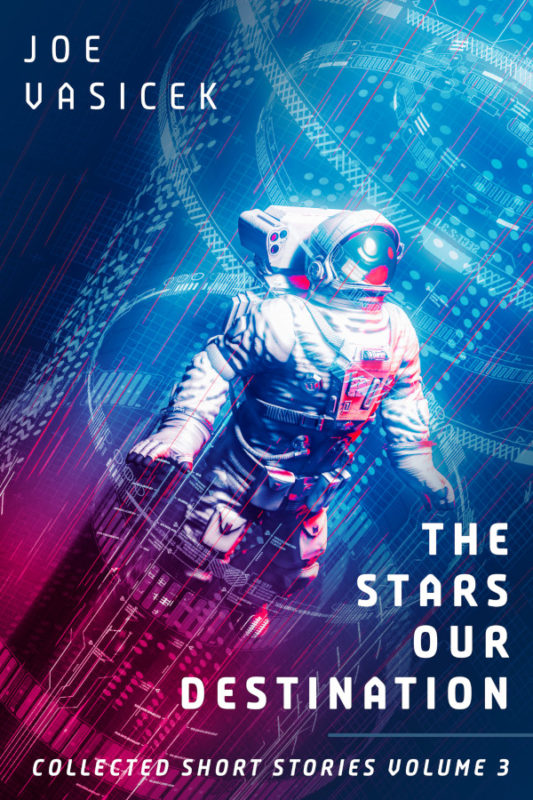
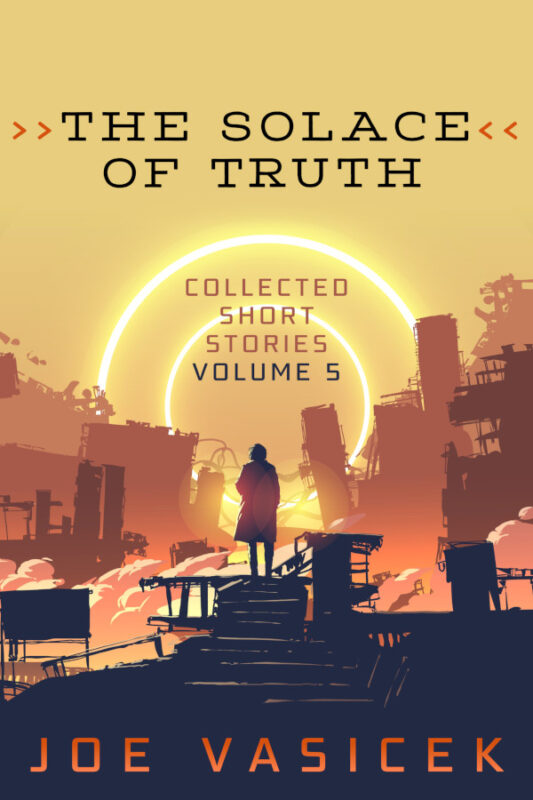
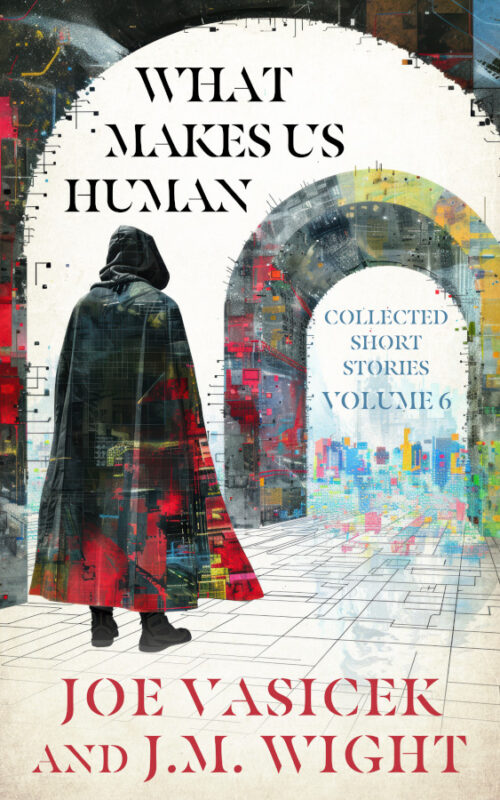
Eleven short stories and a poem that show us what comes after the end of all we know.
This is the fourth volume of the collected short stories of Joe Vasicek. It includes:
The Manchurian Paradox
A Fatal Rebirth
The Final Turning
The New Covenant
Hearken and Behold (by J.M. Wight)
The End of Elysium
The Promise of King Washington
Lord of the Slaves
The Other Side of Reality
Schrödinger's Diaper
Two Hours Ago
Welcome to Our Crazy Family
Eleven short stories and a poem that show us what comes after the end of all we know.This is the fourth volume of the collected short stories of Joe Vasicek. It includes:The Manchurian Paradox
We have met our timeline’s enemy and he is us.
A Fatal Rebirth
Nothing in this world should live forever—not even civilization itself.
The Final Turning
This is how the world ends: not with a bang, but with a whimper—thanks to me.
The New Covenant
To restore a fallen America, an ancient and terrible covenant must be renewed.
Hearken and Behold (by J.M. Wight)
“Hearken, oh ye hypocrites, and behold the desolation that is already come upon you!”
The End of Elysium
For the promise of paradise, the last civilization will surrender to the apocalypse.
The Promise of King Washington
When the aliens came, it wasn’t a military invasion: it was an economic one.
(Again, Hazardous Imaginings, December 2020)
Lord of the Slaves
“Everyone secretly wants to be a slave. Those who deny it simply haven’t found the right master.”
The Other Side of Reality
What if your future self came back to give you advice, and all it did was confuse you?
Schrödinger’s Diaper
“Stays clean and dry until you’re free to change it!” …except not quite.
(Bards and Sages Quarterly, April 2022)
Two Hours Ago
A time machine without paradoxes, so long as it’s not abused.
Welcome to Our Crazy Family
Two genderqueer lesbians and a tranny have a rebellious daughter who does the unthinkable and decides to marry a Christian.
Joe Vasicek fell in love with science fiction and fantasy when he read The Neverending Story as a child. He is the author of more than twenty books, including Genesis Earth, Gunslinger to the Stars, The Sword Keeper, and the Sons of the Starfarers series. As a young man, he studied Arabic at Brigham Young University and traveled across the Middle East and the Caucasus Mountains. He lives in Utah with his wife and two apple trees.
Some of the links in the page above are "affiliate links." This means if you click on the link and purchase the item, I will receive an affiliate commission. You will not receive any additional charge.
As an Amazon Associate I earn from qualifying purchases.