Short Blitz #7: Starchild

Title: Starchild
Genre: Space Opera
Word Count: 3,000
Writing Time: about two weeks

I haven’t trimmed or polished this story yet, but I’m calling it at 3,000 words. If I were stricter about following Heinlein’s rules, I would only give it a proofreading pass, but with shorts I’ve heard that it’s best to cut out as many unnecessary words as possible, so I’ll give it a solid pass before sending it out.

Unlike all of my other short stories so far, this one takes place in the same universe as my novels and novellas. Specifically, it takes place in the Star Wanderers universe, at an unspecified system deep in the Outworld frontier. It’s about a girl in the strictly regimented society of an isolated space colony, who decides to be the first from their outpost to win the heart of a star wanderer. More generally, it’s about the cycle of life on a frontier space station and the inevitable loss of innocence from contact with the outside.

The idea came to me while I was on vacation, so I didn’t do much with it for the first week. I dabbled with it while I was out at the Cape, writing a little here and there, but it wasn’t until I was on the train headed back that I dedicated some serious time and effort to it.

My sister lives in Iowa, at almost the exact midway point between Massachusetts and Utah, so I decided to stop by and pay her a visit along the way. I finished the story this afternoon at her house, and I plan to print it out and submit it to F&SF while I still have access to their printer. What can I say … I’m cheap. :p

I don’t think this will be the last short story that I write in the Star Wanderers universe. If I could write a few good ones that get picked up by a major magazine like Asimov’s or Clarkesworld, that would be a great way to bring in more readers. I figure a story in the same universe as my other books will be much better at that than a generic short story, and since self-publishing is my bread and butter, the more I can get my short stories to serve that, the better.

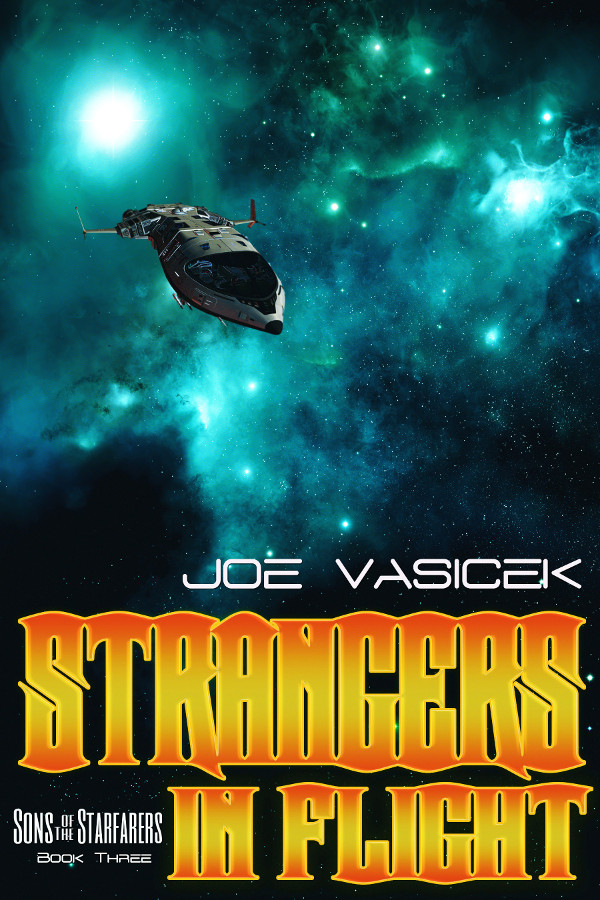
In any case, now that thing one is done, I can focus all of my attention on Sons of the Starfarers. If all goes well, Book III: Strangers in Flight will be published in the next couple of weeks, and Book IV: Friends in Command
will be finished (at least the rough draft) by mid-October. This was a nice project to work on during vacation, but now that it’s finished, it’s time to get back to work!

Almost back from vacation

So I’m in Massachusetts now, getting ready to head back to Utah by way of my sister’s in Iowa. I spent the last week on Cape Cod for family vacation, which was a lot of fun! Cape Cod is one of my favorite places, and it was good to sit back and take a break from things.

Of course, that doesn’t mean I haven’t been writing. While on the beach, I reread Nancy Kress’s Beginnings, Middles, and Ends (an excellent writing book), and in the evenings I tinkered a little with a short story in the Star Wanderers universe. I also sent out several short story submissions, and even received a couple of rejections. I’ve got seven stories out on submission right now, and I hope to push that number even higher before the end of the summer.

But short stories aren’t the main focus. The main focus right now is Sons of the Starfarers, specifically, getting Strangers in Flight published. The final draft is currently with my editor, and the cover art is ready to go. Check it out!

SSF-III (cover)I am definitely looking forward to getting this book out. But if you haven’t read the other books in the Sons of the Starfarers series yet, I would advise you to wait until the first omnibus comes out. I should have that up for pre-order by the middle of September, and I’ll price it slightly lower than all three books put together.

I’m not sure when the fourth book will be out. At this point, all I have is a rough outline. However, I expect that it will be out before Christmas. I don’t think it will take more than a couple of months to write, and I’m really excited to write the fifth book, so once I get started I expect it will go quickly. The title for book four is Friends in Command, and it will be primarily from Mara’s point of view.

That just about does it for now. I’d better get back to packing so that I can get some sleep before the night is over. Take care!

Thoughts after finishing The Last Full Measure by Jeff Shaara

WOW.

This was an amazing book. A highly memorable book. A book I will return to again and again in the future.

There comes a moment when reading a truly amazing book when you don’t think that it can possibly get any better. It’s a ten out of ten, easily five stars. And then … it gets even better.

The Last Full Measure by Jeff Shaara was one of those books. It’s the third book in a trilogy that technically starts with Gods and Generals, but really it started with the middle book, The Killer Angels, which was written by the author’s father, Michael Shaara.

The Killer Angels covers the events of the Battle of Gettysburg, and is definitely one of the best Civil War novels ever written. Years later, Jeff Shaara decided to write a prequel to his father’s book, showing all the events of the war leading up to Gettysburg. The Last Full Measure picks up immediately where The Killer Angels leaves off, and follows the war to its conclusion at Appomattox and the beginning of the Reconstruction.

This book is amazing. It really made me feel like I was there, from the bloody confusion at the Wilderness to the brutal hand-to-hand combat at Spotsylvania, from Grant’s terrible mistake at Cold Harbor to the long, hard siege of Petersburg. And then, at the very end, when Brigadier General Lawrence Chamberlain surveyed the monuments from Little Round Top just before the fiftieth reunion of Gettysburg, I realized that I actually have been there!

It was such a crazy moment, to read about something in a novel and then have it merge with my own memories of the place. It made the whole thing come alive in a way that was just fantastic.

There were a lot of other amazing moments in the book. When General Lee finally surrendered, it very nearly brought me to tears. And later, when Chamberlain accepted the arms of the Army of Northern Virginia and had his men salute the Confederate soldiers in a show of brotherhood and respect, it was amazingly touching.

Chamberlain’s storyline in general was fascinating throughout the whole trilogy. His father wanted him to be a soldier and his mother wanted him to be a priest, but he chose a career in academia instead at the insistence of his wife. But the academic lifestyle left something unfulfilled in him, and he didn’t realize it until the war broke out. He volunteered without telling anybody, not even his wife, and was soon swept up in some of the bloodiest battles in the war. At Fredericksburg, he spent the night on the bloody fields within sight of the enemy lines, shielded and kept warm by the bodies of his men.

Then, at Gettysburg, there was that was that glorious charge on Little Round Top that saved the Union flank, and quite possibly the entire battle. When he came home from that, he’d gained something that he’d never had before in his life: his father’s respect and approval. From Gettysburg, he rose to command a battalion, but at Petersburg the ineptitude of the Union command left him without support at a critical moment, and he was nearly killed. But he came back, taking command of a brigade upon his recovery, and turned the tide of battle at Five Forks and Appomattox.

By the time the war was over, not only had he won great honor and glory, he’d tested and proven himself, learned something about his inner character that he would always take with him, and that would always give him strength. The afterword starts with a quote from Lawrence Chamberlain that sums it all up amazingly well:

War is for the participants a test of character; it makes bad men worse and good men better.

I’m not going to lie: this book almost made me wish that I could go off to war like Chamberlain did. It’s not that Jeff Shaara glorified the Civil War war–just the opposite, in fact. The horrors and brutality and awful tragedy were all depicted in full measure, with the pain and death and suffering. It wasn’t glamorized at all. But there’s something deep, something primal about going through an experience like that–something that strips away all the luxuries, all the securities of modern life and forces you to find out who you really are, what you’re really made of. For all the horrors that those soldiers went through, I envy them for that part of their experience.

I feel like I’ve been channeling that recently in some of my short stories, like that orc story I wrote recently. I have an idea for another one that I’ll probably write while I’m out at Cape Cod. It’s also what drives me to heroic fantasy, to stuff like David Gemmell’s Drenai series. There’s something about taking up a sword, or an ax, or a musket and charging headlong into battle that rouses the spirit–that makes you feel truly alive.

I would love to write a book as good as this one; it’s one of those things that I dream of. I’m not sure if it’s possible to pull off a story as tremendous as this in short story or novella form, though. Maybe, but all of the stories that have had this powerful of an impact on me were all novels. The shortest one that I can remember was The High King by Lloyd Alexander, but that was the fifth book in a series (and it was still a novel). Short stories and novellas are great, but at some point I need to return to novels.

In any case, those are some of my thoughts after reading The Last Full Measure. There were a lot more, but this post is already starting to ramble so I’ll cut it short here. I’ll leave you with the opening credits from the movie Gods and Generals, a great piece that really captures what so many of the common soldiers were fighting for: home.

Take care and be well.

The week from hell

That might be a bit of an overstatement, but this week is shaping up to be really crazy stressful.

First, I’ve got to move out of my current apartment. I think I’ve got a place lined up to move to, when makes things a lot less stressful than they were last week, but I’ve still got to physically move my stuff, clean up my apartment, handle all that stuff, etc.

Second, because of the move, I’ve got a serious cash flow problem until the end of the month. My current apartment won’t send me the deposit until thirty days after I move out, but I’ve still got to pay a deposit and first month’s rent in my new place, so … yeah.

Third, my book sales have unfortunately hit the summer slump–that, or they seem to have fallen off of a cliff. It’s hard not to panic when that happens. If I were better at marketing, this probably wouldn’t be happening, but unfortunately I am not. So I guess I’ll just have to write and publish my way out of it.

Fourth, however, I’m going on vacation with my girlfriend next Monday, and we’ll be gone for two weeks. That means no new releases until at least the end of the month, and not a whole lot of writing either. Which means that I need to get the revisions of Strangers in Flight (Sons of the Starfarers: Book III) done before going on vacation, or at least on the train ride out there, in order to send it to my editor in time for a late August / early September release.

Fifth, my phone died today, only to come back from the dead about an hour later. It was extremely weird: at first, my calls wouldn’t go through, then they would go through, but I wouldn’t hear anything, then I could only hear something if my headphones were plugged in, then after going into “settings” and hitting “activate phone,” everything works fine. But wow, did that give me a panic.

So yeah, I’ve got a lot on my plate right now. Which is not to say that I’m complaining, just that you’re probably not going to hear much from me for a while. I was hoping to release Strangers in Flight this month, but I’ve got to deal with these other things first, so it’s probably going to be pushed back a bit (though definitely not more than a month).

In any case, I’m keeling over from exhaustion over hear, so that’s enough for now. Later!

Short Blitz #6: A Hill On Which To Die

Title: A Hill On Which To Die
Genre: Epic Fantasy
Word Count: Word Count: 15,000
Writing Time: About a month

IT IS FINISHED.

Ugh, this story took forever. What started as a short story soon turned into a novelette, and then that novelette got longer and longer … and then life got crazy busy, and I suddenly had a lot less time to write. And then all these weird writerly anxieties started taking over, and I found myself procrastinating during what little writing time I had …

In any case, it is finished now. IT IS FINISHED! And even though it needs a revision, and a couple of scenes need to be changed or rewritten entirely, I can take care of all that tomorrow.

Anyways, this story is about a band of orcs that leaves their clan to start a new one. The main character is an old veteran war chief who has lived beyond his prime and fully expects to die. There’s blood, carnage, rape, and all sorts of violence. There’s also courage, loyalty, hope, sacrifice, and devotion to a higher cause. It’s a bit like Watership Down, except with orcs instead of rabbits.

In spite of all the trouble this story gave me, I had a lot of fun with it. I’d like to self-publish it, but first I suppose I should send it off to the relevant markets. According to my spreadsheet, there are only five pro-markets that take stories over 15,000 words:

  • Writers of the Future
  • Asimov’s
  • Fantasy & Science Fiction
  • Orson Scott Card’s Intergalactic Medicine Show
  • Tor.com

Leading Edge is a semi-pro market that takes stories up to 15,000 words, but I know for a fact that the content in this one is not BYU appropriate. It’s a lot darker than I usually write, with some sexual violence that almost certainly needs a trigger warning if/when I self-publish.

But even though it depicts a lot of violence, I don’t think it crosses the line into glorifying it. Certainly not the sexual violence, which even the main character admits is wrong. And it’s not like the women are in there just to get raped, either–there’s actually a band of female orc warriors who beat the male orcs at their own game.

In any case, with only five markets that I know of that accept stories of this kind, I figure it won’t be too long before this story returns to me and I can self-publish it for you all to read. If any of you know of any other markets to send this place, let me know!

Why I couldn’t finish Gone with the Wind

For the past month or so, I’ve been on a Civil War kick. I watched the movie Gettysburg to celebrate July 4th, read Gods and Generals, wrote a short story about a time traveler at Gettysburg, and have been listening to a lot of Civil War music as I write. One of the books I decided to give a shot was Gone With the Wind, that classic American novel that’s tied so closely with the Civil War.

It’s definitely a good book. There were parts of it that I really enjoyed, such as the perspective of the people of Atlanta as Sherman’s troops got steadily closer. The poverty of the plantation owners after Sherman’s march to the sea provided a stark contrast to the pompous gaiety of society before the war. You definitely get a sense of what it means to be Southern while reading the book–it’s surprising how similar some things are to the way they were. And just in general, the sheer sense of immersion that the novel gives you is just incredible. It’s rare that I’m sucked into a world as thoroughly as I was sucked into the quiet charm of the antebellum South and the frenzied optimism of Confederate Georgia.

The real shock to me was that I could enjoy the book even as I hated the main characters. Scarlett is a bitchy, stuck-up brat–an entitled rich white girl who cannot comprehend that the world does not revolve around her. Rhett Butler isn’t nearly as stuck-up as she is, but he is an arrogant jerk who sneers at other people, profits from their misfortune, and hides his cowardice with his biting cynicism.

The fact that I enjoyed reading about them even though I disliked them so much is a testament to the fact that not every character needs to be likable. Even thought Scarlett really peeved me off, I still found her fascinating because I felt like I really understood her. Margaret Mitchell does an excellent job of getting you into her characters’ heads and showing where they come from. In some ways, I felt that I understood Scarlett better than she understood herself.

But I have to be honest–from page one, I was only interested in Scarlett for the schadenfreude. I already knew how the story ends, with those classic lines “frankly my dear, I don’t give a damn,” and “tomorrow is another day.” If I’d been waiting instead for Scarlett to experience a growth arc (and she really does start in an excellent place for one), I probably would have thrown the book across the room much sooner.

The part that made me stop reading–and yes, this will spoil the book–was the part where Scarlett steals Frank Kennedy, her sister’s fiance, in order to get the money to save Tara. She’s so singly focused on saving the plantation (Tara) that she’s willing to backstab her own family, who ought to matter a lot more to her than a house and a spot of land. Yes, I understand that it was entirely in her character to do that, but when she actually betrayed her sister like that, I just couldn’t stand it anymore. I skipped to the last chapter, had my juicy moment of schadenfreude, and returned the book to the library.

I had a lot more sympathy for everyone who locked horns with Scarlett (except for Rhett) than I ever did for Scarlett herself. The O’Hara overseer who gets fired in the first or second chapter for making the poor Slattery girl pregnant–I didn’t think it was noble for him to try and steal Tara through his postwar connections, but I could see why he’d do it. He probably didn’t feel like he could marry the Slattery girl because the O’Hara’s weren’t paying him enough. Even if they were, the fact that he married her showed that at least he was trying to set things right. And though I didn’t admire the way he went about trying to get his revenge, a part of me wanted him to succeed.

My favorite character was probably Melanie. As soon as she showed up on the page, I liked her, and as the story progressed, I came to actively admire her. Ashley, too, was a very interesting character to me–his thoughts on the war and on the passing of the old way of life were fascinating. But I could never really respect him, because it was always so easy for Scarlett to manipulate him.

And even though Rhett wasn’t so prone to Scarlett’s machinations, I still couldn’t respect him because he was always such an ass to everyone. It’s not that he wasn’t a gentleman–there were plenty of gentlemen in the book who were jerks, and plenty of men who weren’t gentlemen who were still good people. The thing was, Rhett was just never a good person to anyone except Melanie, and throughout the book, that never changed.

I guess the takeaway here is that it’s almost impossible to have any sympathy for a character who treats their friends and family like garbage. For me, at least, if a character constantly betrays the people who are closest to them, I really want nothing to do with them. But I guess that’s just me–judging from the success of Gone With the Wind, I guess I can’t generalize that at all.

I don’t know. What do you guys think?

Why I quit Facebook

quit-facebookLast month, I made the decision to quit Facebook. Permanently. As in, the Facebook account that I created eight years ago as a college freshman no longer exists, unless Facebook continues to store and monetize data from its ex-users long after they’ve quit the service. Which wouldn’t surprise me at all, since Facebook is in the data business, which makes its users its product, not its consumer. But I’m getting ahead of myself.

I’ve thought about quitting Facebook for some time. Some of the reasons that have moved me in that direction have been that it’s a waste of time, that it’s the high fructose corn syrup of the internet, that it violates my privacy in creepy ways, that it cheapens my interactions with my friends … the list goes on. However, these reasons alone were never enough to convince me to quit. They got me to scale back my usage and cull my friends list, but never delete my profile outright.

Last month, though, Facebook revealed a new ad program where it downloads its users’ browser histories. With this program, Facebook now collects data straight from your browser–data from your internet activity outside of Facebook’s service–and sells that along with the personal data that you share on their site.

Facebook has always had major privacy issues, with the FTC stepping in in 2010 to force them to change their policies. However, until now, the argument was always that if you didn’t want your personal information to be shared, you shouldn’t put it on Facebook. Now, however, Facebook is collecting information that you don’t share with Facebook–information that they gather straight from your computer–without any reliable way to opt-out.

Facebook claims that this program is mainly for advertisers, but what’s to stop them from sharing this data with the NSA? With the Snowden revelations, we already know that there are entities within the US government that are working to create a surveillance state. Facebook is already practically in bed with these people, who have gathered personal information about Facebook users in the past. And since Facebook already has a dismal history of abusing privacy rights, changing its TOS without notice, and undermining its user privacy settings with unannounced updates, I fully expect them to gather that information and share it whether I want them to or not.

This may not be a huge change from the way Facebook used to do business, but it was a huge wake-up call for me. Since I’m not a huge fan of Facebook to begin with, this was the final straw that pushed me away.

I joined Facebook in 2006 when I was 21. I was just getting ready to head out to college, and at that point only college kids were on the site. It was a cool new thing and seemed like a great way to make and keep in touch with friends. Since I was moving away from home and starting a new phase of life, that was important to me.

My first year, I searched out and friended all of the people in my freshman ward at BYU and posted tons of pictures and other updates. It made me feel like I was very close to them! But the next year, I moved and made a new group of friends, and stayed in touch with only one of them. All those other friends just gradually drifted off into other things.

I posted a few more pictures, but mostly just profile pictures because anything else didn’t seem like it was worth the work. Facebook added groups, and I joined a bunch of silly ones just for laughs, but not any serious ones. Friends kept inviting me out to events, and my default answer was “maybe” because it didn’t make me look like as much of a jerk when I just didn’t want to go.

Then I got into a huge political debate with an old friend from high school, and it got insanely ugly. It was weird, because we always seemed to get along so well in person, but online we were just slugging it out at each other. It was very strange. I tried to get him to agree to disagree, but by this point his friends were posting to his wall and goading him on, so he refused. Then he attacked my religion, and the only way I could end the debate was to block him. I haven’t seen or talked with him since.

Facebook changed a lot over the next few years. The biggest change was probably the newsfeed, which replaced the wall. At first, I thought it was a great idea, because I could get all the updates on my friends in one place. Then the feed got swamped with updates from all the friends I’d added over the years. Most of them were people I’d drifted away from–people I’d seen a lot for a semester or two, but hadn’t bothered to keep the friendship up after we’d moved on.

Facebook became a fire-hose, and it started to eat up a disturbing amount of my time. I stayed away from all the obvious distractions, like Farmville and those other games, but it wasn’t enough. The information was just too dense, and though it gave me the illusion that I was staying close to my friends, in reality my interactions weren’t that meaningful.

Facebook developed algorithms to filter the newsfeed, but all that really did was make me use the site more. It didn’t help me to keep in touch with the people who mattered the most to me, since those weren’t the people who were posting the most. Instead, it resurrected a bunch of friendships that had long since faded in the real world and turned them into these weird zombified online relationships where we shared stupid memes, argued politics, and discussed random articles–all without ever seeing each other in person.

By the time I went overseas to teach English, Facebook had become a huge timesuck, and I wanted to break free of it. The first semester, I lived in a large town where I had constant internet access. The center of social life for us expats was a Facebook group called “Georgian Wanderers.” It felt good in some ways to be part of a community where people actually spoke English, but there was a lot of drama and ugliness in that group too. In my second semester, I lived in a tiny village where internet access was spotty, and I didn’t miss much while I was out there.

In fact, living without regular internet access was exactly what I needed. It gave me the chance to step back from my life and see how it had become cluttered. Before going back to the States, I decided to clean things up so as to keep myself from falling into the same rut. A major part of that online decluttering was to go through my 700+ friends list and delete all the people I didn’t want to stay in face-to-face contact with.

I cannot tell you how refreshing that was. At first, it felt like cutting off an arm or something, since I’d been “friends” with these people for so long and how was I going to keep in touch with them? But then, I realized that I didn’t really want to keep in touch with most of them, and besides, dropping them from my friends list wasn’t like disowning them in real life. We could still get in touch with each other in real life and strike up those friendships again.

My newsfeed was decluttered and those zombie friendships had (mostly) been neutralized, but even after all that, it didn’t seem like enough. I just wasn’t getting what I wanted out of Facebook. Every once and a while, I’d have a genuine exchange with someone, but most of the time it was just memes and random articles. I found myself slipping back into useless distractions and frustrating political debates, punctuated only occasionally by major life events from people I cared about.

Over the next year (2013), I found myself using Facebook less and less. Then the Snowden revelations came out, and Facebook seemed creepier and creepier. I’d learned from Douglas Rushkoff that Facebook’s business depended on milking its users for data, and the fact that the government was so intent on the mass collection of data profoundly disturbed me. From then, I suppose it was only a matter of time before Facebook crossed a line where I wasn’t willing to go.

Here’s the thing about Facebook: when you’re using it, it doesn’t feel like a network or a service. It feels like it’s an integral component of your closest friendships. Phrases like “Facebook official” and “pics or it didn’t happen” evince this. We become so entrenched in Facebook that permanently quitting it feels like betraying our friends.

But Facebook’s business doesn’t depend on strengthening our friendships, it depends on monetizing them–on collecting and extracting data to sell to the highest bidder. And since there’s nothing that most of us wouldn’t do for our friends, we grin and bear whatever terms Facebook feels like offering us. We tolerate the most egregious violations of our privacy because we want to keep our friendships, even as the quality of our interactions gets worse and worse.

Not only does this give Facebook incredible license to take liberty with our personal data, it gives them the power to shape and mold our interactions with each other. Just after I deleted my Facebook account, news came out that sociologists had engaged in a massive experiment to see if they could manipulate the mood of its users. The experiment confirmed that yes, Facebook most certainly can manipulate the emotional state of its users. Does this also mean that they can manipulate friendships? That over time, they can make you draw closer to some people and further from others? I’d be willing to bet that they can.

Instead of merely reflecting our relationships, giving an online dimension to friendships that exist in real life, Facebook is increasingly manipulating and constructing them. This in turn makes us more dependent on Facebook as a medium of social exchange. And the tighter we latch on to the network, the more they milk us for everything they can get.

The fundamental problem with Facebook is a misalignment of incentives. In order to make money, Facebook either has to get really creepy about the data it collects and what it does about it, or it has to control what we see on the site in order to create an artificial scarcity. Because it’s a publicly traded company now, it has to do both, because Wall Street is pressuring them to make more money.

When I was a user of Facebook, I felt like I was constantly being used. But now that I’ve quit, it feels much better. I haven’t noticed any sort of deterioration in my friendships, and I’m keeping in touch with my more distant friends just fine. Because that’s the thing about a truly close friendship: it doesn’t matter how much time goes by or how much distance comes between you–when you finally meet up again, it’s like you were never apart at all.

I don’t need Facebook to help me maintain my friendships, and I certainly don’t need it to help me make new ones. It’s one way to keep in touch, sure, but at this point, the benefits just aren’t worth the costs. And so, after eight years of being on Facebook, I deleted my profile and left for good. I doubt I’ll regret it.
Short Blitz #5: The Gettysburg Paradox

Title: The Gettysburg Paradox
Genre: Science Fiction
Word Count: 3,650
Writing Time: about 1 week

Ever since I read The Killer Angels, I’ve been something of a Civil War geek. For July 4th this year, I rewatched Gettysburg and read Gods and Generals. I’m also reading Gone with the Wind right now, and plan to read The Last Full Measure after that. Needless to say, the Civil War has been on my mind.

The basic premise of this story is that a time tourist at the Battle of Gettysburg discovers that most of the combatants are time travelers–that the battle is actually a clash of competing timelines and futures. Appalled, he runs out onto the field in the midst of Pickett’s Charge shouting “We’re all time travelers!” but no one pays him any heed. They don’t find it disturbing at all that the battle–indeed, the entire war–may be a fabrication from time travelers desperate to change their future.

This was a fun one. The idea came to me a few months ago, though I didn’t associate it with Gettysburg until just a few weeks ago. Originally, I thought I’d have someone from the far future come back to a battle in the near future, since that would be easier to write. But I’m glad I decided to go with a real historical battle, because that makes it a lot more interesting.

Here’s a passage that I’m particularly proud of:

It was madness–sheer madness. Soldiers from the future fighting a battle in the past. And did Gettysburg even belong to the nineteenth century anymore? Had it ever? States’ rights and the Union, secession and the constitution, slavery and equality, freedom and independence, the clash of American civilizations and the baptism by fire of democracy and the modern world. Never before and perhaps never since would so much of the future hang on so brief a moment in history. And so, here they were, men of the twenty-second and twenty-third centuries disguised as natives of the nineteenth to give their lives for the future they had never had. How much of it was even real anymore? How much of it was meddling from so many broken timelines? And what if the war itself was merely a fabrication to bring about this great and terrible day?

I wrote this story in three days over the course of about a week. At first, it seemed daunting, considering all the historical details that I wanted to get right. Fortunate, Gettysburg is right up my alley, and I had a lot less trouble with it than I’d thought I would. The rough draft came in at about 4,000 words, so I gave it a quick revision and cut 10% to make it closer to 3,600.

It feels good to write a short story for a change. I’m particularly satisfied with this one and would love to see it in a magazine. The plan for now is to keep it on submission until it finds a home. Then, when it does, I’ll self-publish.

On to the next one!

A Letter to Mr. Bezos

Mr. Bezos,

I know you’re a busy man, so if it’s true that you read all the emails directed to this account, I’ll keep it brief.

I recently read an open letter written by Douglas Preston that encourages readers and writers to email you to let you know what they think about the hardball negotiating tactics in the contract dispute between Amazon and Hachette Book Group. I am an author who has published more than 20 books via Kindle Direct Publishing and is now making a living thanks to the ability that your company has given me to put my books in front of readers.

I think that you, Mr. Bezos, have done more to “defend literature” and advance books and reading than all of the Big 5 publishers combined. The big publishers are middlemen whose existence depends on inserting themselves between readers and writers and extracting as much value from them as they can. They are parasites who would rather treat authors like indentured servants and hold them as collateral than treat them as valued business partners.

For all of our sakes, I hope that you squeeze the bastards at Hachette until they beg you for mercy. The fact that Hachette is using their authors as hostages should not stop you from sticking to your guns. You are taking power from the monopolistic big publishers and putting it back into the hands of readers and writers everywhere, and we–the little guys–can see that clearly.

Stick to your guns, Mr. Bezos! Make the bastards squeal!

Joe

On Amazon, Hachette, and the future of books

I sincerely believe that this is the best time in the history of this planet to be a reader. There are so many great books coming out now–so many new authors who are writing stuff that is new and different and exciting. Because of the internet, it’s so much easier to find the book that you’re looking for. All the old barriers to distribution are coming down, so that authors from Australia or India or Japan are just as easy to find as authors from the US or the UK. Prices are coming down, too, and ebooks allow you to carry an entire library’s worth of books in a single device. Blogs and social media make it super easy to join book clubs, form fan communities, and connect with authors. It’s awesome.

I also believe that it’s the best time in the history of this planet to be a writer. The self-publishing revolution has thrown open the gates and made publishing as easy as clicking a button. Where before it was almost impossible to make a living, thousands if not tens of thousands of writers are quitting their day jobs and building lifelong careers, myself among them. We can write what we want, publish however we want, have as much creative control as we want–in other words, be in charge of our own business. And the terms of that business have never been better.

Before, our only hope of getting published was to sign away our rights, often for the life of copyright. Now, we can publish on every continent in the world and still retain all of our copyrights. Before, we were paid a pittance for our work, with payments and royalty statements that came late if they came at all. Now, we earn the lion’s share of the profit and get our payments every month like clockwork. No longer do we have to put up with publishers that infantalize us as tender, fragile “creative types” that need to be “nurtured.” We can build lucrative careers for ourselves with business partners who actually treat us with respect.

In fact, things have changed so much for the better that it makes you wonder how we put up with all that crap before. How many great books were never published because a slushpile reader never gave it a decent chance? How many writers gave up on themselves because of the crushing grindstone of rejection letters, or the nagging doubt that perhaps their writing was just unmarketable? How many unique and wonderful voices were whitewashed by revisions demanded from lazy agents or incompetent editors? How many promising careers were cut short because of the stupid mistakes of a publisher? How many authors resorted to suicide when the stress became too much to handle?

Make no mistake: the traditional big publishers are not doing anything to make things better for readers or for writers. In fact, to the extent that anything in the book world has changed, it’s in spite of the traditional big publishers. They have been dragged into this world kicking and screaming, conspiring illegally with Apple to raise book prices, collaborating with scammers like Author’s Solutions, clamping down on their authors with increasingly draconian contract terms and accusing Amazon–the company behind almost all of the innovation in the book world–with everything from destroying literature to taking over the world.

amazonhachetteIt’s in this context that one of the largest and most traditional publishers, Hachette Book Group, is now engaged in a nasty and increasingly public contract dispute with Amazon. The sturm und drang in the book world has been rising steadily, and with no resolution in sight, I expect that this tempest in a teacup will get a whole lot worse before it gets better.

From where I’m standing as a self-published author, it looks a lot more like an epic clash of daikaiju than a tempest in a teacup. The outcome will probably have an effect on my career, but there’s nothing I can do to affect it. Taking sides either way is more like joining a cheering section than doing anything constructive, so up to this point I’ve been content to follow it passively, without offering much in the way of commentary. However, that doesn’t mean that my position is neutral.

I’ve got to be honest–I hope that Amazon wins. Not because I self-publish through them, or because I’m in any way illusioned about them “being my friend.” I hope they win because I want to see Hachette get the bloody hell beat out of them.

In a world where disruptive technology has turned the publishing industry on its head, big traditional publishers like Hachette justify their existence by arguing that they serve as “curators” or “gatekeepers.” In other words, they claim to produce value by limiting reader choice, not expanding it, and preventing books from getting published, not from actually publishing them. They “defend literature” by obstructing it!

In fiction, the reader and the writer are the two most important players. Everyone else, from publishers to booksellers to agents to editors to distributors, is just a facilitator between the reader and the writer. Literature happens when a writer touches readers in a profound and enduring way. Anything that gets in the way between writers and readers is therefore a threat to literature. By putting up obstacles between the reader and the writer, Hachette is a far greater threat to literature than Amazon ever was.

Do I feel sorry for the Hachette authors that have been caught in the middle of this contract dispute? Yes–I feel sorry for them in the same way I feel sorry for a victim of domestic abuse. “He does so much for me,” “I’d be nothing without him,” and “he hurts me because he cares about me” are all variations of things that I’ve heard. Is it Amazon’s fault that Hachette’s authors are suffering, or does Hachette bear some of the blame? Remember, these authors have signed away almost all of their rights to their publisher, under terms and payment that pale before Amazon’s self-publishing platform.

So yeah, I hope that Amazon wins this fight. Or, more accurately, I hope that Hachette loses. I hope they get the living snot beat out of them. It may cause some pain for the authors that are married to Hachette, but Hachette is doing far more to hurt both readers and writers than Amazon ever has.