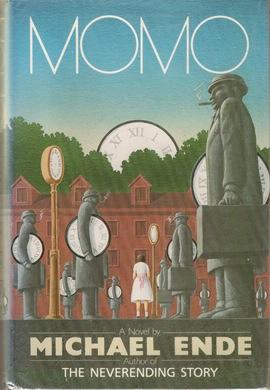
 [I originally wrote this book review in 2006. However, Momo was such a good book that I wanted to include it here on this blog.]
I was browsing around at Pioneer Book in downtown Provo a few weeks ago when I saw this book. Michael Ende wrote The Neverending Story, which was my all-time favorite children’s book, and so I was really excited to see that he wrote this one. When I read it, I wasn’t disappointed.
Momo tells the story of a girl (named Momo) who has the uncanny ability to listen to people. People who have problems, don’t know what they should do, or are generally depressed come to talk with her. Because she’s such a great listener, she helps the people see things about themselves that they couldn’t see before, and helps them find out what they need to do with their lives. In this way, she becomes a friend to everyone and helps many people work out their problems.
Momo lives by herself in some ancient ruins (an awesome place to live, from a kid’s perspective! Kind of like having a tree house as a permanent residence), and she’s supported by her friends from the town, who frequently come to visit her.
The problems begin when these gray businessmen start going around town trying to get people to deposit their time in a timesaving bank. Don’t ask me how it works, that’s part of the fantasy. Basically, these men (who mysteriously know everything about just about everyone) convince people to work really hard so that they can save time, and by doing this, they will have a lot more time sometime in the future. However, the grey men are really these fantastical monsters who exist on stolen time, and their goal is to take all of the time from all of the people in the world. As they do this, the people become more and more miserable because they have less and less time for each other.
Momo recognizes the problem when she finds out that her friends aren’t coming by to visit her anymore. One of the grey men comes to Momo to steal her time, but she’s so good at listening that he ends up telling her who the grey people really are. Momo and her two best friends, as well as a whole bunch of abandoned children, try to find a way to stop the grey people, but it isn’t until Momo finds Never Lane and the source of time itself that she defeats the grey men and rescues all of the people.
I really loved the way this story was written. It was written like a really good children’s book–the kind that doesn’t condescend to children by assuming that they only have a very limited command of the English language. And as far as storytelling goes, this book was very well written. There were chapters that just really gave me this good feeling, like I had just experienced something really worth experiencing. I can see myself reading this book to my kids someday.
As far as the message is concerned, it’s fairly easy to tell that there are a lot of symbols and metaphors in the story. It’s not very preachy, though, which is good. I wish I’d read this story five or ten years ago, because I think I’d have understood the message better. Back then, I really loved reading stories that had deep meaning, and I was really good at picking the meaning out. Now, I guess I’m just older and too saturated with college studies for it to really sink in.
Which gets to the part about the grey men. If I were a character in this book, I wonder if I’d be one of the people who sells out to the grey men. But at the same time, I don’t regret being busy. I’m VERY busy all the time (especially this spring, with Poli Sci 200 giving me a major beating ). There are days where I wake up at 6:00 am and I don’t stop running from one place to the next until the evening. Sometimes, it’s true, I let the world around me just sweep me around and control my life. But I don’t think that things would be much better if I just cut out all the things that I’m doing.
I was home this time last year, not working or taking classes–I didn’t really have any responsibilities at all. And I was miserable. I felt like I wasn’t being productive enough, and I looked forward to coming out to BYU for the summer term because then I’d have something to do. Now that I’ve been really busy for a year, I’ve found that I really like it. It’s good to have a lot of challenging projects and responsibilities. I’m doing what I love and even though it can be difficult, I’m having a lot of fun. Work hard and play hard.
My sister Kate sometimes has problems with being overworked or underworked. When she’s busy, she’s so busy that it makes her anxious and she feels overstressed. We tend to fight a lot when that happens. So then, she takes time off to try and recharge, but she gets anxious because she feels that she’s unproductive. So then she fills up her schedule with things to do, until she’s overstressed again.
I think that the problem isn’t a matter of whether or not you’re always busy, so much as what you make time for. The people in the book got to the point where they figured that good things were something they’d only have time for sometime in the future, so they spent all their time doing menial things, and ignored their friends, families, and anything that was fun or enjoyable.
Life should be kind of like a car battery–once you’re up and doing something, it recharges itself. If I were only busy with things that drained me, I’d go crazy. It would just feel wrong, and I would make some major changes in my life. But if I actually enjoyed all of the things I was doing, and am doing, right now, I would know that things are working the way they should.
And ultimately, I think that that’s the message that Ende was trying to get out. Enjoy your life right now, where you are, and make time for the people around you.
So yeah, if you want to read a really awesome (and apparently very rare) book, check out Momo…if you can find it. Good luck! If you’re like me, and you like going places where you can be surrounded by large stacks of old, work, dusty books, maybe you’ll find a copy. Or maybe you’ll find something better. I’ll definitely be on the lookout.
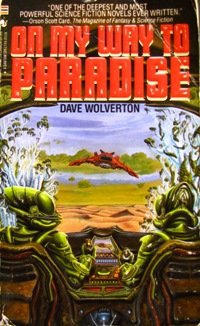 Senior Angelo Osic is a doctor in one of the refugee flooded neighborhoods of Panama. The United Socialist States of South America has launched a new war in its efforts to reshape the human race into something purer, but all of that is far away from the life Angelo lives–until an emaciated woman with a bloody stump at the end of her arm shows up and demands him to grow her a new one.
 They came completely unexpected. Hundreds of silver spaceships, hovering above all the capitols and major population centers of the Earth. For nearly a week, as thousands rioted in the streets below, they sat there, waiting. And then came the voice of Karellen, chief of the overlords, viceroy of Earth, heralding a new, planet-wide administration that was destined to end war, poverty, hunger, disease, ignorance, and fear. But as the generations pass and a new breed of humanity arises–one that has known no suffering, no danger, no religion but science, and no creative drive beyond sheer curiosity–mankind is about to discover that their welfare is not the overlords’ primary goal. Humanity’s time in the universe is about to come to an end–and a new, alien beginning.
 Lyra is a young girl who lives in Jordan college, Oxford university, with her daemon–a shapeshifting, talking animal companion that is as much a part of her as her growing, changing personality. She is perfectly content to stay at the university forever, exploring and playing games with the local children and their daemons.