Nothing to do with science fiction, but I find this channel absolutely fascinating. This is one of their better videos. Looking forward to seeing what Sherni can do once she’s grown up!
Author: Joe Vasicek
Joe Vasicek is the author of more than twenty science fiction books, including the Star Wanderers and Sons of the Starfarers series. As a young man, he studied Arabic and traveled across the Middle East and the Caucasus. He claims Utah as his home.
Larry Correia on Sensitivity Readers
Larry Correia just came out with another highly entertaining rant, this time on sensitivity readers. In case you don’t know, “sensitivity readers” are people that publishers hire to go through an unpublished manuscript to make sure that there’s nothing that could offend any marginalized groups. Larry sums it up quite well:
A Sensitivity Reader is usually some expert on Intersectional Feminism or Cismale Gendernormative Fascism or other made up goofiness who a publisher brings in to look for anything “problematic” in a manuscript. And since basically everything is problematic to somebody they won’t be happy until they suck all the joy out of the universe. It is basically a new con-job racket some worthless scumbags have come up with to extort money from gullible writers, because there aren’t a lot of good ways to make a living with a Gender Studies Degree.
It only gets better from there. And I have to say, I completely agree with him, not only from a political angle (in fact, politics has almost nothing to do with it) but from an artistic angle as well.
You can’t tell a good story without taking the risk of offending somebody. That’s because being offended is always a choice. Always. My favorite Brigham Young quote, which has gotten me banned from multiple forums, is this:

A good story stimulates the mind and excites the emotions. Anytime that happens, people will inevitably be offended. It doesn’t matter the reason. Humans are weird.
Here’s another way of looking at it: in order to create truly great art, you have to pour a significant part of yourself into it. That’s scary, because it makes you vulnerable.
The perpetually outraged crowd loves this, because it’s a weakness that they can exploit. They don’t care about your art. They only care about power. If you give them that power, they will suck all the greatness out of your art and leave you bleeding and broken on the floor.
That doesn’t mean you should always necessarily go out of your way to offend people, of course. But relying on sensitivity readers is a bad, bad idea. Why?
Because fuck your sensitivity.
Seriously, that’s my favorite part of Larry’s rant. If your skin isn’t thick enough to tell these moral busybodies to fuck off—or to simply ignore them, which is probably the better choice—they’re going to walk all over you.
Which gets to the last part of his post:
To further illustrate how Sensitivity Readers stifle creativity and suck all the fun out of books, at a recent writing convention I attended there was a panel on Intersectional Feminism or something like that. I didn’t attend it (I’m not a glutton for punishment) but several of my friends went because they were curious to see how much of a train wreck it would be.
The panel was a bunch of feminists and the whole thing turned into a big competition of who could be more offended, and who could speak for more “marginalized” people. At one point a certain author (who is an upper class white lady) had to establish her street cred, so she actually called her professional Sensitivity Reader and put her on speaker phone.
Seriously, this shit is like the victim Olympics. It has fuck all to do with creating books that readers will actually enjoy.
I went to a party that night where a bunch of people who’d attended that clusterfuck of a panel were talking about it. Apparently the only panels at this event which were more dreary was the one about the evils of capitalism (I shit you not), and the one about writing comedy which degenerated into authors who’d drank the social justice Kool Aid telling everybody what not to write because it might be “offensive”.
I’m pretty sure I was at that convention. I didn’t attend the panel, but I did run into an aspiring professional creator who told me “I just found the solution to my problem! Sensitivity readers!”
Even at the time, I wanted to put my arm around this guy and tell him to have confidence in himself and in his art. I still feel that way. We talked a bit about the outrage crowd, and about the difference between trusted alpha readers who have your best interests at heart, and sensitivity readers who may or may not. But I felt really horrible about it, because I could tell that this guy was getting pushed and pulled and tossed back and forth in all the wrong ways.
If sensitivity readers provide any value at all, it’s basically as overpriced alpha readers. But even there, the value proposition is dubious because the feedback is so toxic. Larry is right: these people create nothing. They can only destroy.
I’m a creator, not a destroyer. Because fuck your sensitivity.
Why I deleted my Facebook account (again)
Please watch this video in its entirety (before YouTube takes it down). Whatever you think of James O’Keefe, this is serious stuff that he’s exposing, and it affects all of us.
The first time I deleted my Facebook, it was out of privacy concerns. I came back because there were social groups, such as my local church congregation, that organized all of their activities on Facebook and by being off the platform, I was cutting myself out of the loop. So I got back on, rationalizing that I could be careful about what I shared and it wouldn’t be an issue.
The second time I deleted my Facebook, it was because of the negative effect it was having on my life. I was disturbed about the way that social media was programming people, and I could feel it beginning to happen to me. It was around this time that I deleted my Twitter as well.
I came back because I worried that I was becoming too much of an “internet hermit.” There were also some social groups that it was more convenient to interact with over Facebook, but much less so than before. Mainly, I knew that there were people who wanted to reach out to me, and cutting out Facebook entirely seemed a little too extreme.
This time, however, it isn’t just about privacy issues, or even about social programming and the negative effects of social media in our lives. It’s about power, and conscience.
Facebook, Google, Amazon, and other big tech Silicon Valley companies have a massive political and cultural influence on our lives, and I don’t like what they’re doing with it. They’ve become too powerful, and now they’re abusing that power to shape our lives and our communities in ways that I don’t agree with. But the truth is, the only reason they have any power at all is because of us. We give them their power, and we can take it away.
I’m getting off of Facebook permanently this time because I don’t want to give that company any more power than they already have. I’m also deleting my Twitter. If I do come back to social media, it’s going to be through alternative platforms like Minds and Gab.
The next big step is to de-Google my life, and I’m not sure how I’m going to accomplish that. However, with the direction things are going, I believe it’s more important now than ever to do so. As for Amazon, it’s going to be much more difficult since such a large chunk of my income comes from them. What I will probably have to do is limit my dependence on these companies without cutting either of them out of my life completely.
Extra Sci-Fi S3E2: The Fellowship of the Ring
Another fascinating episode from Extra Credits, this one focusing on the themes of generational passing and the diminishing of ages that is present in Tolkien’s Lord of the Rings. I have a lot of thoughts on this episode, but they all basically boil down to one thing:
Every generation reinvents the world.
It’s a theme that’s also present in my favorite novel of all time, The Neverending Story. The Childlike Empress of Fantastica is dying, and the only way to save her is for someone from the human realm to give her a new name. Fantastica, of course, is the realm of all fictional stories, and the Childlike Empress receives a new name when the next generation makes the old stories their own. There is nothing new under the sun.
This is also a theme present in Star Wars: The Last Jedi. I’m not a huge fan of the movie, but the best argument I’ve heard in favor of it basically boils down to this theme: that the old generation has to pass away in order for the new one to rise and take its place. I’m still not entirely convinced that The Last Jedi did this well, but I can see how someone who loved the movie would see it that way.
As a writer, this theme weighs especially on me because I feel that I’m personally living it with ever book that I write. All of the greats of the genre, like Tolkien, Herbert, Heinlein, Asimov, Bradbury, Card, Le Guin—the list goes on and on—loom over me every day. With their passing, the world feels somehow diminished. They left us with a great gift—their books—and yet as time passes and the old world crumbles into dust, these gifts from the previous generation feel increasingly out of place. It is time for a new generation to rise and give the Childlike Empress a new name.
I want my books to be a part of that. I hope that one day, mine will be one of the voices that helps to reshape the world. I hope to one day leave behind a gift as great as the ones that we were given: stories and books that made us feel deeply and taught us meaning and love. Is there anything greater than this? Raising a family, perhaps, but that too is a form of generational passing.
I’m sure this theme of generational passing applies to a lot of fields too, not only in the arts, but in trades, and crafts, and sciences too. Indeed, it is a fundamental part of the human story, because of this singular truth: that every generation reinvents the world. There are curses as well as blessings that are passed down from generation to generation, but it is up to each of us to decide whether those curses and blessings stop with us, or whether we will continue to pass them down.
Lots of interesting stuff to ponder and think about. That’s part of what makes Tolkien so great. He spent an entire lifetime writing Lord of the Rings, and that time was not wasted.
Epic music to write by
I don’t put together mixtapes for all of my books, but when I do, chances are there will be at least one song by Magic Sword.
Life, the Universe, and Everything 2019
Life, the Universe, and Everything was this past weekend. It’s a local Utah convention with an academic flair, which means there’s a little less cosplaying and a lot of interesting and informative presentations, in addition to all the great panels. There’s also a strong writing and publishing track, though in recent years they’ve expanded the tracks on art, music, and film. Regardless, it all comes back to science fiction and fantasy.
I’ve been coming to LTUE for the last eleven years, and I think this was my favorite one yet! Part of that might have to do with the fact that future Mrs. Vasicek was there with me, but still. Lots of friends, lots of books, lots of panels, and lots of fun!
On Thursday, there was a really fascinating presentation on pre-modern methods of food preservation, such as pickling and fermentation. Really interesting stuff. Not only did we geek out on cheesemaking and sauerkraut recipes, but we also looked at how the production and supply of salt shaped trade routes, empires, and wars. It was extremely informative.
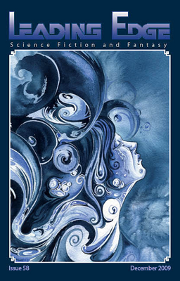
Since Thursday was Valentine’s Day, I picked out some chocolates and a copy of Leading Edge issue 58, where my first published work appeared. I was a bit worried that it would seem tacky, but some friends assured me that it wasn’t, and future Mrs. Vasicek seemed to really appreciate it.
There were a bunch of interesting panels on Friday. My favorite was probably the one on community building for creatives, with Sandra Tayler and M. Todd Gallowglass. They both had some very interesting stories and advice, as well as the other panelists. My biggest takeaway was that in order to build a community around my own work, I need to be a better participant in other creative and fan-based communities. Like LTUE, for example.
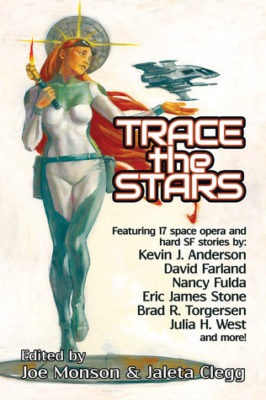
I also picked up a copy of the first LTUE benefit anthology, Trace the Stars. My mission for the rest of LTUE was to get as many authors from the anthology as I could find to sign it. Some of them weren’t there, but I did get most of the ones who were. One day, I’ll get all the signatures and turn it into a book of power! Wuah-haha!
The book signing was fairly low key. A lot of the big names didn’t show up, partly due to the weather, but there was still a good turnout. One of my very first fans who bought Desert Stars at my first ever book signing came over to chat. It was really good to catch up with him, and to let him know that I’m still writing and publishing.
There were a lot of really great panels on Saturday, on topics like surgery in space and what archaeology would look like on an artificially created world. Caught up with Eric James Stone and his wife Darci, who is a close friend of future Mrs. Vasicek. As we were all hanging out in the library, Brandon Sanderson walked up to say hi, and I was able to introduce future Mrs. Vasicek to him. We were actually both in Brandon’s class ten years ago, and didn’t know each other at the time. Brandon got a kick out of that.
My Saturday panels were very well attended and went off very well. The one on villains was particularly good, I think. There was just enough contrast in our viewpoints to keep it interesting without being too argumentative, and everyone had good points. When we made our plugs at the end, I urged everyone to subscribe to Pewdiepie, which got a kick out of the audience. I’m doing my part!
The panels were great, the banquet was great, catching up with old friends was also great. I may have spent a little more than my budget on books, but it was great to support my author friends, and I’m really looking forward to reading some great stuff!
All in all, another great year!
Sons of the Starfarers: Omnibus I-III just hit the #1 spot!
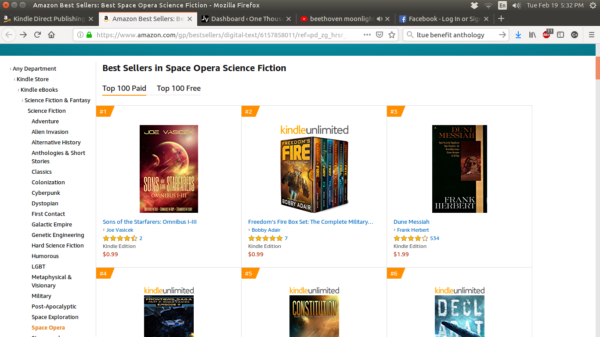
OMH! Oh my heck! Sons of the Starfarers just hit the #1 spot on Amazon’s Science Fiction > Space Opera subcategory!
No secret here, other than a 99¢ BookBub featured deal. I’ve sold a couple thousand copies on Amazon already, easily earning back what I spent on the ad. Looks like BookBub still has legs!
The deal runs until Saturday, so if you haven’t already picked up a copy, now is your chance!
Sons of the Starfarers omnibus on sale!
Nothing Found
New plan for the newsletter
So my fiancee helped me to put together a proper newsletter template for my email list, and it looks pretty good! Much better than the template I wrote myself, and I’m not a programmer (she is).
This gives me the opportunity to make some changes to the way I do things, and I’ve decided to grab the bull by the horns. I’m going to write a proper newsletter, not just a simple “here’s some book deals and a couple of promos to check out!” Here’s the new format:
Welcome
A short, 1-3 sentence “Hello, dear reader! I hope this email finds you well,” etc etc. Kind of like I already do.
Featured Book
The main call to action, put at the top for the casual readers who don’t have a lot of time or interest for much else. This may be a preorder, or a new release, or a special offer. Or it may just be a full-price book that I want to feature, for whatever reason. I’ll have to play around with it and see what works.
I’ve decided to go back to the two-button approach: one that says BUY ON AMAZON and goes directly to Amazon, albeit without an affiliate link, and one that says ALL OTHER STORES and goes to the book page here on my blog. For some reason, Amazon won’t let you put affiliate links in emails, which makes this a tough either/or. I’ll get more click-through and sales with a direct link, which is going to cost affiliate income, but I think it’s more important to focus on my own books than it is to game the affiliate system—at least in this section.
Writing Update
This is a brief, 1-2 paragraph section just below the featured book, where I give an update on my current WIP, along with a status bar. Basically, an accountability section, as well as something to keep the fans up-to-date on my writing progress.
Author’s Note
This is the meat of the newsletter, where in 3-5 paragraphs I share something personal with my readers: either a story or insight from the writing process, a behind-the-scenes look at what I do, or something else. In a recent newsletter, I talked about my grandfather and how his entrepreneurial spirit has rubbed off on me. Stuff like that.
From time to time, I also plan to share book recommendations. With my fiancee’s help, I may design a second template with an Author’s Note section that’s better set up for that.
The goal is to provide my readers with a personal connection and something of value that goes beyond “buy my book!” I already do this in the back of all of my novels, and have from the very beginning, so it will be fun to do something similar in my email newsletter.
Book Promotions
This is where I put all the links to all the promotions that I’m currently participating in, usually with other authors. I already do this in my newsletters, and it seems to be fairly popular, so it seems like something I should integrate into its own section, probably towards the bottom so as to incentive readers to scroll down.
Parting Quote
This is something new: a pull quote from the featured book to close out the email. Nothing too long; just enough to give my readers a taste and hopefully leave them intrigued, or thoughtful, or otherwise interested in reading more.
Farewell
The standard “so long, and thanks for reading!” that I always end on. Not a bad catch-phrase for a writer, I suppose.
So that’s the new format. Because I plan to share frequent writing updates in my newsletter, I’ll probably leave off sharing those updates here on my blog. Besides, that’s not really the strength of this medium: blogging is much better suited for community building, brand engagement, and public discussion. I may still share major updates, but not regularly.
That’s pretty much it. If you have any suggestions or other opinions, feel free to share. Also, you can sign up for my newsletter here if you haven’t already done so. That’s going to be the best way to keep up with me from here on out.
Take care, and thanks for reading!
And you call yourself a writer??
So I got into another online political debate on a writer’s forum last month. Shocking, I know. This one started with a discussion of political correctness and an op-ed piece in the Wall Street Journal, and quickly devolved into an argument about corporate censorship, gun control, Trump, and every other controversial issue in politics. Needless to say, it didn’t take long for people to cry reee and let loose the frogs of war.
That’s not the interesting part, though. Before the discussion devolved into a dumpster fire, I asked one of my more outspoken opponents a simple question:
I’m curious, Perry. Are you capable of seeing the world through the eyes of someone who disagrees with you politically?
To which he responded:
I used to be, before they started endorsing hate speech and supporting authoritarian sociopaths. Now I’ve got no patience for people who believe in a society built on a foundation of inequality and selfishness.
Now, perhaps this was naive of me, but I honestly was looking forward to the challenge of trying to reflect this guy’s own views back to him. I was looking forward to him doing the same for me. After all, isn’t that what writers are supposed to do? Put ourselves in a character’s head, and show that character’s perspective?
It blows my mind that people who call themselves writers can have absolutely no interest in seeing things through the eyes of the people they disagree with. Even if those people really are evil (and in almost all cases, they really aren’t), it’s still a good idea to study how they see the world, because some of the most interesting characters are evil to the core.
Anyone who takes this stance must write horribly dull books. Their bad guys and villains must be one-dimentional cardboard cutouts, or pyromaniacal straw men. The most compelling antagonists always believe that they are the heroes of their own stories, just like everyone else, and the more compelling the story they tell themselves, the more interesting the character.
For example, consider King Candy from Wreck-it Ralph. He was absolutely a villain, but he had a very compelling story for why he was right to keep Vanellope from racing. Never mind that he was an imposter in what was actually Vanellope’s game.
In any case, I think that if we want to write well, we absolutely need to do our best to see the world through the eyes of the people we disagree with. Even if they’re wrong. Especially if they’re wrong. And if our own views are so rigid that we cannot bring ourselves to do this, then maybe we should take a good, hard look in the mirror. After all, how can we hope to change the world if we can’t—or won’t—change ourselves?