I’m not going to lie, I really didn’t like this book when I first started it. In fact, after I got about 100 pages into it, I got disgusted and stopped reading it. But there were some things that just kept coming back into my mind, like the fascinating relativistic space battles and the basic premise: leaving the earth of the present for the earth of the future, only to find that the future isn’t all it’s cracked up to be and you can’t go home. After six months, these things bothered me so much that I decided to pick it up again and finish it, and I am VERY glad that I did!
Author: Joe Vasicek
Joe Vasicek is the author of more than twenty science fiction books, including the Star Wanderers and Sons of the Starfarers series. As a young man, he studied Arabic and traveled across the Middle East and the Caucasus. He claims Utah as his home.
1,302 words and a successful experiment
Between classes this morning, I was checking out the blogs I subscribe to and I read something really interesting about a correlation between creativity and exercise. I haven’t had time to read the original study yet, but I’ll browse over it when I get a chance. Basically, the study shows that Aerobic exercise increases creativity (not sure how they measured that) up to two hours after completing the exercise.
no time no time no time
Man, there is never enough time to do anything! The sun was setting yesterday before I had gotten to a point where I was ready to do homework–and even after two straight hours yesterday, I still had another four hours tonight (I HATE doing homework on Sunday, I wish I didn’t have to do it) and even then, not all of it is done! But, on a good note, I actually had fun writing a paper about Palestine-Israel, and that was encouraging. I would hate to go into a career where I hated the everyday work I had to do, so this is a sign to me that I wasn’t dead wrong to choose a major that required a lot of essay writing.
Citizen of the Galaxy by Robert A. Heinlein
I was browsing around in Pioneer Book about a week ago (and Pioneer Book is an awesome place to hang out if you like books–they’re used, but cheap, and it’s really fun just to go and get lost in there!) and I saw a few used Heinlein books for sale. I don’t know too much about anything in particular that he wrote, just that he’s known as one of the best Science Fiction writers of the last century and had a very strong influence on the genre, and so I decided to pick up one of his books to get a taste for his writing. I settled on Citizen of the Galaxy, for no particularly compelling reason except that it seemed a little bit more interesting from the back cover blurb.
It was definitely a good book! I read it very quickly and really loved it! This was one of those books that I would read between classes (and maybe for the first five minutes of class as well), while eating, while walking back to my apartment from on campus, etc. Basically, any time I had free time.
The story takes place in the far future, when humanity has expanded to many worlds and has diplomatic contact with many alien races. But because space is so large, all the worlds are only held together in a loose confederation. Far away from Earth is the Sargony of Nine Worlds, where human trafficking is alive and well. The main character, Thorby, is a boy who starts out as a slave–but he is bought and befriended by a beggar named Baslim. However, Baslim is much more than a mere beggar, and there are many people from outside of the Sargony who would like to see slavery abolished. Soon, Baslim is killed by the Sargony, and Thorby is forced onto the run. He moves from place to place, among many different people, as he grows from a boy to man. When he finally finds the true identity of Baslim–and his own true identity–he finds that it provides him an unlikely opportunity to fight the evil slave trade. But it will require him to once again give up everything that he wants.
It was easy to read and very fast. In fact, it was surprisingly fast. There were many scenes where I thought to myself “wow, this scene could really be fleshed out more!” The descriptions were minimal, and at times, days, months, and even years passed by in only a couple of pages. Heinlein definitely wasn’t too wordy, but the things that he did describe and did explain were the important and interesting things.
I think a lot of this was due to the point of view. It was 3rd person omniscient, like Frank Herbert’s Dune, except that it was even more detached than Herbert. Herbert would get into the scene enough to give a detailed picture of everything, but for Heinlein, the important thing was the plot of the story–as well as some of the more interesting ideas he had.
One really interesting idea that he had was of a society of space traders that travel the frontiers of known space on long voyages, completely isolated from the rest of humanity, who over time form their own distinct culture and government. Each ship is like its own country, with a very rigid social structure to keep the friction of long voyages from causing mutiny and disorder. The onboard community is almost like a tribe of nomads where everyone plays a role. Every few years, they come together in a giant gathering to intermarry and buy new ships to start new clans.
The way that Heinlein envisioned this society is truly fascinating–he took the conditions that existed on the frontier of the world that he created, combined it with the technology of space travel, and drew it to what he saw as the logical conclusions. He then humanized it somewhat by telling a story within it.
He did this for more than just the Free Traders: he did it to one degree or another throughout the whole book. And these ideas and concepts, combined with the story of Thorby’s rise from anonymity and the underworld, made the story really good. It really got my imagination going, which in my opinion is a sign of greatness in any story.
Oh, and one more thing: one reason why I love reading these old sci fi stories is because it is ALWAYS funny when one of the characters pulls out a slide rule to do some math! ALWAYS!!! It happened only once in this story, but it made me LAUGH so hard! You’ve gotta love old 60s sci fi!
grrrr…!
Ok, so real quick, I didn’t do any writing today. That was very annoying. The really annoying thing, though, was that it took nearly six or seven hours to do less than two hours of homework. That’s what happens when I hang out around the Arabic house–too many distractions. Not that it wasn’t all unpleasant. Got into some really interesting discussions with my Arab friends, Basseem and Yanal. But when I find myself getting sucked into an hour long discussion between my Arab friends and my roommate David over who is the better prophet (Joseph Smith or Mohammed), and I’m trying to read a really dense article on the Israeli-Palestinian conflict, I lose quite a bit of efficiency. Bah. I should have gone to the library!
But, things will be better because tomorrow we’re having a Quark writing party over at Jakeson’s and Gamila’s! Yay! I am very much looking forward to that! I really love having these get togethers; they can be very relaxing and enjoyable. The only problem is that I feel a bit guilty for not hosting one here. The problem, though, is that there are too many people coming in and out. Maybe if the weather weren’t so cold, we could just go outside or something. Maybe when it gets warmer.
Also, as a sort of unrelated side note, I went to an open house today on the Masters of Public Policy program here at BYU, and it really sounded interesting. Very interesting. As in there’s a greater than 50% chance that I’m going to do this. I need to sit down one of these days and ask myself “what are all the possible things I can do with a Poli Sci degree and fluency in Arabic?” and then write out a decision tree that I can use to formulate some idea of a plan for what I want to do. But as far as gut feelings go, this public policy program sounds really good. It sounds like just the thing to shoot me in the general direction where I want to go. And it also means that I would have a little bit more time to get married before jumping into a vocation. I know–I didn’t come to BYU to get married, not at all, but it is pretty important, and even though I probably worry about this more than I should, it is something I would like to figure out before I get too deep into a career.
Tomorrow will be crazy busy as usual, so here are some things I’d like to post about soon: review of Citizen of the Galaxy, review of The Forever War, some thoughts on L’Engle’s philosophies about writing, a pro/con post (or two) on doing writing as a career (from the limited perspective of a mere undergrad such as myself).
Oh, and one last thing. I noticed on this really awesome site that gives out free audiobooks that they have this artificial voice that generates a lot of the mp3 files. I’m assuming that they have a program that can convert word documents / pdf’s into mp3s, which is really cool, especially because the artificial voice isn’t all that bad. Does anyone know where I could get one of these dictation programs? It would be WAY convenient to just plug some of the readings from my classes into a computer program and have it generate an mp3 of the texts.
still here and still writing
So, I’ve gotten out of the habit every day of posting my word count progress, but just so you know, I’ve been doing it very regularly. After I decided to keep working on my novel and not put it on the back burner, I’ve been doing between 500 to 700 words a day.
It’s really great that my friend Steve is also a writer, because when I want to go write, I’ll get out of my apartment and go over to his house to write in his basement, where he usually writes. For some reason, I don’t really like writing in my apartment very much. My roommate usually plays Arabic and Circassian music (he is Circassian and VERY nationalistic, which is great because it’s given me some good ideas for some of my characters), and after dinner there are usually people coming in and out, or watching TV, or something else. Or maybe it’s too messy. I don’t know exactly what it is, but I prefer to get out of the apartment to write.
It’s really great at Steve’s house, because it’s this old house with a dimly lit basement and all kinds of weird stuff all over the place. Slightly mildewy (except not so much anymore), isolated down in the basement from everyone else who usually hangs out doing stuff in the TV room upstairs, and if I need a break I can hang out with my old roommates, which is ALWAYS fun! So it’s just a great place to get away to to write.
I’ve been reading a lot of major sci fi books recently, as a part of my self-education on the genre. I just finished The Forever War by Joe Haldeman just an hour ago–and holy cow! It was good! I’ll review it and Citizen of the Galaxy here in a little bit, after doing some homework. If I’m going to write Science Fiction, I want to become well informed on the genre, know what has been done before, what’s been done well, where it’s going right now, wha the cliches are, what the successful techniques are, etc. Plus, I want to just be a better writer in general, which means that I’ll be going outside of Science Fiction / Fantasy every once and a while. One of the books on my list is The Kite Runner, which I hear is really good. I’ll probably review that one here, too.
And where am I finding this time to read all these books? It’s pretty easy, actually. I started exercising recently, and I found that it’s really easy to read while you’re pedaling on one of those machine bikes. So using only an hour each day, I can hit two birds with one stone: get in some exercise and give myself some reading time. Plus, I walk around campus a lot now with my head buried in a book, and even though I probably look a little weird, I’m getting the hang of it. After a while, you even stop bumping into people.
😉
Forget it…I’m going for it
Ok, so you remember what I said about putting off my novel and focusing on some other stuff? Well, I went a couple of days without writing in my novel, and by the end of it, I decided to change my mind. I’m going to go for it–and if I end up writing too much, well, I’ll just split my time between two projects. I’ve really gotten into this world that I’m writing, and I don’t want to leave it until the story is finished.
I am working on another project with my friend Steve, though. He was my roommate last semester, and he’s a film major. We get along REALLY amazingly well, and we decided to get together to write an online tv show. He’s really gungho about it, feels confident that once we finish the script, we can get funding and actors and all kinds of other stuff. He also thinks that it could be profitable. As for me, I’m more interested in just writing the story, but I’m also excited about this. Because, if this is a webisode series (I’m not sure exactly what you call it–it’s a tv series not on a tv), and we’re the ones who can write and direct it, then I want to make sure that it’s actually good! I mean, the biggest complaint I have with the stuff coming out of Hollywood is the horrible writing–and it’s really not the writers’ fault, it’s the system’s fault. #$%! Hollywood! So, if this is something we’re writing by ourselves, I’m going to make sure that it’s actually good! So far, we’ve just been working on the basic concept of the story, and we have some really good ideas, but I’m going to wait to post about it until we get a little further (and after Steve tells me he’s ok with me blogging about it).
On another note, I found a really interesting podcast. It’s called Tor Podcasting, and the first episode I downloaded was some kind of a panel between sci fi writers / bloggers, and it was really interesting. They said that when aspiring writers had a blog, it really helped the editors to get a feel for them as writers and in some cases helped move them out of the slushpile and on to other things. It’s not a silver bullet, of course, but it seems that blogging could be a good thing for aspiring writers. Which means a couple of things: 1) I need to be more careful about my grammar on this blog–make my rambling more coherent and pleasant to read–and 2) I need to blog about something more interesting than how many words I wrote each day! So, I will probably be making these improvements in the near future.
Other than that, I’m off to go camping with my friend Steve and my other old roommates! No, seriously–they set up a tent in their living room, and they’re going to sleep in there while watching some really amazing nature documentaries in HDTV! It’s going to be SWEET!! An excellent opportunity to relax and write a bit!
And so, with that, I’m off! Bye!
2001: A Space Odyssey by Arthur C. Clark
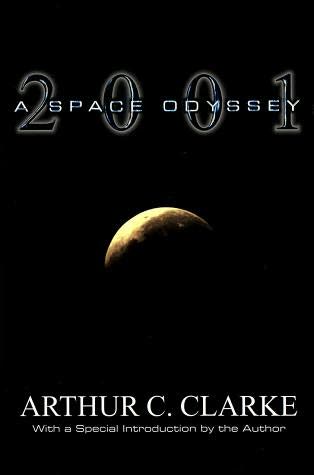 As I’ve become more and more involved in writing Science Fiction, I’ve felt a strong desire to educate myself on the genre and read the major Sci Fi books that have come before me. I want to do this so that I can make my own works stronger, and also because I really enjoy them. When I picked up this book, I did so more because it was one of the more well known books and I felt that I ought to read it than that I really wanted to read it. After all, 2001: A Space Odyssey is known to be really hard sci fi, and most of what I’ve experienced and come to love is more “soft” sci fi.
However, even though this book really is “hard” science fiction, I became totally engrossed and really came to love it. The last 50 pages in particular had a huge impact on me–I literally couldn’t put the book down!
2001: A Space Odyssey kind of reminds me of Asimov’s Foundation series, in that the thing driving the story the most isn’t the characters, the plot, or the conflict, but the idea. In Foundation, it was psychohistory and questions about free will and the ability to predict the future. In 2001, it has to do with the growth and development of humanity and wonder at the universe.
Like Foundation, it really isn’t character based at all–the story starts three million years in the past, when aliens encounter our primate ancestors, and goes forward to 2001, when astronaut David Bowman again contacts these aliens on a mission to Saturn that goes disastrously wrong. But really, it isn’t about David at all–he’s more of a vehicle through which Arthur C. Clarke describes the planets and the aliens.
The thing that really makes this book stand out for me is the writing. When the Discovery was flying by Jupiter, I really felt like I was there. It was almost as if I could feel the same anxiety and wonder that the astronauts felt–and when the probe broke through the first few layers of Jovian clouds to send out a video picture of what lay underneath, my eyes grew wide as if I were there. The writing throughout the book was superb like that.
One thing that surprised me a bit was that I didn’t mind how Arthur C. Clarke treated the man-apes at the beginning of the book. I’m a fairly religious person, and even though I accept most of evolution, there are some things about the Darwinist worldview that clash with my theology and can sometimes irk me. It’s not that I think I’ve got it figured out–because really, like every reasonable person I have to admit that I haven’t–it’s that there are certain things about the Darwinist worldview that I feel leave no space for the kind of stuff that I believe in. However, even though 2001: A Space Odyssey adhered very close to the Darwinist view of human pre-history, I didn’t feel all that upset or thrown off by it. I think this was because Clarke wasn’t preachy about it, or tried to use it as a way to downplay religion. Indeed, Clarke didn’t seem to have much to say either for or against religion–just that this was one aspect of where we came from.
And I think this gets onto something much bigger that I really liked about this book–Clarke didn’t try to explain everything. Indeed, there was a lot more left unexplained than explained, and that helped to preserve the supreme sense of wonder that the book conveyed. This wasn’t like the Star Wars prequels when they tried to do something as lame as explain the force–this book really showed that there are a lot of unanswered questions and fascinating possibilities in the universe. And I really think that that helped to strengthen the book as Science Fiction.
By far the strangest and most fascinating part of the book was the last fifty pages, when David Bowman gets to Saturn aboard the now partly derelict Discovery and finds the stargate. Once he goes through it, ALL KINDS of crazy stuff happen! And it was really thrilling to read! I won’t give away any spoilers, but it was really crazy–and really good as well! The thing that made it good was that even though it was really psychedelic and mysterious, I didn’t feel lost as I was reading it. I felt that I could visualize it very well, even if I didn’t know what “it” was, and every once and a while, Clarke dropped in a short explanation or two without breaking the action. Indeed, since the point of view was not really limited to David, there was room for the narrator to talk with the reader and explain some of the stuff that was going on. But Clarke really did a good job balancing the information he gave so that he preserved a sense of mystery without losing the reader. That, I feel, takes skill and practice, and can really strengthen a good story.
2001: A Space Odyssey is definitely hard sci fi, so if you like reading about characters or stories, you won’t get much from this–but if you have a sense of wonder about the universe and you like pondering scientific ideas, this is a really excellent book to read!
Some of my short story ideas
Alright, here are the two ideas I have right now. I’m not really at a good stopping point for The Lost Colony yet, but I think I can slow down enough to divide my attention.
The first one I got when I finished 2001: A Space Odyssey just last week. I was thinking about dating and relationships, and also thinking about the last 50 pages of 2001 (which, let me tell you, are psychedelically crazy!), and the thought came into my mind that a guy and a girl getting to the point where they start up a relationship is kind of like a first contact situation with an alien species. In both situations, both sides are trying to put their best selves forward; in both situations, communication is awkward and neither side quite knows what to expect; in both situations, each side is driven to figure out what the other side is thinking, and to predict what they will do; in both situations, the stakes are very high. So, I thought I’d write a story which is actually two stories–a first contact story that parallels an awkward dtr, where it’s unclear whether the first contact story is real or is just happening inside the guy’s head. Yes, I know it’s a really nerdy story. Yes, I embraced my geekdom long ago. And…to make it more geeky, I’m probably going to need a little bit of help with this one. So I talked with my good friend Steve, and we’re going to collaborate on this one. I think it could be really funny–just like Decision LZ150207! (speaking of which, I need to send out that story to some publishers)
The other idea I have is a bit darker. I got the idea of it from Joe Haldeman’s Forever War. I thought that the space combat in that book was very intriguing, about space battles fought across solar systems at relativistic speeds, and how the soldiers return after every combat to a very different world. For a few months, I toyed around in my head what a spaceship would look like that fought at such speeds, and I came up with this idea of a one man spaceship that was equipped to defend a planetary system from attack. And then, I thought “what would it be like if one of the pilots blacked out, was thrown out of the solar system at relativistic speeds, and by the time he came back, it was nearly a hundred years later and a peace treaty had been signed?” So now, I just need to come up with an idea for this pilot’s character, and to figure out a few more of the military details. And…I need to figure out what this guy is going to do after his life loses its meaning. He basically forsakes everything to go and become one of these pilots (since he knows that he will be flung far into the future), and the thing that compels him to do that is the urgency of this terrible war, but when something goes wrong in this battle (which he thinks is the final battle for his world) he comes back to find that the enemy that he has dedicated his life to destroy has made peace with his people, and they are now in an age of prosperity. He becomes a relic. What does he do about it? That’s the key issue–and I don’t know exactly how to solve it. I’m not exactly the person to do so, either, since I’m not a soldier and not a veteran of any war. But…maybe I can come up with something. I hope that something in my personal experience can help to suggest an answer to this soldier’s problem. Because I don’t want this to be a lame story where the whole point is to destroy the hero. I want it to be realistic, but worth reading as well.
So, those are some of the ideas I have in my head now. I hope that more will soon come! And really, the thing I need to focus on now is submitting the two stories that I’ve already finished. I’ve been lazy on that end–too lazy.
1,500+ words in two days and some thoughts on practical issues
These last couple of days, I’ve been writing in the morning/midday, and it’s been a lot more productive than waiting to do it as the last thing. I think that if I could get into a routine of doing it early in the morning, maybe before classes, it could be really good. The way I have my schedule next semester, that’s probably what I’ll end up doing. And, if I end up writing on the side of a regular job, that’s probably what I’ll end up doing after college as well–getting my fiction writing in each day before I go to work. I’ve heard that it works very well for some people.
The story is definitely progressing nicely. However, I think I may start turning to some short stories in the near future. There are a couple of reasons.
First of all (and some of you, I know, will laugh at this), I’m a little bit worried about getting too far into this novel before the beginning of winter semester. You see, for English 318 in the winter, we’re going to all start writing novels, but I’m hoping to get away with working on the one I’ve already got going. That becomes kind of hard, though, when I’m already 45,000+ words into mine, and everyone else is at the beginning. And I want to at least finish the rough draft of this one before I start another. So, either I go too far and have to start something new for the class, or…well, I just put it on the back burner for a while. Maybe I’m just stressing about it too much–after all, Sanderson seems like a pretty cool guy–but I dunno. Laugh if you want–it’s what I’m good for. 🙂
Second, I want to get a couple of short stories published in the not too distant future, and if I want to do that, I’d better write a few more. There are a couple of reasons for this. First, I want to prove that I can do it, both to myself and to my parents. It would be really awesome to sell something and see it in print / hear it in a podcast. It would help me feel a little bit more self-validated and encouraged to write more seriously–to feel like I can actually get the ball rolling on this writing dream that I have. And second, it would help validate what I’m doing to my parents. Rightly or not, they feel that I’m stretching myself thin, and want me to focus on the things that I’m passionate about and see if I can make a practical living off of it. I’m passionate about writing, but I don’t plan on doing that as a primary vocation, and I haven’t gotten published yet (although I have made some money off of it–$200 last year with the Mayhew contest!). If I can sell a few short stories, hopefully it will prove that I can actually do something legitimate with this writing thing that I have going.
Now, talking about this reminds me of what I’m reading in this book of L’Engle quotations, about how one of the ways the world marginalizes the truths found in fiction is by saying that writing isn’t a “real job.” And I don’t feel like my parents are doing that. It’s just…financial independence and providing for a family is also very important. I don’t think that they’re telling me not to be a writer–just to evaluate how important are the things I’m doing, and cut out the things that aren’t important.
But the thing is, writing is very important to me. It always has been. I was wondering the other day if I could ever get to a point in my life where I stop writing fiction altogether. And I have to say that I don’t think that that’s possible. When I came back from my mission, I found myself with a completely empty schedule–a life without anything to really keep me busy. And it took me only a week or two to jump into creative writing again–and in 8 months I had a 69,000 word novel. And after the winter semester, when I again found myself with a mostly open schedule, a number of ideas came together to compel me to write the short story The Clearest Vision. Then, while I was in school again, I wasn’t doing too much writing at all, but this idea came to me so strongly that I felt overwhelmingly compelled to write it down. And so I gave birth to another story (ok, the giving birth analogy is kind of weird, but it’s kind of…true…).
What I’m finding nowadays is that ideas are constantly developing in my head, sometimes quickly, most of the time very slowly, always on a subconscious level if not on a conscious level, and that when a number of them get to a critical point, I feel overwhelmingly compelled to write. Before that happens, I can go about my life doing whatever, not even thinking about writing the story, but when it gets to that point, it just has to come out. It’s just the way my mind works. And for that reason alone, I don’t think that I could ever become an un-writer.
The key is to embrace this condition that sets me apart and use it–not only to serve myself, but, according to L’Engle, to “serve the work” as well. Because some of these ideas could probably help to bring people to truths that they didn’t have before, and to see and experience life-changing things. So I want to embrace this, and get good at it. I don’t want to write just to sell something, or to entertain, but to tell stories as good as the ones that have profoundly impacted me and my life. I hope I can do it.
So, that’s what the vision is. And the way to do it is to stop waiting until the idea absolutely must come out, and to try and work with it while it’s developing. Writing is hard work, not just flashes of inspiration and word sprints that turn into golden stories. If I’m going to make this writing thing work, I’ve got to learn how to write regularly, submit my work and get it published, and work with my ideas before they get to that really pregnant stage. And so I’m probably going to work on a couple of short stories in the near future.
This post is getting pretty long, so I’d better wrap it up, but the next post will have some of the short story ideas I’d like to work with. And also, when I get a chance, I’d like to write some reviews of some of the books I read recently, like Mistborn, Princess of Mars, and 2001: A Space Odyssey (a piece of really hard sci fi, but a d*** good book!)