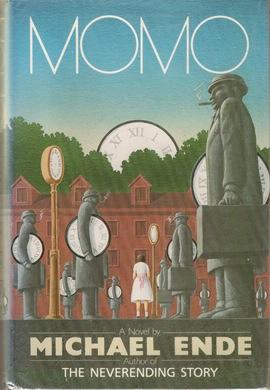
Momo by Michael Ende

[I originally wrote this book review in 2006.  However, Momo was such a good book that I wanted to include it here on this blog.]

I was browsing around at Pioneer Book in downtown Provo a few weeks ago when I saw this book. Michael Ende wrote The Neverending Story, which was my all-time favorite children’s book, and so I was really excited to see that he wrote this one. When I read it, I wasn’t disappointed.

Momo tells the story of a girl (named Momo) who has the uncanny ability to listen to people. People who have problems, don’t know what they should do, or are generally depressed come to talk with her. Because she’s such a great listener, she helps the people see things about themselves that they couldn’t see before, and helps them find out what they need to do with their lives. In this way, she becomes a friend to everyone and helps many people work out their problems.

Momo lives by herself in some ancient ruins (an awesome place to live, from a kid’s perspective! Kind of like having a tree house as a permanent residence), and she’s supported by her friends from the town, who frequently come to visit her.

The problems begin when these gray businessmen start going around town trying to get people to deposit their time in a timesaving bank. Don’t ask me how it works, that’s part of the fantasy. Basically, these men (who mysteriously know everything about just about everyone) convince people to work really hard so that they can save time, and by doing this, they will have a lot more time sometime in the future. However, the grey men are really these fantastical monsters who exist on stolen time, and their goal is to take all of the time from all of the people in the world. As they do this, the people become more and more miserable because they have less and less time for each other.

Momo recognizes the problem when she finds out that her friends aren’t coming by to visit her anymore. One of the grey men comes to Momo to steal her time, but she’s so good at listening that he ends up telling her who the grey people really are. Momo and her two best friends, as well as a whole bunch of abandoned children, try to find a way to stop the grey people, but it isn’t until Momo finds Never Lane and the source of time itself that she defeats the grey men and rescues all of the people.

I really loved the way this story was written. It was written like a really good children’s book–the kind that doesn’t condescend to children by assuming that they only have a very limited command of the English language. And as far as storytelling goes, this book was very well written. There were chapters that just really gave me this good feeling, like I had just experienced something really worth experiencing. I can see myself reading this book to my kids someday.

As far as the message is concerned, it’s fairly easy to tell that there are a lot of symbols and metaphors in the story. It’s not very preachy, though, which is good. I wish I’d read this story five or ten years ago, because I think I’d have understood the message better. Back then, I really loved reading stories that had deep meaning, and I was really good at picking the meaning out. Now, I guess I’m just older and too saturated with college studies for it to really sink in.

Which gets to the part about the grey men. If I were a character in this book, I wonder if I’d be one of the people who sells out to the grey men. But at the same time, I don’t regret being busy. I’m VERY busy all the time (especially this spring, with Poli Sci 200 giving me a major beating ). There are days where I wake up at 6:00 am and I don’t stop running from one place to the next until the evening. Sometimes, it’s true, I let the world around me just sweep me around and control my life. But I don’t think that things would be much better if I just cut out all the things that I’m doing.

I was home this time last year, not working or taking classes–I didn’t really have any responsibilities at all. And I was miserable. I felt like I wasn’t being productive enough, and I looked forward to coming out to BYU for the summer term because then I’d have something to do. Now that I’ve been really busy for a year, I’ve found that I really like it. It’s good to have a lot of challenging projects and responsibilities. I’m doing what I love and even though it can be difficult, I’m having a lot of fun. Work hard and play hard.

My sister Kate sometimes has problems with being overworked or underworked. When she’s busy, she’s so busy that it makes her anxious and she feels overstressed. We tend to fight a lot when that happens. So then, she takes time off to try and recharge, but she gets anxious because she feels that she’s unproductive. So then she fills up her schedule with things to do, until she’s overstressed again.

I think that the problem isn’t a matter of whether or not you’re always busy, so much as what you make time for. The people in the book got to the point where they figured that good things were something they’d only have time for sometime in the future, so they spent all their time doing menial things, and ignored their friends, families, and anything that was fun or enjoyable.

Life should be kind of like a car battery–once you’re up and doing something, it recharges itself. If I were only busy with things that drained me, I’d go crazy. It would just feel wrong, and I would make some major changes in my life. But if I actually enjoyed all of the things I was doing, and am doing, right now, I would know that things are working the way they should.

And ultimately, I think that that’s the message that Ende was trying to get out. Enjoy your life right now, where you are, and make time for the people around you.

So yeah, if you want to read a really awesome (and apparently very rare) book, check out Momo…if you can find it. Good luck! If you’re like me, and you like going places where you can be surrounded by large stacks of old, work, dusty books, maybe you’ll find a copy. Or maybe you’ll find something better. I’ll definitely be on the lookout.
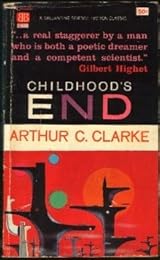
Childhood’s End by Arthur C. Clarke

They came completely unexpected. Hundreds of silver spaceships, hovering above all the capitols and major population centers of the Earth. For nearly a week, as thousands rioted in the streets below, they sat there, waiting. And then came the voice of Karellen, chief of the overlords, viceroy of Earth, heralding a new, planet-wide administration that was destined to end war, poverty, hunger, disease, ignorance, and fear. But as the generations pass and a new breed of humanity arises–one that has known no suffering, no danger, no religion but science, and no creative drive beyond sheer curiosity–mankind is about to discover that their welfare is not the overlords’ primary goal. Humanity’s time in the universe is about to come to an end–and a new, alien beginning.

I read this book in three days, but if I didn’t have any distractions or obligations, I could probably have read it in less than half a day. It’s very short–Clarke doesn’t take time to develop characters, describe the setting, give long info dumps, or show off his prosaic skills. He doesn’t even get into detailed explanations of how everything that happens happens. He waves his hand and gives us the broadest possible sweep of human civilization as mankind finally transcends human existence.

Partially because of the broad brush which Clarke uses to paint his picture, I found myself second guessing him at several turns. I was very skeptical of Clarke’s premises and conclusions, and found it very difficult to believe this story at several points. Believability of the aliens was not nearly so much an issue for me as was believability of humanity.

For example, when the overlords bring out a device that allows people to view any scene from any moment in the past, the world’s religious traditions are exposed and within a generation nobody in the world is religious. That’s not how religious experience works, though. Even if all of the religions in the world were hoaxes–which I’m perfectly willing to allow for the sake of a story–many, if not most of the adherents would continue to hold onto their beliefs, if only for no other reason than to hold onto something. There would be a lot more chaos and upheaval, and religion would stay with us in one form or another, if for no other reason than we as humans are religious creatures. It’s in our nature, whether or not any of the world’s religions are true. Clarke seems to demonstrate an ignorance of this as he paints the future with his broad brush.

A lot of other elements were missing in this book, such as character development, development of the setting, a strong buildup of tension, etc etc. However, as hard, classic sci fi, Childhood’s End doesn’t necessarily need those things to be an accomplished work within its genre. Hard sci fi–especially 50s and 60s sci fi–is all about grand, transcendent concepts, and here Childhood’s End succeeds, especially towards the end. When I finished the story and found out humanity’s final destiny, I was left with a sense of overwhelming awe at the grand cosmic scope of the story’s final message, much as I was with 2001: A Space Odyssey. You really feel, by the end, that you’re staring the incomprehensibly infinite right in the face. Good, hard sci fi will do that to you, and it’s wonderful.

I think this story did what Clarke set out for it to do, despite some of the conceptual spottiness that irked me in the beginning and the middle. The ending was solid, and did an excellent job showing what it means to transcend humanity. If you’re looking for a good story, this book probably will frustrate you, but if you’re interested in dreaming about man’s destiny among the stars, this book will give you that sense of awe and wonder that only classic science fiction can.

The Golden Compass by Philip Pullman

Lyra is a young girl who lives in Jordan college, Oxford university, with her daemon–a shapeshifting, talking animal companion that is as much a part of her as her growing, changing personality. She is perfectly content to stay at the university forever, exploring and playing games with the local children and their daemons.

All of that changes, however, when children across the countryside start to disappear. At first, it starts in far away places, but soon the mysterious “gobblers,” as the kidnappers are called, hit close to home, and Lyra is swept away into an adventure that takes her far to the north, to the land of auroras and the midnight sun; of witches and clans of ferocious talking polar bear warriors, and evil plans that have been revolving around Lyra since long before she was born.

I rated this novel a solid four stars. It had some elements in it that were fantastically wonderful and imaginative, such as the idea of daemons. In Pullman’s universe, every human being has a daemon, an animal companion that represents one’s personality and is as much an integral part of any human being as their head or arm. Adults’ daemons have fixed themselves onto a certain form, but since children are still growing and changing, their daemons can change shapes at will. Whatever one thinks, so does the other; whatever one feels, so does the other; and whenever one dies, so does the other (usually).

This concept of personal daemons was by far the strongest element of this novel. It ranks among one of the most satisfyingly imaginative fantasy elements I’ve ever seen in a story. It got me wondering “if I had a daemon, what kind would it be?” (probably a black bear), and I felt like a little kid imagining what it would be like to have one. Even though he doesn’t set out all of the rules concerning daemons (Do they need to eat like regular animals? Do they go to the bathroom?), it adds a sense of wonder to the novels and gives insight into the thoughts and emotions of the characters in a delightful way. It also ends up driving the plot, when you find out why the gobblers are kidnapping children.

There were other areas, however, where I felt that the novel was weak, mostly with regards to the plot. The first hundred pages were too slow. Pullman is fairly good about building up tension, but he releases it too quickly. For the first half of the novel, I felt as if Lyra was only getting swept around by things outside her control, rather than actually doing anything, and that was slightly annoying. The explanation for some of the crucial events, such as the opening scene, didn’t make much sense to me. The twist at the end, while surprising, was far from inevitable, and I felt jolted in a less than satisfying way. This is the first novel in a trilogy, and the first novel does not stand on its own as a complete story. It ends on a cliffhanger, somewhere near the bottom of the cliff.

Aside from the plot, however, I think Pullman does a good job. The characters were fairly interesting, with strong personalities that drove the story, and the setting was really well done. There were times in reading the story when I felt that I was up in the north, surrounded by forests dimly lit by the aurora, or flying high in a marvelous balloon above the freezing wastes, or in the midst of the bear castle, surrounded by the reek of bird poop and bear odors watching the bears fight in an epic battle.

There were a lot of things that I liked about this book, and the experience itself was very pleasant. It felt like a fantasy world, and that made it really fun.

A lot of people told me that Pullman is very anti-God and that his books are really preachy–or at least that a significant group of people are wrong to think of it that way. I can see how he sets up the church (he never refers to it as more than “the church”) like a straw man, but in this book at least, he wasn’t very preachy. I can’t really pass a verdict on his treatment of religion until I read the other two books, though, so I’m going to have to hold off on that discussion.

New writing goals

Alright, the first week of school is behind me, I’m probably as settled in as I’m ever going to be, so it’s time I set some personal writing goals for myself this semester. So here goes.

My major goal, at this point, is to have three polished novel drafts in time for World Fantasy 2009 in San Jose, California. So far, I’ve got one complete rough draft, one incomplete rough draft, and a REALLY cool idea for a new novel that is just itching to be written. I’ve got a lot of other stuff, too, but that stuff has been dead and buried for a while, and I’m not sure whether I want to bring it back just yet.

So, if these are indeed the three novels that I want to have ready by next year, here are some goals:

  • Finish the second draft of The Lost Colony by January 1st, 2009.
  • Write at least 500 words per day.
  • Write one article in the wiki outline for the new story each day.

The first one is pretty straightforward. I’ve got to polish The Lost Colony and get it to the point where I feel like I can send it out. It won’t be perfect by any stretch, but polished enough to send it out. With four months to finish the rewrite, hopefully I can put this project in the backseat while I focus most of my energies on the new stuff.

The second goal is also really straightforward. 500 words per day, as I discovered with The Lost Colony, is very reasonable. It’s a good starting place, and if I feel like I’m doing well enough, I can always increase it to 1,000 like I did last year (and successfully kept it, for the most part).

The last goal is something of an experiment for me. My least favorite part of the writing process is probably prewriting–all the outlining, worldbuilding, planning, etc. I tend to do all that stuff in my head, not on paper, and I come up with as much as 60% of it as I go along. That’s just how I tend to write. However, I’ve never really tried the alternative, and I think it would be a really interesting experiment to see what happens if I formally plan things out before I sit down and write it. Maybe it’ll work. Maybe I’ll hate it. Maybe both. Whatever happens, I’ll be sure to let you know.

These goals are all pretty straightforward and practical. That’s not what goals are for, however. They exist to push you. So, in order to push myself, I’m going to give myself a goal that’s just a little bit reckless:

  • Finish the second draft of the untitled novel by May 1st, 2009.

Wow. This is crazy. I proved this past year that I could write a 168,000 rough draft in nine months. But this? I’d practically have to finish the thing by January/February in order to have time for the rewrite! And yet, if I can churn out at least a decently polished draft of a novel every 3/4’s of a year, that’s impressive. It might just be enough to prove that I can do this successfully full time (gasp!).

They say that you need to produce a novel a year in order to make a living as a writer. Last year, I proved that I could produce a rough draft in a little less than a year, but a solid, polished draft? Didn’t happen.

But maybe, just maybe, I can prove myself with this next novel. Maybe. We’ll see. At the very least, it’s worth the challenge.

First week craziness

So, this last week was the first week of school.  It was as crazy as anything.  Back to classes, back to papers, readings, buying books, waking up early…everything.

Fortunately, even though I’m taking six classes, three of them are only two credit hours, so the load is going to be somewhat lighter, freeing me up for time to do other things (clubs,  blogging, writing, dating etc…inshallah), and several of the classes are actually fairly interesting.  The poli sci 201 class in particular looks interesting–we’re reading all kinds of ancient texts (like Homer and Dante) and tying it in with Western political thought.

Unfortunately, a lot hasn’t been going very well this week either.  Just lots and lots of hoops to jump through, payments to make, expenses and such.  The little stuff really grates on me, especially when it doesn’t line up.  Probably has to do with my ENTP personality type.  The bigger stuff is harder to handle but I don’t flare up over it.

I don’t know where I’ll be working this semester, and that’s an issue.  I had thought that I would just be rehired by the BYU Bookstore, but right now that’s looking unlikely, because due to my class schedule I can’t work M-F.  It would be nice–REALLY nice–to get a TA job, but nothing has worked out so far.  Or maybe I could go and work for that used bookstore downtown?  THAT would be nice.

So, with all of these stresses and stuff, and just my general disorganization, I’m sad to admit that I haven’t really been doing much writing…but I have been working to get the quark writing group started up again, and I am starting to formulate some really awesome writing goals for this semester.  More on that to come.

And I even if I haven’t actually put any words down in the new novel I plan on writing this year, I’ve been thinking about it A LOT.

This week, as I was walking home to the FLSR under the sunny blue sky, I saw a patch of grass on a hill and decided to lay down and relax for a bit.  As I lay there, drifting in and out of consciousness, I just immersed myself in the world of this new story, working out all the details for the first scene.  That led me to ask several questions about the characters (who are they?  what are they feeling/thinking?  what kind of a background do they have?) which got me to think through their back-stories, and the tribe they come from, and inter-family conflicts, and how I can tie all those into other characters and conflicts later on in the story.  I fell asleep for a little bit, and when I woke up, it was like I was waking up to a new world, coming down from meditating on a mountaintop or something.  Really sweet feeling.  I love taking naps on the grass.

There is SO much I have to blog about!  But it’s 1:58 am and I’d better get some sleep.  Tusbah ‘ala al-kheer!

Why PCs are better than Macs

The unthinkable has happened.  My trusted, beloved laptop, which has served me faithfully for almost three years, has died.  I suspect it’s a problem with the motherboard.  While I was in Jordan, the power cord sometimes had trouble making contact with the contacts in the power socket on the back.  Now, it’s almost impossible to recharge my batteries.  I’d replace the part, but apparently it’s glued onto the motherboard, and besides that, the USB ports have stopped reading my flash drives, which makes me think that the problem is much bigger than just the power contacts.

So I’ve lost my laptop.  This is no small thing.  My computer is practically a part of my soul, like a sword to a samurai.  With it gone, I feel…lost.  The most valuable material possession I have in this world is my data–my journals, my stories, the things I’ve written–and all of those are on my laptop.

But get this.  When I knew for certain that my laptop was dying, I did an awesome little trick.  I turned it off, unscrewed the bottom, pulled out the hard drive (the physical hard drive), put it in a 2.5″ enclosure that I bought last  year, and accessed it from the FLSR computer like a normal USB mass storage device.  My freaking hard drive.  And then I transferred ALL of my data (the important stuff at least) to the FLSR computer, where it is now.

Boo yeah!  Not only is all my data–my stories, journals, and writings from the last three years of my life–safely backed up in a place where I can easily get to it, but it didn’t cost me a dime.  The enclosure cost me about $30, but I’ve had it for a while.  If I were to take my laptop into a store to have the data pulled off of the hard drive, it would cost my upwards of $400.  Youch!  But because my computer is a PC, I can take it apart and put it back together again by myself if I have to.

Now I have to save up for a new laptop.  I could have the motherboard replaced, but I think I’m reaching the point of diminishing returns with this computer.  It’s expensive to replace it, and once I do, something else is going to fail.  Besides, after three years, it’s about time for a new computer.

In the meantime, I can do everything I usually do on public computers, except for photos and podcasts.  If I’m lucky, I can figure out a way to do my photography in one of the computer labs on campus (the photo safari is down!  It’s so sad!), and I have an old desktop that I might set up in my room for downloading stuff.  We’ll see how it goes.

But my data is safe!  Woo hoo!  I am SO relieved.

Published
Categorized as Uncategorized Tagged

Thoughts on being busy

I was browsing through some Facebook notes I’d imported from my old blog (now nonexistent), and I came across an old book review I wrote for Momo by Michael Ende. Awesome book–I recommend it 110%. However, the thing that got to me was what I’d written about how the book made me think about how I was living my life back then:

I don’t regret being busy. I’m VERY busy all the time (especially this spring, with Poli Sci 200 giving me a major beating). There are days where I wake up at 6:00 am and I don’t stop running from one place to the next until the evening. Sometimes, it’s true, I let the world around me just sweep me around and control my life. But I don’t think that things would be much better if I just cut out all the things that I’m doing.

I was home this time last year, not working or taking classes–I didn’t really have any responsibilities at all. And I was miserable. I felt like I wasn’t being productive enough, and I looked forward to coming out to BYU for the summer term because then I’d have something to do. Now that I’ve been really busy for a year, I’ve found that I really like it. It’s good to have a lot of challenging projects and responsibilities. I’m doing what I love and even though it can be difficult, I’m having a lot of fun. Work hard and play hard.

My sister Kate sometimes has problems with being overworked or underworked. When she’s busy, she’s so busy that it makes her anxious and she feels overstressed. We tend to fight a lot when that happens. So then, she takes time off to try and recharge, but she gets anxious because she feels that she’s unproductive. So then she fills up her schedule with things to do, until she’s overstressed again.

I think that the problem isn’t a matter of whether or not you’re always busy, so much as what you make time for. The people in the book got to the point where they figured that good things were something they’d only have time for sometime in the future, so they spent all their time doing menial things, and ignored their friends, families, and anything that was fun or enjoyable.

Life should be kind of like a car battery–once you’re up and doing something, it recharges itself. If I were only busy with things that drained me, I’d go crazy. It would just feel wrong, and I would make some major changes in my life. But if I actually enjoyed all of the things I was doing, and am doing, right now, I would know that things are working the way they should.

And ultimately, I think that that’s the message that Ende was trying to get out. Enjoy your life right now, where you are, and make time for the people around you.

This really gets to me for a couple of reasons.

First of all, I don’t think I’ve been following my own advice this last year. Ouch.

Second, I want to refocus and spend more of my free time doing creative things and/or spending time with people. The advice here about prioritizing really resonates with me.

Third, it’s totally true. Life should be just like a car battery, and if it isn’t, you’re doing something wrong. Trying to get stimulation without putting in any effort is just wrong, even if it’s innocent.

I guess that’s one thing I learned from my experience last semester writing that novel. It took a LOT more effort to sit down and write the thing than it did to play computer games or waste time on the internet, but the satisfaction it brought was a lot better.

At the same time, I didn’t spend enough time getting out and making friends. But really, it’s the same thing. Do you fill your life with busywork or do you make yourself busy with the things that really matter? They take a lot more effort, but give much better satisfaction.

I arrived in Provo a couple of days ago, and I’m still somewhat disoriented. I’ll have some new writing goals, though, before school starts. I’ll also have some new ideas for where I want to take this blog, and I’ll write about that tomorrow.

Figuring out my Characters

I am REALLY close to starting work on my next novel.  It’s an exciting time.

Last time, I didn’t do a lot of planning/worldbuilding before I started: I just had a bunch of general ideas and did the worldbuilding as I went along. This time, I’m doing something of an experiment: I’m doing most of the worldbuilding before I sit down and write the first chapter. Hopefully, this will help me figure out what kind of a writer I am.  

Today, as I was thinking about my characters, I decided that I wanted to know them before I wrote about them.  I don’t want them to be flat, I want them to be complex, interesting, and real. So does everybody, of course, but I figured that to do this it would be better to have an idea of who they are before I start writing from their perspectives.  And what’s a better way to figure people out than personality tests?  I love personality tests, especially the Meyers and Briggs test (the four letter one: I am an ENTP). How cool would it be to build your characters through Jungian personality types?  Yeah, pretty cool.  Needless to say, I had a lot of fun.

It’s tough, though, because the different sites I went to all said different things about the same personality types (I used the personality pagetypelogic.com, wikipedia, and kiersley.com).  The site that was the most useful was also the site that did the worst describing my own personality.  I don’t know if that’s going to hurt the story, but the descriptions made sense and spurred my imagination the most, so I think it will work out in the end.  After all, these are not hard and fast rules for my characters–they’re starting points for me to build off of.  I’m sure that as the story progresses, the characters will come to life and defy my expectations.

I have three main characters that I need to model: Tristen, Mira, and Kayleigh (I might end up changing Kayleigh’s name, though).  I already have a basic idea who they are, but I need to take things further in order to write really close to them.Tristen is someone who wants to be a hero.  I’ve written about him before.  He’s the kind of guy who would willingly put his life on the line to save a stranger.  He has a strong sense of honor and is willing to make spectacular sacrifices to do what is right.

Trouble is, life is never that simple.  More often than not, it’s more important to be consistent in the little things than to sporadically make the dramatic sacrifices.  That means, of course, that Tristen needs a good-natured woman who is consistent in doing the small, daily tasks without needing recognition.

I might as well warn you, there will be spoilers in the rest of this post.  Consider yourself warned.

The thing is, though, that before Tristen meets Kayleigh, he needs to be confused, burned, and tortured with regards to women and relationships.  I can’t tell you why, I just know that that’s the way it is.  And so, I’ve figured out EXACTLY how I’m going to do it.  It involves a horribly awkward and painful falling out with Mira, which is mostly brought about by circumstances outside of either of their control, but also involves some key elements in her personality.

Basically, she has to be the kind of person who would be a perfect match for him–someone whom he feels he shouldn’t leave.  They have to be good friends, understand each other well, be really close to each other, but then circumstances conspire, present two equally distasteful choices to Tristen, and he chooses the one that takes him away from her–all the while wondering “should I have stayed?”

Enough of the introduction.  That’s basically who I need these characters to be for the purposes of the story.  But who are they beyond that?

I started out by reading the descriptions of the four preferences, then working backwards to figure out Tristen’s Jungian personality type.  Since he really wants to be a hero, I considered making him a J instead of a P.  Trouble is, I’m a P and I don’t really understand Js all that well.  If I’m going to be close to this character, he’s got to be somebody that I can understand.  Call it taking the easy way out, but I decided to make him a little more like me.

I decided to make him an ESTP, “the Doer.” There were a lot of things I really liked about this personality type.  He’s extroverted, thinking, and perceiving, all like me, but the sensing part of his personality means that he “lives in the here and now,” has a “do it and get on with it” kind of attitude, and is more of a “straight-forward risk taker.” Sounds like it has the potential for an interesting story.  Besides that, ESTP’s “can sometimes be hurtful to others without being aware of it, as they generally do not know and may not care about the effect their words have on others.”

Even though they may disagree with the establishment, they have a “strong belief in what’s right and wrong” and “their own integrity mandates that they will not do something that they feel is wrong.” This gives me the impression that I can successfully write an ESTP character that feels real while having a very strong personal ethical code, something that I want Tristen to have.

Relationships-wise, things get really interesting.  ESTPs tend to be weak on commitment and want to approach everything in a “big way.” Plenty of room for conflict here: difficulty settling down, combined with a tendency towards the dramatic and spectacular rather than the simple and consistent.  That sounds just about right.

It was even more fun to figure out Kayleigh’s personality type.  In fact, I learned quite a bit about her as I did this.  The personality page says that ESTP’s natural partners are the ISTJ or the ISFJ.  Again, however, the whole J thing kind of threw me off.  Js tend to be planners and organizers, while Ps (like myself) take things one day at a time and can be impulsive and spontaneous.  That’s the kind of person I can relate to easier, so that’s the kind of person I want to write about.

When I started reading about the ISFP, “the Artist,” I felt like I was reading an outline on this character that I’d written myself.  I don’t even know Kayleigh’s exact role in the plot, but her character just jumped out at me.  It was fun.

ISFPs (according to the personality page) are “warm and sympathetic” and “genuinely care for other people.” They also “have a strong set of values” and will “rebel against anything” that conflicts with their need to “feel as if they’re living their lives in accordance with what they feel is right.” They are quiet, don’t look for recognition, and don’t have any interest in controlling (or being controlled by) others, but at the same time can exhibit “carefree light heartedness.” One thing I thought was particularly interesting was that even though they appear light hearted, underneath it all they are quite serious and don’t share their thoughts except with their closest friends.  I think my friend and former roommate Steve is an ISFP.

The thing that worried me, though, was that the main thing about ISFPs is their artistic flair, the thing that defines them.  This is really what defines them, and it’s something I didn’t really have in mind for Kayleigh.  However, as I thought about it, the more it made sense.  Kayleigh lives on a spaceship with her family, and things can get a little bit monotonous and humdrum in such a confined space.  Having someone who can pay attention to sensory details and add color and life to a place can be really refreshing.  In fact, this might be the thing that really catches Tristen’s attention (besides her physical attractiveness).  That’s a possibility I hadn’t thought of before–one that really leads off to a ton of exciting and interesting possibilities.

I haven’t really given a lot of thought to Mira’s personality yet.  However, ISFJ, “the Nurturer,” really makes sense to me.  First of all, ISFJ is one of the natural partners for ESTP.  Second of all, Mira is from a planet-based culture that avoids the rest of civilization and is steeped in tradition.  From what I read about ISFJs, they seem to be more homely, with “respect for traditions and laws” and a knack for homemaking.  At the same time, they need affirmation and tend to blame themselves while putting others’ needs above their own.  It’s important to the plot that Mira is used as a pawn by another character (her father), so this fits really well.

All in all, it was really fun to play around with personality types and build my characters a little better.  There is still a lot of work to do, of course, and I really do expect that they’ll take a life of their own and do things I wasn’t expecting.  Like I said before, this is more of a starting point–but I think it’s a good one!  We’ll see how it plays out once I start writing. 

Megaman DDR!

This makes me happy.

It’s 2:30 am. My work here is finished.

A million different things to say

Wow.  I feel like I have a million different things to say, and I’m not sure which one to start with.

I just got back a couple of days ago from the Jordan study abroad, and I’m currently at “home” (or something similar but not quite it), here in Massachusetts.  In a couple of days, I’ll be heading out to Utah with my brother in law, and we’ll drive with a trailer full of stuff.

I’m looking forward to the trip, but almost more I’m looking forward to being in Utah again.  It’s funny, because that place can feel so old after a while, but that’s where all my friends (and most of my family) currently are, so I feel like my life is on hold as long as I stay out here.

I put quotation marks around “home” because really, my parent’s house isn’t exactly my home.  Not in the full sense of the word.  It’s not where I grew up, and it’s not where I’ve lived for any significant period of time.  In some ways, it feels more like my grandparent’s house than anything else.

Nothing else for me to do back home except explore old memories, I decided spontaneously to drive up to the old house where I’d grown up. It wasn’t ours anymore. We’d moved out of it nearly two years go. The woman who bought it from us was single and had nearly a dozen kids from three different parents. After we moved out, they trashed the place. That’s the last I’d heard of it.

As I drove past, I saw that all the plants in the front were grown over. The red brick mailbox was partially destroyed, evidently by a careless driver. There was a For Sale sign leaning against it. The driveway was empty, but I was hesitant for fear of someone seeing me through a window.

Then I saw a black box dangling from the doorknob on the front door. “What the heck?” I parked the car and walked boldly across the lawn. Sure enough, there was a notice pasted on the door. It said “to enquire about this property, please call…”

The house was foreclosed. The previous residents were all gone.

Nobody was there.

I couldn’t hold myself back. I stepped around the house, peering in all the windows. I walked around back, as if exploring some ancient ruins in a far off land. This space where I had grown up, where I hadn’t returned in nearly a quarter of my life, was practically sacred to me–which only made the desolation that much more surreal.

Walking across the lawn where I used to play as a child, it seemed like the walls of the house were screaming at me. The place was saturated with memories, and they all came back to me as I reverently walked around the property. This was where we had built the old swingset. This was where we had house trained our dog, late at night, while watching Apollo 13 which had just come out on DVD. This overgrown, jungle-infested hill was where I had worked one summer to build terraces for a garden that we never planted. That window was the one that we kids used to secretly leave unlocked so that we could sneak inside if we had to. It was locked tight.

I felt like the place was a holy temple that some gang of street thugs had tagged with crude, ugly, spray painted words of hate. I felt violated. The plants which we had so carefully tended were collapsing on their own, untended overgrowth. Weeds as tall as myself grew in front of the doors. Inside the windows, the floors were scratched to pieces, the doors were dented at the corners, the carpets were stained and dirty. The awning we’d put over the deck was completely gone. The equipment for the fireplace was in pieces, leaning against the wall.

It was like ages had gone by, and the walls were screaming out to me. I was too shocked by what I saw to cry. Yet, at the same time, I was grimly fascinated. It was like I was watching a movie, entertaining myself with my thoughts while someone else controlled my body and my emotions.

All this time, I couldn’t help but think how ironic it would be if one of my old neighbors called the cops on me. To be arrested for walking around the house that, five years ago, I’d left and entered every day. That to return to the place where I’d made the transition from childhood to adolescence and left my adolescence behind now felt like a crime and made me look suspicious. I didn’t care enough to let it stop me.

Later that night, I heard the rest of the story from my father. The woman who had bought the house from us had fallen behind on her mortgage. She was probably one of the thousands of Americans who used the housing bubble to buy a house far beyond her means. Instead, she took out a twisted insurance policy: she slept with the son of her creditor for ammunition to use as blackmail.

It didn’t work, though. In the end, she got foreclosed and evicted just like everyone else. And now, my old home sits ruined and abandoned.

To me, the place is as fractured and weathered as Jerash, Luxor, or Um Al-Jumaal. It’s just gone.

Well, that’s not something that I was planning on saying, but it just sort of spilled out of me.  That’s one thought of many, and one of them had to come out somehow.  Since this post is getting kind of long, however, I’ll cut it here and save the rest for a new one.