End of the apprenticeship

I got in a long conversation with my roommate tonight, where we talked about girls, government, the economy, 2010 elections, corporatism, Ursula K. Le Guin, and all other kinds of good stuff.  Towards the end, we got to talking about my goals to be a full time writer, and I showed him the record I’ve been keeping of my daily word counts.

In case you’re interested in seeing a copy of it, here it is:

wordcounts (to 27 February, 2010)

I basically showed him how I’ve been keeping track of my work, setting and keeping goals on a daily basis, juggling work, school, etc while taking a very professional approach to my writing.  While it impressed him, it impressed me almost more–all of this is so habitual by now that I sometimes forget how hard I’ve been working at it.

The most surprising thing?  Since May 2009, I have written over 422,000 words!

😮 😮 😮

There’s a saying in writing that says you have to write one million words before you write your first good word.  Until now, I thought I was still somewhat short of that number–on the upper end, certainly, but still short.

Well, I’ve been writing on a more or less daily basis since August 2007.  If I’ve written almost half a million words since May 2009, how many words did I write between August 2007 and May 2009?  At least half a million, I’m willing to guess!

In other words, it is quite possible that I’ve already surpassed my millionth word.

Wow.

I’m not sure what to think about that.  On the one hand, it’s exciting. On the other hand, it’s downright scary.  If it’s true, it means that I should move past the apprenticeship phase and start pushing this as my career.

That is insanely scary–and yet, at the same time, absolutely thrilling.  It’s going to mean investing a lot more time into researching the market and sending out to agents, receiving lots of rejections and wondering if my stories are any good.

Scary.  And yet, when I finally do get a publishing deal (and I’m more confident now than ever that this will actually happen someday–inshallah someday soon), that’s when it gets really scary.  If that first book doesn’t earn out, my career will be toast.  I’ll have to slave away in an office for the rest of my life.

Holy crap, that’s scary.  At the same time, though, it’s gonna be awesome.

Bring it on!

Gah! It sucks

I’m about a third of the way through To Search the Starry Sea, and my greatest fear at this point is that it isn’t as good as the last novel I wrote.  Because if it isn’t as good, that means that I’m getting worse, not better, and if I’m getting worse, that means I’m never going to make it as an author, because I’m not even published yet, and if I’m not going to make it as an author, that means I’m going to have to do what I’m doing NOW for the rest of my life, which means that I’m going to be miserable and life is going to suck…

<pant> <pant> <pant>

Seriously, though, sometimes I wonder if I’ve really made the right choice.  To Search the Starry Sea is much more of a happy adventure story, but sometimes I feel that it lacks depth and meaning.  I’m starting to get feedback from my alpha readers for Bringing Stella Home, and their reactions to it are surprisingly encouraging.  That story moved people–but this one?  I don’t know.

Then again, Bringing Stella Home is dark, gritty, and very tragic.  I remember feeling depressed by the story even as I wrote it.  Is that the kind of story I want to be known for?  If I can write something deep and meaningful and have it be optimistic and adventuresome, that would be a lot better.

I’m discovery writing it hardcore, which means that side characters often come to play a much more central role than I’d thought, and events that I thought I could cover in a chapter, I have to cover in two.  I have an idea where the story is going to end up, though, and it’s going to be awesome. How awesome?  Let me show you:

Yeah, it’s going to be awesome.

I think the key to keeping it meaningful is 1) to keep in mind the main character’s inner conflicts, framing them in a way that the readers can relate to their struggles, and 2) keeping the overall growth arc constantly in mind.  How does what’s happening affect how the character is changing?  That kind of stuff.

I hope I can finish this in two months.  I’m mired in the middle of it right now, and the end is far from sight.

In the meantime, I think I’ll get some sleep.

Retired notebook: part 1

Like most writers, I keep a notebook with me at all times.  I use it a lot for scrap paper, but I also jot down all the weird story ideas that come to me, usually while I’m doing something completely unrelated to the idea.

A while ago, my old notebook got too ratty to keep in my back pocket, so I replaced it and put the other in my dresser drawer.  I thought it would be interesting, though, to go through some of the ideas I came up with.

Here they are, from the beginning:

A society in which infanticide is not considered a crime, up to two years (since infants are not conscious in the same way as adults and children).

…okay, maybe that one was a little creepy. Next:

A near future dystopia in which the film extras in movies made in overpopulated developing countries literally act out the battle scenes, because hollywood studios can pay for the loss of life.

Another creepy one, but it’s actually legit. I came up with it in the Las Vegas airport, listening to a panel from CONduit on my iRiver while waiting for my connecting flight.

On the panel, Dave Wolverton mentioned that in China, the most that any corporation can be sued for negligent homicide is $10,000. This got me to thinking, what if they had the extras fill out forms indicating next of kin, and shoot the battle scenes with real guns? It would cause a huge uproar among humanitarian organizations, for sure, but there’s certainly an audience that would pay for it. And really, who loses from it?

Yet another example of economics at work–and why capitalism is evil.

A time travel device that allows collection of data from the future without affecting causality–how would this change political science?

In other words, what if we could go into the future and quantifiably measure the effects of decisions made in the present? What if our hindsight really was 20/20? Something like that.

A candidate who always has the latest liberal candidate’s bumper sticker on the same corner of his/her car, so it builds up over time.

Just an interesting character quirk.

An MMORPG for orcs and elves where they play as humans.

Haha! I’d forgotten about that one. 🙂

Zombie insects.

“Infestation” takes on a new meaning.

Sentient planets.

We’ve already got that (sort of): it’s called the Gaia hypothesis.

Golfing on the moon or mars.

Or tennis, or soccer, or basketball…seriously, how cool would it be?

Were-squirrels!

…okay, maybe that one wasn’t quite as awesome.

A psychic agency that allows you to IM dead relatives.

I’d be surprised if this doesn’t already exist.

There’s more, but I’ll save it for another post.

“This is my culture; this is my community”

So back at World Fantasy in San Jose, I picked up a bookmark for a science  fiction club in the Washington DC area, WSFA.  I figured that since I was headed out there, I should check it out.  Last night, I went to my first meeting.
Getting there was quite an adventure.  The meeting was in Maryland, at a member’s house–I had to go to the end of the green line, then cross over the beltway and walk nearly three miles to get there.  The sidewalks were still covered in snow, so I had to keep to the street, which was a little unnerving on the overpass–but I made it.

I didn’t know anybody there and had no idea what to expect, but the people were friendly and I soon felt like I fit in.  It was a little bit like a cross between Quark and Bimbos of the Death Sun, which is a pretty awesome mix.  The meeting was called to order and people started discussing some pretty interesting projects, like publishing a special edition Jeff Vandermeer novella for Capclave in October and getting various things for the con squared away.

A couple of things about the club surprised me: one, the members were all middle aged and older; and two, how extremely liberal everyone was, politically.  I say I was surprised, but really, I could easily have seen this coming.  The east coast is very different from the inter-mountain west, so it stands to reason that there would be differences.  Not that I minded.

I’m not sure how many people in the club are writers, but like any good sf&f community, everyone seems to be an avid reader.  I was surprised that so few people had heard of World Fantasy, but when I told them I wanted to break into publishing, they all told me that I should come to Capclave, the DC area con that happens in October.  Will I be in the area for that?  Not sure yet.

Fortunately, I didn’t have to walk back to the metro; one of the regulars was heading to Arlington and gave me a ride.  We had an interesting conversation on the way back–he’s from Philly, drove a cab for a few years, and has quite a colorful vocabulary.

We were talking about fandom in general, though, and he made the comment “this is my culture; this is my community.” That’s exactly the sense that I got from the meeting–that these fans have built a community around science fiction and fantasy that transcends fandom and stretches into all other aspects of their life.  It’s similar in some ways to the sense of community that you feel in the LDS church–even when you move to a new place, you’re not a stranger.

Am I going to keep coming to WSFA meetings, or become a member?  I don’t know.  A lot of it depends on what I do in April.  I’ll probably come to a few more meetings, though–these are my people.

Got a bite!

Just yesterday, I got a response to a query for Genesis Earth that I emailed to an agent at Nelson Literary Agency, LLC.  Apparently, my query piqued their interest and they wanted to see the first 30 pages of my manuscript!

It’s not a huge development, of course–they haven’t requested the full, just a partial–but it’s comforting to know that my query letter is decent.  Enough, at least, to lead to the next step, and that’s all that matters.

Writing query letters is hard. There are so many ways to screw them up.  I queried another agent over the weekend with a similar (but different) letter, and I got a standard rejection…within the hour.  Ouch.  I was kind of worried something was wrong with the pitch, but with the other agency’s response, I’m not quite so worried.

Submitting is something that I have to get better at doing.  I’ve started putting together a personal database of agents and editors, but still, it takes guts to put your stuff out there.  I still get chills whenever I slip that envelope into the mail slot, or hit send on the computer.  It’s hard to say exactly what that thrill is–fear of rejection?  Fear of failure?  I think it’s more complex than that, but I’m not sure exactly what it is, or how to put it.  I’ll let you know when/if I figure it out.

I read an interesting post on agent Nathan Bransford’s blog about sending out queries.  He suggested the best strategy is to submit in little spurts, rather than all at once–that way, if you only get form rejections, you can figure out what’s wrong and fix it while still having places to send it.

That sounds like a good strategy, but to really make it work, I should probably set a goal to send out a certain number of queries a month.  Not sure how many that is, but since my main goal is to have a publishing deal by 2015 (and making a full-time living at this by 2020), it should probably not be a small number.  Maybe eight or ten.

I don’t know.  I’ll figure it out.  In the meantime…here’s to hoping!

Snowmageddon! Hooray!

So for the past week, a series of crazy snowstorms has been pelting the Mid-Atlantic.  President Obama has dubbed it “snowmageddon,” and it’s so bad that all federal government offices have been closed since Friday.  With another storm hitting us tonight, it looks like we’re going to have the whole week off! Yay!!!

So, for the past couple of days, I’ve been hanging out around the Barlow Center, watching movies, doing random stuff with my friends here in the program, taking naps in the middle of the day, and writing.  Lots of writing!  It’s awesome–I haven’t had this much free time since Christmas (which wasn’t all that long ago, but still…)!

Today I didn’t write quite as much.  I got in about 1.1k words, a decent amount, but if I’d pushed myself I could have finished the current chapter.  Monday went much better, because I sat down and forced myself to write in the morning.  Once those initial hundred or so words were out, the rest came much easier.

On the first day of snowmageddon, when we were snowed in at Valley Forge, I got in over 1,000 words before noon.  It was rough going, though–nothing was flowing, and everything took a lot of effort.  I hate it when that happens–blegh.

But I think it was necessary, because now, the scenes are flying by pretty easy.  Sometimes, when I’m struggling with momentum, I find it helps if I take a day to focus and push myself through it.  Get rid of all distractions, put my butt in the chair, close all internet browsers, and just write, no matter how difficult.

My next novel, To Search the Starry Sea, is going to be a lot of fun.  It starts out almost exactly like Homer’s Odyssey, with the same basic conflict and setup.  Beyond that, however, I have nothing solid planned–I’m just following where the story takes me.  And boy, is it taking me to some crazy places!

For example, one of the first places Katriona (the Telemachus character) goes is a nearby world, ruled by a friend of her father’s.  To liven things up, I decided to have him live on a giant rotating space station, where the inside is covered by forests and jungles–scenery that Katriona has never seen.

This got me wondering, however: how did the jungle get there?  The answer: thousands of years ago, before superluminal space travel, a group of colonists set out for this world, freezing themselves in cryo.  When they got there, they found that a solar flare-up had rendered the planet uninhabitable, so instead they built this massive station, hoping that it would serve as a second ark for humanity.

Instead, a raiding party of space barbarians took them over, enslaved the colonists, and built their palace in the midst of the carefully maintained artificial biosphere.

This opened up a series of new possibilities for subplots, which shapes my protagonists interactions with the people here, which points her in new directions for the main plot–the next few places that she’s going to go.

This is discovery writing at its best.  Even though I have no clue where she’s going to go next, things are unfolding very nicely, and I’m excited to find out!

Thoughts on writing characters

A couple months ago, I was listening to one of my personal recordings of Brandon Sanderson’s English 318 lectures from last  year’s class.  The topic was writing characters.

Brandon outlined several techniques for making characters sympathetic.  He also outlined how to round them out: give them flaws and handicaps, as well as little quirks to make them unique and memorable.

However, I couldn’t help thinking that something was missing in his formulation.

Before I continue, let me say that I’m not disparaging or criticizing Brandon Sanderson’s abilities to write compelling, well-rounded characters.  As his novel Mistborn shows, writing characters is one of his strengths.

At the same time, I feel that the “checklist” approach to writing characters can be dangerously counter-productive.  Too often, characters in sub-par novels feel like a patchwork of characteristics and personality traits, not like actual, real people.

When I asked Brandon about this, he said that his techniques should be seen as tools, not as fundamentals.  He then went on to say that the most important thing to keep in mind is the character’s motivations–why they want what they want.  Beyond that, you just have to tweak the character until they fit into their role.

After thinking about it for some time, I came to the conclusion that the best way to write characters is to keep two essential rules in mind:

Rule #1: Every character is the hero of their own story.

Rule #2: Every story is composed of three parts: beginning, middle, and end.

The first rule is straightforward: every character sees their life as a story in which they are the main character.  This is because all of us, as human beings, view our own lives in this way.  We may look at other people and consider them nothing but extras in the story of our life, but they certainly do not think of themselves in this way.

To apply this rule, however, we need to understand what it exactly means to be the hero of one’s own story.  We can only understand this when we realize that a story is composed of three basic parts: beginning, middle, and end (or, as we see ourselves: past, present, and future).

Every hero has an origin and a destiny.  Without these, they don’t have a story; they don’t have a beginning and they can’t have a meaningful end.  This is why the hero cycle begins with the miraculous birth and ends with ascension and apotheosis.

Writers should keep this in mind as they sketch their characters.  If you don’t know where your character came from–who their parents are, where they  grew up, what were their major formative experiences, etc–your characters are going to fall flat because they’re just extras in someone else’s story; they have no story of their own.

Likewise, your characters need to have a destiny.  If you’re a discovery writer (like me), this might be harder because you don’t know, from the outset, where everyone’s going to end up.  Keep in mind, though, that rule #1 applies to the story the characters tell themselves just as much as the story you’re telling the reader.

Each character’s individual story is like a thread, which the writer weaves together with other threads to form a beautiful tapestry.  That tapestry is the novel; without the individual characters’ stories, the work would feel week, shallow–threadbare.

Of course, it’s not always possible (or a good idea) to reveal everything about every character.  It’s also not always possible to outline every character in great depth–not without catching “worldbuilder’s disease.” Instead, the rules of worldbuilding should apply–only use 10% of your worldbuilding in the actual story, no info dumps, etc.

I don’t think that’s a comprehensive theory of character just yet, but I think it’s a step closer to one.  If you have any ideas or suggestions of your own, please do share.

Image courtesy Postsecret

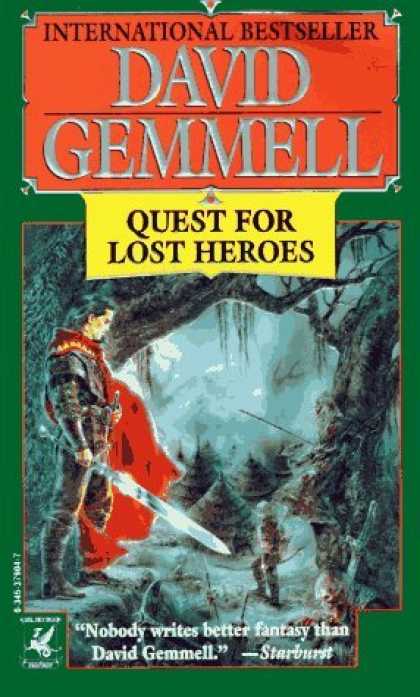
Quest for Lost Heroes by David Gemmell

It has been forever since I read this book.  Still, I really should review it.  Here goes.

At Bel-Azar, four friends held out against hopeless odds, only to be spared by the Nadir Khan.  Known by the Nadir as the “ghosts yet to be,” they enjoyed the fame of heroes for a time, but now live in obscurity in their own kingdom.

When a band of slavers raze a village and carry off the women, however, a young, reckless boy named Kiall calls upon the forgotten heroes to help him free his unrequited love.  And so the “ghosts yet to be” join together for one last quest, only to find that the stakes are much higher than any of them could have forseen…

David Gemmell writes awesome fantasy!  Some of the best I have ever read.  This one, while not quite as deep and meaningful as others like Legend, had its moments.  Let me just say, Gemmell knows how to kill off his characters.

The story started off very well, with some interesting introductions.  It felt a bit like a cowboy movie, where the heroes are all outcasts, unable to find their place in mainstream society.  I immediately took a liking to the main character, Chareos–Gemmell knows how to write heroic characters, even dark heroic characters.

The action began immediately, with blood and battle in every chapter.  As usual, Gemmell did an excellent job getting to the meaning (or lack thereof) of it all, but at times, it felt a little bit superficial.  Not very much, but sometimes, it seemed that he threw the action in just to keep the story interesting.  It didn’t pack quite the same punch as Legend, which was a much superior book.

It took me a few chapters to feel that the story was progressing–Gemmell isn’t always strong on plot–but once I did, it really took off.  I finished the last hundred or so pages at a sprint, and the ending, like all of Gemmell’s endings, did not disappoint.

Overall, I’d say this book is more fan action-adventure story than anything else–light reading, compared to Gemmell’s other work.  Still, it was definitely entertaining, and much deeper and well-written than your typical thriller.  If you like heroic adventure stories with lots of action, you’ll love this book.