Hey, Charlie made a soundtrack of my novel, Genesis Earth. Yay! First fan inspired creation! Anyway, here it is:
Month: June 2009
Hero in the Shadows by David Gemmell
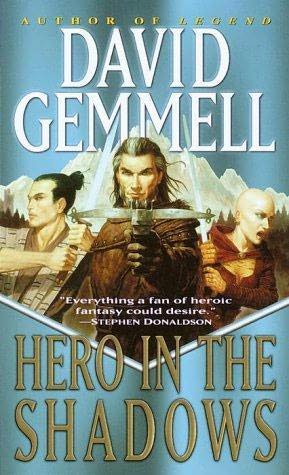 Waylander gave up his dark life as an assassin years ago–or so he thought. When an ancient magic gateway begins to break down and evil beings from another world set out to reconquer the lands of Kydor, Waylander finds himself caught up once again in the cycle of war and bloodshed.
Waylander joins forces with Kysumu, a rajnee warrior who has been training all his life to be the best swordsman, and Ustarte, an escaped changeling experiment who has come from the demon world to organize a resistance. But when the spirit of Qin Chong comes from the past to aid the fledgling resistance, he comes to the unlikeliest person of all–the ditch-digger Yu Yu Liang. As Kysumu wrestles with envy over the spirit’s choice, he comes to understand what it truly means to be a hero.
This book was good. Way good. Not only was it a thrilling action/adventure story, it was full of deep, wonderful insights into the nature of courage and cowardice, life and death, good and evil, and true heroism. David Gemmell’s books are full of wonderful insight, and deliciously complex in the way they deal with life’s most important and meaningful questions.
I read the last hundred pages at a breathless sprint. So many of the characters died! Yet even though the story was very violent, I didn’t feel that it was excessively so. The violence always had a reason to be there, and added something to the story.
What really surprised me was how Gemmell redeemed even some of his most evil characters. Just when you think one of the main antagonists is soulless and outright evil, he shows you another side of the character and makes you rethink him/her entirely. Amazing.
Not only where the “good guy” characters imminently likeable, they were surprisingly relatable. I felt like I understood exactly how Kysumu felt, having spent his whole life training to be the best warrior, only for the spirit of Qin Chong to choose a clumsy, shameless commoner. As he struggled with his jealousy, I felt I knew exactly what he was going through. Interesting stuff.
Waylander, too, was very interesting. Even though he was the best warrior out of anyone in the book, he was far from invulnerable or perfect. He had a dark side that was very believable–not too gritty or over the top. In fact, I think Waylander was originally an antagonist in the earlier books in the series.
When I read White Wolf, I had issues with the plot structure and excessive use of flashbacks. Not so with this novel. The plot progressed wonderfully, keeping me engaged and interested the whole time. The twist ending was delicious! Wonderfully satisfying.
Above all else, this is a book that means something, that actually says something. I came away from this book satisfied, not only because of the excellent, entertaining story, but because of the way the story made me think. Gemmell is an expert at creating depth to his characters and his stories, pulling you beneath the surface to glimpse at things that are really important and meaningful.
Some updates
Just a few quick updates before I go to bed:
My short story, Decision LZ150207, is getting published in The Leading Edge! Hooray! This will be my first publication credit. It certainly won’t be my last!
As you can see from the progress bar to the right, I’ve started work on draft 2.2 of Ashes of the Starry Sea, the novel that I finished back in April of 2008 (my first “finished” novel–and the project that spawned this blog). My goal is to finish this draft by August 1st, 2009.
It is a beast of a novel–I’m predicting it will be at least 150,000 words. The draft is currently at 158,000 words, but I’m going to have to add several scenes as well as vigorously trim out the bad writing.
And boy, is there a lot of bad writing in this draft! I knew, when I wrote it, that I wasn’t that good, but holy cow! Way too much introspection, way too much “tell”-iness, not nearly enough concrete details. Too many adverbs, too much wordiness, especially in the scenes with the action. This is going to be a deep revision.
BYU’s writing conference was a blast! I’ll try to post more about it in the near future, hopefully tomorrow if I can get around to it. The three editors who attended are open to submissions from the conference, and one of them prefers full manuscripts to partials, so on Saturday I printed up the full 2.0 draft of Genesis Earth.
Holding the full manuscript in my hands was surreal. It’s one thing to write it out digitally and see it on your screen, but it is something else entirely to hold the tangible, physical thing in your hands. I just…keep wanting to hold it. It feels so real.
But yeah, I’m kind of uneasy sending the full manuscript off to this editor, especially since she hasn’t asked me for it specifically (she just told all the conference-goers that she prefers full manuscripts). I don’t want to get in trouble sending my full ms out to multiple places, so my game plan is to send this to her ASAP so it can get rejected within the next 1-4 months (what she claimed was her turnaround time).
Because of that, I’m sending her a draft which could be more polished, but oh well. Anything could be more polished–eventually, you just have to send your stuff out. Besides, as pessimistic as this might sound, I do think that my mss has a fighting chance. We’ll see what comes of this.
On your mark, get set…
This post will be really quick, since it’s after midnight and I want to get up at seven tomorrow.
I’ve decided to work on The Phoenix of Nova Terra for my next project. Except…I’m renaming it (yet again!) to…
<drumroll, please>
Ashes of the Starry Sea.
I like this title much more than the previous one. I think that just about everyone, when they first start out, comes up with a somewhat cliche title having something to do with a phoenix.
Even though this is the first novel I ever wrote and finished, I think it has a lot of potential. People always say that your first novel is never publishable, but this one wasn’t my first attempt at writing a novel (it’s something like my sixth or seventh). Besides, when judging these things, you need to look at the work itself, not on these general rules that everyone always throws around.
The story itself is pretty decent, I think. The main things to improve are 1) the worldbuilding/research aspect, and 2) the nuts and bolts writing. To help out with that, I’ve decided to follow some of David Louis Edelmen’s revision advice and completely transcribe every word of this revision draft in a new word document. Hopefully, that level of focus will help me to improve things on the word, sentence, and paragraph levels.
At the same time, I need a very clear macro-level view of this project–after all, it’s been over a year since I finished the rough draft. To do that, I started a wikidpad file that will become the story bible for the new draft. I’ll use it to do the things I mentioned in my previous post, “Outlining for discovery writers.”
I’ll also spend the next week or so reading the most recent draft from start to finish, figuring out my revision notes. This will be hard, since I stopped ennumerating the chapters towards the beginning, but I’ll figure it out.
Gah, everything is so disorganized for this project! I’ve got revision notes for the 2.0 and 2.1 versions, files scattered everywhere, feedback from a friend of mine from the FLSR that I haven’t even looked at yet…just too much. The draft needs a TON of work, too.
If I can polish this draft to a satisfactory, presentable second draft in the next month, I’ll be happy. That’s prettymuch my goal. 140,000 words in five weeks…let’s go!
Bringing Stella Home 1.1 is finished
A few minutes ago, I finished the rough draft of Bringing Stella Home. This is my third completed novel. Huzzah!
It needs a ton of work, too…there’s no way I’m going to let this thing see the light of day, not until I finish the second draft.
In fact, I should probably set down tomorrow and start listing all the plot holes that need to be fixed in the revision, before I forget them all. It feels like there are dozens and dozens of holes. Not a good feeling.
Still, IT’S DONE!!! All that worrying and fretting and gtalk rants at Charlie along the lines of “GAH!! THIS NOVEL SUCKS!!!” have paid off, and I’ve got a draft I can work with! Inshallah, it should be downhill from here.
I remember when I wrote Genesis Earth, how all throughout the process of writing the rough draft, I felt that the work was terrible. And it’s true–the rough draft needed a lot of work. However, I think revising comes easier to me than drafting, and the process of writing the second draft was much, much smoother and more enjoyable than the first one.
So, what I have now is a hunk of rock roughly in the shape of a face. I can’t quite tell if it’s th face of a man, a woman, or a monkey, but it’s a face nonetheless. That’s better than an unworked block of stone, at least. Maybe someday it will be a decent work of art, if my hands don’t slip and I shave the nose off by accident.
I’ll let this draft sit for a few weeks, maybe a month, then pick it up again for the revision. In the meantime, on to other things.
And really, as rough as this draft may be, it feels awesome to finally have it finished. Reality sets in tomorrow, when once again I find myself staring at a blank page.
Bringing Stella Home 1.1
mss pages: 416
words: 118,596
file size: 791 KB
chapters: 21
start date: 6 May 2009
end date: 10 June 2009

POSTSCRIPT: Hahaha! MS Word just popped up a dialogue box saying “there are too many spelling and grammar errors to underline them all” or something like that! HILARIOUS.
Heaven’s library
2,943 words today, even though today was the first day of Writing and Illustrating for Young Readers. I’ve reached the major climax of the book–the moment I’ve been replaying over and over in my head. Perhaps this novel is not as bad as I’d thought–perhaps I can pull this off. The current incarnation is terrible, but I can see in my mind how good it can be in its second or third incarnation. Inshallah, I’ll pull it off.
Today was the first day of BYU’s writing conference, and it was great! The speaker in the last workshop I attended, Dandi Mackall, was exceptional. I don’t have my notes with me and the BYU library closes in twenty minutes, so I’ll recap the best part of her presentation, the story she told in the last five minutes.
She said that once she had a dream where she died and went to heaven (thank goodness!). When she got there, the angel who greeted her offered to show her around, and asked what she wanted to see first. Her answer? The library, of course!
In heaven’s library, she found shelves stretching as far as she could see, full of the very best books. She picked out a few and recognized some of her favorites, the ones that had impacted and changed her life.
After a while, though, she started to get a little disappointed: all of the books in heaven’s library were books we already had down on Earth. Why was that? Didn’t heaven have anything new–anything we hadn’t already seen down below?
“But all these books were here first,” said the angel.
Still, she couldn’t accept that as an answer, so the angel took her down a long, winding, narrow corridor. The deeper she went, the narrower and dustier it became, until she started to feel uneasily. This part of the library was dark and dirty. It was clear that hardly anybody every came down here
Finally, the angel led her to a door covered in cobwebs. He brushed them aside and opened the door, leading her inside. Here was a room many times larger than the first, with old, dusty bookshelves stretching higher than she could see.
She picked out a book and started reading through it. It was one she’d never heard of, but it grabbed her. She could tell that it was really good. She picked up another one, and realized that it was just the kind of book that one of her friends would have loved to read. She picked up another one, and realized that this one could have helped out another friend when she’d gone through a terrible life crisis.
All of this made her angry. “Why didn’t we have these books?” she asked the angel. “They are just as good as the ones in the other room. Why didn’t they make it down?”
“These are all the books that remain unwritten,” said the angel. “Each one of these is a book that a writer, somewhere below, has in them but fails to write down.
“This one is by a writer who just won’t let anyone touch her writing and give her the criticism she needs to improve her craft. This one is by a writer who doesn’t have the discipline to write consistently and finish what he starts. This one is by a writer who doubts her story and doesn’t think she can ever get it to work.”
At this, she nodded and let the angel lead her back out to the main room. As she left, she saw one final book near the door. It had her name on it.
What a great, encouraging story. I didn’t do nearly as good a job retelling it as Dandi did the first time, but it had a tremendous impact on me. I hope sharing it with you, it does something of the same.
For some reason I don’t understand, fate, God, or genetics (or some malicious combination of the three) conspired to turn me into a writer. I don’t write for fame or fortune; I write because I can’t not write. Sometimes, I wonder if I’m making a mistake trying to turn this into a career, into something that will feed myself and my future family. Looking at the millions of other floundering writers like myself, it’s easy to feel anxious. After all, only a tiny fraction of us will ever get published, let alone make a professional career out of this. Do I even have a fighting chance?
But then I hear a story like this one and I remember why it is that I write. Not for fame, fortune, publication, personal gratification, or even just because I can’t not do it. It’s because storytelling itself is important. It helps us connect with the world around us, to see its beauty and wonder. It helps us to appreciate ourselves and understand others. It stimulates our imaginations and, by so doing, helps us to life our eyes from the ground and see the divine potential that is all around us. It helps us to grow through vicarious experience–it helps us to live and to love.
Writing, at its best, is a sacred act, an important act, and if by grace we have been touched by inspiration and given a story to write, we should consider it noble and honorable to bring that story incarnate into the world, to touch the lives of others and lead them to what is good and true.
Outlining for a discovery writer
I’m almost finished with the rough draft of Bringing Stella Home, but I can’t shake the feeling that this draft really sucks and is full of holes.
Part of that is probably that I wrote the whole thing out of the top of my head. The only part that I really took the time to outline was the back histories of the mercenaries–and that gave me material to make the story a LOT stronger. This probably means that I need to do more outlining in the future.
I think I know now what to do and not to do. Here’s my list of do’s and don’ts for someone like me who is more of a “discovery writer”:
Do’s:
- Keep a list of brief explanations for setting elements (history, cultures, traditions, technologies, magics, etc). These do not need to be full length articles, but they should have enough information to trigger your knowledge and/or record the things that you are likely to forget.
- Keep profiles of all the major/viewpoint characters. These should:
–Briefly explain their backstory, including parents/family/origin, childhood, education/training, major formative events, etc. This part should be fairly extensive, and will help you discover even more things about your character as you write your story;
–Explain, in some detail, their motivations–not just their desires, but the basis behind their desires. These usually grow out of the backstory;
–List some basic stats: age, height, distinctive physical characteristics–basically, the stuff someone is going to get on a first impression;
–List their important strengths. This part can be sparse, but you should at least be aware of the things in which they are competent;
–List their important flaws/handicaps. This part can also be sparse, but it should be extensive enough to at least make you aware of and/or get you to think about the potential conflicts that will arise;
–Explain why this character is sympathetic–why the reader is going to like this character. You MUST make a conscious effort to think this out. As the writer, you will love your characters simply because you created them, but the reader will not share in this euphoria. Write this section like a pitch, as if you’re addressing the reader (I haven’t tried that yet, but it sounds like a good idea and I’m going to try it on my next project). - Keep an ongoing list of all the major plot conflicts, with a checklist for each one of things that must/should happen in order to make the conflict as juicy and story-rich as possible. These lists should be sparse: one sentence to explain the conflict (character vs. character), and each point of the checklist should also be one line. You will flesh out each of these points as you go along, and you may even add new conflicts and get rid of old ones as your story takes shape.
Tip: None of these sections needs to be extensive. Sometimes, it will work better if you simply cut and past excerpts from your novel in the appropriate places in your outline. This may be especially helpful for setting elements and minor characters.
Tip: Not all of your outlining has to be done before you start writing. The outline should be an organic document that expands and changes with your draft, and your best ideas will come as you write the story, not as you write the outline. The outline exists to serve the story, not the other way around.
Don’ts:
- Don’t feel that you have to write encyclopedia-style articles on all of your setting/worldbuilding elements. You are the only one who will see these, so you don’t have to extensively edit or proofread these sections.
- Don’t try to explain every detail of your characters’ personalities. When you have a clear backstory, these will come out naturally. To write believable characters, figure out the basics and then GET OUT OF THE WAY and let them take over.
- Don’t outline the plot; outline the major plot conficts with their necessary events, but expect these to change as you write. This should be the most flexible part of your outline.
- NEVER feel that you have to fit your story to the outline. The outline exists to serve the draft, not the other way around. Use it as a reference and a set of guidelines, not a set of rules. You will discover your story as you write and daydream about it, not as you write your outline.
- Don’t worry if your outline is spotty and full of holes. You’re not writing this to an uninformed audience; you’re writing this to your future self, who can fill in the holes quite well. In fact, your outline only exists to fill in the holes in your future self’s head and point him in a clear direction.
- Don’t worry if your story gets ahead of your outline on the rough draft. For discover writers, outlines are more of an after-the-fact thing anyway, and your outline will continue to grow and expand in the rewrite. In fact, you may find it more productive to write the rough draft in a burst of frenzied creative energy, leaving 90% of your outlining for the rewrite.
These are a few of the things that work for me, as a discovery writer. I haven’t tried out everything on the do’s list, but looking back, I can see that they would have helped tremendously if I’d done them while writing Bringing Stella Home.
Just because you’re a discovery writer, that doesn’t mean that you shouldn’t keep an outline. It just means that you need to keep a different kind of outline, one that will enhance your discovery writing process rather than constrain it.
Genesis Earth pitch and other assorted thoughts on writing
Today I got together with Charlie after her work and discussed how to pitch my novel Genesis Earth. We did it in the following way: I took a few minutes to explain what the book was about, while she wrote down the words that stood out and excited her. Later, I took the words and worked out a thirty second pitch for it.
It was HARD! I spent nearly two hours after meeting with her just to write out a stupid four or five sentence blurb! Selling your work is totally different from producing it. Anyway, here’s what I came up with:
Michael has never set foot on Earth, but it haunts him as much as the legacy of his parents. So when his parents build the first artificial, traversable wormhole, he sets out with his mission partner, Terra, to explore the Earthlike planet on the other side. They arrive only to discover an empty, abandoned world and an unresponsive ghost ship advancing towards them. When Terra’s schizoid tendencies threaten her mental stability, they both must learn to trust each other in order to confront the mysteries of the new universe–and the personal insecurities that keep them from what they truly desire.
I have that down to 29.6 seconds. I should probably cut it shorter, but as it is it only has about half of the words that Charlie wrote down. If I cut it any more, I’m afraid it just won’t make sense.
It’s a start, though, and talking with Charlie helped me out tremendously. I realized that when I’m selling this stuff, I need to focus on the characters. Sure, all the worldbuilding stuff is interesting, but it’s not what hooks the reader. If all you’ve got is thirty seconds, don’t cut to the chase–and don’t give a synopsis! Synopsis =/= pitch!
Charlie was exhausted, so as we talked, she started ranting in a way that can be described as bluntly honest. Interestingly enough, most of what she said was actually quite helpful, not only for Genesis Earth, but also for my other projects.
The most helpful thing she mentioned was that when you’re writing characters, you often have to pick out their distinctive character traits and consciously overemphasize them. If you don’t, the reader might not pick up on it and find your characters stale and boring. While I hate melodrama and try to keep my novels free of it, I also need to keep my characters interesting. It’s a fine line to walk, but one that you can’t avoid.
She also said that it’s very easy for protagonists to be more boring than the main characters. I think this is probably because we rely on formulas and cliches when we’re starting out, since that’s much less risky than breaking the rules we don’t yet fully understand. The protagonist is the character closest to the trope, while the side characters can do what they want without threatening the integrity of the story.
Charlie said that because it’s so easy to fall into the trap of a boring protagonist, you need to consciously choose the traits that are interesting about that character and work them into the story as much as possible. I realized, as she said that, that my main protagonist for Hero in Exile is, indeed, a boring character. I need to pick out the things that make him interesting and consciously work those into his character.
This got me to think about planning. I’ve found that if I try to outline a novel when I set out to write the rough draft, I end up telling a completely different story. However, if I try to write a second draft without an outline, I have a hard time keeping things straight and fixing all the stuff I missed while discovery writing the first draft.
(I’m really upset now, because I was going to mention something that I need to foreshadow in the next revision of Genesis Earth, but…I totally forgot what it was! GAH!!! That’s what I get for not outlining!)
Charlie then started to rant about some of our writing friends, and how she would never listen to criticism on her writing from someone she considered to be an inferior writer to herself.
That part was…interesting. While I agree 110% that arguing with criticism is a sign of a poor writer, I don’t think it’s especially useful to rank writers in terms of “good” or “bad.” I would like to believe that I can learn something from everybody, and not just what not to do. Perhaps that’s optimistic, but I think it’s also practical–I’ve found that a bloated ego can shoot you in the foot six ways to Sunday before you even know what’s going on. I’ve found that not just through one unfortunate experience, but through several.
Brandon Sanderson said something very interesting in the last email he sent out to his English 318 class: he said that in New York, editors and agents don’t rank manuscripts by “good” and “bad,” they rank them by how much work they think it needs to be publishable. There is a distinction between the two, just as there’s a distinction between recognizing something that works really well and something that follows the rules.
That’s about all I have the time for now. I’ve got to get to bed. Late night internet == bad idea.
Things to do before June 8th

BYU’s Writing and Illustrating for Young Readers conference is coming up in less than a week, and I’m pretty excited for it! I’m signed up for the afternoon sessions only, but it should still be a great experience. From what I’ve heard, this conference is several steps up from CONduit and LTUE in terms of professionalism, and I want to be ready. Here’s my list of things to do to prepare:
- Spot edit Genesis Earth for the really major stuff that I can reasonably fix in the next few days–especially the first three chapters. A lot of the feedback I’m getting suggests that this novel might comfortably fit in the YA genre, which means that I’ve actually got something I can market to these agents and editors. I want it to be ready (or, barring perfection, at least as ready as I can make it).
- Work out a good elevator pitch for Genesis Earth. I’m not going to ambush anyone with it, but I want to be ready in case I get into a conversation with an agent/editor and they ask about it.
- Research all of the agents/editors/authors coming. The list is here.
- Polish shoes.
- Do laundry.
- Iron shirts.
- Shave. Probably every day of this thing.
- Get business cards? I’m not entirely sure about this. I suppose it couldn’t hurt. Anyone know where I could get a few dozen cheap/free ones on short notice?
- Brush up on recommended conference etiquette. Miss Snark has several great posts on this in the archives of her blog.
- Buy/reuse a cheap notebook and get ready to take lots and lots of notes. Sorry, guys, I probably won’t be recording or posting mp3s of this conference. It’s not a fan event, after all, and I don’t want to do anything that would get me in trouble.
Anything else I’m leaving out?