Almost at part 3

Wow, writing this novel is going a lot faster than I had thought. At the same time, though, I sometimes worry that I’m not going fast enough.

I broke the 50k mark this week, and I haven’t even gotten to any of the major climaxes yet. This thing could easily go to 90k words before the end. With only 6 1/2 weeks left in the semester, can I finish it in time?

At the same time, I have NO IDEA what I’m doing this summer. Really. I have a lot of possibilities, but no concrete plans. With the semester coming to a close in a little more than a month and my housing contract with the FLSR coming to an end, that is a little bit unnerving.

Whatever I do, I want to devote some serious time to revising and rewriting these novels, getting them polished. Finding a spring/summer contact isn’t that hard in Provo; the question is whether I can find a job. I also want to go to the Middle East for a while, and if I go home to Massachusetts in August (which I would like to do) another possibility is Worldcon 2009 up in Montreal.

As far as how Bringing Estella Home is coming, it’s coming along very well. I have all of the key climaxes mapped out in my head, and the one that ends part 2 and begins part 3 is only two chapters from where I am now. I don’t normally keep a detailed outline of the whole novel, but I can usually see at least one chapter ahead. Kind of like the faith-promoting story of how a train conductor only has to see as far as his headlights, except that with novel writing, getting derailed is a very real possibility. I know I’ve crashed and burned in my novel attempts before. Fortunately, this one seems to be right on track.

This semester hasn’t been too hard, but last week was somewhat harder than usual. However, it seems like things are starting to calm down into another lull (knock on wood), so I think I can shoot a little higher as to where I want to be at the end of this week (in terms of my novel). I’ve found that I can do about one viewpoint scene per day, one chapter per week. This week, I’m going to shoot for two chapters by Monday. It seems a bit tough, but since I’ve already written the first scene in chapter 9, I think I can do it.

Also, as an experiment, I’m going to try to wake up early and get in a solid hour of writing before I start my day. I found a random website the other day (lost the link, sorry) that showed the routines of several famous, successful writers. Almost all of them woke up early in the morning and did most of their work before noon. Right now, I write almost everything between eleven at night and three in the morning, so I’d like to see if I can change that. I may fail miserably, but what the heck. Now is the time in my life to figure out what works and what doesn’t.

White Wolf by David Gemmell

Skilgannon the Damned is one of the mightiest warriors in the world, yet every day the memory of the innocents he has killed haunt him.  He seeks solace in becoming a monk, but as alliances break down and wars sweep the land, mob violence comes to the monastery and Skilgannon once again takes up the swords of Night and Day.  The swords, however, are cursed with an enchantment that corrupts the soul of the one who wields them, and the old witch who gave Skilgannon the swords–and who cursed them–is behind the political machinations that threaten to drive Skilgannon into the hands of his greatest enemy: his old lover, the queen of Naashan.

I’d heard about the Heroic Fantasy subgenre from English 318 last year, and thought I’d try it out.  I’d heard a lot of good things about David Gemmell, both from Brandon Sanderson and Orson Scott Card, so I kept an eye out for his books at the used bookstore and found this one.

White Wolf was an enjoyable read.  I particularly enjoyed the moral and ethical questions that Gemmell raised, both during the fight scenes and between the fight scenes in the dialogue between the characters.  Gemmell will often come right out and have his characters directly address issues like bravery and cowardice, death and sacrifice.  Far from sounding strained or pedantic, these were my favorite parts of the novel, mostly because the characters were struggling with these issues themselves.  Druss and Skilgannon, of course, have a little more experience and know the answers to these things, but the boy Rabalyn, a recently orphaned boy who has nowhere to go but follow the warriors and become one of them, goes through a very interesting growth cycle.

Gemmell also did a very good job creating an evil villain and raising the stakes.  As Skilgannon’s adventure winds in and out, he finds himself on a mission to save a girl who has been tortured to the point where she may lose her very humanity.  However, the villains are not all black and white.  Technically, Skilgannon himself is a villain, or maybe a post-villain, and the queen of Naashan is a similarly complicated character.  Gemmell’s world is populated with uber-heroes and uber-villains, but there are plent of people who fall in the middle as well.

The biggest issue I had with this novel was the plot.  It seemed to follow a loose quest structure, but it had a weak beginning and middle.  Skilgannon is supposedly onthis quest to resurrect this girl he once loved, but prior to this he’s been living the monastic lifestyle, trying to escape the world.  There is no clear moment where he says “I’m going to resurrect this girl,” yet supposedly this is supposed to drive him to travel hundreds of miles to get somewhere and do something.

The middle is littered with flashbacks–they are everywhere.  While the flashbacks are interesting and engaging, they interrupt the action in the present of the narrative, which often gave me the sense that nothing notable was really happening.  I started to lose motivation to read the book somewhere in the middle, just because I had lost that sense of plot progress.  If it weren’t for the characters and the conflict, I probably would have given up on it altogether.

However, I really enjoyed this book.  The last third was really good, and the epilogue was fantastic!  Probably the best epilogue I’ve ever read.  I wish I could say more, but it would give out major spoilers.  It was just a very well written, very well done epilogue.

I’d definitely be interested in reading some more Gemmell, though he’s not on the top of my list right now.  When I do pick him up again, I’d like to start with Legend, the novel that launched him into the big time.  I hear that’s a good one.

Yet another story idea

Ok, here is a cool one that came to me the other day.

One of the time traveling cliches is that of someone going back in time to kill off some infamous world leader in his/her infancy, thus changing the course of history and averting a major disaster (or causing an even bigger one). It’s a common what if scenario: what if someone went back in time and killed Hitler? (Red Alert) What if someone went back in time and supplied the Confederacy with AK-47s? (The Guns of the South)

Well, here’s my take on it: what if time traveling agents have ALWAYS been going back in time, trying to fix up problems like this? What if history is one long story of the screw ups of a bunch of secret agents trying to alter things, trying to get it right, trying to get to some kind of utopia?

Of course, by altering history, they alter their own futures, making it impossible to go back to the future from which they came. Which means that they would have to go forward, see how it worked out, then go back again to make another change, take out another horrible world leader, then go forward again, etc etc.

If that’s the case, perhaps our universe is actually one of the “rough drafts” that this agency has been working on. Perhaps our universe is so screwed up because the agency hasn’t yet made all of the changes they want to make…not in this timeline, anyway.

In order for this to work, the people of this agency would have to all travel together, since leaving someone behind before going back to make alterations would mean leaving that person behind in a timeline that could never be reached again. From this, two things follow: 1) the time travelers would have to have some kind of a really cool ship, on which they all live and travel, and 2) they would be completely autonomous from any kind of government or other institution limited to one particular timeline.

This raises a number of ethical questions. Is it wrong to go back and alter the course of history in this way? Do the people in the original timeline cease to exist, or do they continue to exist in a parallel universe? If you take the latter view, how does that alter the ethics of changing things? You’re not really screwing people over–they still exist, just in an invisible parallel universe. And you’re trying to make the world a better place, too. But, then again…you’re basically playing god with history, and that sounds pretty unethical.

My idea for incorporating this into a story is this: a regular guy from our time bumps into these time travelers and gets sucked into their little plot to build a utopia. He has to struggle with getting taken out of his world, never to return (or never to return to it quite the way it was). There could possibly be a love story of some kind, especially if these are steampunk time travelers (perhaps that would explain why the 20th century was more spectacularly screwed up than any other–the time travelers started in the 1800s and are more concerned about their era than after their era. But then, there are also divisions and disagreements among the time travelers, with some getting fed up and discouraged with the whole thing, others (possibly the leader) with megalomania, and others who are beginning to have doubts about the morality of their undertaking.

Pretty cool, neh? Now, back to doing homework… 😛

Progress!

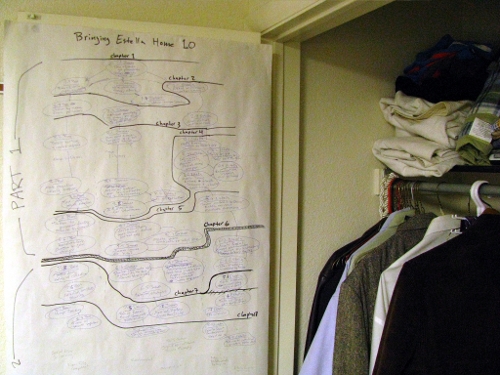
I’m sludging through the middle of Bringing Estella Home.  I’ve heard people call this the “blue collar work” of writing, all the parts between the beginning chapters and climactic ending chapters.  I believe it.

In particular, I was having some difficulty with chapter 7 last week.  I have, basically, three separate plot threads tied up in four viewpoints.  Sometimes, it can be frustrating to give them all equal time while putting the scenes together in such a way that they contrast and build off of each other.  In particular, it’s difficult to get the chapters right.

I’ve heard that each chapter is supposed to be its own distinct sub-story, with its rising action, a mini-climax, and a falling action of some kind.  I’m fairly confident that I can do this intuitively over one or two viewpoints, but over four viewpoints, with three different plot lines?  It’s tough.  Last time I tried was with my first novel, and when I went back for the rewrite I had to reorder several of the chapters, especially the first three ones.

The way I’m doing it for Bringing Estella Home is picking one of the plot lines to be the main subject, if you will, of the chapter.  I build on the other plot lines as well, but the big climax, the big reveal, comes in the plot line that I’ve designated for that chapter.  Typically, I’ll start each chapter with a viewpoint from the plot line that is central to the rising and falling action of that chapter–or, if I don’t start it with the viewpoint, I start it with the characters talking about the idea that is central to the climax of the chapter.

Originally, I thought that the climax / central aspect of chapter 7 would be the brainwashing / mind-altering procedures that Ben undergoes in becoming a soldier for the Hameji.  I started with James discussing the Hameji with the other mercenaries on the ship and talking about various legends they’ve heard of mind-altering drugs that give the Hameji special powers.  The next scene was Ben forced to take some of those drugs.

However, I really hadn’t figured out Ben’s part of the story at this point.  I knew he’d take the drug, and I knew how it would change him, but I didn’t know what happened next.  As a result, the rest of the chapter just felt like a chore, one that I accomplished over several late nights (probably to the detriment of the quality of the writing :P)

It wasn’t working.  The chapter just didn’t feel like it held together.

Then, I had a genius idea–why not make the last scene of chapter 6 the first scene of chapter 7?  The viewpoint was from Estella, meeting the jealous head wife of the Hameji overlord.  That scene set up the conflict for the next two chapters of Estella’s story–in retrospect, why didn’t I make it an opening scene for that reason alone?

I don’t know.  But it worked out wonderfully well!  Once I shifted the central focus of the story to Estella, EVERYTHING fell into place!  Her conflict at this point really was a lot more interesting than anything else in the chapter.

So now, with chapter 7 under my belt, I am WAY excited for chapter 8!  While I was walking back from school one day, I figured out exactly what needs to happen next in his story, and it is amazing!  Brutal, violent, and torturous, but it is amazing!  And this is the perfect chapter to insert James’s philosophical discussion with Danica, the one that I wrote down nearly a month ago just because I had to get it out!  I’m excited.  Maybe I’ll even finish it before Saturday.

Anyways, it is 2:30 am, and I am way tired.  Time to get some sleep.  Thank goodness my first class doesn’t start until noon! 🙂

Apocalyptic story idea

Ok, here’s another crazy story idea.

When I was really young, I used to hang upside down off the edge of the bed and look up at the ceiling, trying to imagine what it would be like if the ceiling were the floor and the floor were the ceiling.  You should try it sometime–it really changes the landscape of your house.  I think there was a Calvin and Hobbes comic strip on this same concept, too.

So, here’s the idea.  It’s a little wacky, but here goes.  What if everyone, all over the world, suddenly fell UP instead of falling DOWN?  Not objects, or animals, or anything else–just people.

Imagine where you are sitting right now.  Look up.  What would it be like if all of a sudden you fell down–or, rather, up?  Would it hurt?  How much?  Would you die?  Would you be able to grab onto something?  What would it be like once you stood up and found yourself on the ceiling?

Then, imagine the change to the landscape!  Imagine the change to the WORLD!  Instead of sky, there’d be nothing but ground overhead, and a giant, bottomless blue abyss beneath!  Would you be able to leave the building you’re in?  If you were in your car, what would you do?  If you were in your car, and you got into an accident, what would you do?

Imagine all those people, walking around outside in the city streets, or walking around campus the moment the apocalypse hits, and BAM!  They’re all falling skyward!  How crazy would that be?  How tragic!

What would you do after you’d realized what happened?  Would you be able to get around?  If you had access to a car, probably–just lie down on the ceiling and drive upside down, I suppose.  But then again, what about the accelerator pedal?  How would you reach it?  You’d have to rig something up–it would be difficult.

And what if you were trapped in a building with no way out?  What if your car were parked outside somewhere?  How would you survive?  Where would you get food?  What would you do once that ran out?  How would you contact people?  Would you even make it?

What if the ceiling weren’t strong enough to support your weight?  What if you fell through it?  What if you were with someone who fell through a weak part in the ceiling?  What would happen?

You get the idea.  It’s a pretty wacky idea, but think about it–if it happened, it really WOULD be apocalyptic!  Crazy!