He remembered me!

Ok, so it’s 1:40 am right now and I have to be up at 7:00, so this is going to be short.

Yesterday was the release party for Brandon Sanderson’s newest book, Hero of Ages.  I had to go to work from three to four, but while walking through the bookstore on my way there, I saw a handful of cosplaying fans sitting merrily in a short line (maybe five or ten people) in front of the table covered in Brandon’s books.   I thought to myself, Ok, I don’t have to worry too much about the line being that long when I get off at 4:00.

Well, I arrived, and the line had already snaked its way around a couple of bookshelves.  That was ok, though.  I expected a wait.  Sat down in my spot and read a little from Tales from the Thousand and One Nights.

Fantasy fans can be really interesting, quirky people.  There was this girl in line just a few spaces ahead of me who talked the whole time about just about anything fantasy related.  It was really funny and entertaining.  The conversation in that part of the line was really interesting and engaging, even for those of us who were just listening in.  One of the people behind me mentioned later, “you can tell she’ll be a writer because of the way she talks.”

The guy behind me struck up a conversation by asking what I was reading (I had also pulled out the Qur’an to get some reading in for my history class), and I found out that he’d come all the way from his work in Salt Lake to get the book.  That was surprising, considering that he hadn’t even read Mistborn 1 yet.

Neither had the guy right in front of me.  He was an energetic freshman who pulled out his computer and wrote in his fantasy novel for a while.  I gave him the Quark writing group email (quarkwritinggroup@gmail.com, if you happen to be an interested BYU student) and we spent a good long time talking about various sci fi and fantasy books that we had read.

Brandon showed up, and the line started moving.  It was pretty slow, but that was ok because we’d all prettymuch broken the ice and were chatting it up the whole way there.  I saw a bunch of random people I knew, which was really fun. “Fantasy brings us together!”

So then, I got there at the desk where Brandon was signing the books.  He looked a little stressed up there, but he also seemed to be having a good time.  I wanted to know if he’d recognize me from his class last year–after all, he’s a busy man, especially now with Mistborn 3, Alcatraz 3, and the final Wheel of Time book.

But he did!  He saw my name on the sticky note and said “Joe!  How’s it going?” We chatted for a bit, and he asked how my novel was coming along!  I said it was coming along well, that it had been rejected once and he was like “yeah, of course that’s going to happen,” so I said I was working on it, as well as a new one, and that I was looking forward to his class in the winter.

He signed my book “For Joe–keep writing!” I was number 79.  Took a picture with him, and now it’s my Facebook profile picture.  It’ll be up there for a while!
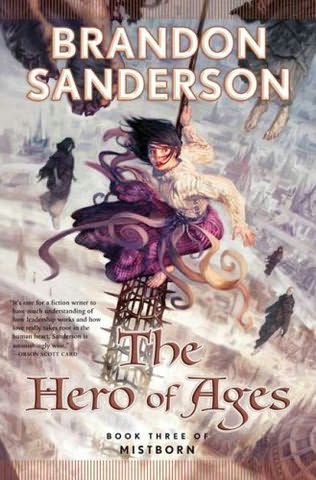
Hero of Ages release party tomorrow!

Tomorrow at 5:30 pm is the Mistborn release party at the BYU Bookstore!  I am so excited!

Brandon Sanderson is a great fantasy writer, an awesome teacher of creative writing at BYU, and a really friendly, approachable, good person.  I had loads of fun in the English 318 class he teaches (definitely my favorite class of the semester) and he was kind enough to take the time and come speak to the Quark writing group on how to become a published author.

I also read Mistborn: The Final Empire and The Well of Ascension last year, and was greatly impressed with both of them.  In particular, I think that Mistborn is one of the best fantasy books that I’ve read.  Vin’s transformation and personal growth throughout the book completely fascinated me, and it rang as true as anything else I’ve read.  Also, I enjoyed the fact that the good guys did not always win; in fact they failed a lot more than I expected them to, and the ways they had to adjust their plans with each failure kept me engaged and interested in the story with every page.  There were enough genuine twists that I was only able to predict the ending and climaxes about half of the time.  Eventually I stopped trying and just enjoyed the book–and I definitely enjoyed it!

When I picked up The Well of Ascension and started reading it, I remarked to Brandon that I didn’t realize how much I had missed his characters until I picked up the sequel.  I wonder if that’s how I’ll feel once I start reading Hero of Ages?  I definitely will.  The thing I most want to see is how Vin and Eland end up, what kind of peace is brought to the empire and how it comes about, what happens to Sazed (he was my favorite minor character)–but mostly I just want to see how Vin grows into a person with a full, healthy life.  The magic system and dark lord and setting and other characters are all really well done, but the thing that I’m most invested in as a reader is Vin and her character arc.

So I got a sub for work tomorrow, which means that I’ll be in line at about 4:00 pm.  The signing starts at 5:30, so I’ll probably be one of the first people in line.  It really helps an author when you buy their book in the first week after it’s released, because those are the numbers that publishers and critics put the most stock on, so I figured I’d help Brandon out and come to the release party.  There’s even a fairly good chance I’ll get one of the first fifty numbered editions–those are supposed to be super valuable or something.

But really, the thing I care the most about is finishing the series.  The release party and everything else is going to be fun, but reading a good book–a genuinely good book–that’s the best thing of all!

Wrestling with my novel

Grrr…writing was so hard today.

It probably didn’t help that I was operating on only four hours of sleep, or recovering from a sickness, or constantly allowing myself to be distracted, but for some combination of these and other reasons, it was just really hard to write today.

I usually love revising.  I think it comes naturally to me, in some ways.  However, I’m well past the beginning of Phoenix and just starting to get to the part where I got muddled the first time I wrote it

Last year, I started to stall and sputter at this point because I had followed several of my initial ideas from the beginning to their preliminary conclusions and had to start adding new ideas to enrich the main story.  I still didn’t know the ending, so I was basically throwing all sorts of ideas in at random and waiting for the magical reaction to happen.

That reaction did happen, but it didn’t really take off until around page 300.  By that point, I’d thrown in enough random story elements that I had the start of a causal chain that would carry the story to an ending that excited me.  I let things take off and rode the story to its conclusion, having a wonderful adventure right up to the last page.

Trouble is, now I have to clean up the mess I left behind–all those other random elements I threw in that never really mixed well with the others.  Loose and frayed ends that I need to cut out or tie back in.  At the same time, I need to isolate and strengthen the elements that ended up being important.  That involves restructuring sections within chapters as well as paragraphs within sections, and it is bloody annoying.

It’s more than cutting and strengthening existing narrative.  It’s cutting and pasting from multiple places, reorganizing it, and then throwing it all out and totally rewriting it in a way that actually works.  It is so difficult, I’m probably going to get it wrong and have to rewrite the whole novel again to get it right.

(If I hadn’t taken a step back a few days ago and started outlining each section and chapter from a more macro view, I wouldn’t know what I need to do to fix this story.  I’d see the problems and know that they exist, but I wouldn’t know how to restructure things so that the novel works together as a whole.  So thanks, Reigheena, for helping me to step back and look at the wider picture.)

The most frustrating thing about this process, by far, is the choppiness.

When you have a blank page in front of you and you’re forging ahead with the first draft, it’s difficult but fairly linear.  Everything flows out in a relatively streamlined progression.  When you’re fixing the relatively minor details, it’s deliciously linear because you’re going going from paragraph to paragraph.

But when you’re revising the novel on a more macro level, overhauling the major story elements, you have to look at the story as a whole, transforming stuff on page 120 and introducing it in its new form on page 90, or adding new stuff between pages 80 and 100 to make the stuff before and after flow more smoothly from one to the other.  You get a whole section full of dialogue and you realize it’s not working, because you’ve developed your character deeper than you had at this point in the original draft, and so you end up throwing out and rewriting everything.

Because the process is so choppy, I find it really easy to be distracted.  I’ll have the exact sentence in my mind that I want to say, but the urge to get just a few moments of relief will be so strong that I’ll switch over and check my email, or check Facebook chat, or check my blog aggregator, or play a game for a little while, etc etc.  So then, when I get back to work, it takes time to readjust, and that sentence that I had will be buried under half a dozen other ideas, so then I have to dig it out.  Grrrr…

I’m tired, it’s late, I’ve had a miserable time wrestling with this novel today, and I’m going to bed.  But before I do, I want to link to this highly interesting and well written blog post I saw on A Motley Vision, a Mormon arts and culture blog.   The blogger tells the story of how she picked a controversial LDS fiction novel by Virginia Sorenson for her ward’s book club.  Both her reactions and her friends’ reactions to the novel were really interesting, especially because they were so different.  The ensuing discussion on the blog is really interesting because it’s all about the pros and cons of controversial, edgy LDS fiction, both to the readers as well as to the LDS publishing industry and LDS society in general.  At least, I found it interesting.  You can check it out and see for yourself.

I am so going to be in bed twenty seconds after I finish this sentence!  Gnight!

I really love this story

I should have written this last night, but yesterday I set out at 8:00 to write in Hero in Exile, and two hours / 1,300 words later, I realized that I really like this story.

Maybe I’m just a sucker for the romantic, exotic Western view of the Middle East–stunning deserts with their rocky cliffs and enormous sand dunes, desert caravans with their exotic wares, colorful clothing and tents, etc.  Desert Bedouin with long, flowing robes and headscarves, swords and horses, striking fast and then disappearing back into the desert.  I know it’s not entirely true…but I’ve been over there, and it’s not entirely false either.  But in any case, I just really love this kind of stuff, and it really shows in the stories I write.

I mean, both Hero and Phoenix feature relatively primitive tribal desert cultures.  In Phoenix, though, the people have a very low level of technology (bows and arrows), whereas in Hero they have stuff like nuclear powered dune buggies and portable hydroponic gardens.  However, in both stories, the society is very tribal, monotheistic religions with prophets play a very important role, women and men are strictly separated, and everything else is just very…Arab.  Maybe not Arab 100% (because hey, I’m not an Arab myself and even though I’ve lived among Arabs for the past year+ I’m sure I still have some misconceptions about them), but enough so that a Westerner reading one of these stories will basically be like “oh, these are Arabs on another planet.  Cool.”

But last night, as I finished up the first chapter of Hero, I realized that I’ve got a really interesting set of conflicts going on here.  Tristen (the main character) basically crash landed on this world after his family’s ship was attacked in orbit, and he’s been raised by this group of pseudo-Arabs in the desert.  He wants to get back out into space and find out what happened to his biological family, but he has mixed feelings because he’s strongly attached to his adopted family.

Meanwhile, the sheikh of the tribe (Tristen’s adopted father) doesn’t want Tristen to leave because he has no living sons to inherit after him.  He wants to manipulate Tristen to keep him in the camp.  And the way he tries to do it is sooo dirty!  It’s going to screw up Tristen’s emotions and relationships so bad, it’s just going to be so much fun to write.  Because, you see, the sheikh assumes that Tristen, like most adolescent boys, is a slave to his hormones.  The thing is, though, that Tristen has a conscience and a sense of honor that he’s willing to die for.  But when everything starts to go grey, and all the role models Tristen’s ever had turn out to be false, what does he do?

Oh, it’s going to torture him!  And this is just the first section of the book–this is nothing!

The trouble is, if I’m already 7,700 words into this novel and I just finished the first chapter, the completed first draft is going to be WAY long.  As in, maybe 150,000 words if I’m lucky.  I mean, the scope of my novel here borders on epic.  There is so much cool stuff I’ve got planned for this story, and I haven’t even really figured out the ending.

So, if I’m going to write this novel, I’m really going to have to focus.  No more avoidance behavior or procrastination.  Butt in chair, hands on keyboard.

I did that the last two days and really had a lot of fun.  Friday, I wrote 1,300 words in Hero in Exile, and today I revised the first part of chapter 6 in Phoenix of Nova Terra.  Trouble is, I have trouble switching between the two projects.  I can work on one the one day, and the other on another day, but not both on the same day.  Still need to work on that.

So anyways, since I talked about how my understanding (and love for) Arabs and Arab culture has influenced my writing, I’d like to close this post by linking to some my friends’ blogs from the Jordan study abroad this summer:

I hung out with Nikki quite a bit on the Jordan study abroad, and she’s got a pretty cool blog.  She has tons of pictures on her site that you can check out.  Right now she’s in Ecuador blogging about her experiences there, but if you check out the archives you can see some really interesting posts she wrote.

Gini didn’t blog very much while we were in Jordan, but she has an interesting post up right now about her feelings on Americans and the Arab-Israeli conflict.  I’ll just say that I share her frustrations 100% and leave it at that (for now).

Nate’s got an interesting blog about the far off places he visits.  You should check it out; he’s got some interesting stories and perspectives about the places we visited in Jordan.  Plus, he can name 88 countries in five minutes.

Finally, Breanne blogged extensively about Jordan and the Middle East, probably more than me in fact.  Even though her experiences were not always as positive as mine, she describes what things are like over there really well.  Her blog isn’t active anymore (she’s on her mission now), but it’s worth it to check out the archives.

One last thought: I was chatting with an Arab friend of mine from Zarqa today.  She’s a writer like me, and we exchanged stories and gave each other book recommendations while we were over there at the University of Jordan.  I emailed her a copy of Hero in Exile (what I have so far), and it’s going to be really interesting to hear back from her.  She’s probably going to think it’s ridiculous–my dreamy, romantic ideas about Arab culture as a foreigner looking at her culture–so it’s going to be really interesting to get her feedback.

Revising, outlining, and a goals adjustment

The comments on my last post were really interesting, and made me do some thinking today. When I sat down to work on Phoenix today, I decided to look at the broader picture by outlining, in two or three sentences, what is going on in each scene I’ve revised so far.

As I did this, I realized that my chapter breaks are in all the wrong places. Not only are most of the beginning chapters way too short, but the breaks just didn’t feel natural. I decided to rearrange them.

At first, I thought it would be easy, but after an hour of trying to figure it out, I realized that it was a lot harder than I’d thought.

Then, I remembered what Brandon Sanderson taught in English 318: chaptes are like miniature stories in themselves, where each one has a beginning, middle, and ending that leads to the next chapter.

Once I starting thinking of it this way, I was able to organize things in a workable pattern. While the story progresses at a steady pace throughout the book, each chapter is organized around a common theme. The chapter begins with an issue or problem, and ends when that problem either is solved or totally spins out of control.

For example:

Chapter one begins and ends with Ian’s unease about setting his feet on the surface of a planet since he was six years old. His ship, the Avion-45, gets hit by some kind of futuristic EMP and the captain decides to abandon ship. The central issue is Ian’s fear of going planetside–a fear that he doesn’t understand.

Chapter two begins with the crew loading onto the escape pods to make an emergency landing on the planet. There is an accident, and Ian’s pod gets separated from the rest of the crew. Ian, with Melinda and Ben, crash land in a desert. The chapter ends with the bandit attack, with Ben and Melinda wounded and possibly dead. The central problem is that Ian is progressively separated from his peers, and it gets worse right up to the end.

Chapter three introduces Leila, a princess kidnapped by the bandits and abused by their women. They send her out to investigate the battlefield, and she meets up with Ian. She manipulates the situation so that the bandit women think that Ian has rescued her and subjugated them. The main problem is Leila’s subjugation by the bandits, and the chapter ends with her successfully turning the tables on them.

Etc etc.

So then I used this way of thinking to outline the next chapter that I need to revise. As I wrote it out, scene by scene, I realized that the best way to develop the central focus of that chapter was to combine two events into one and reorganize how I did the perspectives. Not only would that shorten the chapter, but it would also make it less choppy and more straightforward. It would also build the suspense a lot better.

So now, even though I know that I have a ton of work to do to rewrite that chapter, I’m stoked to dive into it because I know what I’m doing. If I keep to this method, I think that the second draft will be much stronger than it otherwise would have been.

Oh, and I decided to revise my goals a bit. Here are some daily goals that I think I can actually accomplish:

  • Revise at least six pages of The Phoenix of Nova Terra.
  • Write at least 500 words in Hero in Exile OR write a wikidpad article about some aspect of the story universe.

These are goals that I feel I can actually accomplish on a daily basis. And if I think I can accomplish them, I’m sure I will.

What I really need is to keep my mind in both stories at the same time. That’s the real challenge. But if I want to write professionally, that’s a skill that I’m going to need.

Finally, here’s something cool a friend of mine just showed me. If your Meyers Briggs personality type is INTP (or if you have a significant other whose personality type is INTP), this might interest you. It’s just so hilarious that a bunch of INTPs got together and made a website devoted to their personality type. If any of the sixteen types were to do it, it would definitely be them.

Question about revising

Here’s a question about an issue I’m starting to have with revision.

I’m currently revising the rough draft of my novel The Phoenix of Nova Terra.  So far, I’ve just been cutting out unnecessary descriptions/wordage and rewriting some of the passages to make them stronger.  Although I’m making a lot of changes, I haven’t really changed any of the larger story elements, such as character, plot, setting, etc.

Yesterday, I got to the point in my novel where Leila’s father, king Malek, makes his first appearance.  Leila is a major viewpoint character, but her father is not.  When I wrote the rough draft, I didn’t really develop him at all–in some ways, he was just a placeholder for the plot, a fatherly figure for me to use to develop Leila’s character.

But as I thought about his role in the story, especially his role in the first scene where he makes an appearance, the more interested I became in his character.  Whereas some kings are tyrants, Malek is a cultured, diplomatic gentleman.  This is all the more interesting because the world on which he lives has a very violent and tumultuous history.  The more I thought about it, the more intrigued I became with his character–and interested in taking some time to flesh him out.

There are two problems with this, however.  The first is that this novel is already too long as it is–check the sidebar.  165,000 words is really pushing it for science fiction.

Second, it would require…well…work.  I mean, if I tried to add something in every time I see something new and interesting in my story, wouldn’t I be writing a different novel every time I revise it?  That sounds…hard.

So my question is, how do I know when I can (or should) go in and change something fundamental to the story on the rewrite?  Editing and deleting scenes is fine, cutting out or adding dialogue is not hard, tightening descriptions and viewpoint is fairly straightforward and not too challenging–but rewriting character, setting, or plot?  That is a major overhaul.

How do I know what major elements to change, and how much?  I want to have this draft finished before the end of this year, after all.

Ottoman airships

I just had a REALLY cool idea. It comes from an unhealthy combination of Girl Genius (one of the coolest steampunk stories I’ve ever read) and too many classes on the history and humanities of the Middle East.

What if blimps, dirigibles, and airships were invented in the Middle East before flying machines ever came to Europe or America? What if airships thrived and became an integral part of the culture in that part of the world, instead of declining after the advent of airplanes and dramatic disasters such as the Hindenburg accident?

How would our world be different? Would I get to fly in giant, luxurious airships? Would the Middle East have experienced a renaissance instead of the steady decline it has seen since Napoleon’s invasion of Egypt? Would Napoleon have even been around to invade Egypt?

I suppose it makes more sense to think of the airship as a potential invention of the Ottoman Turks, instead of, say, the Abassid Caliphate back in the tenth and eleventh centuries. I mean, the Ottomans had gunpowder, and the age of steam wasn’t that far away. I’m not sure what technology is prerequisite for the building and operating of airships, but it seems that those are two that would go with it. After all, an airship has to have some measure of self-propulsion (steam) and a means for providing massive amounts of helium or hydrogen gas, which infers a knowledge of chemistry that is probably advanced enough to produce something like gunpowder. Then again, I’m not an Engineer and I really don’t know.

But how cool would that be?? Ottoman airships, decorated in all the ornate arabesque patterns and inscriptions of the mosques of those ages. Emperors, princes, sultans, caliphs, and oriental courtiers all in their luxurious flying palaces. Turkish merchants and warlords commanding fleets, caravans, and armies of the air. A renaissance Europe dominated by these fearsome dirigible armies, then mastering the technology on their own and turning against their Turkish and Arab conquerors. The Age of Discovery, not by sea, but by air, as intrepid explorers such as Columbus, Magellan, and Vespucci commanded their expeditions by airship and discovered the New World from their dirigibles.

I love airships. The next novel I write (after I’m finished with the three I’m working on) will probably be a steampunk fantasy. Will I use this idea? I have no idea. It sounds more like speculative fiction than pure fantasy, but who knows?

Whatever it is, I think it’s a really cool idea! What do you think?

Published
Categorized as Uncategorized Tagged

I did it!

Yay!  I finally hit all three of my daily goals in one night!  Six+ pages of revision in Phoenix, 500+ words in Hero, and a contribution to the wikidpad notes on Hero!  It may not sound like too much, but it makes me happy.

And I’m sick.  Blegh.  Since it’s after 1:30 am and I have a class at 8:00 that I absolutely cannot miss, I’m going to bed now.  Hopefully, I will not be a wreck in the morning.  Nothing gets you down like sickness.

But the sickness didn’t get my writing down!  Woo hoo!

General Conference and weekend progress (or lack thereof)

This weekend was General Conference.  I watched most of the sessions from friends’ apartments here in the FLSR.  While I enjoyed many of the speakers and caught all four sessions, I have to confess that I slept through a lot more of the talks than I should have.  I’ll definitely download the mp3s and listen to them when they come out.

As far as writing goes, this week was a lot slower than I would have liked.  Yesterday was packed from the moment I woke up (10:30 am) to when I finally went to sleep, though I did get in a little bit of writing between sessions.  Today, I woke up feeling sick, which didn’t help things either.

Despite all this, I’m really happy to say that I made some serious progress in Phoenix.  Cut out more than a thousand words and revised nearly twenty pages altogether.  Things are right on track for that story, and I’m really enjoying the rewrite.

Hero in Exile, though, is different.  I didn’t make nearly the progress that I wanted to on that one. <sigh> looks like I’ll have to wait for the next weekend.  That, or start writing in it more consistently.

That’s all for now.  In the meantime, check out this amazingly cool picture of a solar prominence from Astronomy Picture of the Day.  Or my friend Steve’s blog.  Just remember, Steve claimed for the longest time that he would never write his own blog, so don’t believe a word he says.  You have it from me.

Posting story ideas

My friend Steve posted a comment on my last post that I thought was deserving of a post all to itself. He said:

Joe,
If you have a good idea, you shouldn’t put it up on your website, man. Someone is gonna’ steal it. Take your flower idea and hoard it, man. Because, I’m gonna’ be honest with you, Victorian women using flowers to fight with in that punk setting is awesome. And you need to protect your kids, dude.

I can understand why people would be wary of sharing their best story ideas in a public place. For a long time, that was my philosophy as well: that good ideas should be hoarded and protected, lest anyone should “steal” them and run away with all the credit.

However, I know what I’m doing. My perspectives have changed, and I have several reasons for posting my story ideas up here publicly. Here are a few of them:

1) Ideas are cheap.

There are a ton of really good story ideas floating around in the sf/f publishing world. In English 318, Brandon Sanderson said that any given editor sees dozens of fascinating, imaginative, stupendous ideas in any given day. The thing that gets you the contract, though, is the quality of your writing. There are just so many amazing story ideas out there that even the most amazing ideas are relatively common.

2) Everyone has a different take on the same idea.

Two authors, writing essentially the same story, will come at it so differently that both books will be unique. Heinlein’s take on space travel is very different from Frank Herbert’s or Arthur C. Clarke’s, and Haldeman’s take on galactic war and colonization is radically different from Scalzi’s. Trantor is not Coruscanth, and Arrakis is not Tatooine.

All these story elements, though based on similar ideas, differ radically from each other because each author had a different take on things. When we write fiction, we bring all our personal beliefs, values, experiences, and perspectives to the story, whether consciously or subconsciously. It’s unavoidable. And since all of us are unique and different, so long as we’re honest in our writing our stories are going to reflect that uniqueness.

I’m not afraid of someone “stealing” my ideas because I know that my approach is different enough that my stories (so long as they’re honest) will be very different.

3) It takes several ideas, combined in a unique way, to make a full novel.

I used to think that you could write a novel based off of two or three really good ideas. Maybe that’s why I never finished anything. I’ve learned over the last year that, in fact, it takes somewhere around fifteen or twenty ideas, minimum, to come up with a good story. And that’s just for starters. Once you sit down and start writing it, new ideas erupt as the story progresses, and you find yourself taking things in unplanned directions. Adjusting your plans and integrating the new ideas with the old ones is part of good writing.

Brandon Sanderson said this in English 318, and I believe it: a novel is not found in the ideas by themselves, it’s found in the synergy that happens as you combine them together. As ingredients, your ideas may be powerful by themselves, but when you combine them together, the end result is much more powerful than the mere sum of them all. It’s all in how the ideas intermix.

4) Ideas grow and develop when you bounce them off of other people.

I do not believe that story ideas are static. They are not like Lego blocks that you stack together to make a construct. They are dynamic–they change and grow over time, like plants in a garden. If you take a plant and hide it in a closet, it will die. Similarly, I believe that if you “hoard” your story ideas, showing them to nobody and putting off writing them until you can write the best novel possible, those ideas will become weaker.

I tried to hoard one of my story ideas a few years ago, thinking that it was the best idea I’d ever come up with and that I needed to wait until I was experienced enough to include it in my magnus opus. Now, the idea doesn’t even interest me that much. I’ve grown, but the idea hasn’t, and I’ve moved on to other things.

My goal in sharing my story ideas here on this blog is to bounce them off of other creative minds and start a discussion. From that discussion, I think that my ideas will grow and become stronger. Other people often see things that I miss, and their take on things can really spark my imagination and help me to take my ideas to a new level. Discussing my ideas, not hoarding them, is what I need.

5) It’s easier to lose a notebook than it is to lose data stored on your website.

This last idea is purely practical. I keep a notebook with me at all times and scribble down story ideas in it as they come to me. Over the summer, I lost a notebook that I’d been keeping for several months. It had maybe thirty or forty story ideas in it, and now those are lost. From that, I learned the importance of keeping a backup. This website, in a way, is my backup.

So those are the main reasons why I’ve decided to blog about my story ideas and make them public. If my story ideas inspire you, then by all means go ahead and run with them. We live in an open source world, and besides, your take on the idea is still going to be very different from mine. And if you have any thoughts to share, please do! I welcome comments, especially for these posts on my story ideas. My goal is to bounce ideas off of you as the reader, because interaction is one of the things that makes blogging so useful.