Disorganization…

Yuck.  My life is so disorganized right now.  Behind in homework, behind in my writing, behind in my blogging, zombified with sleeplessness…ugh.

First step, I guess, is to get a good night’s sleep.  So that’s what I’m going to do.

But first, I have been writing a little…500 words yesterday, 200 words today, rewrote the first chapter of The Lost Colony (I SWEAR I am going to change that title!  It needs to go–next time I sit down with it, that’s the first thing I’m going to revise!).

Also, I started exercising again, which means that I have a lot more time to read.  I’m currently rereading Dune for the next Quark book club meeting–it’s going to be a lot of fun!  Dune is a classic.  Besides that, there are so many other things I want to read–books on writing and art, 1001 Arabian Nights (which I will not only be reading for fun, but also for a class; two birds with one stone), The Faded Sun Trilogy, and just so much other freaking stuff that I want to read.  I’m ravenous for books, for some weird reason.

Oh and good news!  I got the FHSS writing lab job!!  Yay!  So tomorrow they officially hire me, I find out what my hours are going to be, what my duties are, and…yeah.  It’s going to be great.  More on that later.

And now, sleeeeeeeeeeeeeeeeeeeeeeeeeeep…

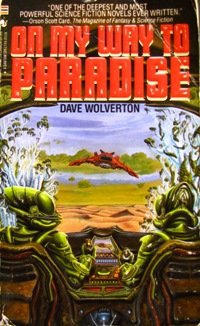
On My Way to Paradise by Dave Wolverton

n17823603_36079523_8117Senior Angelo Osic is a doctor in one of the refugee flooded neighborhoods of Panama.  The United Socialist States of South America has launched a new war in its efforts to reshape the human race into something purer, but all of that is far away from the life Angelo lives–until an emaciated woman with a bloody stump at the end of her arm shows up and demands him to grow her a new one.

Events rapidly spin out of his control, and Angelo flees on the first spaceship leaving earth–a mercenary transport taking hundreds of superhuman warriors to fight in a bloody planet-wide war among Japanese colonists.  As he tries desperately to evade socialist assassins, he makes friends among the mercenaries on the spaceship–as well as deadly enemies.  In the eerily realistic virtual reality world of the training simulators, Angelo dies a hundred times and slowly becomes desensitized to killing.

As the ship reaches its final destination–a world awash in a genocidal bloodbath–and Angelo’s enemies finally start to catch up with him, how will he maintain his humanity?  Will he ever be able to feel love and compassion again–or will he become the monster he fears the world is making him?

This book is violent.  It is violent and gritty. Rape, murder, assassination, brutal disfiguration and torture, graphic battle scenes and massive acts of genocide–it’s all in there. That said, the book is not about the violence–it’s about moral dilemmas, how we respond to injustice, and how we can maintain our humanity in the face of the most horrific evil this world can see.

Unlike a lot of cyberpunk, Angelo wants to be good–he desperately wants to be an upright, moral person–but time and again he finds himself in situations where he cannot avoid getting his hands bloody, sometimes up to his elbows.  How he responds to this evil, and how he endures it without becoming evil himself, is where the story has its meat.

On My Way to Paradise is a book that makes you think, and after you put it down, you can’t put it out of your mind.  It’s a book that has the power to change your life and how you see the world.

I found it by listening to it as a free audiobook on a podcast that podfaded shortly after, so I only caught the first seven chapters.  For the next year and a half, the story haunted me–I could not forget about it, or about the dilemmas and issues it raised.  I hunted all the bookstores for it, but sadly it’s been out of print for over a decade.  When I finally did find out that Pioneer Book had a copy in their warehouse, I ordered it and finished it a week or two later.  If I regret anything, it’s that I didn’t order it sooner.

This is honestly one of the best books I’ve read.  It is a masterpiece.  I’ve rarely read anything so real and down to earth, anything that resonates as truth so deeply.  It’s definitely not for everybody, but this book is incredible.  I’ve rarely read anythings so powerful–or so meaningful.

Ggggggggroggy

Yes I am.  No routine and lots of destractions equals late, late nights.  I don’t think I’ve gone to bed before 2 am at any time this week, and now I’m suffering for it.  Fortunately, though, this is the weekend, so I can recuperate a little.

The only writing goal I’ve marginally been keeping up with is the 500 words/day one.  However, I’ve been off to a rocky start with Hero in Exile, and I’ve rewritten the first chapter about three times now.  Fortunately, I got a lot of extremely helpful feedback from the quark meeting today, so I think that this latest rewrite is going to be the final one…for this draft at least.

Which reminds me, we had our first Quark writing meeting of the semester today!  Yay!  I think it went really well: Gamila, Jakeson, Cholisose, Hillary, Marissa, and John all came today, plus a new guy whose name is Steve.  Also, I met a couple of people at the social who are interested in coming this year, including FYsenshi and some new guys.  We’ll see if membership explodes like it did last year, but if it doesn’t, I’m sure we’ll still have fun.

So, yeah, it’s getting late, and I really, really need to get some sleep this weekend.  I’ll probably be writing all day tomorrow when I’m not in church, since I want to finish the short story I mentioned earlier before I ask this girl out on a second date and get an earthshaking rejection.  That would definitely freeze my creative juices on this endeavor and I think that it might actually end up somewhat decent–that is, if I can edit out all the superlatives and the melodramatic cheesiness on the rewrite.  We’ll see how it goes.

One final thing: just now I saw this really cool site where you can create a word cloud for a website and/or a bunch of text.  I copy and pasted the rough draft of The Lost Colony and this is what I got.  Check it out!

Three day weekends!

Ok, this is going to be a quick post because it’s late and I CRAVE sleep.

I tried this semester to schedule all my classes on Tuesday and Thursday, and because of that I wasn’t rehired at the BYU bookstore because I didn’t have mornings open TTh.  Suck.  What’s more, I ended up having to schedule a couple of classes on Monday and Wednesday, so I wasn’t even able to have the awesome MWF free schedule that I wanted in the first place.  Double suck.  HOWEVER, I DO have Fridays free, and it is heaven!  Three day weekends all semester!  Woot!

Also, you know what?  Every time I get fired and/or lose my job, it ends up being a great blessing–exactly what I needed at the time, even.  I lost my job in the MTC cafeteria right before the start of a really killer semester, and I know I would have been horribly overwhelmed if I’d had to work as well as study.  And the next semester, when things cooled down, I got the bookstore job, and it was awesome.  While it lasted, that is.

But even though I wish I could still be working for the bookstore, I think in the long run it’s going to be a blessing.  Today as I was looking on the job boards in the wilk, I saw three openings in the FHSS writing lab.  They pay fairly good–about $8.95/hr–and I was surprised to find that I met and/or exceeded all of their qualifications for the job.  So I dropped by the lab, picked up an application, and tomorrow I’m going to drop it by and hopefully get interviewed.  Inshallah, everything will go well and I’ll soon be getting paid to help students in my college write their papers.

Man, I’m just blessed.  Life is beautiful and I love it.

As far as writing goes, I painfully rewrote the first chapter of Hero in Exile and sent it off with the rest of the Quark submissions.  Yes, the Quark writing group is starting up again.  I hope that this year it will be better than ever!  We only got three submissions for our first meeting, but once we get on a roll I think things will really take off.  Inshallah, we’ll get plenty of new members this year to keep the club going strong.

The short story I mentioned in my previous post is off to a rocky start, but it’s going fairly well.  I’m going to try to finish it in the next week or so–before life shifts again and I lose the perspective that impelled me to write the story in the first place.

And now, SLEEEEEEEP!   Why?  Because tomorrow is the last day of the BYU Bookstore’s progressive booksale, where everything is 90% off, and I want first dibs!  And after that…THREE DAY WEEKEND!!!

Dang.

Dang.  I haven’t written at all for the past two days.  That’s lame.

Fortunately, I have a really good idea for a short story / abstract little piece / whatever.  I don’t usually write short fiction, but when I do get an idea for something, wow.  It’s like Ray Bradbury: one of the characters does some random thing and “two hours later the story is finished.”

This one is based off of an interesting thought I had about dating and relationships that goes like this: dating is like trying to bring the space shuttle in for a landing.  If you don’t come in hard enough, you’ll ricochet off of the atmosphere and be flung out into empty space.  If you come in too fast, though, the friction with the air will be so hot that your ship will burn up like a meteor. If you want to land that shuttle, you have to hit just the right angle…good luck.

I went on a really fun date today with a really awesome girl I know, and I think I got the angle right.  Two or three more and that’ll be a semester record for me. After two years of taking things too slow, burning up in the atmosphere is looking a lot more attractive to me than floating endlessly in empty space.  This is going to be one roller coaster of a semester.

It’s 2:50 am and I’m getting up at six to be the first one at the BYU Bookstore’s progressive book sale.  Tomorrow I’m going to be a walking zombie and it’s going to be awesome.

Hero in Exile

Today I finally started writing my new novel.  Yay!  Despite the fact that it was like pulling teeth to get the words on that first page–and I’ll probably end up rewriting it a dozen times or more–it was good to fill up that empty page with something.  800 words, and even if it was hard after so much time not writing, it was good to get it up.

While I was writing, I chatted with a bunch of my friends and asked them what kind of a title I should use for it.  The working title was Exodus to the Stars, and that just didn’t feel right.  Of course, it was kind of lazy for me to ask everyone else, and they couldn’t do much to help me.  It was good to chat with my friends, although maybe I do that a little too much.

The title I ended up settling on was Hero in Exile.  It might sound a little bit corny, but I like it at this point–at least more than Exodus to the Stars.  And really, even though the title doesn’t objectively matter at this point, it does to me.  Maybe it just gives me confidence and drive to be writing a story that has an awesome title.  Maybe I just can’t stand lame titles at all.  I don’t know.

So, after weeks of playing this opening scene and maybe half a dozen others over and over in my mind, it’s starting to come together.  I hope my writing has improved–it’s unnerving to reread The Lost Colony and see just how cheesy the writing is in my first novel–but really, I can’t afford to worry about that now.  Just gotta keep pushing forward.

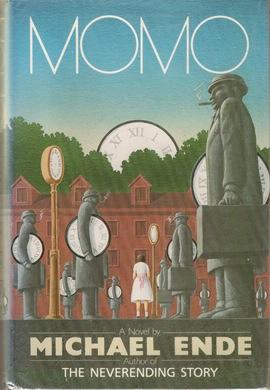
Momo by Michael Ende

[I originally wrote this book review in 2006.  However, Momo was such a good book that I wanted to include it here on this blog.]

I was browsing around at Pioneer Book in downtown Provo a few weeks ago when I saw this book. Michael Ende wrote The Neverending Story, which was my all-time favorite children’s book, and so I was really excited to see that he wrote this one. When I read it, I wasn’t disappointed.

Momo tells the story of a girl (named Momo) who has the uncanny ability to listen to people. People who have problems, don’t know what they should do, or are generally depressed come to talk with her. Because she’s such a great listener, she helps the people see things about themselves that they couldn’t see before, and helps them find out what they need to do with their lives. In this way, she becomes a friend to everyone and helps many people work out their problems.

Momo lives by herself in some ancient ruins (an awesome place to live, from a kid’s perspective! Kind of like having a tree house as a permanent residence), and she’s supported by her friends from the town, who frequently come to visit her.

The problems begin when these gray businessmen start going around town trying to get people to deposit their time in a timesaving bank. Don’t ask me how it works, that’s part of the fantasy. Basically, these men (who mysteriously know everything about just about everyone) convince people to work really hard so that they can save time, and by doing this, they will have a lot more time sometime in the future. However, the grey men are really these fantastical monsters who exist on stolen time, and their goal is to take all of the time from all of the people in the world. As they do this, the people become more and more miserable because they have less and less time for each other.

Momo recognizes the problem when she finds out that her friends aren’t coming by to visit her anymore. One of the grey men comes to Momo to steal her time, but she’s so good at listening that he ends up telling her who the grey people really are. Momo and her two best friends, as well as a whole bunch of abandoned children, try to find a way to stop the grey people, but it isn’t until Momo finds Never Lane and the source of time itself that she defeats the grey men and rescues all of the people.

I really loved the way this story was written. It was written like a really good children’s book–the kind that doesn’t condescend to children by assuming that they only have a very limited command of the English language. And as far as storytelling goes, this book was very well written. There were chapters that just really gave me this good feeling, like I had just experienced something really worth experiencing. I can see myself reading this book to my kids someday.

As far as the message is concerned, it’s fairly easy to tell that there are a lot of symbols and metaphors in the story. It’s not very preachy, though, which is good. I wish I’d read this story five or ten years ago, because I think I’d have understood the message better. Back then, I really loved reading stories that had deep meaning, and I was really good at picking the meaning out. Now, I guess I’m just older and too saturated with college studies for it to really sink in.

Which gets to the part about the grey men. If I were a character in this book, I wonder if I’d be one of the people who sells out to the grey men. But at the same time, I don’t regret being busy. I’m VERY busy all the time (especially this spring, with Poli Sci 200 giving me a major beating ). There are days where I wake up at 6:00 am and I don’t stop running from one place to the next until the evening. Sometimes, it’s true, I let the world around me just sweep me around and control my life. But I don’t think that things would be much better if I just cut out all the things that I’m doing.

I was home this time last year, not working or taking classes–I didn’t really have any responsibilities at all. And I was miserable. I felt like I wasn’t being productive enough, and I looked forward to coming out to BYU for the summer term because then I’d have something to do. Now that I’ve been really busy for a year, I’ve found that I really like it. It’s good to have a lot of challenging projects and responsibilities. I’m doing what I love and even though it can be difficult, I’m having a lot of fun. Work hard and play hard.

My sister Kate sometimes has problems with being overworked or underworked. When she’s busy, she’s so busy that it makes her anxious and she feels overstressed. We tend to fight a lot when that happens. So then, she takes time off to try and recharge, but she gets anxious because she feels that she’s unproductive. So then she fills up her schedule with things to do, until she’s overstressed again.

I think that the problem isn’t a matter of whether or not you’re always busy, so much as what you make time for. The people in the book got to the point where they figured that good things were something they’d only have time for sometime in the future, so they spent all their time doing menial things, and ignored their friends, families, and anything that was fun or enjoyable.

Life should be kind of like a car battery–once you’re up and doing something, it recharges itself. If I were only busy with things that drained me, I’d go crazy. It would just feel wrong, and I would make some major changes in my life. But if I actually enjoyed all of the things I was doing, and am doing, right now, I would know that things are working the way they should.

And ultimately, I think that that’s the message that Ende was trying to get out. Enjoy your life right now, where you are, and make time for the people around you.

So yeah, if you want to read a really awesome (and apparently very rare) book, check out Momo…if you can find it. Good luck! If you’re like me, and you like going places where you can be surrounded by large stacks of old, work, dusty books, maybe you’ll find a copy. Or maybe you’ll find something better. I’ll definitely be on the lookout.
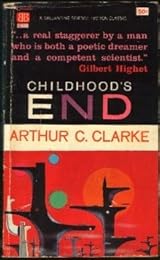
Childhood’s End by Arthur C. Clarke

They came completely unexpected. Hundreds of silver spaceships, hovering above all the capitols and major population centers of the Earth. For nearly a week, as thousands rioted in the streets below, they sat there, waiting. And then came the voice of Karellen, chief of the overlords, viceroy of Earth, heralding a new, planet-wide administration that was destined to end war, poverty, hunger, disease, ignorance, and fear. But as the generations pass and a new breed of humanity arises–one that has known no suffering, no danger, no religion but science, and no creative drive beyond sheer curiosity–mankind is about to discover that their welfare is not the overlords’ primary goal. Humanity’s time in the universe is about to come to an end–and a new, alien beginning.

I read this book in three days, but if I didn’t have any distractions or obligations, I could probably have read it in less than half a day. It’s very short–Clarke doesn’t take time to develop characters, describe the setting, give long info dumps, or show off his prosaic skills. He doesn’t even get into detailed explanations of how everything that happens happens. He waves his hand and gives us the broadest possible sweep of human civilization as mankind finally transcends human existence.

Partially because of the broad brush which Clarke uses to paint his picture, I found myself second guessing him at several turns. I was very skeptical of Clarke’s premises and conclusions, and found it very difficult to believe this story at several points. Believability of the aliens was not nearly so much an issue for me as was believability of humanity.

For example, when the overlords bring out a device that allows people to view any scene from any moment in the past, the world’s religious traditions are exposed and within a generation nobody in the world is religious. That’s not how religious experience works, though. Even if all of the religions in the world were hoaxes–which I’m perfectly willing to allow for the sake of a story–many, if not most of the adherents would continue to hold onto their beliefs, if only for no other reason than to hold onto something. There would be a lot more chaos and upheaval, and religion would stay with us in one form or another, if for no other reason than we as humans are religious creatures. It’s in our nature, whether or not any of the world’s religions are true. Clarke seems to demonstrate an ignorance of this as he paints the future with his broad brush.

A lot of other elements were missing in this book, such as character development, development of the setting, a strong buildup of tension, etc etc. However, as hard, classic sci fi, Childhood’s End doesn’t necessarily need those things to be an accomplished work within its genre. Hard sci fi–especially 50s and 60s sci fi–is all about grand, transcendent concepts, and here Childhood’s End succeeds, especially towards the end. When I finished the story and found out humanity’s final destiny, I was left with a sense of overwhelming awe at the grand cosmic scope of the story’s final message, much as I was with 2001: A Space Odyssey. You really feel, by the end, that you’re staring the incomprehensibly infinite right in the face. Good, hard sci fi will do that to you, and it’s wonderful.

I think this story did what Clarke set out for it to do, despite some of the conceptual spottiness that irked me in the beginning and the middle. The ending was solid, and did an excellent job showing what it means to transcend humanity. If you’re looking for a good story, this book probably will frustrate you, but if you’re interested in dreaming about man’s destiny among the stars, this book will give you that sense of awe and wonder that only classic science fiction can.

The Golden Compass by Philip Pullman

Lyra is a young girl who lives in Jordan college, Oxford university, with her daemon–a shapeshifting, talking animal companion that is as much a part of her as her growing, changing personality. She is perfectly content to stay at the university forever, exploring and playing games with the local children and their daemons.

All of that changes, however, when children across the countryside start to disappear. At first, it starts in far away places, but soon the mysterious “gobblers,” as the kidnappers are called, hit close to home, and Lyra is swept away into an adventure that takes her far to the north, to the land of auroras and the midnight sun; of witches and clans of ferocious talking polar bear warriors, and evil plans that have been revolving around Lyra since long before she was born.

I rated this novel a solid four stars. It had some elements in it that were fantastically wonderful and imaginative, such as the idea of daemons. In Pullman’s universe, every human being has a daemon, an animal companion that represents one’s personality and is as much an integral part of any human being as their head or arm. Adults’ daemons have fixed themselves onto a certain form, but since children are still growing and changing, their daemons can change shapes at will. Whatever one thinks, so does the other; whatever one feels, so does the other; and whenever one dies, so does the other (usually).

This concept of personal daemons was by far the strongest element of this novel. It ranks among one of the most satisfyingly imaginative fantasy elements I’ve ever seen in a story. It got me wondering “if I had a daemon, what kind would it be?” (probably a black bear), and I felt like a little kid imagining what it would be like to have one. Even though he doesn’t set out all of the rules concerning daemons (Do they need to eat like regular animals? Do they go to the bathroom?), it adds a sense of wonder to the novels and gives insight into the thoughts and emotions of the characters in a delightful way. It also ends up driving the plot, when you find out why the gobblers are kidnapping children.

There were other areas, however, where I felt that the novel was weak, mostly with regards to the plot. The first hundred pages were too slow. Pullman is fairly good about building up tension, but he releases it too quickly. For the first half of the novel, I felt as if Lyra was only getting swept around by things outside her control, rather than actually doing anything, and that was slightly annoying. The explanation for some of the crucial events, such as the opening scene, didn’t make much sense to me. The twist at the end, while surprising, was far from inevitable, and I felt jolted in a less than satisfying way. This is the first novel in a trilogy, and the first novel does not stand on its own as a complete story. It ends on a cliffhanger, somewhere near the bottom of the cliff.

Aside from the plot, however, I think Pullman does a good job. The characters were fairly interesting, with strong personalities that drove the story, and the setting was really well done. There were times in reading the story when I felt that I was up in the north, surrounded by forests dimly lit by the aurora, or flying high in a marvelous balloon above the freezing wastes, or in the midst of the bear castle, surrounded by the reek of bird poop and bear odors watching the bears fight in an epic battle.

There were a lot of things that I liked about this book, and the experience itself was very pleasant. It felt like a fantasy world, and that made it really fun.

A lot of people told me that Pullman is very anti-God and that his books are really preachy–or at least that a significant group of people are wrong to think of it that way. I can see how he sets up the church (he never refers to it as more than “the church”) like a straw man, but in this book at least, he wasn’t very preachy. I can’t really pass a verdict on his treatment of religion until I read the other two books, though, so I’m going to have to hold off on that discussion.

New writing goals

Alright, the first week of school is behind me, I’m probably as settled in as I’m ever going to be, so it’s time I set some personal writing goals for myself this semester. So here goes.

My major goal, at this point, is to have three polished novel drafts in time for World Fantasy 2009 in San Jose, California. So far, I’ve got one complete rough draft, one incomplete rough draft, and a REALLY cool idea for a new novel that is just itching to be written. I’ve got a lot of other stuff, too, but that stuff has been dead and buried for a while, and I’m not sure whether I want to bring it back just yet.

So, if these are indeed the three novels that I want to have ready by next year, here are some goals:

  • Finish the second draft of The Lost Colony by January 1st, 2009.
  • Write at least 500 words per day.
  • Write one article in the wiki outline for the new story each day.

The first one is pretty straightforward. I’ve got to polish The Lost Colony and get it to the point where I feel like I can send it out. It won’t be perfect by any stretch, but polished enough to send it out. With four months to finish the rewrite, hopefully I can put this project in the backseat while I focus most of my energies on the new stuff.

The second goal is also really straightforward. 500 words per day, as I discovered with The Lost Colony, is very reasonable. It’s a good starting place, and if I feel like I’m doing well enough, I can always increase it to 1,000 like I did last year (and successfully kept it, for the most part).

The last goal is something of an experiment for me. My least favorite part of the writing process is probably prewriting–all the outlining, worldbuilding, planning, etc. I tend to do all that stuff in my head, not on paper, and I come up with as much as 60% of it as I go along. That’s just how I tend to write. However, I’ve never really tried the alternative, and I think it would be a really interesting experiment to see what happens if I formally plan things out before I sit down and write it. Maybe it’ll work. Maybe I’ll hate it. Maybe both. Whatever happens, I’ll be sure to let you know.

These goals are all pretty straightforward and practical. That’s not what goals are for, however. They exist to push you. So, in order to push myself, I’m going to give myself a goal that’s just a little bit reckless:

  • Finish the second draft of the untitled novel by May 1st, 2009.

Wow. This is crazy. I proved this past year that I could write a 168,000 rough draft in nine months. But this? I’d practically have to finish the thing by January/February in order to have time for the rewrite! And yet, if I can churn out at least a decently polished draft of a novel every 3/4’s of a year, that’s impressive. It might just be enough to prove that I can do this successfully full time (gasp!).

They say that you need to produce a novel a year in order to make a living as a writer. Last year, I proved that I could produce a rough draft in a little less than a year, but a solid, polished draft? Didn’t happen.

But maybe, just maybe, I can prove myself with this next novel. Maybe. We’ll see. At the very least, it’s worth the challenge.