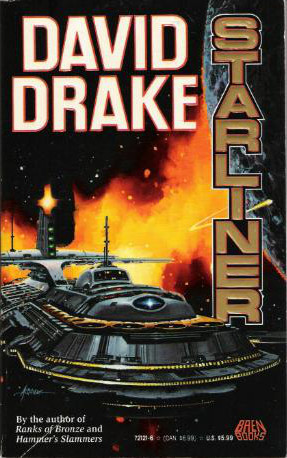
starlinerWelcome to the Empress of Earth, the finest luxury liner in all of settled space.  Whether you’re alien or human, first class or economy, there is a place on the ship for you.  Just watch out for those Grantholmers and Nevassans–those planets are about to go to war, but don’t worry, the Empress is strictly neutral territory.  The envoys from Earth will see to that.  And as for the rumors that one of those sides might try to hijack the ship, I’m sure the crew is capable enough to deal with such threats.  Even if they are unarmed…
I saw this book on my also-boughts on Amazon, so I decided to pick it up.  It was an enjoyable read.  David Drake is very good at showing competent characters dealing with all sorts of complicated problems, operating within a strict chain of command while sometimes bending the rules a bit to get the job done.

The book is really a series of small vignettes, all tied together through the main viewpoint character, Ran Colville.  There is an overarching storyline about the Empress’s role as a coveted pawn in a larger interstellar war, but that only really drives the story at the very end.  Really, it’s more of a slice-of-life story about the crew of the ship, punctuated by all of the strange and exotic stops along the way–and boy, are there plenty of those!

Even though the Empress is neutral, she’s a potentially valuable military asset that both sides in the Grantholm-Nevassan war want to capture.  To complicate matters further, some of the passengers are dignitaries from either side.  At one point, there’s a romance between the peacenik daughter of a Nevassan diplomat and the son of a Grantholmer nobleman who is honor-bound to fight in the war.  That subplot was a lot of fun.

As you can imagine, there’s plenty of violence.  And really, what would you expect from one of the world’s best military science fiction writers?  Drake does a really good job showing the adrenaline-soaked excitement of combat, as well as all the ugliness.  Even the mooks get a viewpoint from time to time, and when they die, it’s messy and traumatic.  For that reason, the violence feels very realistic, especially in how it affects the main characters.

Ran is something of a player, so there is a fair amount of explicit sex (including a bit of inter-species action).  Drake doesn’t mince words or shy away from the gritty details–he puts it all on the page as matter-of-factly as any other aspect of life.  The sex was brief enough that it didn’t really bother me that much, but Ran’s relationship toward one of his coworkers takes a turn at the end that seemed to come completely out of left-field.  I could understand why, for the purposes of the story, it had to happen, but the way it was handled I just didn’t buy it.

That was probably my biggest gripe.  If I had another, it would be that the story seems to meander a bit in the first two-thirds, but the world-building was interesting enough that it didn’t really bother me.  Overall, it was a fun, light read (well, light for military sf).  The ebook version is free on Amazon, so it’s definitely worth picking up.  If you haven’t read any David Drake yet, this isn’t a bad place to start.

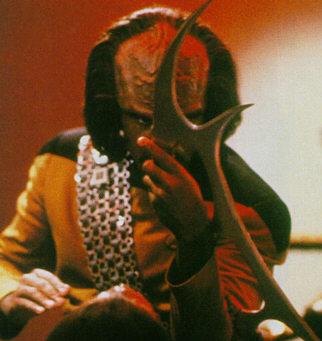
worfAh, the proud warrior race.  Where would science fiction be without it?  From Klingons to Ur-Quans, Wookies to Sangheilis, Mri to Green Martians to Vor Lords, warrior races have been a staple of space opera and space-centered science fiction pretty much since the genre was invented.

The concept behind this trope is the same as the one behind blood knight: honor is more valuable than life, and the best way to win or defend honor is through combat.  It’s not necessarily death that these guys live for, so much as glory and a chance to prove their prowess.  Unlike the always chaotic evil races, these guys usually follow a strict code of honor, sometimes to the point of absurdity.

When taken too far, of course, you get a planet of hats, where everyone has exactly the same values without any kind of depth or diversityFridge logic leads to Klingon Scientists Get No Respect.  After all, how did the Klingons build starships and discover space travel if they’re all constantly fighting each other?

Fortunately, we have plenty of real-world examples for how this sort of thing works.  Lots of human cultures have placed a high value on warrior qualities, including the Spartans, the Samurai, the Vikings, and the Mongols, just to name a few.  Of course, relying on stereotypes may lead to some unfortunate implications, so it’s not a good idea not to have too narrow or ethnocentric a reading of history.  Still, there’s a lot from history that we can glean.

In fact, you could make a valid argument that humans are the quintessential warrior race.  After all, we developed the technology to annihilate our own species before we put a man in space.  Even today, the amount of resources we spend on war and security far outstrips the amount of resources we dedicate to just about any other pursuit.  From the earliest ages, we engage in competitive physical sporting activities that mimic warfare and video games that outright simulate actual combat.  Our everyday language is full of violent terms like “on target,” “wiped out,” and “having a blast,” to the point where most of them are invisible.  Indeed, if we ever make contact with an alien race, we may very well find that we are the Klingons.

In that respect, this trope is just another way that science fiction acts as a mirror through which we can better see ourselves.  The proud warrior race fascinates us because we have so much in common with them.  Klingons are not just faceless orcs for the good guys to slay by the dozen–in many sci-fi universes, they (or individual members) actually become good guys.  Just think of Worf from Star Trek, or The Arbiter from Halo, or Aral Vorkosigan from Louis McMaster Bujold’s Vorkosigan Saga.  While on the surface, these guys seem absolutely crazy, when you start to explore them you frequently find a lot of depth.

I am fascinated by the concept of a warrior race.  I’ve played with it quite a bit in my own work, especially with the Hameji in Bringing Stella Home, Sholpan, and Stars of Blood and Glory.  The Hameji are an entirely spacefaring society that lives on the outer fringes of space, beyond any terraformed planets.  Because they live entirely on spaceships, they must capture and repurpose new spaceships just to have enough living space to expand their families.  Since their battleships also house their families, they make no distinction between military and civilian, and live by an extremely rigid social hierarchy with the patriarchal captain at the top and everyone else under his command.  Life is a privilege, not a right, and disobedience is strictly punished since it has the potential to put everyone’s life at risk.

As a result of all this, the Hameji are extremely vicious and warlike, living by a moral/ethical code that runs completely counter to our modern sensibilities but makes perfect sense to them.  They think nothing of slagging entire worlds and killing billions of people because to them, a world is a giant starship, and all those billions of people are so many enemy warriors.  They look down at the planetborn as weak because of their lack of discipline and obedience, and think nothing of enslaving them due to their strict social hierarchy.  In fact, because resources are limited and life is a privilege granted by the ship’s captain, the Hameji prefer to space their prisoners rather than keep them alive.

Man, those books were fun to write. :D Brutal, but fun.  Because the weird thing is, as much as you abhor a culture whose values contradict your own, when you really understand them, you can’t help but feel something of a connection.  You might not love them, but you respect them, and in a strange sort of way sympathize with them.  I’m not sure if that’s the experience with the Hameji that my readers have had, but that’s definitely been my experience in writing them.

So yeah, I’m definitely a big fan of the proud warrior race.  Expect to see me play with it many more times in the future.

More »

Before the world fell apart and the Empire took over, when there were still men of honor in the world who stood boldly against evil and fought for the weak and the downtrodden, there was this trope.  The weapon of choice of a bygone age, more elegant and noble than the crass instruments of wanton destruction so common in the world today.  It might not be practical–or sometimes, even usable–but it definitely will be cool.

Because katanas are just better, this weapon often takes the form of a cool sword, especially in science fiction.  The eponymous example is of course from Star Wars, where Jedi Knights errant fight against evil with laser blades, but it also features prominently in Star Trek (ever been to a Klingon wedding?) and Dune.  The one who introduces the weapon is usually an old master, or a mentor figure of some kind.  Often, the weapon is handed down from generation to generation.

In a lot of ways, this trope reflects the age-old tension between Romanticism and Enlightenment, hearkening back to a simpler time rather than looking ahead to a glorious future.  Perhaps that’s why many of these weapons tend to be swords rather than guns.  And since science fiction is traditionally the more forward-looking genre, perhaps that’s why it’s invoked so often in subgenres like space opera that lean more toward fantasy–to provide ready contrast.

When used well, the effects of this trope can be awesome.  It wasn’t just the shiny blade and the cool sound effects that made lightsabers so awesome as a kid–it was the sense that something about the weapon was special.  None of the mooks had one, after all, and Luke’s came from his long-lost father.  It probably helped that Star Wars paired this trope with the call to adventure (in a very specific way).

In my own work, this appears in Desert Stars with the heirloom rifle that Sathi gives to Jalil.  At least, I think it qualifies.  The rifle is more of a status symbol than a combat weapon, but it does figure prominently in the story.  However, my forthcoming novel Stars of Blood and Glory goes a lot further with this trope than Desert Stars.  It has Katanas, and a far-future Polynesian-Japanese society that knows how to use them.

There aren't enough scoundrels in your life.

Unless you have an unhealthy aversion to kissing books, you’re probably familiar with Slap Slap Kiss.  It’s common in genre romance, but you’ll often find it in science fiction & fantasy too.  When done well, it’s a great way to make sparks fly, but when done poorly…I think you can fill in the rest.

The basic underlying concept is that love and hate are just two sides of the same coin.  Both involve strong feelings for another person, the kind that drive you crazy and make it hard to think straight.  According to this theory, it’s a lot easier to fall in love with someone you hate than to fall in love with someone you don’t really care about.  And once you fall in love, the rest is easy. <snark!>

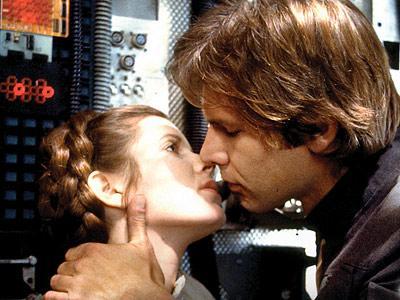
Kiss Kiss Slap is the Tsundere’s standard MO.  An effective way to end the will they or won’t they? phase, though the trope is so common that you can spot it almost as soon as the slapping starts (Dinosaur Comics has a good commentary on that).  Sometimes happens in conjunction with Foe Yay, though the couple doesn’t have to start out as sworn enemies.  The kiss itself is usually one of those “lovely trick[s] designed by nature to stop speech when words become superfluous.” When set up properly, is often accompanied by a Love Epiphany.

Of course, it’s possible to go too far.  There’s a fine line between “all’s fair” and kicking the dog, and if you cross it…good luck.  Alternately, if the slapping doesn’t cross the line, but the kiss doesn’t live up to expectations, it’s also going to fall flat.  And if the main reason you invoke this trope is because the plot demands it…let’s just say, you’re doing it wrong.

In general, I think it’s important to keep the following in mind:

  • The attraction needs to be properly foreshadowed.  If the characters start slapping each other without even a hint of sexual tension first, no amount of backpedaling is going to make up for it.
  • Neither of the characters should tear each other down.  There’s a big difference between a slap and a punch (and a roundhouse kick, for that matter).  Even though the characters may abuse each other, they have to have at least some mutual respect.  After all, Han still called Leia “your highness,” and Leia still complimented Han on his “bucket of bolts” (albeit sarcastically).  Once the respect is gone, so is any hint of romance.
  • The kiss needs to be proportional to the slap.  Lots of slap with an innocent little peck is going to feel anticlimactic, while a tap on the chin with a giant make out moment immediately afterward is going to feel melodramatic.  The two need to be balanced in order for the trope to work.
  • The couple should have at least something in common. ”Opposites attract” is often just an excuse for shoddy character development.  In real life, if the two people don’t have at least something in common, value-wise and personality-wise, the romance is pretty much doomed to fail.  As always, however, Your Mileage May Vary.

Finally, even though there are a lot of reasons to hate this trope, there’s a reason we keep coming back to it.  What that reason is exactly, I can’t say, but I know it when I see it.  After all, you really shouldn’t over analyze some things.  Like this video:

I think my work here is done.  What sayest thou?

Wow.  I just finished In the Realm of the Wolf by David Gemmell a couple hours ago, and it was AMAZING.  So amazing, in fact, that I want to write a post examining my reaction to it before I write the review.

You know that ecstatic, otherworldly feeling you get when you finish an amazingly good book?  Where you feel like you just came home from a long, epic journey and you can’t stop thinking about it?  Where your mind is racing with all sorts of new and beautiful ideas, as if you’ve opened your eyes for the first time?

That’s how I felt after finishing this book.

As a writer, I want more than anything for my readers to have the same experience when reading my books.  I don’t expect everyone will, but I want to be able to connect with a good chunk of my readers this way.  David Gemmell does this for me, and my main question is therefore: how does he do it?

Looking back, I’ve got to say that the book started good and steadily got better, right up until the awesome finish.  The first two chapters were good, but around the third chapter, my expectations started to be exceeded.  It wasn’t until the last half of the book that I realized just how much I was connecting with the characters, and when the climaxes hit, I found myself rooting for them more than I usually do.

So I guess escalation had something to do with it.  Gemmell starts with a pretty simple plot: Waylander has to evade a bunch of guild assassins out to kill him, but he doesn’t want to because his wife just died and he’s depressed.  Then more and more characters get involved, and the stakes steadily grew until the fate of global empires hung in the balance.

Yet throughout it all, the focus was always on the personal conflicts and the impact of the events on the individual characters.  The vast armies sweeping the land were more of a background setting element than anything else; the real story lay in the choices the characters made and why they made them. And when the characters started confronting their demons, I rooted for them as if they were my close, personal friends–or more than friends.

Yet Waylander himself is very much a larger-than-life character.  He’s a better hunter and tracker than the Sathuli tribesmen, a better swordsman than most of his opponents, by far the best crossbowman in the Drenai saga, and a cold, efficient killer with a body-count of hundreds.  Not only is he rich enough to support the bankrupt king of Drenai singlehandedly with his vast financial assets, but in each of the three books in his trilogy, he plays the most pivotal role of any character in the rise and fall of nations and empires.

And yet…I can still connect with him.  Why is that?

Maybe it’s because he’s far from perfect.  He vanquishes hundreds of soldiers, assassins, monsters, and demons, but he doesn’t escape uninjured.  In Realm of the Wolf, his less-than-perfect swordsmanship is a key element of the plot.

It’s the internal conflict, however, that really makes me connect with him.  Don’t get me wrong–I’m not a cold, unfeeling killer, nor have I lost my whole family to roving bandits–but I can understand his struggle to find happiness in the face of so much evil, both within him and without.

Or maybe it’s not so much that I understand him as that I’m fascinated by him, and I don’t know why.  It certainly helps that he has a soft side–that he’s not a complete monster.  In all the books, his quest is always to save lives, not just to take them, and every once and a while he does something to keep my sympathy.  The way he spared the Sathuli scout in Realm of the Wolf, for example.

Overall, though, I think it’s the characters and their conflicts that made this book come alive.  Waylander is basically an adventure tale with some interesting characters; In the Realm of the Wolf is also an adventure tale, but the personal stakes are much higher, and the focus is more on the characters than on the rise and fall of empires.

Anyways.  I still feel like there’s something elusive that I’m not quite getting, but those are my thoughts after finishing this book.  If you didn’t find it helpful, I hope you at least found it interesting.  And if you have the chance, read the trilogy!  It’s goood!

John Wayne Cleaver wants very much not to kill you.  He wants it so much, in fact, that he’s made up a host of rules to keep his inner monster from taking over.  The way he complimented your shirt, for example–he said that to counteract the delicious thought of you tied to a wall, screaming in terror while he skins you alive.

It’s nothing personal.  He doesn’t hate you.  He just has a need–or rather, his inner monster has a need–to take your life.

You see, John Cleaver is a sociopath with all of the psychological tendencies of a serial killer.  Now that he’s killed once (albeit to save his community from an ancient demon), it’s getting very difficult for him to tell who he really is.  Is he his addiction?  Or is that a separate persona–one that he can control, suppress, and eventually overcome?

He’d better find out quick, because a new killer has arrived in town–a demon, just like the first–except this one is in touch with the Brotherhood.

This was a good book.  I enjoyed it as much as I enjoyed the first, perhaps a little more so.  The ending was awesome–excellent lead-in to the last book in the trilogy.  Too bad we have to wait a year to read it. <shakes fist at the universe>

Dan Wells is very good at writing strong, well-developed characters, especially with his main character, John Cleaver.  This might sound bad, but as a Mormon I can relate with John’s personal rules to keep his stray thoughts under control.  Not that I have a secret desire to murder people, but I’d be lying if I said that it’s easy to live a celibate, porn-free lifestyle as a twenty-something young man.  But I digress.

The best part of this book was the way the romantic tension compounded the basic conflict of John vs. his need to kill.  It’s not easy to date a girl when you have passionate dreams every other night of killing her.  That tends to make things a little awkward (just a little).  In spite of how sick that might sound, John and Brooke’s relationship is quite compelling, and I found myself instantly drawn to them because of it.  Again, it makes it easy to relate–not that I, uh–yeah.  Whatever.

Overall, the book is great.  However, I do have one criticism, which may be more personal, but I’m sure it applies to others as well.  When John confronted the killer, things got a little too disturbing for me–not the tense, wide-eyed, “oooh, what happens next?” kind of disturbing, but the “this is just wrong–why am I reading this?” kind of disturbing.  It didn’t make me put the book down, and the resolution was quite satisfying, but I did step back and ask that question at one point.

The ending, though, is pure awesome.  The last page–man, I’m looking forward to see what happens next!  And if there are only three books in this series, John Cleaver has to come to terms somehow with his inner monster–he can’t continue in this way all his life.  He just can’t. He’s got to find some kind of equilibrium.  And him and Brooke–well, let’s just say I’m very eager to see how the series wraps up.

Mr. Monster comes out in the US at the end of September (I borrowed the UK edition from my sister).  Like I said, it’s probably not for everyone, but if you can stomach a particularly gruesome episode of Law and Order: SVU, you shouldn’t have a problem with this book.  Or should you?  Guilt!  Guilt!

Owen Zastava Pitt wants nothing more than to be a mild-mannered accountant with a comfortable, boring life.  Unfortunately, fate has other plans.  His father–a retired green beret–brought him up to be a killing machine, with or without a firearm.  To pay for college, Owen worked alternately as a bouncer and a highly illegal cage fighter.  But all that’s behind him now; he has a respectable job–one where he isn’t required to kill things for a living.

When his boss turns out to be a werewolf, however, and Owen single-handedly kills him, all of that changes.  A guy shows up at the hospital with a business card for a company called “Monster Hunter International,” and promises to help him make a lot of money killing things for a living.  It turns out that vampires, wights, werewolves, and evil tentacled monsters are real, and the business of monster hunting is quite lucrative.

At first, Owen is hesitant.  But when an old Jewish man starts showing up in his dreams, telling him about an ancient, evil plot to subjugate the world,  he realizes that he has little choice in the matter.  Fate has given him a calling–or, as the old man likes to say, the “short end of stick.”

If  you’re a gun fanatic or a B-movie connoisseur, you’ll love this book.  It’s basically Men in Black meets Van Helsing, with enough firearms and weapons to make Rambo look tame.  Hundreds of mindless zombie wights?  Bring out your automatic 12 gauge shotgun.  Giant flying gargoyles the size of semi-trucks?  Hope you brought enough RPGs and grenade launchers to go around.  Hordes of undead swarming across Alabama?  Better arm the 5-kiloton tactical nukes.

The story was quite entertaining, with enough comedic and romantic subplots to keep things interesting.  The battle between good and evil was pretty clear cut and unambiguous, with evil being measured by how many tentacles a thing has, but some of the monsters (such as the vampires) were much more complex.  When you have to decapitate your buddies after they die, to make sure they don’t come back as something that will kill you, that makes things interesting.

I felt that the second half of the novel lagged a little, especially with the number of false endings.  However, the ending itself was quite satisfying, with an interesting twist that caught me a little by surprise.  The quality of Correia’s writing was a little weak in places, but the story was more about killing the bad guys than crafting beautiful prose.  In any case, I don’t think his intended audience will mind.

Overall, it was an entertaining, surprisingly fast read.  It’s not the type of thing I usually read, but I enjoyed it.  If you’re looking for deep, meaningful literature that changes the way you view the world, or a clean, wholesome read that’s free of excessive language or violence (Gamila, I’m talking to you), this book probably isn’t for you, but if you’re looking for an entertaining story about undead monsters where the good guys aren’t pussy-footing idiots, you’ll probably enjoy this book.  If you own more than one firearm, it’s a must-read.

Just a micro-quick update, since it’s 2:00 am and I need to meet up with friends tomorrow morning to carpool to Salt Lake.

The first day of CONduit was awesome–there were several excellent panels on writing, as well as many familiar faces from the local writing scene.  I’ll blog all about it this weekend, after the big day tomorrow.

Wrote 3k words today and killed off a couple major characters.  Invigorating, as always.  Only 7k words to go to the end.

Goodnight.