So I have a bunch of ideas for blog posts I’d like to write, and I’ll probably get around to them eventually, but I thought I’d drop a line now just to let you all know what I’ve been up to.  It’s been a pretty good week, with some decent progress on the current WIP (Lifewalker) and some other random stuff that may be of some interest.

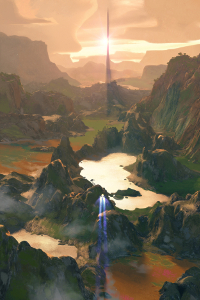
First, Lifewalker.  It’s coming along quite well.  I’m averaging around 2k words a day, so more of a leisurely pace than a white-hot creative heat, but not too bad.  It’s kind of turned into a post-apocalyptic Western, mostly because I can’t write about southern Utah without the landscape taking over.  This video should give you an idea why:

At the same time, the character’s voice really seems to be taking shape in a way that I like.  He’s kind of drifting right now, but the way he writes about it is very much like an old man reminiscing on the course of his life, lingering on the regrets as well as the triumphs, with some rather wistful commentary on each.  This is really a character that I can just pick up and run with–the story is practically writing itself.

It’s not just the voice, either.  Random stuff is just finding it in–powerful stuff that makes the story awesome.  For example, just in the last chapter, the characters were holding a meeting to see what they should do to rescue some of their friends who had been kidnapped.  Out of nowhere, one of them pulls out a skull from a human baby, with beads and feathers dangling from it like some sort of totem.  He brought it out to show that the people who’d attacked them were not just normal bandits, but cannibals from the Nevadan wastelands, which put them in a whole new category of badassery.  Stuff like that comes out of nowhere every time I write, and it’s awesome.

I’ve had a lot of time to write, though I don’t feel I’ve been using it all productively.  Still, I’m on track to finish this thing by the end of the month, which will be extremely gratifying.

In the meantime, I’ve been experimenting a lot with cooking and gardening.  Just planted some tomatoes in 3-gallon ice cream buckets (with dirt instead of ice cream, of course), and those are growing nicely.  It’s fun to have something to water in the morning, and when they start to yield fruit, I’m sure it will be awesome as well.

But I’ve also been experimenting with the old Egyptian kushari recipe I picked up after the 2008 study abroad.  It always seemed to be missing that one thing that would make the other ingredients come together and achieve that delicious synergy.  Well, I think I’ve found it: chickpeas and cumin, with maybe a touch of vinegar.  It might not be 100% authentic, but when I cooked it this time with that stuff, it tasted heavenly.

So this weekend, I’m going to try to perfect the recipe, something I’ve been wanting to do for years.  I’ll try cooking the rice in chicken broth, and adding more onions and garlic with maybe a little tomato.  Also, coriander–I know that coriander and cilantro are basically the same plant, but I think the coriander will go with this better than cilantro.  Also, it helps to fry it with a little oil after taking it out of the refrigerator, rather than sticking it in the microwave.  I haven’t had a microwave for over a year, and I think I actually prefer cooking without it.

Speaking of food, my roommate’s sister’s roommates dropped off a bag full of crap from their kitchen, since they’re moving out for the summer.  We’ve been having an interesting time combing through it–found some pretty good stuff, actually.  One of the more useful things is a bag full of buckwheat, which is AWESOME because kasha was one of my favorite dishes in Georgia.  Kasha and lobio–delicious!

So yeah, I’ve had food on my mind a lot this week.  If things work out, maybe I’ll post a recipe or two.  Kushari is delicious, cheap, filling, and healthy–a winning combination if ever there was one.  Kasha is pretty simple, but that’s what makes it so great–a simple, hearty food that leaves you feeling warm and whole.

Besides cooking exotic foods, I’ve also been reading a lot of Freefall.  I discovered it just last week, and I have to say, it is awesome.  One of the better webcomics I think I’ve ever read.  Like Schlock Mercenary, it’s a space opera comedy romp, but where Schlock kind of turned dark in recent years (which I’m not complaining about, don’t get me wrong), Freefall has still stuck to its happy-go-lucky roots.  And just like Schlock Mercenary, the humor is not only entertaining, but often wonderfully insightful.

Florence_AmbroseBut by far, the best part of the story is how compelling the characters are.  My favorite is Florence Ambrose, an artificially bred Bowman’s Wolf who is kind of a human-wolf hybrid.  She’s one of only 14 members of her species, and the corporation that created her considers her more as property than an individual. She’s got all these biologically programmed safeguards that force her to obey direct human orders, no matter how ludicrous–but the only way for her species to survive is to convince the corporation that Bowman Wolves are profitable, so that they’ll make more (the whole 50-500 rule and all that).

Somehow, she becomes the engineer of the Savage Chicken, a down-and-out starship captained by the infamous Sam Starfall.  Sam is basically a lazy, larcenous alien squid who wants nothing more than to steal everyone’s wallet and become famous doing it.  At first, it seems like a horrible combination–Florence is basically a good, honest person, who wants to do good work and please everyone.  But as the story goes on, the two develop quite a rapport, and start to rub off on each other.

Florence helps Sam to clean up and get his act together, and Sam helps Florence to learn ways to get around her difficult situation vis-a-vis her safeguards and lack of free will.  More importantly, Sam helps her to stop feeling guilty long enough to recognize that doing the right thing sometimes means breaking (or at least twisting) the law.

As if that weren’t enough, there’s the whole cross-species romance angle between Florence and the biologist who rescues her back in one of the earlier subplots.  As you might expect, it gets really lonely being the only Bowman’s Wolf on the planet–especially when the other 13 are frozen in cryo, on their way to a world several light-years away.  Florence knows that she needs to do what she can to propagate the species, but she’s also got some emotional needs that demand to be satisfied now.  Winston is kind of similar, a lonely parasitic biologist on a frontier terraforming project with only 40,000 humans and a 40-60 male-female ratio.  Except for the whole cross-species issue, they make a really good couple.  I’m riveted to find out what happens next!

So yeah, if I had to sum it up: good, honest, likeable person + insecure future + social limbo + unsatisfied emotional needs = really compelling story.  Plus, she’s half wolf–how cool is that?  What I would give for her incredible sense of smell…

In any case, it’s getting late, and even though tomorrow is Saturday, there’s a bunch of stuff I want to do tomorrow so I’d better cut this short for now.  See you later!

Star_wars_oldThey say that the golden age of science fiction is about twelve years old.  That’s definitely true for me.

My first exposure to the genre was Star Wars: A New Hope.  I saw it when I was seven, right around the height of my dinosaur phase.  Everything about the movie completely blew me away, from the Jawas and Sand People of Tatooine to the stormtrooper gunfights and lightsaber duels.  After watching Luke blow up the Death Star, I spent the next few hours running around the yard pretending to fly my own starfighter.

In a lot of ways, I’ve never really stopped.

My parents made me wait until I was nine to watch The Empire Strikes back, because it was rated PG.  Without any exaggeration, I can say that those were the longest two years of my life.  I was literally counting down days by the end, and to pass the time without going crazy, I read up on all the books about space that I could possibly find.

My father bought the original X-wing flight simulator game somewhere around then, and I soon became totally engrossed in it.  Since the 386 was our only entertainment system (no Super Nintendo–I had to visit a friend’s house for that), X-wing became the defining game of my childhood.  I spent hours and hours on that game, to the point where I knew exactly which simulated missions the characters from the books were flying and how to complete them faster and easier.

I thought The Empire Strikes Back was a little slow the first time I saw it, but it’s since grown on me, to the point where now it’s my favorite film in the whole series.  Thankfully, my parents let me watch Return of the Jedi the next day, and for the next few months my life felt utterly complete.

Around this time I discovered the Star Wars novels and soon immersed myself in them.  The Courtship of Princess Leia by Dave Wolverton soon became one of my favorites, as well as the Heir to the Empire trilogy by Timothy Zahn and the X-wing series by Michael A. Stackpole.

But it was Roger Allen McBride who first introduced me to a different flavor of science fiction with his Corellia trilogy.  As I mentioned in V is for Vast, those books had just enough of a touch of hard science to intrigue me about the other possibilities of the genre.  That was the last Star Wars series that I read before branching out into other works of science fiction.

The Tripod trilogy by John Christopher was my first introduction to the dystopian / post-apocalyptic genre, depicting an enslaved humanity after an alien invasion.  Those books really captured my imagination for a while.  The Giver was also quite interesting and thought provoking, though since it didn’t involve spaceships or aliens it wasn’t nearly as compelling.

I read a lot of fantasy in my early high school years, including Tracy Hickman, Lloyd Alexander, and (of course) J.R.R. Tolkien.  While I enjoyed those books and immersed myself in them for a while, my true love was still science fiction.  For almost a year, I watched Star Trek: Voyager religiously with my dad.  And every now and again, I’d pick out a science fiction book from the local town library and give it a try.  That’s how I discovered Frank Herbert’s Dune.

In eleventh grade, my English teacher had us choose an author and focus our term papers solely on their books for the entire year.  She suggested I choose Orson Scott Card, but I chose Cormac McCarthy instead.  I’m not sure if that was the worst decision of my high school career, or the best decision, since assigned high school reading tends to make any book feel like it sucks.  I discovered Ender’s Game the following summer, and finished it in a delirious rush at 3am the morning after checking it out from the local library.

More than any other book, Ender’s Game cemented my love for the genre, and showed me just how powerful and moving the genre could be.  It opened so many insights into the world and human nature, reading that book made me feel like I’d opened a pair of eyes that I didn’t even know I’d had.  Looking back, that was probably the moment when I knew I would be a science fiction writer.  I’d known I was going to be a writer ever since I read A Wrinkle in Time at age eight, but to be a science fiction writer specifically, that goal was probably cemented by reading Orson Scott Card.

After high school, I served a two year mission for my church, during which I didn’t read any novels or watch any TV or movies.  When I came back, though, Orson Scott Card and Madeline L’Engle helped me to ease through the awkwardness of adjusting back to normal civilian life.  When I left for college, I expanded my horizons even further, starting with Isaac Asimov’s Foundation series and Edgar Rice Burrough’s Princess of Mars.

When I discovered Pioneer Books in downtown Provo, I knew I’d found my favorite bookstore in Utah Valley.  I have so many fond memories sitting cross-legged on the floor in the science fiction section, browsing through the musty used books for hours at a time.  That’s where I discovered C.J. Cherryh, Arthur C. Clarke, Robert A. Heinlein, Ursula K. Le Guin, and numerous other authors who are among my favorites today.

When I discovered Spin, Robert Charles Wilson soon became one of my favorites.  I picked up that novel as a free PDF from Tor, and read it over the summer while studying abroad in Jordan.  Once again, that same hard sf sensibility I’d gotten from Roger Allen McBride touched me in an unforgettable way.  But it was the human element of that book that really moved me–in fact, it’s always been about the human element.  The world building in Downbelow Station was great and all, but the romance of Merchanter’s Luck had a much more lasting impact.  Starship Troopers had some good ideas, but it was Mandella’s personal journey in The Forever War that moved me almost to tears.  The intrigue of the Ender’s Shadow series was quite entertaining, but it was Ender’s Game and Speaker for the Dead that really taught me what it means to be human.

I finished my first novel, Genesis Earth, shortly after returning from that study abroad, and tried to capture the same sensibility from Spin as well as the intimately human element.  Since then, I’ve written several more sci-fi novels, some of them tragic, some triumphant, but in all of them I’ve tried to get as close as I can to the personal lives of the characters.  I don’t know if I’ll ever write a character portrait so intimate as Shevek’s in Ursula K. Le Guin’s The Dispossessed, but I certainly hope to someday.

For me, science fiction started out as a wonderfully exciting entertainment and turned into something much more meaningful.  If there’s anything the genre has taught me, though, it’s that the two aren’t mutually exclusive–that you can have your adventure and learn what it means to be human as well.  Indeed, the more imaginative the adventure, the greater the truths I’ve taken from it.

Because of that, even though I’m almost in my thirties now, I can’t possibly foresee a time when science fiction isn’t a major part of my life.  It’s a love affair that’s grown just as much as I have, and continues to grow with each new author I discover and each new book I write.  When I’m old and grizzled and pushing eighty, I’m sure there will still be a part of that twelve year old boy in me, still running around the yard flying his starship.

More »

rebel_allianceJust as sprawling interstellar empires are a staple of space opera, so are the plucky rebels that fight against them.  From Star Wars to Battlestar Galactica, Firefly to FTL, there’s no shortage of characters in science fiction trying to stick it to the man.

I’m not sure how it is in other cultures, but in America, it seems like science fiction upholds a host of values closely related to rebel tropes, such as self-reliance, individualism, freedom and independence, frontier justice, enterprising self-made men, etc.  A lot of this probably grew out of the genre’s early ties with pulp-era adventure fiction, which often featured former Confederate soldiers leaving the civilized world for the realms of adventure following the US Civil War.  That’s certainly the case with John Carter in A Princess of Mars, and echoed to some extent with the Browncoats from Firefly.

It may go even further, though, to the revolutionary origins of the United States itself.  The frontier has always loomed large in our culture, shaping our values in the early days of settlement and, now that the age of the frontier is largely over, standing for an idealized nostalgic past.  Americans have always favored the self-made individual who stands up to injustice and corruption in high places, and we’ve always had an aversion to the centralization of power and authority.

Back in the days of the Cold War space race, when writers like Heinlein and shows like Star Trek really started to popularize the genre, there seems to have been a real push to promote American identity and values.  The science fiction of that day certainly got caught up in all that, which is weird because as pro-Americanism became the establishment, a genuinely rebellious counterculture began to push back.  To its credit, though, there was plenty of science fiction that embraced the counterculture, especially in the New Wave movement that followed the Golden Age.

So why are we so enamored with rebels?  Probably for the same reason that we all love a good rogue.  Since space is the final frontier, it’s naturally the kind of place that would attract a more rugged, individualistic type.  At the same time, rogues and rebels are much more likely to have exciting adventures than the more mild-mannered folk who are apt to stay at home and conform.  Let’s not forget that most people who read science fiction are adolescent boys (of all ages), hungry for adventure and often a little rebellious themselves.

Though the rebels are often the good guys, that’s not always the case.  It all depends on who they’re fighting against, and how black and white the story is trying to be.  If they’re fighting against the Empire, then they’re almost always courageous freedom fighters standing up for truth and justice and all that, but if they’re fighting against the Federation, things can be a lot more gray.  In FTL, for example, the rebels are the outright antagonists, and you have to save the galaxy by defeating them.

The rebels don’t always win, either.  In stories like Star Wars that skew towards idealism, then in the end they usually do, but in darker, grittier tales (such as most cyberpunk), they may or may not.  And even in some happy-go-lucky adventure stories, the rebels are apt to be martyrs for a lost cause–again, think of the Browncoats from Firefly.

The wide variety in the role of rebels in science fiction is a good indication of a healthy, vibrant back-and-forth in the genre that’s been going on for some time.  It also means that there’s plenty of room for a new writer to take these old, worn tropes and shake them up in a new and exciting way.  As much as we love Luke Skywalker, we love Han Solo just as much, and if you combine him with John Carter to get Mal, then you’ve got a rebellious character that a whole new generation can come to know and love.

I love playing around with these tropes, and do so quite often in my own fiction.  In Bringing Stella Home, James McCoy is very much a rebel, though it’s not the Hameji that he’s fighting against so much as everything standing between him and his brother and sister.  In that sense, he’s kind of a martyr without a cause, a determinator who shakes his fist at the universe even when the more sensible thing is to learn how to cope.  Similarly, Danica and her band of Tajji mercenaries all fought in a failed revolution and have been wandering the stars ever since.  Their backstory features much more prominently in Stars of Blood and Glory, in which things come around full circle.  And then, of course, there’s Terra from Genesis Earth, who isn’t about standing up to the man so much as giving him the finger and running off somewhere where none of that even matters–the frontier ethic taken to its furthest extreme.

So yeah, I’m a fan of this trope, and have been ever since I saw Star Wars and fell in love with the genre.  You can definitely expect to find lots of rebellious characters throughout my books in the future.

More »

Being a mentor to the hero can be a pretty tough job.  Don’t believe me?  Check out the tvtropes page:

If you don’t have to convince The Chosen One who just wants to be normal to grow a spine and accept the Call to Adventure, you have to convince your blindly excited and dangerously eager young pupil that You Are Not Ready to learn the Dangerous Forbidden Technique. When you try to protect The Hero from the Awful Truth, you end up facing their Rage Against the Mentor. You have to maintain an ongoing conspiracy to keep The Hero Locked Out of the LoopIf they’re an orphan, you have to find them a set of Muggle Foster Parents while keeping social services in the dark. You have to endure accusations of insanity when you’re trying to teach your charge that Your Eyes Can Deceive You, give them advice on how to tell a love interest ”It’s Not You, It’s My Enemies,” and keep a close eye on them 24/7.

And what is your reward for all this patience and effort?

You die.

And that right there is the heart of the matter: mentors tend to die.  And stay dead.  Even if they do figure later in the story, they tend to be spirit advisors from the other side with little or no chance of coming back from the grave–even if everyone else does.

So why does this happen?

The most obvious reason is that if the mentor and the hero are both working toward the same goal, the mentor cannot overshadow the hero–otherwise, why not forget the hero and send the mentor off to save the world?  The hero may start off weak, which is why he needs the mentor in the first place, but at some point in the growth arc, he’s  going to have to stand on his own two feet.  Oftentimes, the most poignant (and convenient) way to mark that transition is to knock the mentor off.

That doesn’t explain everything, though.  If the only reason for killing the mentor is to give the hero a growth arc, you can accomplish that just as well by putting him on a bus.  So why does he have to die?

Lots of reasons!  Character growth, increasing tension, making the story more meaningful–the list goes on and on.  For an in-depth discussion on killing off characters, I’d recommend checking out this last week’s episode of Writing Excuses.  My own personal take is that everyone dies eventually–even the immortal characters have to pass through some sort of transition from this world to the next–so the best thing I can do for a character isn’t to keep them alive, but to make their lives and their deaths actually mean something.

It’s also worth pointing out that in most stories, the mentor isn’t actually fighting against the big bad, but the dragon–the big bad’s lancer.  Again, the main reason for this is to keep him from overshadowing the hero.  But the dragon is a character in his own right, with his own agenda that may run counter to his boss–think Darth Vader from Star Wars.  And in a lot of stories, the dragon actually tries to tempt the hero to come around and join him.

Perhaps that’s another reason why mentors often die–if they didn’t, then the bad guys wouldn’t ever be able to dissuade the hero through temptation.  The hero would be so protected that he’d never have the opportunity to switch sides, or at least he’d never have to face any moral ambiguity because of the guardian mentor constantly guiding him.

So those are some of the reasons why mentors tend to have a short life expectancy.  Can you think of any good ones?

Also known as the temptress or the seductress, the vamp is one of the more dangerous characters the hero meets on his journey.  A devastating beauty who is as evil as she is sexy, she uses her feminine wiles to exploit men’s flaws to her own advantage.  If the hero falls for her, he will be destroyed.

Unlike the femme fatale, her more neutral counterpart, she is completely evil and cannot be redeemed.  This is because her role in the story demands it.  She generally makes her first appearance in the initiation phase of the hero’s journey, after the hero sets out on the adventure but before he masters the unfamiliar world.  In many cases, she represents a leave your quest test or a secret test of character.

Joseph Campbell thought this character was so important that he dedicated an entire phase of the monomyth to her:

When it suddenly dawns on us…that everything we think or do is necessarily tainted with the odor of the flesh, then, not uncommonly, there is experienced a moment of revulsion: life, the acts of life, the organs of life, woman in particular as the great symbol of life, become intolerable to the pure, the pure, pure soul. The seeker of the life beyond life must press beyond (the woman), surpass the temptations of her call, and soar to the immaculate ether beyond.

As such, the vamp represents the more carnal elements of the hero’s nature, which he must reject or overcome in order to be transformed.  Confronting her is an important part of the story because it gives him an opportunity to recognize his flaws and master them.  It isn’t easy, though–the vamp is an extremely deceptive character, and often plays tricks like the wounded gazelle gambit to confuse the hero and gain his sympathy.

While often a female character, there are a few male examples of this character.  Mr. Wickham from Pride and Prejudice is one of the more obvious ones.  Basically, the vamp can be of any gender, so long as s/he is someone the main character finds sexually enticing.  Because of the traditionally male-centric nature of the hero’s journey, however, she’s almost always female.

Also, I think it’s important to add that it’s not just the vamp’s sexiness that makes her evil, it’s the way that she uses it to manipulate and undermine the hero.  If she starts out evil but has a heel-face turn later in the story, she doesn’t fulfill this trope.  Likewise, if falling for her wouldn’t make the hero fail, then she doesn’t fulfill the trope either.

I’ve played with this trope a little bit in my own work, but not in a big way yet.  Heloise from Star Wanderers: Fidelity (Part II) probably fits this trope the best, though her appearance is fairly brief.  Tamu from Bringing Stella Home might appear superficially to be one, but she’s actually more of a fair weather mentor for Stella (and has good reasons for choosing the life of a Hameji consort).  And of course, Mira from Desert Stars doesn’t fit this trope at all, seeing how much she changes by the end.

After the hero crosses the threshold of adventure and finally sets out on his journey, he passes through a long phase that Campbell called “the road of trials.” This is often where the meat of the story happens, but it doesn’t fit squarely into any one trope because of all the possible directions where the story can go.  For that reason, I think it’s more useful to think in terms of who the hero meets, not what the hero does.

The Trickster is often (though not always) one of the first characters the hero encounters upon entering the lands of adventure.  He is almost always male, though sometimes he can change shapes and even sexes (for example, Loki, who turned into a mare and conceived Odin’s horse).  His role in the story, though, can range from mentor (Merlin, Yoda, Mary Poppins) to bad guy (the Joker, the Homonculi, Grand Admiral Thrawn) to the hero himself (Prometheus, Bugs Bunny, Bilbo Baggins).

Obviously, the Trickster is a very slippery character.  You can tell who he is, though, by whether he meets these two basic criteria:

  • completely unpredictable
  • not beholden to any authority

In this way, the Trickster often stands in stark contrast to the people of the ordinary world that the hero left behind.  Which makes sense–having just crossed the threshold of adventure, the hero needs to leave his old mentality behind and be exposed to new experiences and ideas.  For that reason, the Trickster’s antics often serve to teach the hero an Aesop, helping him to learn and grow.

That doesn’t mean that the Trickser is harmless.  Quite the contrary–he’s a dirty, lying cheat, capable of taking any disguise and throwing the victims of his pranks into any moral quandary just for laughs.  He’s not necessarily a jerkass–he may even be more of an ally than an enemy–but he definitely is not to be trusted.

Like most things associated with the hero’s journey, the amazing thing is just how prevalent this trope is.  It’s even cropped up in some of my own work.  For example, in Bringing Stella Home, Ilya Ayvazyan is a trickster of the playful hacker variety.  In Star Wanderers, Samson is a blithe spirit who doesn’t necessarily have Jeremiah’s best interests at heart…though his girlfriend (the one at Alpha Oriana) is a lot more sinister.  I’m not sure if anyone fits this trope in Desert Stars, but you could probably make a case for Lena or Amina–or better yet, Ibrahim.

Of all the major character archetypes, though, the Trickster is the one I feel like I know the least about.  If you have anything else to add, I would like to hear it!

I recently read an amazing blog post by Shannon Hale titled “Why boys don’t read girls (sometimes).” In it, she makes a number of excellent points about how our society stigmatizes boys who read “girlie books,” and why that’s harmful.

Perhaps the most moving part of the post was at the end, where she described an experience at one of her book signings where she saw a boy hanging back and asked him if he would like her to sign one of his books.  The boy’s mother jumped in and said “yeah, Isaac, would you like her to put your name in a girl book?” The boy’s sisters all laughed at him, shaming him for reading anything that ran against their strictly defined gender roles.

In direct contrast to Shannon Hale, Dave Farland released a “daily kick” newsletter a couple of days ago where he advises writers to never let their characters cry.  In it,  he states:

Whatever problem [the character has]—whether terminal disease or sociopathic neighbor or anything else—the problem must be faced with courage. This means that your character can’t cry about it, no matter what the source of pain…Any time that a character breaks down, we as an audience may cast judgment upon that character.

Now, I have nothing but respect for Dave Farland.  I’ve been following his “daily kick” emails for years, attended dozens of his convention panels, and even interviewed him once for an online magazine.  He’s been a very influential writer to me personally, and his advice has had a huge impact on my writing.

But on this issue, I think he’s dead wrong.

Even if you don’t have any problem with the idea that men should never cry–a disturbing belief that harms men by forcing them to hide their true feelings, and harms women by teaching men that compassion and empathy are signs of weakness–even if you’re comfortable living in a culture that accepts this belief, there are still instances where having a man cry in your story can be both moving and poignant.

Cross his woman, and he’ll blow your brains out–quoting scripture while he does it.

The best example of this that I can think of comes from David Gemmell’s The Jerusalem Man.  No one–and I mean no one–writes manlier heroes than David Gemmell.  And among his characters, Jon Shannow ranks as one of the manliest.

In The Jerusalem Man, Jon Shannow is a lone gunman roving the post-apocalyptic wastelands of Earth on a spiritual quest for the city of Jerusalem.  Near the beginning of the book, he comes across a frontier woman under attack from bandits.  He stops to defend her homestead, and she shows her gratitude by inviting him into her bed.

Jon Shannow is a middle aged man, but because of the post-apocalyptic setting, this is his first sexual experience, and it moves him to tears.  For me, that was one of the most poignant moments of the book.  It didn’t take away anything from his masculinity throughout the rest of the story–indeed, it added significantly to it when the woman got kidnapped and he determined to rescue her.

I’m sure there are other examples that you can think of.  Certainly in real life, this notion that men should never show their feelings is both harmful and outdated.  To say that in fiction, no characters should ever cry–female characters as well as male characters–that’s just so wrong it’s infuriating.  If crying is so taboo that it’s even forbidden in the pages of a book, then something is wrong with the culture, not the story.

In 2008, I attended a fascinating panel at LTUE in which Tracy Hickman and a number of romance and fantasy writers discussed how to write romance in science fiction and fantasy.  Tracy explained that in all the novels he writes with Margaret Weis, she does the fight scenes and he does the romantic ones.

He then went on to talk about how there’s a whole side of life that our culture has shut men off from–a feminine side which is present in all of us, men as well as women.  The way he explained it, romance is not just the “kissy bits,” but a vital and enriching way to see the world–a paradigm that infuses everything with feeling and passion.

It makes me think of The Princess Bride, where even the action scenes with Inigo Montoya have a certain romantic flair to them.  In the old days, the term “romance” described not only love stories, but action & adventure stories as well.  In modern times, we seem to have forgotten all the old qualities like honor, love, sacrifice, loyalty, heroism, and compassion–even though they still make for the best stories.

Of course, our characters need to have courage.  But courage is not the absence of fear–it’s pressing on in spite of it.  And crying is not always a sign of weakness–it can actually be a sign of great emotional strength.  And if it’s true that the best literature helps us to see our world in a new light, giving us a greater understanding and appreciation for the human condition, how is it “courage” for anyone to hide their true feelings?

So do the characters in my stories cry?  Hell, yeah!  I don’t have them hide their feelings just because some readers might look askance.  Some of them cry more than others, and many of them don’t hardly cry at all, but those who do cry do so because the story demands it.

Even though I write science fiction, I do my best to infuse my stories with romance–not just the “kissy bits,” but that depth of feeling and passion for life that made me fall in love with books and reading in the first place.  Star Wanderers is a great example of that, and so is Desert Stars.

And yes, in case you’re wondering, I’ve read a lot of “girlie books.” They’re some of my all-time favorites.

June, 1863.  In a bid to destroy the Army of the Potomac, Robert E. Lee invades Pennsylvania with an army of 70,000 men.  Using the mountains to screen his movements, he advances toward Harrisburg, fully expecting to secure a victory that will end the American Civil War.

But two weeks into the campaign, Stuart’s cavalry still hasn’t reported back, leaving the Confederate army blind.  Deep in enemy territory, with reports of the Union advance beginning to trickle in, Lee moves his forces to converge on a small town named Gettysburg.

In the titanic clash that follows, friend will fight against brother, generals will knowingly send thousands of men to their deaths, and the fate of the United States of America will lie in the hands of farmers and mountain men, immigrants, West Point classmates, and a New England professor.

This book is awesome.  Epic, in the best and truest sense of the word.  I’m not a civil war buff, but it reduced me to tears.  The scope is tremendous, and yet at the same time the characters feel like real people.

For some, like Chamberlain, the war is about slavery and equality–something that disturbs him when he comes across a black man for the first time.  For others, it’s about states’ rights and self-government.  But for most everybody else–including Robert E. Lee–it’s about a myriad of other things, like honor, duty to country, boredom, a desire to prove one’s manhood, and a hunger to be part of something greater.

What’s remarkable is how so many good people, who more often than not respect the opposing side and hold them in the highest regard, end up getting swept into such a horrific and bloody battle.  No one, especially the generals, have the power to prevent any of it–all they can do is leave it in the hands of God.  And the tragedy of it all is summed up so perfectly in the film rendition of this book, when General Armistead reaches the high-water mark of the Confederacy and falls, only to hear that his friend and classmate on the Union side, General Hancock, has fallen too (skip to 23:15):

“Not both of us!  Not all of us!  Please, God!”

I’ve been to Gettysburg several times, and stood on the ground where the most critical parts of the battle were decided.  And yet, I feel that living as an expat on  the other side of the world has given me a much greater appreciation of my country’s history.  Perhaps that’s one of the reasons why this book was so moving to me at this time.

Here are some of my favorite quotes:

He was a man to depend  on, and there was this truth about war: it taught you the men you could depend on.

According to the now retired General Schwarzkopf, The Killer Angels is “the best and most realistic novel about war that I have ever read.” You really get a sense of what it’s like to be in command–what it’s like to depend on the actions of your men, and what goes through your mind as you lead them.  The only other novel I’ve read that comes close to capturing that is Ender’s Game.

If the war goes on–and it will, it will–what else can we do but go on?  It is the same question forever, what else can we do?  If they fight, we will fight with them.  And does it matter after all who wins?  Was that ever really the question?  Will God ask that question, in the end?”

Robert E. Lee’s words after the Confederate defeat on the third day.  There is, of course, some criticism about how much artistic license Michael Shaara took in portraying the central historical figures.  Regardless, this novel gave me a much greater respect for Lee and his men.  There are no “bad guys” in this book–and therein lies the heart of the tragedy.

In the presence of real tragedy you feel neither pain nor joy nor hatred, only a sense of enormous space and time suspended, the great doors open to black eternity, the rising across the terrible field of that last  enormous, unanswerable question.

Well put.  I’ve never experienced any tragedy on the scale of the American Civil War, but I do know what it’s like to lose family and loved ones, and this captured a bit of that for me.  I can only imagine what it must be like to experience the tragedy of war.

This novel is a classic.  If you have any interest in American history, it is absolutely a must-read.  And even if you don’t, if you enjoy reading stories about war, whether modern, historical, or fantasy, you will almost certainly enjoy this book.