Star_wars_oldThey say that the golden age of science fiction is about twelve years old.  That’s definitely true for me.

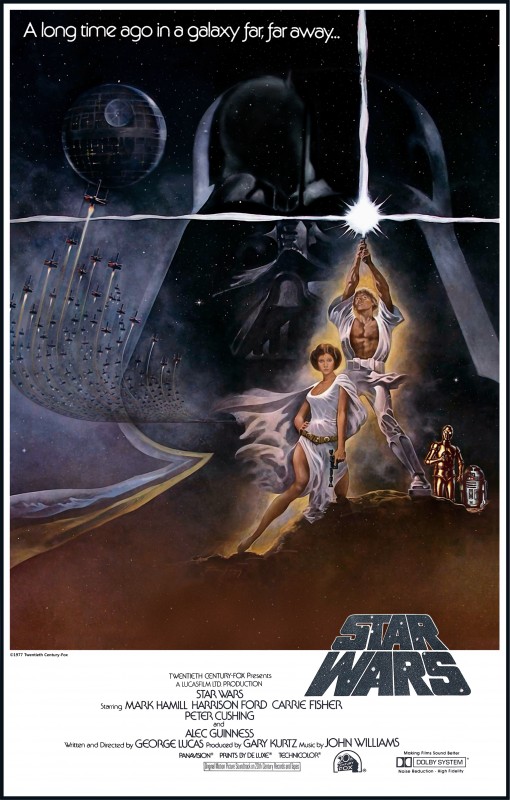
My first exposure to the genre was Star Wars: A New Hope.  I saw it when I was seven, right around the height of my dinosaur phase.  Everything about the movie completely blew me away, from the Jawas and Sand People of Tatooine to the stormtrooper gunfights and lightsaber duels.  After watching Luke blow up the Death Star, I spent the next few hours running around the yard pretending to fly my own starfighter.

In a lot of ways, I’ve never really stopped.

My parents made me wait until I was nine to watch The Empire Strikes back, because it was rated PG.  Without any exaggeration, I can say that those were the longest two years of my life.  I was literally counting down days by the end, and to pass the time without going crazy, I read up on all the books about space that I could possibly find.

My father bought the original X-wing flight simulator game somewhere around then, and I soon became totally engrossed in it.  Since the 386 was our only entertainment system (no Super Nintendo–I had to visit a friend’s house for that), X-wing became the defining game of my childhood.  I spent hours and hours on that game, to the point where I knew exactly which simulated missions the characters from the books were flying and how to complete them faster and easier.

I thought The Empire Strikes Back was a little slow the first time I saw it, but it’s since grown on me, to the point where now it’s my favorite film in the whole series.  Thankfully, my parents let me watch Return of the Jedi the next day, and for the next few months my life felt utterly complete.

Around this time I discovered the Star Wars novels and soon immersed myself in them.  The Courtship of Princess Leia by Dave Wolverton soon became one of my favorites, as well as the Heir to the Empire trilogy by Timothy Zahn and the X-wing series by Michael A. Stackpole.

But it was Roger Allen McBride who first introduced me to a different flavor of science fiction with his Corellia trilogy.  As I mentioned in V is for Vast, those books had just enough of a touch of hard science to intrigue me about the other possibilities of the genre.  That was the last Star Wars series that I read before branching out into other works of science fiction.

The Tripod trilogy by John Christopher was my first introduction to the dystopian / post-apocalyptic genre, depicting an enslaved humanity after an alien invasion.  Those books really captured my imagination for a while.  The Giver was also quite interesting and thought provoking, though since it didn’t involve spaceships or aliens it wasn’t nearly as compelling.

I read a lot of fantasy in my early high school years, including Tracy Hickman, Lloyd Alexander, and (of course) J.R.R. Tolkien.  While I enjoyed those books and immersed myself in them for a while, my true love was still science fiction.  For almost a year, I watched Star Trek: Voyager religiously with my dad.  And every now and again, I’d pick out a science fiction book from the local town library and give it a try.  That’s how I discovered Frank Herbert’s Dune.

In eleventh grade, my English teacher had us choose an author and focus our term papers solely on their books for the entire year.  She suggested I choose Orson Scott Card, but I chose Cormac McCarthy instead.  I’m not sure if that was the worst decision of my high school career, or the best decision, since assigned high school reading tends to make any book feel like it sucks.  I discovered Ender’s Game the following summer, and finished it in a delirious rush at 3am the morning after checking it out from the local library.

More than any other book, Ender’s Game cemented my love for the genre, and showed me just how powerful and moving the genre could be.  It opened so many insights into the world and human nature, reading that book made me feel like I’d opened a pair of eyes that I didn’t even know I’d had.  Looking back, that was probably the moment when I knew I would be a science fiction writer.  I’d known I was going to be a writer ever since I read A Wrinkle in Time at age eight, but to be a science fiction writer specifically, that goal was probably cemented by reading Orson Scott Card.

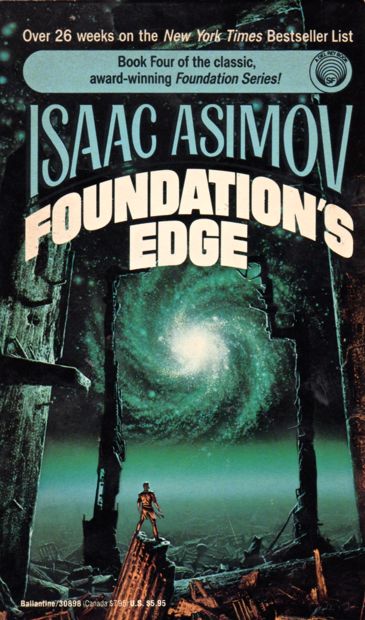
After high school, I served a two year mission for my church, during which I didn’t read any novels or watch any TV or movies.  When I came back, though, Orson Scott Card and Madeline L’Engle helped me to ease through the awkwardness of adjusting back to normal civilian life.  When I left for college, I expanded my horizons even further, starting with Isaac Asimov’s Foundation series and Edgar Rice Burrough’s Princess of Mars.

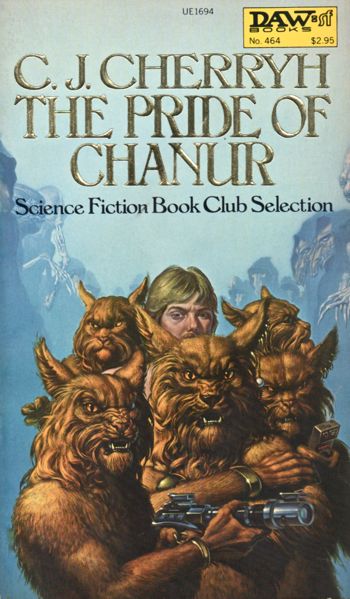
When I discovered Pioneer Books in downtown Provo, I knew I’d found my favorite bookstore in Utah Valley.  I have so many fond memories sitting cross-legged on the floor in the science fiction section, browsing through the musty used books for hours at a time.  That’s where I discovered C.J. Cherryh, Arthur C. Clarke, Robert A. Heinlein, Ursula K. Le Guin, and numerous other authors who are among my favorites today.

When I discovered Spin, Robert Charles Wilson soon became one of my favorites.  I picked up that novel as a free PDF from Tor, and read it over the summer while studying abroad in Jordan.  Once again, that same hard sf sensibility I’d gotten from Roger Allen McBride touched me in an unforgettable way.  But it was the human element of that book that really moved me–in fact, it’s always been about the human element.  The world building in Downbelow Station was great and all, but the romance of Merchanter’s Luck had a much more lasting impact.  Starship Troopers had some good ideas, but it was Mandella’s personal journey in The Forever War that moved me almost to tears.  The intrigue of the Ender’s Shadow series was quite entertaining, but it was Ender’s Game and Speaker for the Dead that really taught me what it means to be human.

I finished my first novel, Genesis Earth, shortly after returning from that study abroad, and tried to capture the same sensibility from Spin as well as the intimately human element.  Since then, I’ve written several more sci-fi novels, some of them tragic, some triumphant, but in all of them I’ve tried to get as close as I can to the personal lives of the characters.  I don’t know if I’ll ever write a character portrait so intimate as Shevek’s in Ursula K. Le Guin’s The Dispossessed, but I certainly hope to someday.

For me, science fiction started out as a wonderfully exciting entertainment and turned into something much more meaningful.  If there’s anything the genre has taught me, though, it’s that the two aren’t mutually exclusive–that you can have your adventure and learn what it means to be human as well.  Indeed, the more imaginative the adventure, the greater the truths I’ve taken from it.

Because of that, even though I’m almost in my thirties now, I can’t possibly foresee a time when science fiction isn’t a major part of my life.  It’s a love affair that’s grown just as much as I have, and continues to grow with each new author I discover and each new book I write.  When I’m old and grizzled and pushing eighty, I’m sure there will still be a part of that twelve year old boy in me, still running around the yard flying his starship.
More »

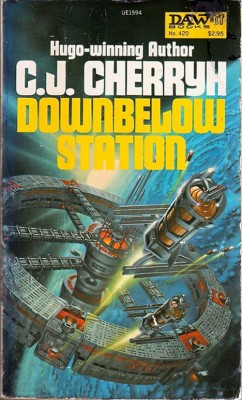
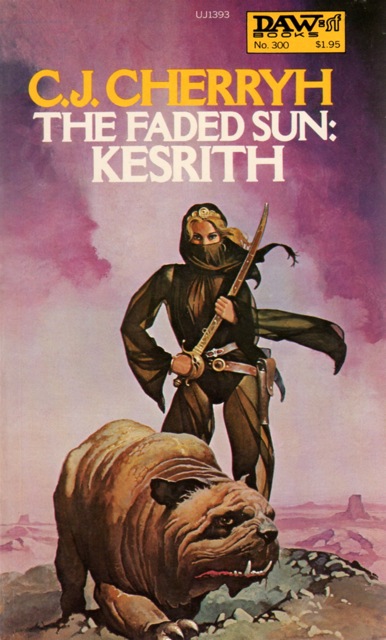
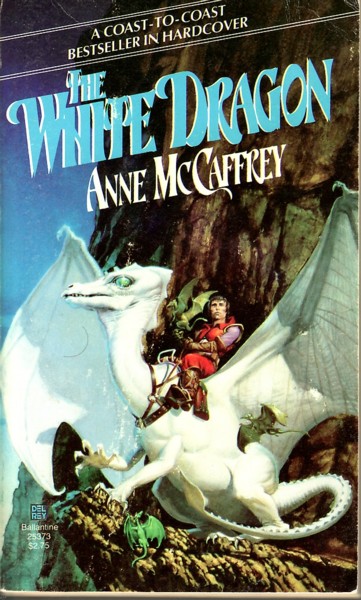
downbelow_stationPlanets are not the only setting for science fiction stories–space stations are common as well.  From the Death Star (“that’s no moon…”) to Downbelow Station, the Venus Equilateral to ISPV 7 to the Battle School in Ender’s Game, space stations are a major staple of any space-centered science fiction.

The reasons for this should be fairly obvious.  Before we can go to the planets and the stars, we need to have a permanent presence outside of this massive gravity well we call Earth.  The easiest and most logical place to expand first is to orbit, where supplies can be ferried up without too much difficulty and astronauts can escape in case of an emergency.  Indeed, with the International Space Station, that’s exactly what we’re doing right now.

In science fiction, of course, space stations go much further than they do in real life.  They’re often giant orbital cities, with thousands of people living and working there permanently.  Often, they feature some sort of rotating toroidal structure in order to simulate gravity.  If there are settlements on the planet below, the station often serves as a major hub for commerce, serving as a waypoint for interstellar merchants and wholesalers who ferry their wares up to orbit.  And if the planet is still being colonized, then the space station often serves as an important umbilical to the outside universe.

They can also have strategic value in the event of a war.  Battleships need to be serviced too, after all, and a station’s position in orbit can provide an excellent platform from which to bombard or lay siege to the planet.  Alternately, outposts at more distant locations like the Lagrange points can serve as a staging ground for future attacks–a sort of astronomical “high ground,” if you will.  If nothing else, abandoned stations may contain supply caches that can aid a fleeing starship, or provide shelter behind enemy lines, as was the case with the first Halo game.

Stations can come in all sorts of different flavors, from the puny to the magnificent.  The most eye-popping station of all is probably the Ringworld from Larry Niven’s series of the same name.  As the name would imply, the station is a giant ring–so huge, its circumference is the orbit of a habitable planet, with the sun at its center!  Gravity is provided by rotation, and night and day by giant orbiting panels that block out the sun at regular intervals.

My favorite stations, though, are the more realistic ones–the ones that I can imagine myself living on someday.  That was one of the things I enjoyed about Downbelow Station by C.J. Cherryh–her depiction of human expansion into space is eminently believable, and her stations are a natural extension of that.  I also really enjoyed her focus on the social dynamics of living on a giant station, and what it would be like to live in such a society.

The Battle School from Ender’s Game is another huge favorite of mine.  One of the advantages of building a structure in space is that gravity becomes malleable, so that some parts of the structure can simulate Earth-surface gravity while others leave people completely weightless.  The Battle School uses that to its advantage, with the main training room a zero-g laser tag battle arena, where the students have to learn how to stop thinking in terms of the planar dimensions, where “up” and “down” have any meaning.  It’s really quite fascinating.

It should come as no surprise that space stations pepper my own works.  They’re especially common in the Star Wanderers series, where few worlds have been terraformed and orbital platforms make up the majority of human living space (at least in the Outworlds).  In Sholpan and Bringing Stella Home, James, Ben, and Stella are all from a space station–a distinction that is especially useful for Stella, since her Hameji captors despise the “planetborn.” Genesis Earth takes that a step further, as spaceborn Michael and Terra have never been to the surface of a planet before until midway through the novel.  Just as going into space is paradigm shifting for us, the experience of walking on a planet proves just as transformative for them.

More »

CherryhMerchantersLuckCoverIf space is an ocean and interstellar colonization is happening on a grand scale, then it should come as no surprise that so many starship captains are intrepid merchants, traveling the galaxy in pursuit of a good business deal.  Whether they’re doing it legally as entrepreneurs or illegally as smugglers, you can find these guys in almost any space opera, from Star Wars and Star Trek to Firefly and Foundation.

Ever since Marco Polo and Sindbad the Sailor, intrepid merchants have played a major role throughout history.  The brave adventurers who travels to exotic locales to bring you all the best deals, these are often the guys at the forefront of exploration and expansion.  After all, Columbus sailed the ocean blue to find a better trade route to India–discovering a new world was just a side benefit.  The British Empire had its origins in mercantilism, forming the empire to protect their trade routes (and later, to secure markets and resources for their industrialized economy).

Unlike their real-world counterparts, however, space merchanters have a lot more challenges to contend with than sandstorms and bandits.  Science fictional universes are teeming with all sorts of exotic dangers, from black holes and solar flares to space pirates and strange alien races.  Unless FTL communication is in force, the immensity of space often makes it impossible to know exactly what to expect on your next FTL jump.  And then there’s all the normal space stuff, like busted airlocks and critical failures in the oxygen recyclers.

The best stories, though, are the ones that world build their merchanters to the point where they form their own distinct society.  This may overlap with the proud merchant race, though IMO it works best when it’s more than just a hat that everyone wears.  The merchanters from C.J. Cherryh’s Alliance-Union universe are a great example, where the entire society has restructured itself around the nomadic spacefaring lifestyle.  Another is Heinlein’s Citizen of the Galaxy, where the free traders have developed a strict social hierarchy that defines everyone’s role in running the spaceships.

Since space-centered science fiction largely grew up in the Cold War era, I wonder how much of this trope stems out of the clash between communism and capitalism.  The original Star Trek certainly shows a lot of Cold War influences, with the Klingons originally playing proxy for the Russians.  Is the genre’s fascination with the adventurous space merchant somehow an outgrowth of that world-shaping conflict?  And if so, how do the stories differ on the Soviet side?  It makes me wish I could read Russian, since the Soviets certainly had their own fascination with science fiction and space opera.

In my own work, this trope plays a central role.  Most of the major characters in my stories are merchants of one stripe or another.  James McCoy from Bringing Stella Home is the son of a merchanter, and comes from a mining colony where interplanetary trade drives the local economy (setting up the conflict for Heart of the Nebula after the Hameji take over).

But the trope takes special prominence in my Star Wanderers novellas, which was largely a reaction to C.J. Cherryh and Heinlein.  I wanted to create a spacefaring society on the starbound frontier that revolved not only around trade and colonization, but much more personal struggles like finding love and fighting loneliness.  In that sense, the stories are a lot more like Merchanter’s Luck than Downbelow Station–more about the lives of individual characters than the grand sweep of galactic history.

Either way, I’m a big fan of this trope.  If you’ve got any examples from your favorite books, please share!  Wish-fulfillment is a huge part of any fictional genre, and science fiction is no exception.  If I could leave it all behind to become a merchant to the stars, you can bet I’d do it in an instant!

More »

I recently read a fascinating post on John Brown’s blog with an interesting exercise for analyzing the kinds of stories you most like to read.  By finding out what really turns you on in a story, you can have a much better idea what to write, and how to make your own stories better.

He prefaced the exercise with a story about the interior designer who helped them to decorate their house.  The designer spread out a number of home magazines in front of them, and told them to go through and tear out the pictures that most turned them on.  After doing this, they analyzed the pictures to see what they had in common, and thus discovered how to best decorate their house.

The exercise works much the same way.  First, pick out five books you really like that immediately come to mind.  Mine are:

As many of you know, these are some of my favorite books of all time.  I’ve reread three of them, and I intend to reread the other two at some point.

Next, pick out the elements that these books have in common.  Here’s what I came up with:

1) Set in a different time and place.

Not all these books are science fiction, but the all take place in a world far removed from our own.  Only Spin takes place largely on Earth, but the events of the story transform the world as we know it so much that by the end of the novel, it’s completely different. SPOILER (highlight to see) Besides, at the very end, the two main characters leave Earth by going through the giant portal to another planet, so the novel is arguably about escaping the world as we know it.

2) Stakes that are much more personal than global.

This was interesting, and highlights something I realized when I compared Merchanter’s Luck with Downbelow Station.  In all of these stories, the central driving conflicts are extremely intimate and personal.

To be sure, many of these stories also have an epic backdrop; Mistborn certainly does.  However, I was much more interested in Vin’s growth and development than I was in how the Ska would overthrow the Lord Ruler–in fact, Mistborn is my favorite book in the trilogy for that very reason.

3) Encourages deep introspection.

This shouldn’t come as too much of a surprise if you’ve followed this blog for a while, but I love love LOVE stories that make me see the world in a new way.  Thrillers and adventures are all fun and good, but if it doesn’t make me think, I’m usually like “meh” at the end.

4) Female characters who aren’t weak or passive.

This one might be a bit more controversial, but in all of these stories, I’ve noticed that the female characters are pretty strong, even if they aren’t all kick-butt Katniss wannabes (ugh…I hate Katniss).  Even in Legend, which is largely dominated by men, you still have the earl’s daughter, who is one heck of a spirited woman.

5) Life and death conflicts.

This is interesting: in all of these books, the threat of death is immanently real.  Some of them, such as Legend and On My Way to Paradise, are among the most violent books I’ve ever read.  I’m not sure what it is, but there’s something about life and death struggles that really draws me.

6) Romantic in a broad sense.

I’m using Tracy Hickman’s definition here, in which romance is all about teaching us to feel and bringing us in touch with our deepest feelings.  That’s the central theme of On My Way to Paradise: learning how to be a man of passion after witnessing some of the worst atrocities of war.

All of these books not only make me feel, they are about the feelings that they inspire.  In other words, the emotional elements of the story are both a part of and deeply embedded in the story’s central theme.

The exercises isn’t complete after this, though.  For the last part, take another five books and analyze them to see how they compare.  My second list includes:

So how does the list stack up?  Let’s see…

  1. Definitely true.  NONE of these stories take place in the world as we know it–and that’s awesome.
  2. A Canticle for Leibowitz might seem like an exception, since it follows the broad rise and fall of human civilization after the nuclear apocalypse.  But the things that really drew me to the story were the more personal elements: the novice who makes the illuminated manuscript of the electrical diagram, for example, or the abbot at the very end who SPOILER tries desperately to convince the single mother not to take her baby to the mercy killing station after the bomb fatally irradiates them.  In any case, it’s telling that A Canticle for Leibowitz made this list, whereas none of Arthur. C. Clarke’s books even came to my mind.
  3. Definitely true.  Even Citizen of the Galaxy, which is more adventure fiction than high concept sf, features a fascinating society of interstellar traders that really made me sit back and think about the way we structure our society.  Heinlein has a really awesome way of doing that with everything he writes.
  4. The only possible exception here might again be Heinlein, who had some very extremist views of women (putting it lightly).  However, if I recall, Citizen of the Galaxy has a female character at the end who helps pull out the main character from his indigent circumstances and helps him to come into his own.  Again, they might not all be kick-butt tramp-stamp vampire slayers, but they certainly aren’t weak.
  5. Less true of The Neverending Story and The Dispossessed, but while the central conflicts might not be about life and death, the threat of death (or a total loss of identity) certainly comes into play.
  6. Definitely true.  Few books have taught me to feel more deeply than The Neverending Story.  An absolutely magnificent piece of literature.

So there you have it.  According to this exercise, I should write books set in another time and place, where strong female characters face life and death decisions that personally impact the people in their lives and make the readers think and feel.  Interestingly enough, that is a PERFECT description of Bringing Stella Home, as well as Desert Stars and Into the Nebulous Deep.

Cool stuff.  Makes me want to write.  So on that note, I think I will.

In case you didn’t know, NPR just put together a list of the Top 100 Science Fiction and Fantasy novels of all time.  The list had a panel of judges who vetted nominations, but the voting was public and turnout–over 60,000–was pretty high.

I usually don’t like top 100 lists, but this one did a pretty good job representing the genre.  I recognized about 2/3rds of the titles, and most of my own personal favorites were included.

There were a few notable exceptions, however.  David Gemmell wasn’t represented at all–a travesty of the highest proportions.  Neither was C.J. Cherryh, which I find very surprising.  Robert Charles Wilson has certainly written some books worthy of the list, and Dave Wolverton’s On My Way to Paradise–which, I would argue, is one of the best science fiction novels ever written–was notably absent.

Also, a few of the titles were further down on the list than I would have put them.  The Dispossessed by Ursula K. Le Guin came in at #78, while I would have put it at least in the top 20.  A Canticle for Leibowitz did better at #35, but was it really an inferior book to The Handmaid’s Tale?  Come on, people.

One thing I don’t think this list represents well (or top 100 lists in general) is the way in which sf&f fandom has split into dozens of communities and tribes, almost like Darwin’s finches on the Galapagos Islands.  Before science fiction went mainstream, it was possible to follow all the various titles and developments.  Now, however, there’s so much out there that it’s impossible to be fully cognizant of everything.

I think fandom has split into some very distinct communities clustered around the popular authors and sub-genres, and there’s not a whole lot of overlap between them.  None of them are large enough to spawn an entirely new genre (with the possible exception of paranormal romance), but lumping them all into science fiction & fantasy can be a bit problematic.

That said, I think this is a pretty good list.  What do you think?

One of the essential elements for a successful in epublishing is a killer book description, and I think I’ve got a pretty decent one for Bringing Stella Home.  However, I could use some feedback, so if you could read it and tell me what you think, that would be great. Here it is:

It is a dark time for the galactic empire. Rebellions at Tajjur and the New Pleiades sap the empire’s strength from within, while hordes of spacefaring Hamiji warriors from the outer reaches sweep ever closer to the Imperial capitol, slagging entire worlds in their wake.

When the Hameji forces conquer his homeworld, young James McCoy runs away to rescue his older brother and sister, Ben and Stella, from their grasp. Though he faces an enemy undefeated in battle and feared throughout all of inhabited space, James will stop at nothing–not even death–to get his brother and sister back.

Things start to look up when he meets Danica Nova, a Tajji mercenary captain who takes him in and becomes his mentor. James reminds Danica of her own brother, whom she failed to protect when the empire slaughtered her family years ago. Now, she hopes to find some redemption from her demons by saving James from his own.

Unfortunately, neither of them realizes that Stella has become a concubine to the main Hameji overlord–and that Ben has been brainwashed and made into an elite shock trooper in the empath squadron sent to hunt them down.

So what do you think?  Too long, too confusing, too cliche, or too boring?  The genre (if you can’t tell) is space opera / space adventure, so I’m hoping it will appeal to fans of Orson Scott Card, C. J. Cherryh, Lois McMaster Bujold, Star Wars & Star Trek, etc.  It’s also got a slight military science fiction bent to it, though I wouldn’t presume to be qualified to write true military sf.

In unrelated news, I recently did an interview with Charlie of Playground51, which appears to be down for some reason (the link is on my Blog Tour page above).  Topics discussed include how I got the idea for Genesis Earth, which parts were inspired by real life, and thoughts on book promotion.  Hopefully the site will be up again soon!

Also, I’m thinking it’s time to do a major overhaul of my blog template.  As much as I love the current one with the purple stars and nebulae, I need something with two sidebars so that my books don’t push everything else to the bottom.  If you have some ideas for a good WordPress template that still keeps the sci-fi feel of this one, please let me know!  I’m very much open to suggestions.

Finally, since the Borders liquidation is all over the news, I thought I’d share my $.02.  It’s sad, certainly, but I don’t think that the fallout will be nearly as gloomy as Joshua Bilmes claims.

Corporate-run big box stores are certainly on the way out, but there will always be a market for good stories, and in many ways the new ebook technology is causing that market to expand at a wonderful rate.  So while the predictions of the print death spiral appear to be coming true (David Gaughran did a great post recently on that), new models will emerge–indeed, are already emerging–which will fill the vacuum.

The thing that gives me great reason to hope is that these new business models give so much power back to writers.  Instead of relying on the mercies of large media corporations to build a viable career, we can now make a living by publishing independently or going with any number of small independent presses.  Readers have more choices and writers have more options.  It’s glorious.

If anything, the Borders bankruptcy has confirmed to me that I’ve made the right choice to go indie, rather than wait for New York to anoint me before launching my career.  Will I ever go with a traditional publisher?  I’d like to someday, but I no longer feel dependent on the old system to accomplish my dreams.  Instead, it’s my readers who will decide my fate, and that’s exactly as it should be.

So thanks for reading!

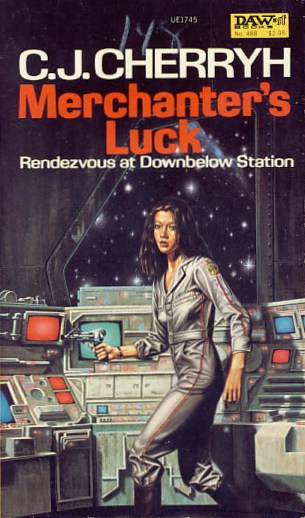
He was a down and out merchanter, the captain, crew, and sole proprietor of a run-down bucket of bolts spacecraft.  She was a daughter of one of the finest starfaring clans, with seven hundred cousins standing between her and the one thing she wanted more than anything else: command of a starship.

They met at Pell during the height of the Company War–the key strategic point on the border between Union and Earth.  Their fateful meeting would affect not only the outcome of the war, but the course of their own lives–for the starship Lucy of Wyatt’s Combine was not at all what she seemed to be.

Before I review this book, I need to issue a disclaimer: you probably aren’t going to enjoy it very much unless you’ve already read Downbelow Station.  Cherryh isn’t the best at easing her readers into her worlds, and without the background on Union, Alliance, and the Company War, you’ll probably be hopelessly lost.

That said, I absolutely loved this book.

The premise is so awesome.  Space adventure hardcore, with a beautiful love story set amidst an epic interstellar war, where alliances are constantly broken and no one can be trusted…oh man, I LOVED this book!

While the premise seems pretty standard, C. J. Cherryh transcends the well-worn tropes and cliches of her genre by intimately developing her characters and working their motivations into the story until they are the ones driving the plot, and not the other way around.

Every character is unique, and though they act in ways that may seem strange to our modern sensibilities, there are always reasons for everything they do, cultural or otherwise.  As windows into their far-future spacefaring culture, they give the reader a wonderful view of Cherryh’s unique and marvelously constructed universe.

The thing that surprised me the most, however, was the sharp contrast between this book and Downbelow Station. While Downbelow Station traces the epic arc of the Company War through the viewpoints of a large cast of characters, much like Tolkien or Dune, Merchanter’s Luck focuses more on the characters themselves, in much the same way as David Gemmell or Ursula K. Le Guin.  In other words, while Downbelow Station is comparable to “high” or epic fantasy, Merchanter’s Luck would fall closer to “low” fantasy or sword & sorcery.

The interesting self-realization I took from the book was that I’m much more interested in the intimately personal stories than the sweeping epic tale of the Rise and Fall of cultures and civilizations.  I suppose that’s why I’m more of a David Gemmell nut than a Tolkien fanatic, and perhaps why I’m more into space opera and military sf than epic fantasy.  In all of my novels, the focus is always on the individual characters and their personal conflicts, and whenever I get sidetracked and focus too much on the overworld story, it always falls apart. 

Merchanter’s Luck definitely doesn’t get sidetracked, and that’s why I loved it so much.  I fell in love with the characters almost from the very first page–from the blurb on the back cover, even.  And most of all, I fell hopelessly in love with the starship Lucy:

You know you’re doing science fiction right when your readers bemoan the fact that they weren’t born in the 26th century, when they could command their own spaceship.  C. J. Cherryh is an amazing writer, and if I had the chance, I would teleport into her Union-Alliance universe in a heartbeat.
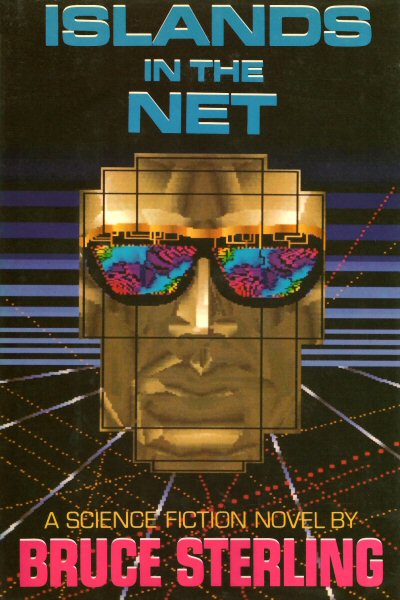
If you love well-crafted far-future worlds and stories about the people that live in them, check out Downbelow Station (or really, just the first chapter–that’s all you need for a solid grounding) and read this book!

Alright, here is the second part of my oldest story notebook, the one that I just found a couple days ago.  These ideas date from 2007 when I started pursuing writing as more than a hobby, up to the summer of 2008 when I went to Jordan on the BYU study abroad program.

The Singularity: it will lead more to a social change and conflict than a transformation of humanity–increasing disparity between techies and non-techies, and a tech/class conflict. What will the perspective be of those who look at us and our advances after the new dark ages? Or are we in the dark ages?

Interesting–if you believe in the technological singularity, that is. I’m not quite so sure I do anymore; that’s kind of what Genesis Earth

was all about.

An alien race of beings that have no sensory organs, but instead perceive the thoughts of beings with sensory organs, and thus do all their perceiving through others.

There is so much cool stuff you can do with aliens–stuff that nobody seems to be doing, because they always stick with the tropes. Or maybe I’m just not well-read enough.

The more advanced our society becomes, the more our education specializes so that it becomes harder to know the minimum necessary to understand everything. This leads to class/tech divisions, and to the potential for society to fall apart.

Have you ever wondered about this? I mean, it’s kind of crazy how complicated we’ve made life and living. And all this we call “civilization.”

When relativistic space travel becomes more widespread, society will develop new rituals and ways to mourn and deal with the separation that comes with people going forward out into space.

I think I had this thought while reading Speaker for the Dead or another of Orson Scott Card’s Ender’s Game books. That series totally blew my mind.

If we lived in a telepathic society, we would learn to separate our deep thoughts from our shallow thoughts to put up a facade in public–but how would the relationship between deep and shallow change the way society works? If we had to hide even our thoughts?

Heck, what would a telepathic society even look like?

Aliens who shed their skin each year (or something else) and have derived a culture that treats each person as having a different identity each year.

Kind of like in Tahiti, where people change their names at different stages of their lives (childhood, adulthood, etc). I hear it makes family history work insanely frustrating.

We make contact with aliens who need a human companion with whom they merge telepathically, and the story is from the human translator’s point of view.

This would make a really cool anime.

First contact was made in the 12th century with the Abassids, and the explorer ship returned with Arab emissaries to the alien homeworld. Now those emissaries are returning to establish regular connections via ansible, and they are shocked to find the world in its current state.

Okay, I think this idea has some really cool potential. I’m not sure I’d be the one to write it, but it sounds like it could be really awesome, if it were done right.

An alien species incapable of lying.

It would probably turn first contact into an unmitigated disaster. After all, lying is the essence of diplomacy.

When we first go into space, colonies will be governed by multi-national corporations, not stats. Profit will come before the welfare of the colonists themselves, and the wars will be over trade routes and tariffs.

Sounds like something straight out of C. J. Cherryh.

An alien species* that considers it okay to show uncovered reproductive organs but obscene to show the eating organs. *Or, a human society

It sure would be weird, especially if it were a human society that did that.

An alien spaceship comes to Earth and it’s full of colonists.

Definitely been done already. Probably multiple times.

Dolphins are a post-alien species that came to Earth millions of years ago.

Has this been done before? I seriously doubt it. I’d write it, but any story set on Earth tends to bore me.

EDIT: Alright, yeah, it’s been done–quite a bit, actually. Looks like I need to get out from under my rock and read some more.

Aliens have colonies under the ocean.

Hey, if they have them anywhere, they’re probably down there.

Is a necessary element of our free agency our ignorance of ourselves, on the deepest level?

Perhaps.

A 19th century Mormon gets stuck in a time warp and ends up in 21st century Utah.

Oh, the horror!

I’d better stop here, since general conference is about to start. I’ll finish this list in the next couple of days, probably. Blogging keeps me sane. In the meantime, have a wonderful Easter!