The first round of 3rd quarter honorable mentions for the Writers of the Future contest are in. I’m not in them.
I also haven’t received a rejection yet.
<crosses fingers>
The first round of 3rd quarter honorable mentions for the Writers of the Future contest are in. I’m not in them.
I also haven’t received a rejection yet.
<crosses fingers>
I mapped out all the major assignments for my capstone class for the next month on my calendar. Turns out I’ve got a lot more work than I thought I did. Because of that, I decided to start work on Genesis Earth 4.0 today.
This is the final polish before World Fantasy convention. Of all the stuff I’ve written, Genesis Earth is the only ms that I feel is ready for me to send to editors/agents. With this draft, I hope to smooth out the writing, make the text more readable–basically, make this book really shine. We’ll see if it succeeds.
It’s kind of nerve-wracking, in some ways, doing this final edit (inasmuch as any edit is “final”). Previously, whenever I did a revision, I knew that I had time to come back later and fix anything that I just couldn’t get to. Now, this is where it counts. The writing has to be perfect.
Imagine how horrible it was to find a grammatical mistake on page one. I’d forgotten to capitalize the first word of a sentence in the third or fourth paragraph. Thankfully, it was the only mistake I saw on that page, but it’s enough to make me nervous about those chapters I sent out to the editors from BYU’s Writers and Illustrators for Young Readers. I know how to write–really, I do! Please believe me!
So today, every hour of the day was jam packed with classes, work, homework, and obligatory social activities. I only had two hours to write, and in that time, I only wrote about 500 words for Genesis Earth (though, to be fair, I’m measuring it by comparing documents and only counting the words that changed). Ouch. Not sustainable, if I want to finish Genesis Earth and Bringing Stella Home (I need to change that title) before World Fantasy. I made up for it by writing for half an hour just now in Stella, but still…
And this is where I hope I don’t mess things up. Every time I’ve tried to juggle two projects at once, I’ve found it very hard to do so. It’s something I’ll probably have to learn, if I want to write professionally, but it’s still very hard. I hope my writing quality doesn’t suffer because of it.
If worst comes to worst, I’ll focus on Genesis Earth until it’s done to my satisfaction. Shouldn’t take more than a couple of weeks, even with school. But I’m still keeping my goal to finish Stella before World Fantasy.
In unrelated news, in my political philosophy class today, Professor Hancock mentioned Huntington and I said, under my breath, “that guy was so full of crap.” Well, it turns out that Professor Hancock is quite the admirer of Samuel Huntington and his clash of civilizations theory. This is going to make class…interesting, to say the least. After studying this stuff my entire college career, I really do believe that Huntington’s theories are utterly full of crap.
Oh, and I had a great idea for a comic: Plato’s Republic, as a cartoon! Okay, maybe I’m just a geek, but seriously, if it were done well, it could be really, REALLY cool. Really cool.
It’s true. This is what my wordcount spreadsheet currently looks like:
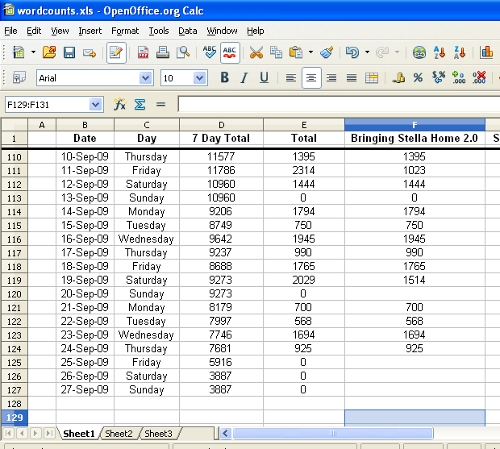
Note that the seven day totals are dropping consistently. If I want to finish this novel before World Fantasy, I’m going to have to keep that number above 7,800…not including the work on Genesis Earth 4.0.
Something tells me that’s going to be very hard.
This week was particularly busy. I had a research proposal presentation for my capstone class–that was stressful–plus a writeup of the presentation. Thankfully, the full written proposal isn’t due for a couple of weeks.
Besides that, I’ve been working my two TA jobs and doing a buttload of readings and summaries for my other classes. Ugh.
The cool thing, though, is that when it’s my office hours and the students aren’t coming, I can get paid for reading Aeschylus, Plato, Sophocles, and all those other awesome Greek writers. The Libation Bearers was surprisingly good. I’d like to read The Furies, but I’ve got to read Plato’s Apology in order to keep up with the class. Still, the Apology is good stuff, too.
Reminds me: today, I went kayaking on Utah lake with the wilderness writing class. While I was there, I had this story idea: what if the Greek civilization had developed in Alaska instead of Aegea? And then I realized that it already happened: the Norse.
With school and work consistently kicking my butt, the only time I have to write EVER is between 10pm and 12pm. Every day this week (except for one time, when I drove a girl home), I’ve been in the Harold B Lee library until closing time, when the music starts to play. Every day, I come home exhausted. And then I get up the next day at 7am to get ready for class. Something tells me this isn’t sustainable.
Still, I think the worst times in the semester are at the beginning and the end. In the beginning, you’re still in the summer mentality, so the work beats you up until you get used to it. In the last half, everything gets so insane with exams and term papers that you can barely keep your head above the water no matter what you do. I’m adjusting slowly, but adjusting.
I’ll keep up with the writing as best I can, but Genesis Earth is going to be my top priority when I start that. In the meantime, I’ll just try to finish Bringing Stella Home by plugging away and catching up on the weekends.
In the meantime, I’ve got some great ideas for my next big project. Come November, I’m going to have a lot of fun.
🙂
I really do.
School is difficult, because you can never really separate yourself from your work at the end of the day. You’ve always got homework to do for the next day, or some project to prepare, some reading to do. There’s never a defined time where it “ends.”
This semester so far has been pretty crazy–not as crazy busy as some semesters, but it’s starting to approach it. I’m taking my capstone class, and it’s fairly rigorous. Today, I’m doing a research proposal presentation, and I just discovered, after looking in the syllabus last night, that a 2 page mock grant proposal is due Wednesday. On my birthday. <groan>.
I’m stressing out a bit about this presentation. Professor Christensen is a real stickler for presentations. Going over 6 minutes will dock your grade 10%+. Looking at the audience for less than 90% of the time will dock your grade about 5% or so. It doesn’t help that I’m going on the last possible day.
Now, I’m probably stressing out more than I need to. I’m just unfamiliar with this format for presentations, and that’s getting to me. The result is that when I sit down to write, I find it very hard to concentrate because my mind is on this other stuff. And since I could be using any writing time to work on my presentation, I usually end up doing that. Unfortunately, because I’m not very familiar with this kind of assignment, I don’t think a lot of that time is particularly productive.
It will be nice to have a job that ENDS at five o’clock and gives me the rest of the day to do what I want, without having to worry about the stuff that happens from nine to five. In some ways, it will probably be more conducive to my writing, even if it does require more time than my classes. It’s very hard to have the mental space for writing when you’re over your head in homework.
.jpg) Hundreds of thousands of years ago, an ancient race of sentient aliens known as the Amarantin went extinct just as their civilization experienced a golden age. No one knows why, but archeologist Dan Sylveste is determined to find out. Unlike the other colonists on the remote planet of Resurgam, he believes that the answer may be important.
Hundreds of thousands of years ago, an ancient race of sentient aliens known as the Amarantin went extinct just as their civilization experienced a golden age. No one knows why, but archeologist Dan Sylveste is determined to find out. Unlike the other colonists on the remote planet of Resurgam, he believes that the answer may be important.
He has no idea how right he is.
Just as he’s on the verge of a major breakthrough, a team of rebels takes over the administration of the colony. Sylveste becomes a prisoner of war, and his research comes to a frustrating halt.
Meanwhile, on Yellowstone (the nearest human-inhabited planet to Resurgam), a mysterious entity known as The Mademoiselle hires assassin Ana Khouri for a special mission: kill Dan Sylveste.
The only ship headed in that direction, however, is an ancient warship commanded by a rouge crew of Ultras, genetically modified transhumans. They seek Sylveste in order to heal their captain, who suffers from a plague that melds human biology with advanced technology. The de facto leader, Illia Volyova, hires Khouri to replace the ship’s gunner, who went mad and mysteriously died.
But neither Khouri nor Volyova realize that the thing that drove the gunner mad still resides deep in the ship’s systems. It is neither human nor AI–and it knows what killed off the Amarantin nine hundred thousand years ago.
Revelation Space is a space opera unlike any other that I’ve read, with the possible exception of Dune. The far-future universe Alastair Reynolds created for this book is incredibly complex and expansive, almost completely unrecognizable from our own, with technology bordering on godlike, posthuman and transhuman races that are all but commonplace, and nothing but a blurry, indistinct line dividing the human and the machine. On every page, I felt as if I had left the real world behind for something completely (and often disturbingly) alien.
Setting, by far, is the strongest point of this book. In fact, as an aspiring writer, I found it somewhat intimidating. Reynold’s Revelation Space universe was completely alien, but in ways that made perfect sense for the far future in which it was set. From this, I’ve learned that to make a far future setting believable, you have to make it…well, as alien and complex as Reynolds makes it. It shouldn’t be an exact copy of Reynold’s mold, of course, but if it’s 500 years in the future and everyday life still feels exactly like our own–well, there had better be a reason for that.
As for character and plot, I did not feel that those were particular strong points of this book. It’s not that they were done poorly, it’s just that they weren’t done well enough, in my opinion.
The characters in Revelation Space did not particular engage me at first; I found that I had to force myself to keep reading, rather than read because I had to find out what happened to them. Later on, as the story progressed, they grew on me, but I never felt that I intimately knew them.
As for plot, I felt that every fifty or one hundred pages, Reynolds would pause the story and throw something in from left field, simply because he had to foreshadow something coming up. In this way, the book seemed a little choppy–like a debut novel (and, in Reynold’s defense, this is his debut novel).
Even with these issues, however, this was an incredible book, and it’s stuck with me even months after finishing it. Reynolds pulled off an amazing ending–very satisfying, with a twist that I had not foreseen but that made good sense. The final scene, and the last two sentences of the final scene in particular, were just awesome. They made me want to clap my hands and say “bravo.”
If I could describe Revelation Space in terms of other works, I would say that it’s a cross between Neuromancer and Stargate the movie. While it’s solid space opera, it has a dark and gritty feel that borders on Cyberpunk / post-Cyberpunk. It’s not exactly the kind of stuff I want to write, it comes pretty darn close.
Just passed the major climax in the middle of Bringing Stella Home. In a moment that I hope is as poignant to the reader as it was to me, I…well, let’s just say I’m glad I’m not my main character.
I hit the climax doing a 1,765 word sprint, with this song playing on repeat:
So awesome. I just hope that when I wake up from this daze, my writing doesn’t suck.
Next, gotta finish up the chapter, clean up the mess, give the denouement. After every emotionally poignant climax, I think it’s critical to have a good denouement to give those emotions their proper release and bring everything full circle, bring some proper closure. Best denouement of any story I know: the Throne Room from Star Wars IV:
The denouement for my story will not be nearly so triumphant. But then again, it’s not the final climax–there’s a lot more to come, a lot more pain and suffering for my main character to endure.
I’m 2/3rds of the way through this rewrite now. I hope I’m not being too melodramatic, or that the story sucks. They say it’s not enough to be good–to make it as a writer, you have to be brilliant. Does this story have that potential? Gosh, I hope it does. As it stands, though, it sure needs a lot of work.
But still–it’s been awesome writing it.
I’m in the middle of revising a major battle scene right now. This is supposed to be one of the more important climaxes of the book, adding a lot more tension and emotion as the novel approaches the main climax.
Let me just say, writing a good battle scene is tough. The first version of this one…yeah, it sucked. Hardcore sucked. I’m cutting whole sections at a time–five hundred words, eight hundred words–and completely rewriting them from the ground up. I’m not sad to see these sections go, either–they were BAD.
I think the most difficult thing is to keep the pacing up without confusing the reader. For that reason, I reconceptualized most of the action here and made it simpler. I also repeated several times the main point of tension–basically, will we get out of here before reinforcements come and kick our trash? I hate it when a fight scene is so confusing that the tension just leaks out. I don’t want that to happen here.
At the same time, I’m trying to filter everything through the viewpoint character. Too often, I’ll read an action scene that’s just a blow-by-blow of the physical action. That gets boring REALLY fast. Without character, you have no stakes. I want the stakes to be high from the very onset.
Still, it’s hard. I don’t know if I’m succeeding yet. I probably won’t until I distance myself from what I’ve written tonight and take a good, hard look at it.
Since I can’t do that until the third revision, I’m not going to worry about it. Better to write it out now and move on than to try so hard to get everything perfect that I can’t see the story for the words.
On the plus side, I’ve been listening to a LOT of Star Wars battle music while writing this. That’s always fun!
Holy cow! How is September halfway over? It seems like school started just a week ago. Only six and a half weeks before World Fantasy convention in San Jose, and I think I’m going to have to readjust some of my goals.
I’d wanted to finish Bringing Stella Home 2.0 by the 11th of October, but the way school and work is looking, I probably won’t be able to write 2k words every day in order to meet that goal. Besides, the story has several major issues that can only be fixed with a major overhaul, so there’s no way this novel is going to be ready for submission in time for the convention.
However, Genesis Earth is looking pretty good. So far as story issues go, I was very satisfied with the third draft–I think I fixed all the major issues and wrote something that’s pretty close to salable. Before the convention, I want to go through and make one final revision, one where I polish up the prose and fix the readability issues. That shouldn’t be too hard–I can probably do that in two to three weeks.
So here’s what I’m going to do in the next six weeks. I’m going to check out all of Robert Charles Wilson’s books and immerse myself in his prose–not to copy it, but to hopefully boost the quality of my own prose. The quality of his writing is fantastic, a beautiful mesh of literary prose and thriller pacing and rhythm. While I’m doing that, I’ll start the 4.0 draft of Genesis Earth and work hard at it, until I’ve polished that work as much as I can. That’s the work that I’ll try to sell when I’m at World Fantasy.
I’m a little worried, because I submitted the full manuscript to Krista Marino back in June and haven’t heard back. At the BYU Writers and Illustrators for Young Readers conference, she said she had a response time of 4 months, but I’m worried I won’t hear back from her before World Fantasy. Is it appropriate to send a polite note asking her to get back to me before the convention? I don’t want to shoot myself in the foot by sending out simultaneous submissions, and if an editor asks to see my ms, I want to be able to send it to them ASAP. Then again, I suppose I could just tell them that the full is currently with someone else, and that would demonstrate some professionalism…but I want to be able to send it if/when they ask for it.
Which reminds me: I need to do some HEAVY agent/editor research before this convention. I want to go to World Fantasy with a list of people to look for, so I know where to go to network, which panels to attend, who to look out for in the hallways and parties. I want to be very professional about this, and get the most out of those two/three days that I can.
As for Bringing Stella Home, my current WIP, I’m going to do my best to finish it before World Fantasy so that I can start November with something new. I need to finish that book before I can set it aside and let it percolate in my mind for the next revision. Besides, it’s been too long since I’ve worked on something completely new. After October, I’ll need to take a break from all these revisions.
So that’s the plan: Finish Genesis Earth 4.0 and Bringing Stella Home 3.0 before World Fantasy. Research all the editors and agents to look out for at the convention. Oh, and hold down 14 credit hours and 2 on-campus jobs at the same time, with some time left over for a dating/social life (INSHALLAH).
Hehe…these next six weeks are going to be packed!
People in Utah are generally nice and easy to get along with…until it comes to traffic. That’s when all the jerks come out. I’ve seen the finger more times here in Utah than anywhere else in my life–even as a missionary in California. After living here for a while, it starts to irk you.
So tonight, as I was waiting to turn left on the corner of Canyon and Bulldog, just as the light turns green a jogger runs out in the road. Predictably, the oncoming traffic honks at him, but what does he do? He flips them off.
I turned left to cut through the RB/SFH parking lot on my way home, and realized that the jogger was running the same way. Since his disrespectful gesture had rubbed me the wrong way, I decided to slow down, roll down my window, and confront him.
So, while he continued to run, I drove parallel to him and we had this conversation:
Me: Hey, why did you flip that guy off?
Jerk: Because he was being a prick!
Me: But you were the one who ran across the road.
Jerk: Yeah, but I have the right of way!
Me: Not when you’re running a red light.
Jerk: Oh yeah? Pedestrians always have the right of way, retard!
Me: So I’m a retard? Is this how you plan to get through life, by being rude to everyone?
Jerk: <laughs> EXACTLY. That’s exactly how I plan to get through life.
Me: That’s not a very good way to live. You should control your temper.
Jerk: Yeah, whatever. <waves me off> Later, dude.
Me: So now you’re just going to run away from what you did?
Jerk: <runs up to car window> Look, do you want to make this a little more serious? <threatens to punch>
Me: Not really. I just want to hold you accountable for what you did.
Jerk: <runs off again> Whatever, dude. I’m just trying to exercise.
Me: And I’m doing you a favor. You should learn to control your temper. <drives off>
I don’t know if I accomplished anything by this (or even what I wanted to accomplish), but it felt satisfying knowing that one less jerk in Provo got away with his rude and disrespectful behavior. I hope that guy remembers this conversation for a while, even if it only makes him madder. One day, he’ll learn.
I had an awesome day today. Totally awesome. If every day this semester is like this one, I’ll be dead tired before Thanksgiving but so happy it won’t even matter.
It started at 7am. Woke up, worked out, read a galley from Dragon Moon Press for Leading Edge while working out. The book wasn’t that bad, either.
Showered, ate breakfast, read 1st Jacob chapter 1 in Arabic. Great scripture study. Read “The false gods we worship” by Spencer W. Kimball on the walk up to school. Powerful. President Kimball was a Prophet with a capital P.
Met with Dr. Bowen to discuss the TA job she wants to hire me for. It’s going to be a LOT of fun! I’ll be doing all kinds of interesting research on the Israeli-Palestinian conflict and making a sort of game / role play for the students in the class…and getting paid good money to do it. Fun fun fun.
Classes were awesome. I love my capstone. Professor Christensen is a blast. Talked about spatial voting and why political parties in America tend to be identical. Made fun of Provo/Orem municipal elections. Good times.
After classes, met with Professor Kramer to discuss the other TA job I’ll be working. He was incredibly happy to have me on board. Out of the hundreds of papers he read for PL SC 201 last year, he still remembered mine. Holy cow. I’m shocked.
Proceeded to run through a series of bureaucratic hoops to get all the paperwork filled out for both TA jobs. I was so giddy about working I didn’t mind the hassle. Dr. Bowen at one point said “What’s the other job paying you? Eight something? Well, we can do better than that!” Man, I’m going to earn so much money this semester.
Went home, cooked up some locally grown corn and spaghetti. Mmm, corn on the cob! Delicious. Talked with my roommate Ben Crowder about all the stuff he’s done since graduating. Dude, he is a renaissance man, through and through. Awesome guy.
Leading edge was a total blast. The editors threw a start-of-semester pizza party, and we had almost a dozen new people show up to read slush. Plus, Peter was there–he’s always fun. Talked about spaceballs and Big Bang theory (the movie), how Arrested Development is funnier than The Office, violence in fiction, crazy story ideas, and all kinds of stuff. Good times.
So then, after finishing my homework, I was sitting in the library when I realized I only had an hour and a half before the library closed. An hour and a half, and I had not written a single word in my WIP that day. In order to keep up with my self-imposed deadline, I needed to write 1.2k words. 1.2k words…in 1.5 hours.
I didn’t really think I could do it, but I decided what the hell and gave it a shot. Turned off the music, avoided the email and twitter, and just focused on the work.
An hour and a half later, lo and behold! 1.2k words! And just as I realized that, the HBLL closing music comes on…and it’s Dropkick Murphies!
Let me just say, there is no better way to end an awesome day than with some good outro music. So let me end this post with tonight’s awesome outro music, courtesy the Harold B. Lee Library.
That’s the news and I AM OUTA HERE!