This sucks and I’m a horrible writer

It’s getting really, really hard for me not to believe that statement, especially as I finish up with the middle part of this novel.  I’m starting to realize that I made a whole bunch of mistakes pages and pages ago, and that the climaxes just aren’t working without everything set up right.

I know, cognitively, that it’s mostly just psychological and that this book probably isn’t as bad as I think it is, but I’m finding it hard to convince myself of that.  I got to the climax of part II yesterday, and it was…not what I’d had in my head.  That’s probably what’s frustrating me the most.  If I can’t write down the story as I have it in my head, what does that mean?  It either means I’m a terrible writer, or that I didn’t get the setup right (or both…gah!).

So…where do I go from here?  Throwing out the entire story isn’t an option–I’m not going to allow myself to do that.  I could, however, put it on the back burner for a while, let it simmer…or I could do or die and finish the 1.0 draft, no matter how crappy it turns out.  I suppose that would accomplish something for my self esteem, but is that the way to best serve the story?

Fortunately, this past week we talked about revision in English 318.  Listening to my recording of the class gave me a few ideas.  I could make a list of known problems, with their fixes, and continue as if I’d already made them.  I think I did that a few times with The Phoenix of Nova Terra, but I don’t know how I feel about that now.  I could probably make it work…

The main issue is that I feel very, very distant from this book.  A month ago, I was immersed in the thing, writing over a thousand words each day, just chugging it out.  Now, for various reasons, other things have come up and drawn away my attention, so I don’t feel that I’m really in this world anymore.  I feel like I’m more of an outsider, writing for the sake of writing rather than trying to tell this story the way it wants to be told.  I can’t really remember what I wrote a hundred pages ago, despite that big sheet of butcher paper up in my closet.

Another thing that complicates all of this is that I’m really, really excited about the other novel, Genesis Earth. I’ve gotten back comments from most of my alpha readers, and I’m all but chomping at the bit to start working on it again.  If I had nothing else going on, no pressing obligations or assignments, with the enthusiasm I have for this project I could probably finish the second draft in a week, and the third draft the week after that.

So…what’s next?

Well, I think I’m going to start the revision on Genesis Earth today or tomorrow.  When I was this enthused about revising Pheonix, I decided to wait and finish Genesis Earth instead, and the enthusiasm for that project died down surprisingly fast.  Better to start now than wait until I’ve got the free time but struggle with motivation.

In the meantime, I’m going to finish the current chapter of Bringing Estella Home and let it rest for a bit.  I’ll probably reread what I’ve got from the beginning, make a few revision notes, perhaps an outline of sorts–try to figure out what’s wrong, what I need to change to make it work.  I’ll restrain myself from actually making those revisions (though I did that, mid-draft, for Genesis Earth, and it turned out alright…sort of), but once I feel I’m sufficiently “into” the story again, I’ll get back to work and finish the 1.0 draft.  Hopefully, I’ll be able to do all that before the end of May.

The trouble here is that I’ll probably end up writing the first draft of this novel and revising the other one at the same time…something I tried last September and failed miserably.  However, by the time all of this is finished, inshallah school will be over and I won’t have to worry about it.  Things are looking really good for me to get an internship in NYC, which makes me think I should drop my Spring classes and just take it easy for a month before I start (as for housing, that’s a whole other conundrum…).

Gah!  Writing is complicated.  Is this something I want to do for the rest of my life?  Something I can do?  I don’t know.  I really don’t know.  I just have to keep on writing through this depressing pessimism and trust that it will pass.

As a side note, I took the title of this post from a Writing Excuses episode some time ago; here is the link to that episode, in case you want to hear it.

The Martian Chronicles by Ray Bradbury

Welcome to Mars, a magical world of ancient ruins like giant glass chess sets and canals of wine and sandy desert seas. A world inhabited by golden eyed people who can telepathically project hallucinations–some of them still live up in the hills. A desolate, empty world, the next frontier for a new generation of pioneering spirits, each with different dreams, different reasons, different goals and outlooks on their new life in the new world. Some come with respect and reverence to the ancient world, while others come to exploit it. But no matter why they come, everyone is deeply and profoundly changed. Some never return.

Ray Bradbury is one of the biggest names in science fiction, and this book is one of his greatest works. A lot of my friends really love Bradbury, but strangely, I haven’t read a lot of him (Fahrenheit 451, way back in Middle School, and a few essays, but that’s pretty much it). After putting this book down, all I can say is wow. Now I know what my friends were talking about.

The Martian Chronicles is more of a collection of short stories than anything else. That’s understandable, when you consider that science fiction began with short stories, not with novels. Keep that in mind as you read it, too. This is not a book you can read all in one go; you have to take time between the chapters to let each one soak in, otherwise your mind will just get overloaded. Bradbury delivers a bang! ending to just about every story in this book, and some of them are really deep. My favorite one was the one with Sender, and how the fourth rocket discovered that all the Martians were killed off by the chicken pox. There are some really profound ideas in that one, and I loved reading it.

A lot of hard sf purists tend to call Bradbury a writer of fantasy disguised as science fiction, and I can see where they’re coming from. There’s nothing really scientific about this book; the Mars of Bradbury’s stories is a purely fantastic invention (even for the 50s). I remember the story about the third rocket, and how it landed on a grassy green lawn, and all the crew stepped out and found themselves in a little Ohio town, and all I could think was “what??” It was very fantastic, very surreal and even trippy at parts, but once you get the hang of it, it’s not so bad. And really, I’d argue with the whole “Bradbury = fantasy” thing–I think some of the ideas in these stories definitely blur the line between fantasy and science fiction.

One thing Bradbury is fantastically good at is infusing all of his writing with passion. There wasn’t a moment in this whole book when I couldn’t envision Bradbury himself, his eyes wide and bloodshot, gripping me by the shoulders and shaking me. His imagery was amazing, and his twist endings were incredible. You really read Bradbury for his prose and for his ideas; everything else takes a back seat, but he does so well with the first two that that’s ok.

These are the kinds of stories that stick with you long after you’ve read them. They might not be consistent with each other or follow in a coherent, logical order, but they will deeply and profoundly move you.

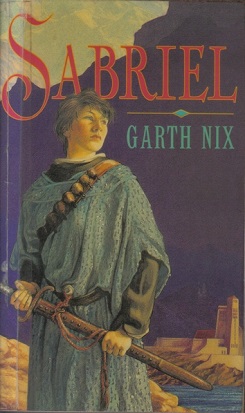
Sabriel by Garth Nix

Sabriel doesn’t know it, but her father is more than just a powerful necromancer; he is a key in the political intrigue of the Old Kingdom–the land beyond the wall. When he interrupts her class at Wyverly college by sending a hand–an enslaved spirit–from beyond the fourth gate of Death to drop off his sword and magic bells, Sabriel knows that something is wrong.
Something is holding her father hostage in Death, and Sabriel is determined to find him and rescue him. When she crosses over the wall, however, into the world of magic, both free and charter, she discovers just how little she knows about the history of the world, and the conflict in which her father was intimately involved. On this side of the wall, the world nearly ended two hundred years ago, and something that should have passed beyond the ninth gate of Death has come back to finish what it started and claim the world as its own…

I read this book for English 318 this year; we discussed it in class a couple of weeks ago. I ended up reading the book in about 48 hours, and as far as required reading goes, it wasn’t bad. Not bad at all. In fact, I really enjoyed it.

Garth Nix creates a fascinating world in this book, with magic that feels wondrous and otherworldly and places that feel fantastic. His conception of Death as a river with nine gates–nine waterfalls–is extremely fascinating, and the use of the bells to cast spells is really well done. The first hundred pages of this book felt a little bit like the beginning of The Dark Is Rising: it felt really dark and spooky, like being lost in the woods and knowing that something ancient and dangerous was out there with you.

The characters were also interesting and likeable. Sabriel is a necromancer who, in some ways, is afraid of facing death–the fact that everyone has to go at sometime. This is a YA book, so she was basically a young adult thrown in way over her head, tossed back and forth from crisis to crisis. At the same time, she takes charge often enough that she is definitely not just a weak character, driven passively from place to place. When the love interest enters the story, she’s basically the “prince” that rescues him from the “dragon,” repeatedly.

The biggest issue I had with this book was its predictability. It seemed that I could see every plot development and big reveal at least fifty pages before it happened. That said, the main thing driving me through the book wasn’t the plot–it was the setting and the characters. Sabriel has to learn some difficult lessons in order to succeed, and the magic she uses is just really freaking cool. Charter symbols, free magic, the five great seals of the charter, the nine gates of Death and the voices of the bells–cool stuff. That was enough to keep me interested, despite the relatively straightforward and unsurprising plot.

Overall, this was definitely a good fantasy. Garth Nix does a great job creating a sense of wonder, and his characters were interesting too. If you like fantasy and haven’t yet heard of this one, I’d definitely recommend it.

Ugghhhhh…

Man, I am sick.  It sucks.

I’m also at a low spot in writing this novel.  That sucks too.

When you get towards the last third of the book you’re writing, you start to have doubts about the whole project.  Is this really any go0d?  Is the story really holding out?  Things slow down a lot, and you lose most of the enthusiasm that carried you through the first half.  The daily drudgery of writing becomes harder and harder, and pretty soon you can’t see beyond the chapter you’re presently writing.  It’s not a whole lot of fun.

Then, as you get into the final stretch, the ending comes into sight and you start to regain a little bit of the enthusiasm.  Your goal isn’t too distant, and you start to see how things wrap up to bring you to that final climax and ending.  You find yourself believing in the story again, and excited to see it to the grand finale.

Of course, the actual writing gets harder and harder, exponentially, right up until the last page, but you’ve regained the motivation and you have at least a portion of the drive.

Right now, I’m kind of at the low point.  It doesn’t help that school is starting to get busier, too.  It certainly doesn’t help to be sick, even if it does give me more time around the house (man, I need to get out…I need to get out…).  But I’m almost at the end of the second act–one climactic battle, one huge and tragic development, one major try-fail cycle, and then I’m on the final stretch.  I’m currently at 64,250 words, so I should wrap up part two by about 68k and finish up the novel at around 100k.  Perhaps a little longer, but I don’t think part three is going to be much longer than part two.

One of the major doubts I have about this novel is that it’s too predictable.  All of my readers from English 318 have been making their predictions, and…really, most of them are correct.  In fact, they’re correctly predicting stuff that happens WAY later, stuff from part three that I haven’t written yet.  If this story doesn’t have any surprises, I worry that it might not be as good.

On the other hand, it has some ideas and concepts that are really drawing in my alpha readers, particularly with the Hameji.  Over and over again, that’s the comment I get–they want to find out more about the Hameji.  This is something that might help me to carry the book, even if it is a bit predictable: show this barbarian spacefaring culture at their most brutal, make them the key antagonists, and then slowly humanize them until the readers understand exactly why they do what they do, and even come to agree with them.  That is pretty fun.

So we’ll see how that goes.  In the meantime, I’m going to go to bed early–9:30 or 10:00.  This sickness is just killing me, and I don’t know of anything more effective at curing it than sleep.  G’night.

Many Bothans died to bring you this weekend

img_5998This past week was pretty crazy.  Tests, papers, homework…BLEARGH.  Less than satisfying.  What’s more, I was starting to get cabin fever from being in Provo so long.  Every day, doing the same old thing, going the same old places, seeing the same old sights…
…Then I got a call from my friend Ben Fisher, saying that everyone from the old Capitol House was going down for a camping trip near Moab.  Would I like to come?

HECK YES!!!

I basically dropped everything to run away with these guys.  First, I had a late paper that I had to finish–stayed up until 5am Friday to write it, took a 3 hour nap, then went to class.  CRAZY.  Emailed it to professor Ricks, with “many Bothans died to bring you this paper” in the body.  Got my coworkers to cover for me so I could get out early, met up with Ben, and then we loaded up our car with the girls and the camping stuff and basically ran down to catch Steve, Warren, Mike, and the others, who were already at the campsite.

campfireWhat an awesome weekend!  Ben had brought a couple of dutch ovens and tons and TONS of good food!  Dinner was much better than the stereotypical hot dogs and smores (though we did have smores in the morning).  We had cobler, sweet and sour chicken, and fried rice for dinner–awesome!  Plus, it was fun just to hang out around the campfire and talk.  Good times.
We laid out some tarps on the sandy ground, then threw down our sleeping bags and had a big bivouac under the stars.  I fell asleep as Ben was telling us all a story that had something to do with galoshes…I don’t really remember it all that well actually…and then I woke up a couple of hours later and didn’t sleep again the whole night.  I hadn’t brought a mattress, and man, the ground was hard…ugh.  Note to self–get a better sleeping bag and some kind of a camping mattress.  Mike Lebben was the smartest–he brought a cot.

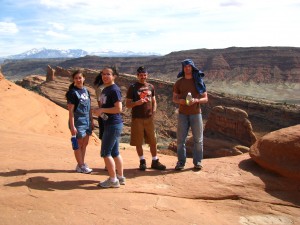
hanging out at ArchesGot up early, restarted the campfire, and we had a good breakfast–biscuits and gravy, and then smores a little while later.  Good times.  We took off a little later and went up to Arches National Park to do some hiking.
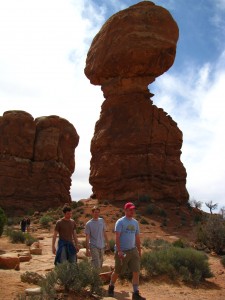
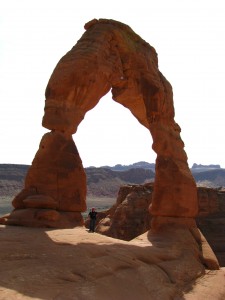
We checked out Delicate Arch and Balancing Rock, then did some rock climbing out near Sandstone Arch.  Lots of fun.  I got sunburned really bad (of course), but the weather was really nice!  Not too hot, with a good breeze up near the top of the mountain.

hanging out near balancing rockThis was my first time at Arches, and despite some problems with the parking, it was a lot of fun.  The desert around Arches reminds me a lot of Petra–lots of sandy red rocks in weird formations, making for relatively easy climbing.  In fact, the whole trip reminded me a lot of Jordan and Petra.

One of the most interesting things about these trips is the social dynamic and getting to know new people.  I knew all the guys from the capitol house, but I met a few new people as well.  Natascha was there (she kept telling me to take a candid picture of her, then posed!  The pictures above are some of the few ones where she didn’t know I was pointing the camera at her), and her sister Hannah, who I hadn’t met before, plus her good friend Beth, who always bugs me about the one time I didn’t sub for her at the MTC cafeteria when it was her birthday (for consolation, I told her I was fired the next year–I think it made her feel vindicated to hear that), plus a couple of other friends of the other guys.   It was also good to see the guys from the capitol house again.  Probably my favorite part of the trip was hanging out around the campfire, or the conversations we had driving the three hours up and back.

In a lot of ways, the weekend was a roller coaster.  Beth commented that she was really surprised that all of us from the old Capitol House, with our strong personalities, get along as friends without tearing each other to pieces.  It was a valid comment–me and Warren weren’t getting along this weekend, for some reason.  I think I was still stressed out about the past week, plus I just haven’t hung out with him a lot recently.  So that was one of the lows of the weekend.  Another low was getting up Sunday morning, after we’d gotten back, and finding out that I had a 102 degree fever.  Not too much fun.

Still, there were quite a few highs.  On the way back from Moab, Natascha and her sister got me talking about my mission, and I shared a TON of old mission stories with them.  Good times, even if I was more than a little loopy (or perhaps it was BECAUSE I was so loopy…).  Also, when I got back, I found out that I’d gotten a letter from the English department–turns out I won first place in the Mayhew short story specialty contest!!!  WOOHOO!!!  Awesome!

So, anyways, that was my weekend.  Basically, it was like half of a summer rolled up in 2 days.  It was SOOO good to take a break and get out of Provo!  Good times!

Slow but steady

Okay, quick post before I go to bed.

Things are progressing in this novel, slowly but surely, as you can see from the wordcount.  Unlike past weeks, I’m not pushing myself too hard, mostly because I’ve got a lot of schoolwork right now and if I were to spend much more time on this novel, I would neglect a lot of the more important stuff.  Even though my course load is relatively light this semester, I’m a senior and I’m really not as motivated to do this stuff as I used to be.  I get done what needs to get done, but just barely.

I have been successfully getting up early, however.  And I’ve discovered something very interesting: I’m more productive when I have less free time.  Thursday, I didn’t have class until noon, so when I got on the computer at about 6:30 to write, I opened up the email, opened up facebook…and, by the time I had to leave for class, I had only written about 430 words.  Disgusting.  But today, when I had class at 9:00 am and still had my Arabic homework to do, I got in about 700 words in half an hour.

I still have a lot of self discipline to learn, I guess. 😛  The scary thing is that my idea, up to this point, has been to keep my time open in the summer so that I’ll be able to write.  Err…yeah.  We’ll see how that goes.

I’ve been getting a lot of comments back from my alpha readers on Genesis Earth, and it’s been REALLY fun!  Even the criticism–as long as it’s helpful criticism, I really appreciate it.  This one girl in my ward asked me if she could be an alpha reader, then read the whole thing in only a couple of days.  She had a LOT of positive comments–in fact, almost all of her comments were positive–and she said she really loved it!  So much so, in fact, that she said she was having withdrawals, so I sent her The Phoenix of Nova Terra v1.2.  Hopefully, getting her comments back will give me motivation to pick up that old thing and rework it…goodness knows it needs it.  Needs it bad.

My first two novels, The Phoenix of Nova Terra and Genesis Earth are completely different in some ways, but very similar in others.

<spoiler alert>

They both have an important romantic element, and they both have generally positive endings.  The book I’m writing now is something of a tragedy, at least at it’s core, and there is a completely different dynamic there.  No love stories, no happy resolutions–lots of pain, lots of violence, lots of grappling with difficult issues.

</spoiler alert>

I suppose it’s good to try out a lot of different things early on in your writing career.  That’s what I’m doing.  At the same time, though…I get feedback on the one novel, and I kind of want to work on it instead of the one right in front of me!  And when I think about what I did right in the one I finished, I look at the one I’m currently writing and I think “man, this is crap.” Of course, I keep working on it because I recognize that I ALWAYS think “man, this is crap” at some point before I’m done.  Knowing that doesn’t make it easier, however.

Jason from the FLSR writing group said something interesting about that, however.  He said that writing a draft of a novel is like climbing a mountain: you do it three times.

The first time, you climb it in your mind as you plan it out.  You’re excited and motivated, and busy with all the preparations.

The second time, you actually physically do the work of climbing.  It is long, hard, and frustrating, you get lost a few times, the summit is anticlimactic, and the return is boring.  You can’t wait until you’ve finished and it’s all over.

The third time is when you look back on the experience after you’re safely back down.  No matter how excruciating the climb was, you look back on it fondly and remember all the best parts.  You thrive on the memories and wish that you were back up there, standing on the summit, enjoying the experience.

Right now, I’m on my third climb for Genesis Earth and my second climb for Bringing Estella Home. I can remember how miserable I was when I was still in the middle of Genesis Earth–for a while I seriously thought about throwing the whole thing out and doing something else.  However, now that I’ve been letting it sit for a while, I’m getting really, really excited about it!  I can hardly wait before I can get back and write the second draft.

But that’s not going to happen until I finish Bringing Estella Home.  And, no matter how difficult it gets, I swear I WILL finish this book!  I’m a chapter away from act III, and that’s too deep into the thing to quit and start something else!  This book WILL be finished–if not by April, then by sometime in May!

“You do watcha gotta do for Rock ‘n Roll, ya know?”

Check this out. Apparently, back in the 80s, U2 randomly decided to put on a show on the roof of a liquor store in the middle of LA. A free show. They played one of their best songs, “Where the streets have no name,” and then the police shut them down. This video is apparently footage from that incident.

How awesome is that, dude?

I mean, aside from all the stress they gave the cops, and the crowd difficulties and dangers inherent in pulling a stunt like this, just how freaking awesome is the concept? Dude, I would have LOVED to have been there! Check out the people, standing around, waving their hands, hanging off of traffic lights pumping their arms–it must have been awesome!

U2 is one of my favorite bands of all time. I know people think Bono is way arrogant and self-righteous, that he projects himself as the Pope of Rock ‘n Roll, but honestly, come on, the music is pretty good. I mean, lets not get so caught up in everything that we forget the music. Classic. Truly classic.

And then, when you DO look at some of the stuff these guys have done, it’s pretty freaking impressive, Pope or no Pope. In Chile in the 90s, U2 put on a HUGE benefit concert for the Mothers of the Disappeared, a human rights group calling for an inquiry and public closure on Pinochet’s brutal regime…right under Pinochet’s nose! Right there, Bono called out one of the world’s totalitarian dictators IN HIS OWN COUNTRY. How awesome is that??

And it’s not like Bono is just posing for the camera, throwing concerts to boost his fame and fortune, doing all the showy stuff for human rights but not actually doing the leg work. He puts on his suit, picks up the briefcase, and meets with the major leaders in the non-governmental organizations and trans-national activist networks and works with these guys, behind the scenes. He’s really out there, doing his part.

Plus, just look how long the band has stuck together–thirty years now. How many bands have you seen that fall apart after a year or two, just because the members get all pissy and immature with each other? These guys in U2 aren’t like that–they can work together, they can do much more than just get along with each other. They can really thrive together and build off of each other.

When I was in Jordan, I listened to U2 all the time, especially their older stuff. Their music and message was born out of the conflict in Northern Ireland, and because of that it really resonated me as I lived around some of the effects of the Arab-Israeli conflict. They have a way of singing about love and peace in a gritty, hard-edged way that can still really cut right to the heart of how you feel and how you want things to be. That’s how I feel, at least, and for that reason I listened to U2 just about every day in Jordan.

Man, U2 has got to be one of my favorite bands of all time. These guys really know how to rock out, in the best possible sense of the word.

Slugging it out and summer plans

Ok, last week I wrote almost nothing on this blog, and last night I wrote a quick post before going to bed that didn’t really explain much.  I just got done reading one of Dave Farland’s kick-in-the-pants series of email newsletters and it said, basically, to post every day if you have a blog (unless it cuts into your writing time).  Sounds like a good plan: more, shorter posts instead of fewer, longer posts.  Here goes.

Last week was pretty crazy.  I got everything done by the time it needed to be done…barely…but it was so disorganized and upside down that it really grated on me.  It was one of those weeks where, when Saturday rolls around, you look at the calendar and think “where did all that time go?”

I tried to write every day, in the morning, but it didn’t work out.  At all.  I allowed myself to get distracted, and by the time I was ready to sit down and write, it was time to go to class.  After a couple of days of that, I just stopped getting up altogether.

I wanted to get through the last two chapters of Bringing Estella Home by yesterday, but that TOTALLY didn’t happen.  I’m still in the middle of chapter 9, not even to the major climactic battle that ends the second part.  Bah.  As a result, I’m starting to have doubts that I’m going to actually finish this novel by April.

HOWEVER, on a more positive (and a completely different note), I actually have an idea of what I’m going to do this summer.  I don’t know when or how exactly it hit me, but I have something of an idea, and it’s starting to really grow on me.

Here’s the plan: I spend the spring term here in Provo, retaking a handful of freshman level classes in order to boost my GPA (I got a C- in beginning piano, and a B- in Geo 120…yeah, those could be raised a little).  That’ll give me plenty of time to work on my writing and the opportunity to attend a couple of interesting looking writing conferences out here in Utah, such as BYU Writers for Young Readers and CONduit.

After the spring, I’ll head back East (haha!  ‘back East’!  I’ve been transformed into a Utahan!), spend a couple of days at home, take a train down to New York City and live for a month or two with my old roommate Steve Dethloff, who’s moving to NYC after he graduates.  I’ll try to get a job, possibly doing something writing/editing related, or maybe make some contacts in the publishing world.  Or not.  We’ll see how it goes.  But either way, I’ll have enough time to work on my writing.

Also, if I’m back East in August, I’ll be in a good position to attend Worldcon 2009 in Montreal.  I haven’t yet decided if I’m going to go, but it’s only 4-5 hours from my home.  I could borrow my parents’ car and drive up.  Then, later in August, we’re going to have our family vacation out on Cape Cod, so if I’m back East for summer, I’d definitely be in a good position for that.

Wherever I go, I’ll try to find work, but even if I don’t, I still have enough money left over from the Pell grant that these plans are still viable.  I’m certain I can find work down here in Provo, but I’m not that certain about New York.  Still, if I’m down there for only a month or two, it shouldn’t be too hard.  If I sublet out from Steve, rent should only be about $250-$300 per month.

Trouble is, there isn’t any awesome trip to the Middle East involved in these plans. :'( That’s sad.  But still, if I want to focus on my writing to get ready for World Fantasy and (potentially) Worldcon, it’s probably a better idea to stay in the country.  Going abroad would mean making a lot of difficult cultural and linguistic adjustments, and I’m worried that that would make it difficult to write.  I know that last time I went to Jordan, I didn’t hardly write at all (except in my blog, of course).

So, until I come up with a better plan, that’s what it looks like I’m doing for now.  We’ll see if things change.  And as for my novel, this week I’m totally going to do better.  I got up at 7am this morning and got in a good hour of writing before school.  Momentum is definitely building up again.

Experiment, take two

Ok…the experiment I wrote about last week…yeah, it failed.  Miserably.  Got almost no writing done, and I wasn’t able to get up early hardly ever.

However, I’m going to try it again.  Part of the problem was that I always ended up staying up late, past 1am, even when I intended to get up early, and that just killed me.  Also, whenever I did get up early, I always allowed myself to get distracted by other important things, such as email, homework, etc.  The predictable result?  No productivity.

There were other problems too, however.  It’s the middle of the semester, so the weeks are starting to race by like so much rushing water.  I’m not the only one who feels like the last week was sucked out of my life without my realizing it.  Also, before I started the week, I lost a lot of writing momentum by missing a few of my daily wordcount goals.  I would write 2,000 to 3,000 words one day, the next day, nothing.  Lost momentum can be really crippling.

When you write late at night, you tend to go through this routine of distracting yourself, checking your email, playing a game here and there, chatting with friends, etc, before you finally settle down to start writing.  This is my current routine.  I need to get to the point where I’m able to sit down, open the document, and get started.  Or, if I can’t get to that point, I at least want to minimize the distraction time.

So, this week, I’m trying it again.  I’ll try to get up early, 6am if I can, and get in at least a half hour of writing each day.  We’ll see how it goes.

…and they all lived evily ever after.

Today we had a quark writing group party, and it was lots of fun! We all went up to drek‘s new house, up in Draper, and read some of our really old, really bad first attempts at writing stories. Good times!

Drek, Nick, lexish, slipperyjim, jakeson, gamila, aneeka, and one of my friends from the FLSR writing group all came up. Jakeson and his crew got lost on the way, but we had a good time hanging out, chatting, eating the pita bread and hummous that I’d cooked (I figured everyone else would bring sugar-heavy treats, so I cooked something a little more on the healthy side–still delicious, as evidenced by how much everyone ate!), and talking about how we’d gotten started writing.

I think a lot of us had similar stories–while we all wrote for different reasons, we all tried to do something big in high school, something that marked a turning point of some sort. The other common thread that ran through our stories was…how laughably bad they were! There were gradations, of course (Nick’s story that started with the word “Gandalf” and only got worse was pretty ridiculously crazy), but all of our stuff was pretty bad.

It can be both fun and painful to look back on past stuff, especially the stuff you wrote back in high school. It’s like, all the painful awkwardness of high school is not limited to your social life, it seeps into your writing as well, especially if that’s when you first try out your hand at the craft. So many cliches, so much bad grammar, so many viewpoint errors and info dumps…ARGH!!!

Of course, that is precisely what made it so entertaining. The awkward, emo, immature teenage grasp of the universe, combined with dozens of stale cliches and atrocious grammar–brilliant! I’m glad we were all at a point where we could look back on this stuff and laugh. It can do you good to air out your closet and let go of some of the old stuff you are sure would destroy you if you ever let it saw the light of day.

My first writing attempt was a novel that has since been entirely lost. I printed up a hard copy, once a long time ago, but I’ve lost that one and really have no desire to try and dreg it up. Of course, all the digital copies haven’t survived. My second novel attempt, however, I have in both digital and hard copy. That’s the one that I dipped back into for this writing party.

I actually sent out a copy of this to my aunt in Washington DC, who is/was an editor for a magazine. She read about the first twenty or thirty pages and sent me this letter, which I will use to finish off this post. The only places I’ve used ellipses are when my aunt described problems specific to certain passages and quoted them.

October 14, 1999

Dear onelowerlight [name, obviously, has been changed 😛 ]

The manuscript your mom sent home with Evan has proven to be an interesting read in many ways. It is wonderful to see people take an interest in writing. This pastime has given me many hours of satisfaction. I find that the joy is in the journey and that the process is as important to me as the finished job. However, it is always satisfying to have a finished product that I feel good about.

What it looks like you have is a wonderful outline for a novel. Your language is colorful and descriptive. The battle scene held my interest and made me want to know what was going to happen next. My intent was to read the manuscript from beginning to end purely for the joy of reading it. The urge to edit, an urge that often gets in my way as I write a first draft, got in my way as I read. Hence I was not able to follow through. I have written on some of the pages. What follows are a few other observations.

A really good writer named John Gardner said that a piece of fiction opens up a dream to the reader. Anything that causes the reader to become aware of the author or that jolts him out of the fictive dream does not belong. It is always helpful to let a manuscript cool for several days and then begin to read it. This will help you be more objective. Sometimes the things that seem marvelous turn out to be less enchanting than one thought during the rapture of creation.

Titles are difficult. Would anyone have read Catch 22 by another name? Some people don’t think so. It has been postulated that the reason the story about The Man Who Went Up A Hill And Came Down A Mountain didn’t do better as a movie–and presumable a book–was because of the length of the title. For many authors the title is the last thing to be written.

Your first two or three pages contain a good deal of “throat clearing.” An opening needs to grab the reader so he will continue. There needs to be a problem, action and change. It should be action that is vital to the story. Someone is going on a trip. Someone is going into battle. someone is getting married. Someone is being born. Unless you want to write erotic literature it would be better not to start with conception. Work the background in later. In The Gospel of John the first few verses talk about the Word. Immediately the Word is identified with the Son of God and the story of his baptism. The problem of establishing himself as a teacher is presented. In episode IV of Star Wars the force is not explained to us at the beginning, rather we see what it can do. It isn’t until Solo talks about fools who believe in an ancient religion that we begin to have some idea th at the force is more than magic. The characters give all this information to us.

Point of view is the perspective that the story is told from. T he most difficult and therefore least used these days is the omniscient narrator. A good rule of thumb is to see the story through the eyes of the person with the problem. Many authors write in first person. One can also use second or third person. Third person is similar to first person except the pronoun I isn’t used as much. (Actually it is more complicated than that, but that will suffice for now.) Sometimes a narrator who doesn’t see into anyone’s mind tells a story. Most fiction that looks like omniscient narrator is actually being told from the point of view of one of the characters. The narrator can then see into the mind of one person and all the other action is viewed through his eyes. Sometimes a novel will contain oone person’s point of view in one chapter and that of another character in another. This seems to work. It is confusing when shifts occur without warning.

Psychic distance has to do with how close you want your reader to be to the story. Stephen King wants to inspire terror. He gets his readers as close as he can. You hear breathing, feel sweat, hearts race. Jane Austin keeps her readers at a great distance. You see the lights, you hear the conversation, it is all very proper–no sweat, no breathing, no racing hearts. Just as with the point of view, the important thing is that the narrative remains consistent. It must not switch in the middle of a sentence, paragraph, or chapter.

Write in active voice as much as possible. Your English teacher will tell you all about this. Be aware that verbs ending in “ing” do not help your story. (Running up the hill after Jill and tripping over a rock Jack stumbled.) This slows the action of the story down but when used sparingly can add emphasis. The following construction works better (Jack ran up the hill after Jill. He tripped over a rock and stumbled. “D___!” he grumbled. Jill took water from her bucket and soap from her pocket and washed his mouth out.)…

…You have many long sentences. Your writing will be tighter and stronger with shorter sentences and fewer prepositional phrases…

…There are lots of ways to deal with dialogue. You can put the dialogue first and description second…you can put the dialogue at the end…you can break it up the way you have in your manuscript or you can put description on either sie of it…Like every other element of your story, you don’t want it to call attention to itself.

I believe you changed fonts to show a change in viewpoint or in who is speaking. For me this is very distracting. There are other good ways that work. Also it is easier for me to read when it is double-spaced.

Two books that I have found most helpful are John Gardner’s The Art of Fiction. It is out in paperback. John Gardner also wrote a wonderful fantasy called Grendal. It is not very long. It is told from the point of view of the monster. The other book is The Elements of Style by Strunk and White.

Thank you for sharing your manuscript with me. It takes great courage to share one’s work. I admire you for starting out early. Remember free advice is worth what you pay for and don’t let anybody discourage you. You learn to write by writinig. You have a good start.

Your’s truly,

Aunt Yvonne